Can AI translation preserve tone and brand voice? Yes, modern AI systems can often reproduce broad stylistic qualities such as formal, conversational, concise, friendly or technical language. Consistency improves when the system receives a clear style guide, approved terminology, target-locale information and examples of preferred writing. Human review is still valuable for high-visibility marketing, sensitive communication and markets where small wording choices affect trust.
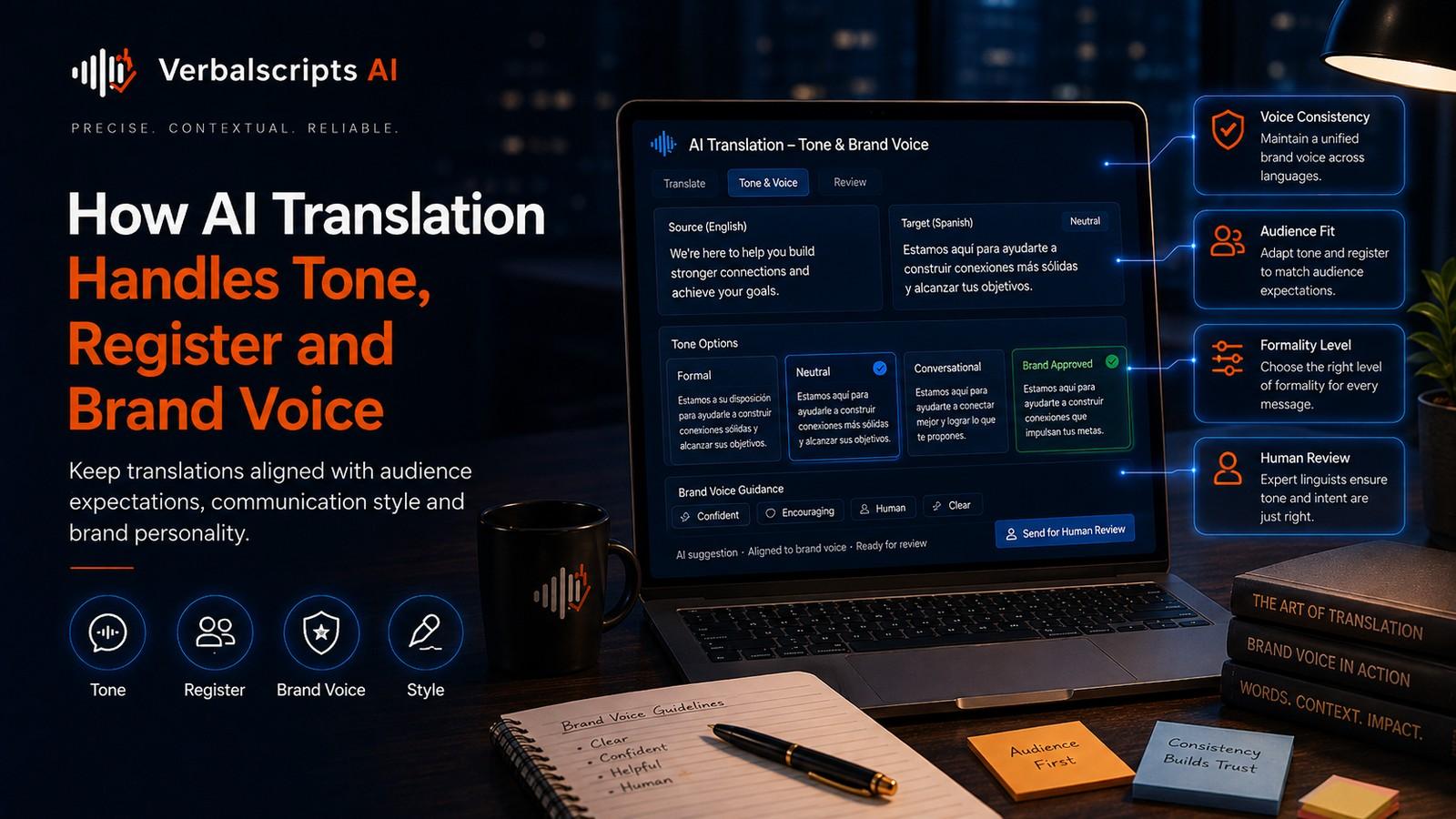
A translation can be factually correct and still sound wrong. It may be too formal, too casual, too sales-driven, too blunt, too academic or simply unlike the brand that produced the original. That is why professional AI translation needs to manage tone, register and brand voice, not just meaning.
For production speech-to-text workflows, see our AI Transcription service for the delivery path behind the guidance in this article.
Tone is not decoration added after translation. It is part of the message.
Tone, register and brand voice are related but different
These terms are often used interchangeably, but separating them makes translation quality easier to manage.
Tone is the attitude or emotional quality of a specific piece of communication. A support message may be reassuring; a security notice may be urgent; a campaign may be playful.
Register is the level and type of language appropriate to a social or professional situation. Formal legal writing, a casual chat message and a technical manual use different registers.
Brand voice is the relatively stable personality a company aims to express across communications. It may be confident but not arrogant, expert but accessible, warm but concise.
A brand can have one voice and many tones. The same organization may sound celebratory in a launch announcement and serious during an outage while remaining recognizably itself.
Why translation can distort style
Languages do not encode politeness, directness or formality in identical ways. English can often address the reader simply as “you,” while other languages require choices that signal social distance, number, gender or formality. Sentence length that feels energetic in English may feel abrupt in another language. A slogan built around an English verb may need restructuring to sound natural elsewhere.
This creates several common failure modes:
- literal wording that preserves information but loses personality;
- inconsistent formality within one document;
- overuse of generic corporate language;
- translations that sound machine-generated despite being grammatical;
- culturally inappropriate directness;
- slogans that read as claims the source never intended;
- inconsistent product terminology.
Research on controlled formality in machine translation has shown that style can be modeled explicitly rather than treated as an accidental by-product. This matters because stylistic variation carries communicative intent beyond literal semantics.
How AI models infer tone
Modern models use lexical choice, syntax, punctuation, context and learned patterns to infer style. A sentence such as “We’re thrilled to have you with us” carries different cues from “Your account has been successfully activated.”
The model can also respond to instructions such as:
- use a professional and approachable tone;
- prefer plain language;
- avoid idioms;
- use formal second-person address;
- preserve short, direct sentences;
- do not translate product names;
- use the approved glossary;
- sound confident, never promotional.
The more operational the instruction, the more useful it is. “Make it on brand” is vague. “Use short sentences, active voice, no exclamation marks, no slang, and address the reader formally” is testable.
What a brand voice guide should contain
A translation-ready style guide does not need to be hundreds of pages. It needs to make important decisions explicit.
Voice principles
Define three to five attributes such as:
- precise;
- calm;
- human;
- direct;
- expert.
Then define what each attribute means in practice. “Human” might mean contractions are acceptable in English, but that rule cannot simply be copied into every language.
Tone by content type
A support article, sales page and privacy notice should not necessarily share the same tone. Provide a matrix by content type.
Formality
Specify whether the audience should be addressed formally or informally in languages where that distinction is grammatical.
Sentence and paragraph style
State preferences for sentence length, active versus passive voice, headings, lists and calls to action.
Terminology
Include approved names, abbreviations, translations, non-translatable terms and forbidden alternatives.
Punctuation and typography
Spacing, quotation marks, date formats, capitalization and numeral conventions can all differ by locale.
Examples
Paired “preferred / avoid” examples are often more useful than abstract adjectives.
Microsoft’s localization guidance recommends establishing style guidance early because consistency in source material improves downstream localization. Its terminology guidance similarly emphasizes managing terms early to improve consistency across products, documentation and marketing.
How AI should use a style guide
A good AI-assisted workflow converts the style guide from a PDF people occasionally consult into rules the translation process can actually use.
The system can be provided with:
- the source text;
- target language and locale;
- approved terminology;
- style rules;
- relevant examples;
- content type;
- audience;
- risk level.
For long projects, the same configuration should be applied consistently across batches. If one job uses “customer” and another uses “client” without a reason, the reader experiences the inconsistency even if each sentence is individually correct.
Register is language-specific
A major error in multilingual workflows is assuming that the same level of directness maps neatly across languages.
English software interfaces often use concise imperatives: “Save,” “Try again,” “Get started.” In another language, a direct imperative may sound normal, overly informal or unnecessarily harsh depending on the context and market.
The translator therefore has to preserve function, not merely grammatical form. A source instruction should still function as an instruction, but the phrasing may need to change.
This is also why locale matters. Portuguese for Brazil and Portugal, French for France and Canada, or Spanish for different markets can differ in everyday vocabulary, address conventions and expected level of formality.
Brand voice in marketing translation
Marketing is where the limitations of literal translation become especially visible.
A campaign may rely on rhythm, brevity, wordplay, emotional associations or cultural references. The target version may need transcreation: a controlled adaptation that preserves the commercial objective and brand identity rather than the exact words.
AI can accelerate the process by generating several alternatives:
- closest semantic translation;
- more natural localized version;
- concise campaign version;
- high-energy version;
- conservative brand-safe version.
A reviewer can then compare options against the brief.
For high-value campaigns, do not ask a model simply to “translate.” Ask it to preserve specific messaging priorities and explain where a direct equivalent does not exist.
Brand voice in customer support
Support content needs a different balance. Clarity usually comes first, but tone directly affects the customer experience.
Consider these two versions:
- “You failed to enter a valid code.”
- “That code doesn’t appear to be valid. Please check it and try again.”
The technical meaning is similar. The interpersonal effect is not.
A multilingual support style guide should define:
- whether apologies are appropriate;
- how to express uncertainty;
- how to address the customer;
- which technical terms remain in English;
- how to phrase instructions;
- whether contractions or casual language are acceptable;
- escalation language for security, billing and safety issues.
Brand voice in legal and regulated content
Some content should not be “improved” stylistically. Legal disclosures, consent language, financial statements and regulated warnings may require close semantic control.
In these cases, style rules should include limits: do not soften obligations, do not make legal conclusions more definite, do not add reassurance, and do not rewrite defined terms for variety.
A brand voice system therefore needs content-aware constraints. The same creative flexibility appropriate for a landing page is inappropriate for a contractual clause.
Terminology is part of voice
A brand is partly recognized by the words it chooses repeatedly. Product names, feature names, category labels and key concepts form a controlled vocabulary.
A terminology database can specify:
- source term;
- approved target term;
- definition;
- context;
- part of speech;
- do-not-use alternatives;
- case sensitivity;
- whether the term should remain untranslated.
Google Cloud’s translation documentation describes glossaries as custom dictionaries for consistently handling domain-specific terms and named entities and for preventing selected product names or borrowed words from being translated. The broader principle applies across AI translation systems: terminology control reduces unnecessary variation.
Examples are stronger than adjectives
A common instruction is “make this friendly.” That is subjective. Few reviewers will score it identically.
Instead, give examples.
Preferred: “You can update your billing details at any time.”
Avoid: “Billing information may be modified by the user at their discretion.”
Preferred: “We’ll email you when the export is ready.”
Avoid: “A notification shall be transmitted upon completion of the export process.”
Examples show vocabulary, sentence length, pronoun use and rhythm at once.
For multilingual work, approved examples should be native-quality target-language examples, not just translations of English examples.
How to measure brand voice consistency
Brand voice can be evaluated with a rubric instead of intuition alone.
Score each segment or page on:
| Criterion | What to look for |
|---|---|
| Meaning | No loss, addition or distortion |
| Formality | Correct social distance and address |
| Tone | Appropriate emotional stance |
| Terminology | Approved terms used consistently |
| Naturalness | Reads like native target-language content |
| Brand fit | Matches documented voice principles |
| Locale fit | Appropriate for target market |
The reviewer should record both severity and type of issue. Over time, this creates data that can improve prompts, glossaries and reviewer instructions.
A human-reviewed AI workflow
A practical workflow can be organized as follows.
1. Define the brief
Identify audience, locale, content type, channel and purpose.
2. Attach brand assets
Provide glossary, style guide, prohibited wording and prior approved translations.
3. Generate the AI draft
Translate with document context and explicit style constraints.
4. Run automated checks
Check missing numbers, placeholder corruption, terminology mismatches, untranslated segments and formatting errors.
5. Perform linguistic review
A reviewer confirms meaning, tone, register and naturalness.
6. Perform brand review when needed
For campaigns or executive communications, a brand owner may approve wording separately from linguistic quality.
7. Capture decisions
Approved terminology and recurring edits should feed back into future projects.
That feedback loop matters. If reviewers make the same correction every week and the workflow never learns from it, the system is not truly being managed.
Source content affects translation quality
One of the most effective ways to improve multilingual brand voice is to improve the source.
Ambiguous headlines, inconsistent terminology, long chains of clauses and unexplained cultural references create problems before translation begins. Microsoft’s writing guidance for localizable technical content recommends simple, clear sentences partly because they are easier to translate reliably.
This does not mean every source should be bland. It means intentional style is easier to preserve than accidental complexity.
AEO and multilingual discoverability
Tone and SEO should not fight each other. Search-friendly content can still sound like the brand.
For answer-focused pages, use clear headings that reflect real questions, provide direct answers early, define important terms and then expand with evidence and examples. Google states that the same foundational SEO practices apply to its AI search features, with emphasis on helpful, reliable, people-first content rather than special “AI Overview” tricks.
For translated pages, do not keyword-stuff awkward target-language variants. Search behavior differs by market, so keyword research should be localized rather than mechanically translated.
Common mistakes
Translating the style guide too literally
A voice principle created in English may need reinterpretation by locale. “Casual” does not map to the same linguistic choices everywhere.
Letting variety override terminology
Writers value synonyms, but product terminology often needs consistency more than stylistic variation.
Reviewing only grammar
A grammatical translation can still be culturally awkward or off-brand.
Using one prompt for every content type
Marketing, product UI, support and legal content need different levels of flexibility.
Ignoring source inconsistency
AI cannot reliably enforce a brand voice if the organization itself has not defined one.
Frequently asked questions
Can AI keep the same brand voice in every language?
It can improve consistency substantially when given style guidance and examples, but exact equivalence is unrealistic because languages and cultures express tone differently. Native review is valuable for important markets.
What is the difference between tone and register?
Tone describes the attitude or emotional quality of a message. Register describes the level and type of language appropriate to a social or professional context.
Do I need a translation glossary and a style guide?
For recurring multilingual content, yes. The glossary controls terminology; the style guide controls how the brand communicates.
Can AI translate marketing slogans?
It can generate useful options, but slogans often require creative localization or transcreation. Human approval is recommended for campaign-critical copy.
How do I evaluate translated brand voice?
Use a documented rubric covering meaning, formality, tone, terminology, naturalness, locale fit and brand fit. Review recurring errors by category rather than only by individual sentence.
Conclusion
The highest-quality AI translation does more than preserve literal information. It preserves the relationship the brand is trying to create with the reader.
Tone, register and brand voice become manageable when they are turned into explicit rules, supported by terminology, demonstrated through examples and verified by native reviewers where the stakes justify it. That hybrid approach allows AI to deliver speed without forcing every market into generic, interchangeable language.
Research references
- Niu, Martindale & Carpuat (EMNLP 2017), *A Study of Style in Machine Translation*:
- Microsoft Learn, *Manage terminology*:
- Microsoft Learn, *Localize your product*:
- Google Cloud, *Overview of the Cloud Translation API*:
- Google Search Central, *AI features and your website*: