Should you use AI voice translation or transcript translation? Use voice translation when the final experience must be listened to in another language, such as dubbing, live interpreting or voice assistants. Use transcript translation when accuracy, reviewability, search, subtitles, documentation or reuse matters most. For high-value media, a strong hybrid workflow creates a verified transcript first, translates it, then uses the approved translation as the script for target-language voice.
There are two main ways to make spoken content multilingual.
For production speech-to-text workflows, see our AI Transcription service for the delivery path behind the guidance in this article.
You can translate the speech into another spoken language, or you can translate the speech into text and use that text for transcripts, subtitles and other content.
Neither workflow is universally better.
Voice translation is powerful when listeners need an audio experience. Transcript translation is easier to review, edit, search and reuse.
That hybrid model often delivers the best quality.
What is AI voice translation?
Voice translation converts spoken content into another spoken language.
The pipeline may include:
- speech recognition;
- machine translation;
- text-to-speech;
- voice conversion;
- timing adjustment.
The listener hears translated speech instead of reading text.
What is transcript translation?
Transcript translation converts spoken content into target-language text.
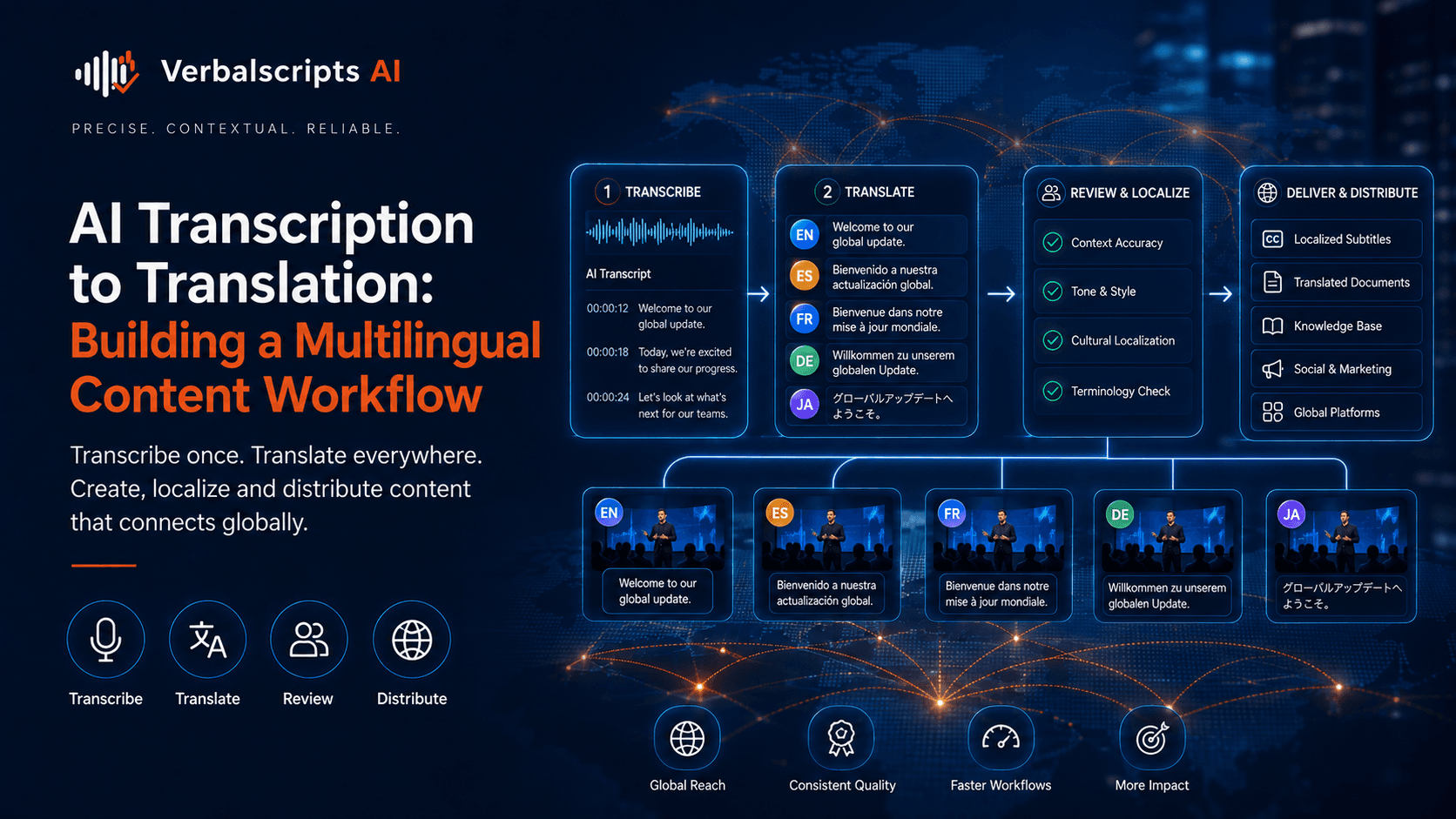
The pipeline is:
- speech recognition;
- source transcript;
- translation;
- review.
The output can be used for:
- subtitles;
- articles;
- searchable archives;
- reports;
- study data.
Why the distinction matters
Voice output is ephemeral and harder to inspect.
Text is visible and easy to compare.
If a translated sentence is wrong in a transcript, a reviewer can highlight and edit it.
If a voice translation is wrong, the reviewer must listen, find the timing and regenerate the audio.
This makes transcript-first workflows easier to govern.
Accuracy
Both workflows depend on recognition and translation quality.
Voice translation adds another layer: speech synthesis.
Possible voice errors include:
- mispronunciation;
- awkward pacing;
- wrong emphasis;
- unnatural emotion.
Transcript translation avoids these issues.
Speed
Real-time voice translation can be extremely fast.
It is useful for:
- meetings;
- travel;
- support calls.
Transcript translation may take longer if review is required.
However, for recorded content, batch transcript translation can also be very fast.
Human review
Transcript translation is much easier to review.
Reviewers can compare:
- source transcript;
- target transcript;
- audio.
For voice translation, review requires listening through the target audio and aligning each issue to the script.
A strong production system should retain the translated script even when the final output is voice.
Accessibility
Transcript translation supports:
- captions;
- search;
- screen readers;
- silent consumption.
Voice translation supports listeners who prefer audio but does not replace captions.
For video accessibility, captions remain important even if a dubbed language track exists.
Searchability
Text is searchable.
A translated transcript can support:
- web search;
- internal knowledge search;
- content discovery;
- quotations.
Voice alone is difficult to index without a transcript.
Editing
Text is easy to edit.
Voice translation may need regeneration when:
- terminology changes;
- a mistake is corrected;
- pronunciation is adjusted.
This makes script approval important.
Dubbing
AI voice translation is especially useful for dubbing.
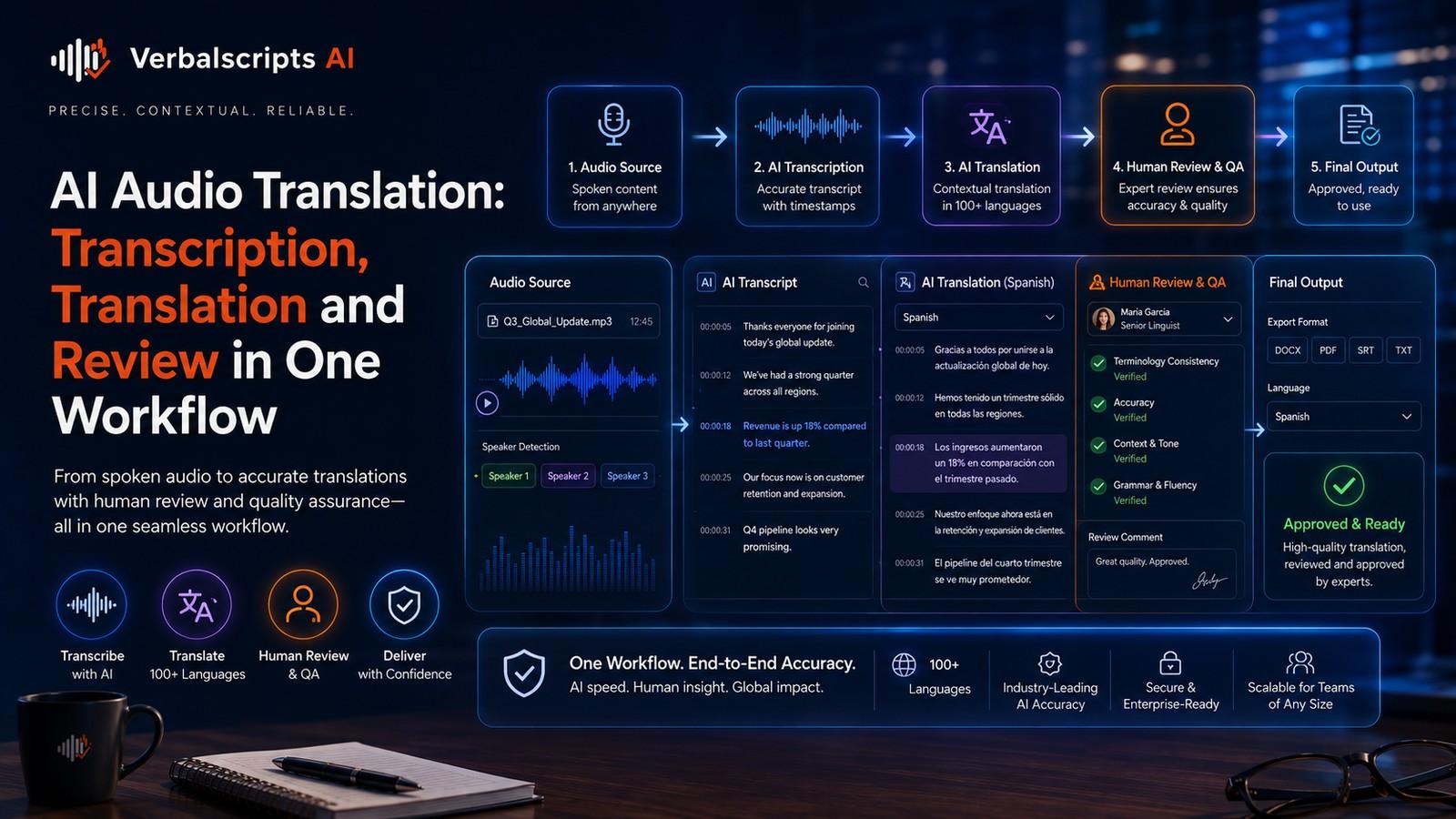
A good dubbing workflow:
- creates a source transcript;
- translates it;
- reviews the target;
- synthesizes voice;
- checks timing;
- reviews pronunciation.
This avoids synthesizing an unverified translation.
Meetings
Live voice interpretation can help people participate naturally.
But translated captions or transcripts can still be useful because they create a visual fallback and permanent record.
For high-value meetings, use both when available.
Podcasts
Voice translation can make a podcast feel native.
Transcript translation is cheaper, easier to publish and easier to search.
Publishers can start with transcripts in many languages and add dubbed audio only for priority markets.
Interviews
Translated voice can be sensitive.
A synthetic target-language voice may sound as though the interviewee personally spoke words they never recorded.
Consider:
- consent;
- disclosure;
- authenticity.
Transcript translation avoids that particular ambiguity.
Training
Voice translation helps learners who prefer listening.
Transcript translation supports:
- captions;
- notes;
- review.
A hybrid approach is usually strongest.
Pronunciation
Proper nouns and technical terms are frequent voice-translation problems.
A transcript can contain the correct spelling while speech synthesis pronounces it incorrectly.
Use:
- pronunciation dictionaries;
- phonetic guidance;
- human review.
Emotion
Speech contains emotion that text may only partially represent.
Voice synthesis can produce a neutral delivery that changes the feel of:
- testimonial;
- interview;
- dramatic content.
Some advanced systems model prosody, but review is still important.
Voice identity and consent
Voice cloning introduces ethical and legal considerations.
Ask:
- does the speaker consent?
- is synthetic voice disclosed?
- can the voice be reused?
- is the translation script approved?
Do not treat voice identity as a free production asset.
Cost
Transcript translation is generally simpler operationally.
Voice translation may add:
- synthesis cost;
- voice licensing;
- review time;
- audio engineering;
- regeneration.
The business value may justify the cost for high-priority content.
Localization
A translated transcript can be adapted more deeply before voice generation.
Reviewers can:
- adjust idioms;
- shorten lines;
- localize references;
- fix terminology.
Then the voice uses the approved target script.
This is usually safer than end-to-end unreviewed voice generation.
Quality checklist
For transcript translation
- source accurate;
- target accurate;
- terminology correct;
- speakers and timestamps preserved.
For voice translation
All of the above, plus:
- pronunciation;
- timing;
- prosody;
- voice appropriateness;
- consent.
Decision matrix
| Need | Better starting workflow |
|---|---|
| searchable archive | transcript |
| live conversation | voice/captions |
| subtitles | transcript |
| podcast dubbing | transcript-first voice |
| legal review | transcript |
| accessibility | transcript/captions |
| immersive localization | voice |
| multilingual analysis | transcript |
Common failure patterns
Voice-first without script review
Translation errors become audio.
No transcript retained
Corrections become difficult.
Voice cloning without governance
Consent and trust problems arise.
Using voice instead of captions
Accessibility needs remain unmet.
Treating literal translation as dubbing script
Target audio sounds unnatural.
Transcript-first voice translation as a quality architecture
A transcript-first pipeline provides checkpoints.
First, the source speech is recognized and corrected. Second, the target text is translated and approved. Third, the voice system produces speech from the approved target script.
This structure makes it possible to identify whether a problem came from:
- recognition;
- translation;
- synthesis.
An end-to-end voice system may feel faster, but it can make errors harder to diagnose.
Latency in live voice translation
Real-time voice translation has to balance:
- waiting for context;
- responding quickly.
If the system speaks too soon, it may mistranslate a sentence that changes meaning at the end. If it waits too long, conversation becomes awkward.
This latency-quality tradeoff is less important for transcript translation because the system can process complete segments before delivery.
Voice style and identity
A target voice may be:
- generic;
- matched by gender or style;
- cloned from the source speaker.
Each choice has implications for:
- authenticity;
- consent;
- brand tone;
- audience expectations.
For public media, disclosure can help viewers understand that the translated voice is synthetic.
Multilingual voice at scale
Voice translation is more operationally demanding across many languages because each language requires:
- suitable voice;
- pronunciation;
- audio QA;
- timing.
Text translation scales more easily.
A publisher might therefore support 20 transcript languages but only 5 dubbed languages. This is a sensible tiered strategy.
Updating published content
Text is easy to patch.
If one sentence changes in a translated transcript, edit it.
In voice output, the sentence must be regenerated and reinserted. The new audio may differ in tone or timing from adjacent speech.
This makes change management another reason to retain the approved script.
Accessibility and user choice
The best multilingual media experiences often offer several options:
- original audio;
- target-language audio;
- captions;
- translated transcript.
Different users prefer different formats.
Voice translation should expand choice rather than replace text alternatives.
Quality assurance for synthesized speech
Reviewers should listen for:
- correct names;
- natural pronunciation;
- pacing;
- emphasis;
- truncation;
- robotic artifacts;
- mismatch between audio and subtitle text.
A linguistically correct script can still produce poor speech output.
Risk-based use of synthetic voice
Synthetic voice is lower risk for:
- training narration;
- generic explainers.
It is more sensitive for:
- witness statements;
- personal testimony;
- documentary interviews;
- political or reputational content.
The closer the content is to a real person’s identity, the stronger the consent and disclosure requirements should be.
Hybrid delivery can be staged by market
Organizations do not need to choose one format globally. A useful strategy is:
- transcripts and subtitles for broad language coverage;
- dubbed voice for priority markets;
- original audio everywhere.
This creates a scalable base while reserving the higher cost of voice production for audiences where demand justifies it.
Real-time conversation versus recorded media
The decision also changes by use case. In a live support call or meeting, voice translation may reduce friction because participants can keep speaking. In recorded media, transcript-first translation usually offers better quality control because there is time to review before generating target audio.
Transparency for audiences
When synthetic voice is used, consider whether viewers or listeners should be informed. Disclosure is especially important when the translated voice resembles a real person closely. The target audience should not be led to believe that the speaker personally recorded a language version if they did not.
Compliance and sensitive content
For legal, medical, financial or regulated recordings, transcript-first translation usually offers the clearer audit trail because reviewers can approve visible text before any voice is generated. Voice output can still be created afterward, but the approved script remains the controlled source.
Operational recommendation
If the organization is uncertain which workflow to choose, start with transcript translation. It creates the most reusable asset and can later support captions, summaries, search and synthesized voice without repeating source transcription.
Subtitles can bridge the two workflows
Subtitles are created from translated text but consumed alongside audio. They provide a useful middle ground when full dubbing is not justified. Viewers can keep the original speaker’s voice while reading the target language, preserving more of the source performance and reducing synthetic-voice concerns.
Start from the audience need
A decision about voice or transcript translation should begin with how the audience will consume the content, not with which technology appears more advanced.
Frequently asked questions
Is voice translation more accurate than transcript translation?
No. It uses many of the same translation components and adds speech-synthesis variables.
Which is easier to review?
Transcript translation.
Can I generate voice after reviewing a transcript?
Yes. This is one of the most reliable dubbing workflows.
Does dubbed audio replace subtitles?
No. Captions and subtitles serve different accessibility and usability needs.
Which workflow is cheaper?
Transcript translation is generally simpler. Voice translation adds synthesis and audio review.
Conclusion
The best choice depends on what the audience needs to do.
If they need to listen, voice translation is powerful. If they need to verify, search, quote, subtitle or analyze, transcript translation is stronger.
For important recorded content, the most reliable answer is usually not one or the other: create and approve the translated transcript first, then use it as the foundation for voice.
Research references
- Microsoft Learn, Speech translation quickstart:
- Microsoft Learn, Azure Speech language support:
- W3C, WCAG 2.2: