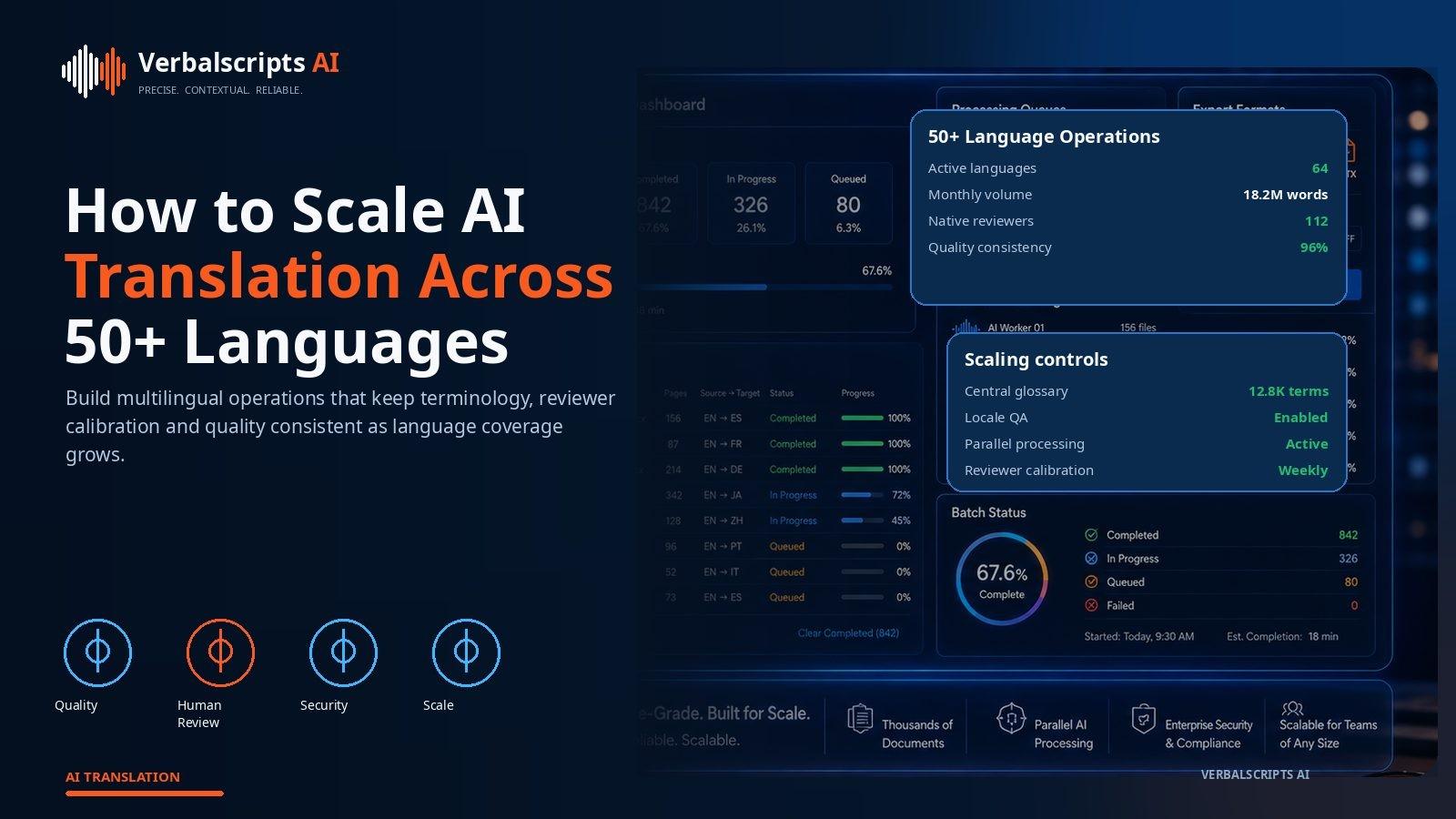
How do you scale AI translation across more than 50 languages? Build a centralized content and terminology pipeline, classify languages and content by risk, use automation for source ingestion and mechanical QA, maintain locale-specific style guidance, route high-risk content to native/domain reviewers, track quality per language rather than globally, and roll out new languages in controlled stages. Use a concept-based termbase and language metadata so the system can expand without duplicating decisions manually.
| SEO title | How to Scale AI Translation Across 50+ Languages |
|---|---|
| Slug | scale-ai-translation-50-languages |
| Meta description | Learn how to scale AI translation across 50+ languages using language tiers, terminology, automated QA, native review, governance and content pipelines. |
| Primary keyword | scale AI translation |
| Search intent | How-to / Enterprise |
| Hero image | 168-scale-ai-translation-50-languages.jpg |
| Hero alt text | Global translation operations dashboard showing more than 50 languages, quality tiers, terminology and review coverage |
| Article body words | 1972 |
For production multilingual workflows, see our AI Translation service for the delivery path behind the guidance in this article.
Going from 5 languages to 50 is not a tenfold version of the same workflow.
At 50+ languages, terminology multiplies, reviewer capacity becomes uneven, model quality varies, content updates drift and a simple spreadsheet stops being a reliable system of record.
AI makes translation generation scalable. The operational challenge is scaling governance and quality at the same rate.
The core principle is to standardize the workflow while allowing language-specific quality controls.
Why 50 languages changes operations
At 5 languages:
- team can know reviewers personally;
- manual tracking works.
At 50:
- hundreds of language-pair combinations;
- different scripts;
- low-resource quality variation.
Processes need automation.
Centralize source content
Use:
- CMS;
- TMS;
- repository.
Avoid email attachments.
Every translation should reference:
- source ID;
- version.
This prevents outdated translations.
Locale inventory
For each locale record:
- language tag;
- market;
- script;
- direction;
- reviewer;
- glossary coverage;
- model;
- quality tier.
This becomes the language registry.
Language tags
Use BCP 47-style tags to distinguish:
- language;
- region;
- script.
Examples:
- pt-BR;
- zh-Hant.
W3C provides guidance on language tags for multilingual systems.
Tier languages
Not every language has equal:
- demand;
- model quality;
- reviewer supply.
Tier 1
High volume, strategic.
Full review resources.
Tier 2
Medium.
Automated + sampling.
Tier 3
Long-tail.
AI + on-demand review.
Tiering is operational prioritization, not language value.
Content tiers
Also classify content:
- legal;
- product;
- support;
- internal.
A Tier 3 language legal contract can still require full review.
Language and content risk combine.
Model routing
Use best-performing model by:
- language pair;
- domain.
One provider may not be optimal for all.
Maintain benchmark data.
Low-resource languages
Expect:
- lower confidence;
- higher edit rates.
Use:
- native review;
- related-language transfer;
- curated terminology.
Research on low-resource MT emphasizes that training resources vary enormously across languages.
Terminology at scale
Use one concept database.
Do not maintain 50 independent spreadsheets.
Concept:
Speaker diarization
Locale entries:
- fr-FR;
- de-DE;
- ja-JP.
Each has owner/status.
Style guides
Create:
- global core;
- locale addendum.
Do not write 50 complete guides from scratch if most brand principles are shared.
Automated ingestion
Pipeline:
- source changed;
- detect affected locales;
- reuse unchanged translations;
- AI translate new;
- QA;
- review.
This supports continuous localization.
Translation memory
Reuse approved translations.
At 50 languages, reuse reduces:
- cost;
- inconsistency.
AI can retrieve historical examples.
Automated QA
Mandatory at scale:
- numbers;
- placeholders;
- glossary;
- language/script;
- missing text;
- length.
Humans cannot manually catch every mechanical issue.
LLM quality triage
Use an evaluator to flag:
- semantic risk;
- omission;
- awkwardness.
Calibrate per language.
Do not assume identical thresholds.
Native reviewer network
Build:
- roster;
- qualification;
- availability;
- domain.
For rare languages, build relationships before urgent projects.
Reviewer calibration
Locale owners should calibrate reviewers with:
- examples;
- terms;
- severity.
Quality data is only useful if reviewers apply standards consistently.
Sampling by language
Review more heavily for:
- new locale;
- new model;
- low-resource;
- critical content.
Review less after stable performance is proven.
Quality dashboard
Show per locale:
- error rate;
- critical errors;
- term accuracy;
- edit rate;
- TAT.
Global average can hide one failing language.
Content freshness
Track source change.
If English page version 12 updates, target version 9 is stale.
CMS should mark:
- translation outdated.
Do not let stale content look approved.
Publication orchestration
At 50 languages, publishing all at once may fail.
Use waves:
- priority locales;
- QA;
- remaining.
Critical launches may require synchronized release.
SEO
Multilingual web at scale needs:
- stable locale URLs;
- hreflang;
- localized metadata;
- internal linking.
Google recommends explicit multilingual site structures rather than relying on IP-only adaptation.
Data and privacy
Different markets may have:
- data-region requirements.
Maintain policy by content/data, not language stereotype.
Cost control
50 targets multiply:
- API characters;
- review.
Prioritize content.
Not every blog article needs 50 translations.
Use analytics.
Human capacity planning
AI produces faster than humans review.
Forecast:
- daily review words by locale.
Throttle generation to avoid huge backlog.
Incident response
If one glossary error affects 50 languages:
- pause;
- fix source/term;
- re-run affected content.
Centralization makes correction faster.
Launching a new language
- define locale;
- select model;
- create glossary;
- translate benchmark;
- native review;
- build style guide;
- pilot;
- expand.
Do not launch by clicking a language checkbox.
Governance
Assign:
- global localization owner;
- locale owners;
- engineering;
- security.
NIST AI RMF principles around governance and measurement are relevant to enterprise AI translation.
Example operating model for 60 locales
A global SaaS company might designate:
- 12 Tier-1 revenue locales;
- 18 Tier-2 growth locales;
- 30 long-tail locales.
All 60 receive automated translation and deterministic QA. Tier 1 gets full native review for core product and marketing. Tier 2 gets full review for product plus sampling for help content. Long-tail locales get full review for legal/safety content and risk-based sampling elsewhere.
This creates differentiated operations without making lower-volume languages second-class for critical information.
Quality debt
When source content changes faster than localization, stale translations accumulate. Track this as localization debt:
- number of outdated pages;
- age;
- traffic/risk.
Prioritize debt reduction like technical debt. AI can accelerate catch-up, but only if source-version tracking is reliable.
Launch gates for new locales
Before opening a locale publicly, require:
- glossary coverage for critical product terms;
- style guide;
- benchmark pass;
- native reviewer;
- checkout/support path;
- legal pages;
- correct language metadata.
This prevents a “translated homepage” from being mistaken for a complete market launch.
Central versus local decision rights
Central team should own:
- source concept;
- quality framework;
- technology.
Locale owners should own:
- local terminology;
- register;
- cultural adaptation.
Define escalation when global brand preference conflicts with local naturalness.
Use analytics to decide expansion
Prioritize translation based on:
- target-market traffic;
- sales;
- support demand;
- product strategy.
AI makes it tempting to translate everything simply because generation is cheap. Review, maintenance and governance still cost money, so active-language portfolios should be evidence-based.
Content-selection strategy at 50+ languages
Translation volume can explode if every source asset is sent to every locale. Classify content:
- global core: product, legal, onboarding;
- market-priority: campaigns, sales pages;
- on-demand: long-tail blog/archive.
Translate global core broadly, market-priority according to business strategy and long-tail based on demand. This keeps the multilingual estate maintainable.
Source-of-truth synchronization
Every target page should know:
- source content ID;
- source version;
- last translated version.
A dashboard can show:
- current;
- outdated;
- missing.
At 50+ languages, this synchronization layer is essential. Manual spreadsheets eventually lose track of what changed.
Reviewer marketplace versus dedicated teams
Tier-1 locales may justify dedicated reviewers who know the product deeply. Long-tail languages can use a vetted on-demand network.
Keep the same:
- terminology;
- style guide;
- QA rubric.
The staffing model can differ without changing quality policy.
Language-specific model routing
Build a benchmark table such as:
This turns model choice into an evidence-based configuration rather than one global default.
Translation debt threshold
Set an SLA for stale content:
- high-risk pages: update before source launch or within hours;
- product help: within days;
- low-priority archive: on demand.
This helps business teams understand that multilingual freshness has a cost and priority system.
Mature scale metric
A useful KPI is not “number of languages supported.” Track:
- percentage of active locale content that is current and approved.
A company with 60 current, governed locales may be more multilingual than one with 150 machine-generated but stale and unreviewed language options.
Translation memory at 50+ languages
Approved content reuse is crucial. If one sentence appears in:
- product UI;
- help article;
- training deck,
the same approved target should be reused when context is equivalent.
A translation memory or content-addressed reuse layer reduces both cost and variance. AI should generate new language only when reuse is not appropriate.
Locale launch order
A practical sequence:
- terminology/style;
- core navigation and legal pages;
- product onboarding;
- support content;
- high-value marketing;
- long-tail content.
This creates a complete user journey before the organization spends effort on low-priority archives.
Cross-locale incident propagation
If the English source contains a critical error, every translated locale may inherit it. Maintain a way to:
- identify all targets derived from a source segment;
- invalidate them;
- trigger correction.
This source-target lineage becomes increasingly important as language count rises.
Quality staffing ratio
There is no universal ratio of reviewers to locales, but a program should explicitly model:
- monthly word volume;
- expected review percentage;
- reviewer throughput;
- peak launch demand.
Long-tail locales can share centralized operations while preserving local linguistic ownership.
Support-language parity
Do not launch a customer-facing product language if users cannot access critical support or safety information in that language unless the business clearly communicates the limitation.
Localization is a journey. A translated marketing page without translated support may create a poor customer experience.
Decommissioning a locale
Sometimes a locale is no longer maintained. Define:
- freeze date;
- user communication;
- archival behavior;
- link redirects;
- legal obligations.
A 50-language program needs a lifecycle for languages as well as a launch process.
Quality parity does not mean identical workflow
A low-resource locale may need 100% human review while a mature high-resource locale uses 5% sampling. Both can still achieve the same final acceptance standard.
This is an important distinction: equitable multilingual quality often requires different amounts of support, not the same process everywhere.
Reporting language health
Give every active locale a health status based on:
- content freshness;
- glossary coverage;
- quality score;
- reviewer capacity;
- unresolved incidents.
A language can be “supported” technically but unhealthy operationally if its content is stale or no reviewer is available.
Invest in source-content architecture
At 50+ languages, clear modular source content creates enormous leverage. Reusable components, stable IDs and controlled terminology reduce the amount of content that must be generated and reviewed in every locale.
Internationalization of content operations is one of the strongest long-term scaling investments.
Implementation takeaway
For production use, treat source-version lineage, locale health and risk-adjusted reviewer coverage as measurable parts of the workflow rather than assumptions. Define the relevant policy before processing content, keep the model or data configuration versioned, and verify results on representative material from the actual language, locale and domain. If automation produces a result that conflicts with a deterministic rule, authoritative terminology or qualified human evidence, escalate the item instead of averaging the disagreement away. The most durable multilingual systems preserve source-to-target traceability, record exceptions and feed reviewed corrections back into benchmarks, glossaries or routing rules. That discipline makes quality improvements reproducible when models, providers, reviewers or source content change.
Frequently asked questions
Do all 50 languages need human reviewers?
Not every segment, but each production locale should have access to qualified human review and governance.
Can one model handle everything?
A multilingual model can cover many languages, but quality should be benchmarked per pair.
What is the biggest scaling bottleneck?
Quality governance and reviewer capacity, not translation generation.
How do you control terminology?
Central concept-based termbase with locale owners.
Should every page be translated into every language?
No. Prioritize by audience and business value.
Conclusion
AI makes 50-language translation technically easy and operationally demanding.
Centralize content, terminology and quality data. Tier languages and content by risk. Automate mechanical QA and route human attention where it matters.
Scale is not the number of languages a model claims to support. It is the organization’s ability to keep every active locale accurate, current and governable over time.
Research references
- W3C, Language tags:
- Google Search, multilingual sites:
- Haddow et al., Survey of Low-Resource MT:
- NIST AI RMF: