What should an AI translation SLA include? Define service availability for APIs, turnaround by project type and volume, support response by severity, quality criteria and critical-error rules for reviewed translations, security-incident notification, data handling responsibilities, reporting and remedies. Make every metric measurable, specify exclusions and define how disputes are validated.
| SEO title | AI Translation SLAs: Quality, Turnaround, Security & Support |
|---|---|
| Slug | ai-translation-slas-quality-turnaround-security-support |
| Meta description | Learn what AI translation SLAs should cover, including quality, turnaround, uptime, security incidents, support response and remedies. |
| Primary keyword | AI translation SLA |
| Search intent | Commercial research / Enterprise |
| Hero image | 167-ai-translation-sla.jpg |
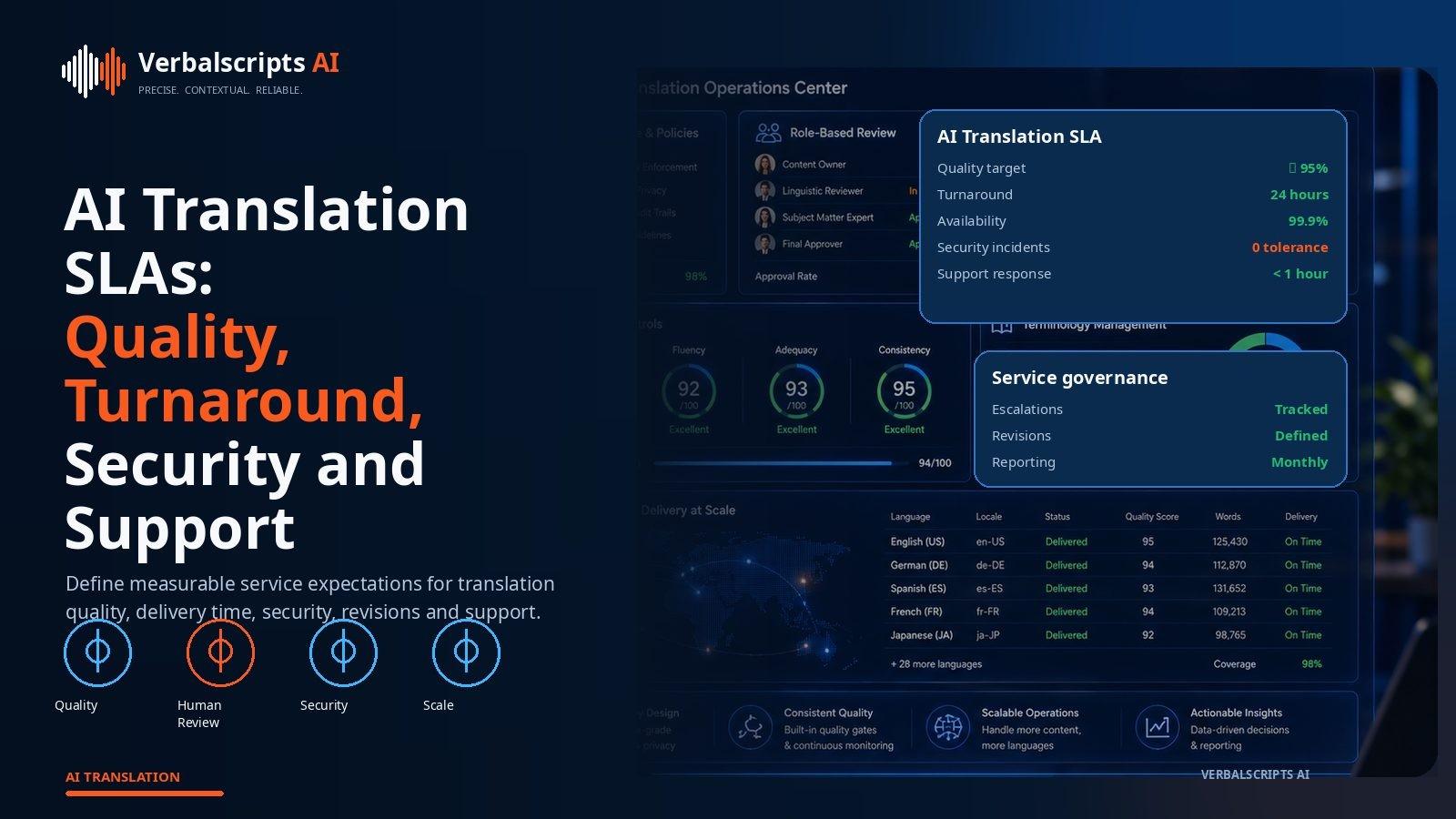
| Hero alt text | Translation SLA dashboard showing quality targets, turnaround, API uptime, support response and security incident commitments |
| Article body words | 1964 |
For production multilingual workflows, see our AI Translation service for the delivery path behind the guidance in this article.
A service-level agreement turns expectations into measurable commitments.
For AI translation, one SLA rarely covers everything. Software availability, human turnaround, translation quality, security incident response and customer support are different dimensions and need different measures.
The hardest part is quality. “99% accurate” is not a useful contractual target unless the method for measuring accuracy is defined.
An SLA should match the risk of the use case rather than copy a generic SaaS template.
SLA versus SOW
SLA
Ongoing service commitments.
Statement of work
Specific project scope.
For a managed translation project, turnaround and quality may appear in the SOW.
For an ongoing API platform, availability belongs in the SLA.
Availability SLA
For translation API:
- monthly uptime percentage;
- region;
- planned maintenance;
- measurement.
Example:
99.9% monthly availability
Define what counts as unavailable.
A single failed translation due to invalid input is not service downtime.
Latency
If real-time translation matters, define:
- percentile latency;
- payload size;
- region.
Average latency is weak because spikes can hurt users.
Use:
- p95;
- p99.
For batch translation, throughput is more relevant.
Throughput
Define:
- characters/minute;
- documents/hour;
- concurrent jobs.
Provider quotas may impose technical limits.
Azure publishes current service limits including document batch counts and character throughput.
A vendor SLA should not promise throughput above upstream infrastructure without architecture.
Turnaround
Human-reviewed translation needs turnaround.
Define by:
- volume;
- language;
- review tier.
Example:
- ≤10k words: 2 business days;
- 10–50k: schedule.
Avoid one TAT for all volumes.
Start clock
Define when the clock starts:
- upload complete;
- payment received;
- instructions complete.
Pause conditions:
- client clarification;
- corrupted file.
This avoids disputes.
Rush
Define:
- availability;
- multiplier;
- cut-off.
Do not promise unlimited rush capacity.
Quality SLA
Quality can be based on:
- critical errors;
- weighted error rate;
- terminology;
- acceptance.
Example:
- zero critical errors in human-reviewed high-risk content;
- terminology compliance ≥ threshold;
- major error points ≤ threshold.
Define evaluator.
Error taxonomy
Attach:
- accuracy;
- terminology;
- fluency;
- severity.
MQM-inspired categories can support this.
Quality is measurable only with shared rules.
Sampling
If SLA quality is evaluated by sample:
- sample size;
- selection;
- reviewer;
- period.
Do not let provider choose only easy samples.
Use random + risk-based.
Dispute process
If client finds error:
- report segment;
- provider reviews;
- classify;
- adjudicate if disputed.
Define who has final authority.
For specialized domains, neutral expert may be needed.
Human-reviewed versus raw AI
Do not use same quality SLA.
Raw AI may have:
- best-effort quality;
- benchmark reporting.
Human-reviewed service can have:
- acceptance criteria.
Make tiers explicit.
Security SLA
Include:
- security incident notification;
- response;
- containment.
Coordinate with DPA/MSA.
Do not define a vague “prompt response.”
Privacy requests
If provider is a processor, contract may include timelines for:
- deletion;
- access assistance.
SLA can operationalize these.
Support SLA
Severity levels:
Sev 1
Production unavailable.
Sev 2
Major degradation.
Sev 3
General issue.
Define:
- initial response;
- update interval;
- resolution target where possible.
Quality incident severity
Translation incidents can also have severity.
Example:
Critical
Wrong safety instructions published across thousands of pages.
Major
Terminology regression in one locale.
Minor
Style inconsistency.
This helps escalation.
Reporting
Monthly report:
- uptime;
- jobs;
- TAT;
- quality;
- support;
- incidents.
Enterprise buyers need visibility.
Remedies
Possible:
- service credit;
- retranslation;
- expedited correction.
Credits should not be the only response to serious quality/security incidents.
Corrective action matters.
Root-cause analysis
For major breach:
- cause;
- impact;
- corrective action.
Require RCA timeline.
Repeated failures should trigger service review.
SLA exclusions
Reasonable exclusions:
- force majeure;
- unsupported files;
- client system failure.
Keep exclusions narrow.
Model updates
SLA should address material model changes.
Possibilities:
- notice;
- quality regression monitoring;
- rollback.
AI services evolve more often than traditional software.
Data retention SLA
If deletion within X days is contractually important, make it measurable.
Clarify backups.
Subprocessors
If important, require notice of material changes.
This may live in DPA rather than SLA.
Multi-provider architecture
An enterprise may maintain a fallback provider.
SLA design should account for:
- failover.
But quality between providers may differ.
Test fallback.
Internal SLAs
Even if vendor SLA is strong, internal translation operations need:
- reviewer TAT;
- approval.
The external provider cannot control your bottleneck.
Avoid vanity SLAs
Examples:
- “100% quality”;
- “instant”;
- “unlimited.”
Use realistic measurable commitments.
SLA negotiation priorities
High-risk:
- security;
- quality;
- support;
- TAT;
- cost remedies.
Low-risk API:
- uptime;
- latency;
- support;
- cost.
Match business impact.
Example SLA matrix
| Area | Metric | Example measurement |
|---|---|---|
| API availability | monthly uptime | provider monitoring + client logs |
| Online translation | p95 latency | defined payload/region |
| Batch service | job completion | volume tier |
| Human review | turnaround | business hours from valid intake |
| Quality | weighted error rate | agreed sample/rubric |
| Support | first response | severity-based |
| Deletion | completion time | deletion log |
The actual targets should be negotiated, but the matrix demonstrates that each promise needs its own measurement method.
Quality SLA should specify the population
If quality is measured on 5% of monthly output, define:
- which jobs are eligible;
- how sample selected;
- whether provider or client selects;
- minimum sample size.
Otherwise both parties can obtain different “quality rates” from different samples.
Turnaround and quality are coupled
Aggressive turnaround can reduce review time or require more reviewers. The SLA should not promise a quality threshold and a rush turnaround that cannot be staffed together.
For high-volume rush work, require a capacity plan or define:
- maximum rush volume;
- languages available;
- notice.
Service credits versus corrective action
Credits compensate for failure but do not repair language. For quality breaches, require:
- corrected deliverable;
- affected-content search;
- root-cause analysis for serious incidents;
- prevention plan.
For security incidents, remedies belong in the broader contract and applicable law rather than relying on SLA credits.
Client obligations
An SLA can also define client responsibilities:
- provide supported files;
- approve glossary;
- answer clarification questions;
- provide access.
If the provider cannot proceed because the source is corrupted, the turnaround clock should pause according to an explicit rule.
Quality SLA example with error points
A reviewed-translation SLA could define:
- critical error: automatic fail for affected deliverable;
- major error: 5 points;
- minor error: 1 point;
- acceptance: fewer than X weighted points per 1,000 words plus zero critical.
The actual threshold must be calibrated. The important part is that both parties use the same taxonomy and sample method.
Turnaround SLA by service tier
Example structure:
- machine-only API: latency/uptime SLA;
- standard reviewed project: business-day turnaround by word tier;
- rush reviewed project: separately accepted capacity;
- specialist legal/medical: project-specific schedule.
Do not mix system latency and human turnaround into one number.
Language-specific SLA limitations
A provider may be able to offer 24-hour review for Spanish but need 72 hours for a low-volume language because reviewer supply differs. State those differences in the service schedule.
Uniform promises that cannot be staffed lead to rushed low-quality review.
SLA monitoring from both sides
Clients should keep their own:
- API logs;
- delivery timestamps;
- quality incidents.
Vendor reports are useful, but independent evidence makes SLA discussion objective.
For quality disputes, preserve the exact source and delivered target version.
Material model changes
If a provider makes a model change that materially affects output behavior, the contract can require:
- notice for controlled enterprise services where feasible;
- quality regression;
- rollback/remediation for serious degradation.
Not every underlying provider change will be visible, so define the obligation around measurable service quality rather than impossible model immutability.
Service review meetings
For high-volume relationships, quarterly reviews can cover:
- SLA performance;
- quality;
- costs;
- reviewer capacity;
- upcoming launches.
This makes the SLA a living management tool rather than a document consulted only during failure.
SLA for human reviewer capacity
If the provider promises high-volume reviewed translation, include capacity assumptions.
For example:
- up to X source words/day at standard TAT for Tier-1 languages;
- rush available up to Y with prior notice.
This is more meaningful than an unlimited turnaround promise.
Definitions for clock time
Clarify:
- calendar versus business hours;
- customer time zone;
- weekends/holidays;
- cut-off.
A “24-hour” SLA can otherwise mean different things.
Dependency pauses
Turnaround should pause if the client has not provided:
- readable source;
- required terminology decision;
- answer to blocking clarification.
The provider should document the pause and restart time.
Quality remediation window
Define how quickly the provider will correct:
- critical;
- major;
- minor reported errors.
For a public critical mistranslation, correction may need immediate escalation rather than waiting for a routine revision cycle.
SLA for data deletion
If deletion is important, define:
- request channel;
- active-system completion target;
- backup expiry disclosure;
- evidence/reporting.
This turns retention policy into a service commitment.
Multi-language service review
Report SLA performance per priority language where reviewer capacity differs. A global average TAT can hide repeated delays in one smaller locale.
Renewal trigger
Use SLA history during renewal. If one metric repeatedly fails, require a corrective plan or rebenchmark alternative providers rather than treating service credits as permanent compensation.
Service credits should not encourage under-reporting
If every quality incident automatically causes a punitive credit, providers or internal teams may become reluctant to classify borderline issues accurately. Design the SLA so severe or repeated failures have meaningful remedies while normal quality improvement remains collaborative.
A mature relationship should reward transparent incident reporting and root-cause correction.
SLA baselines before commitment
Before agreeing to a latency or turnaround threshold, measure the pilot. A target should be:
- achievable;
- relevant;
- statistically measurable.
An SLA chosen because “99.99 sounds enterprise” can be expensive and meaningless if the workflow does not require it.
Include change-control procedure
When scope changes (new target languages, new specialist domain, double volume), the SLA may need adjustment. Define how new service tiers are evaluated and added rather than assuming original commitments apply automatically.
Final SLA principle
Every SLA metric should answer a business question: Is the service available when users need it? Are reviewed translations delivered when promised? Does quality remain within the agreed risk tolerance? Are incidents handled quickly and transparently? If a metric cannot answer a meaningful operational question, it probably does not belong in the agreement.
Implementation takeaway
For production use, treat measurable service levels, language capacity and quality remediation as measurable parts of the workflow rather than assumptions. Define the relevant policy before processing content, keep the model or data configuration versioned, and verify results on representative material from the actual language, locale and domain. If automation produces a result that conflicts with a deterministic rule, authoritative terminology or qualified human evidence, escalate the item instead of averaging the disagreement away. The most durable multilingual systems preserve source-to-target traceability, record exceptions and feed reviewed corrections back into benchmarks, glossaries or routing rules. That discipline makes quality improvements reproducible when models, providers, reviewers or source content change.
Frequently asked questions
Can translation quality be in an SLA?
Yes if the measurement rubric, sample and severity are defined.
What uptime is normal?
It varies by provider and product. Evaluate current published commitments and business need.
Should raw AI have a quality guarantee?
Usually benchmark/monitoring rather than human-quality guarantee.
What happens if quality SLA fails?
Retranslation, corrective action and agreed remedies.
Should security incidents have SLA timelines?
Yes, coordinated with contractual/legal requirements.
Conclusion
An AI translation SLA should tell both parties exactly what “good service” means.
Separate uptime, turnaround, quality, security and support. Define measurement, exclusions and remedies. For quality, use explicit error categories rather than marketing percentages.
A good SLA does not guarantee that nothing ever goes wrong. It ensures the organization knows how performance is measured and what happens when it does.
Research references
- NIST AI Risk Management Framework:
- Microsoft Azure Translator service limits:
- ISO 17100:2015: