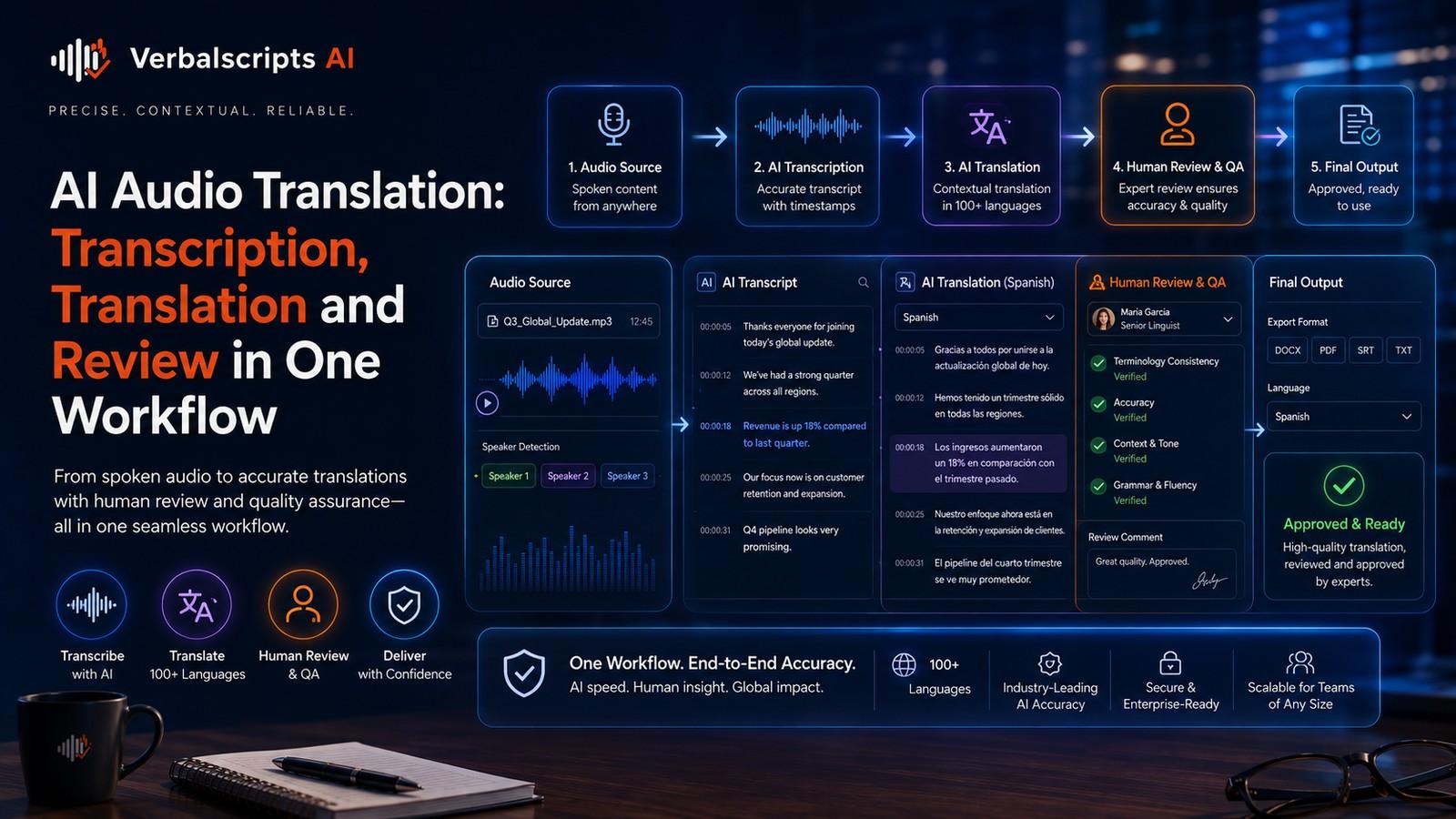
How should AI interview translation be done? Create an accurate source-language transcript with speaker labels and timestamps, correct important names and terminology, translate in conversation-level context, then review the target against the source and audio where necessary. Decide in advance whether the output should be verbatim, lightly edited or publication-ready, because those goals require different levels of cleanup.
Interviews are difficult to translate well because people do not speak like documents.
For production multilingual workflows, see our AI Translation service for the delivery path behind the guidance in this article.
They hesitate, repeat themselves, use slang, correct earlier statements and rely on shared context. A sentence may sound unfinished in isolation but make perfect sense inside the conversation. AI can translate interviews quickly, but the best workflow protects speaker voice and preserves uncertainty instead of rewriting every answer into polished prose.
For interviews used as evidence or research data, preserve meaning and uncertainty more strictly than for marketing or editorial publication.
Interviews are conversational data
Unlike reports, interviews contain:
- false starts;
- incomplete sentences;
- fillers;
- interruptions;
- overlapping speech;
- emotional reactions.
Translation needs a policy for each.
A research transcript may preserve them.
A magazine article may clean them for readability.
The AI system should not decide the editorial standard silently.
Source transcription quality
The source transcript is the foundation.
Check:
- speaker labels;
- names;
- unusual terms;
- timestamps;
- unclear audio.
If the source transcript is wrong, the target will be wrong.
Review low-confidence or difficult audio before translating important interviews.
Speaker identity
Interview translation should clearly distinguish:
- interviewer;
- interviewee;
- moderator;
- interpreter;
- additional speakers.
Generic labels are fine if names are not needed.
For legal or research interviews, preserve speaker attribution rigorously.
Context matters
An answer often depends on the previous question.
For example:
- “Yes, that happened before.”
- “Not exactly.”
- “The second one.”
These statements are hard to translate in isolation.
Process conversational turns with surrounding context.
Tone
The interviewee may sound:
- uncertain;
- angry;
- humorous;
- cautious;
- emotional;
- formal.
Translation should not flatten these differences.
Tone can affect interpretation, especially in journalism, research and legal material.
Hedging and uncertainty
Words such as:
- maybe;
- probably;
- I think;
- I’m not sure;
- as far as I remember
matter.
AI sometimes removes hesitation when polishing language.
For evidentiary or research use, preserve it.
A confident target sentence can misrepresent a cautious source statement.
Slang and idioms
Interviews often contain colloquial language.
A translator can:
- use a target-language equivalent;
- paraphrase;
- retain and explain.
The choice depends on the purpose.
A public interview may prioritize readability. A sociolinguistic study may need closer preservation.
Code-switching
Bilingual speakers may switch languages mid-answer.
Do not assume this is an error.
Code-switching can convey:
- identity;
- emphasis;
- technical vocabulary;
- quoted language.
A research project may want to mark language changes explicitly.
Names and places
Interviewees may mention:
- local people;
- neighborhoods;
- organizations;
- product names.
Speech recognition can mishear unfamiliar entities.
Correct these before translating.
If a name uses another script, follow the project’s transliteration policy.
Interviews for research
Qualitative research needs:
- traceability;
- careful handling of quotes;
- consistent concepts;
- source-target alignment.
The translated interview may later be coded.
Over-smoothing can remove analytically relevant speech features.
Interviews for journalism
Journalistic interviews may need:
- readable quotations;
- verified names;
- quote approval policies;
- preservation of meaning.
If a quote is shortened for publication, that is an editorial decision separate from translation.
Interviews for legal matters
Legal interviews require stricter treatment.
Review:
- speaker attribution;
- exact numbers;
- dates;
- uncertainty;
- questions and answers.
Do not paraphrase away meaning.
Customer and user research
Product research interviews often combine:
- everyday speech;
- product terminology;
- emotional reactions.
AI translation can help research teams analyze interviews across markets.
Reviewers should preserve customer language enough that product teams can understand how users actually speak.
Medical interviews
Medical research or patient interviews can include sensitive symptoms and terminology.
Use qualified review for:
- clinical concepts;
- medication;
- medical history.
Protect privacy.
Translation modes
Verbatim-oriented
Preserve repetitions, fillers and false starts according to guidelines.
Clean verbatim
Remove non-meaningful fillers but preserve content and tone.
Publication-ready
Edit for readability while preserving meaning.
Document which mode applies.
Timecodes
Timestamps allow a reviewer to return to the audio quickly.
They are useful for:
- research citations;
- video editing;
- legal review;
- subtitle creation.
Preserve them through translation.
Interview review interface
The ideal reviewer can see:
- waveform;
- source transcript;
- target translation;
- speaker labels.
This reduces review time and improves confidence.
Human review
Human review is most important when:
- quotes will be published;
- interview is evidence;
- analysis depends on nuance;
- topic is technical;
- audio is difficult.
Routine internal interviews may use lighter review.
A practical workflow
- Transcribe with timestamps and speakers.
- Correct names and difficult source passages.
- Define translation mode.
- Translate complete turns with context.
- Run terminology and entity checks.
- Human-review high-value segments.
- Export aligned source and target.
Common failure patterns
Polishing away uncertainty
The interviewee sounds more confident.
Losing slang
Speaker identity becomes generic.
Wrong speaker
Answer is attributed incorrectly.
Translating isolated sentences
Pronouns and references become inconsistent.
Unmarked editorial rewriting
Readers cannot distinguish translation from adaptation.
Direct translation from audio versus transcript-first review
For low-risk work, a platform may translate the interview directly from speech. For important interviews, transcript-first review is safer because the source becomes visible and editable before translation.
This is particularly important when the recording contains:
- unusual names;
- heavy accent;
- weak audio;
- specialized vocabulary.
A short source-correction pass can prevent the same mistake from appearing in every target language.
Interview questions should be preserved too
Translation teams sometimes focus on the participant’s answers and treat the interviewer’s questions as secondary. That can remove important context.
Questions establish:
- topic;
- assumptions;
- time frame;
- meaning of short answers.
For research and evidence, preserve both sides of the conversation.
Editorial quotations
When an interview translation will be published as selected quotes, keep a link between:
- source audio;
- source transcript;
- target translation;
- final edited quote.
This protects against accidental over-editing and helps editors resolve disputes.
Cultural references
Interviewees may mention:
- local institutions;
- idioms;
- traditions;
- geographic references.
A reviewer may decide to:
- keep the source term;
- add a short explanation;
- use a target-language equivalent.
The right choice depends on the audience and publication style.
Interview translation for market research
Global market-research teams often compare answers across countries.
A shared glossary for core study concepts helps analysts avoid mistaking translation variation for real participant differences.
For example, a product concept should not be rendered with one connotation in one market and a substantially different one elsewhere unless that difference is intentional.
Confidential participant data
Research and HR interviews may contain sensitive personal information.
Use:
- access controls;
- pseudonyms;
- limited retention;
- redaction where appropriate.
If a quote is published, confirm that the translation does not accidentally reveal identifying information removed from the source-language presentation.
Reviewer qualifications
The ideal reviewer understands:
- both languages;
- the interview domain;
- the purpose of the transcript.
A general linguist may be enough for ordinary media interviews. Specialized research or legal material may need a subject-aware reviewer.
Coding and analysis
If translated interviews will be coded, decide whether analysts work from:
- source transcript;
- translated transcript;
- both.
Document the choice. Translation is part of the methodological chain and can influence themes or sentiment.
A quote-quality checklist
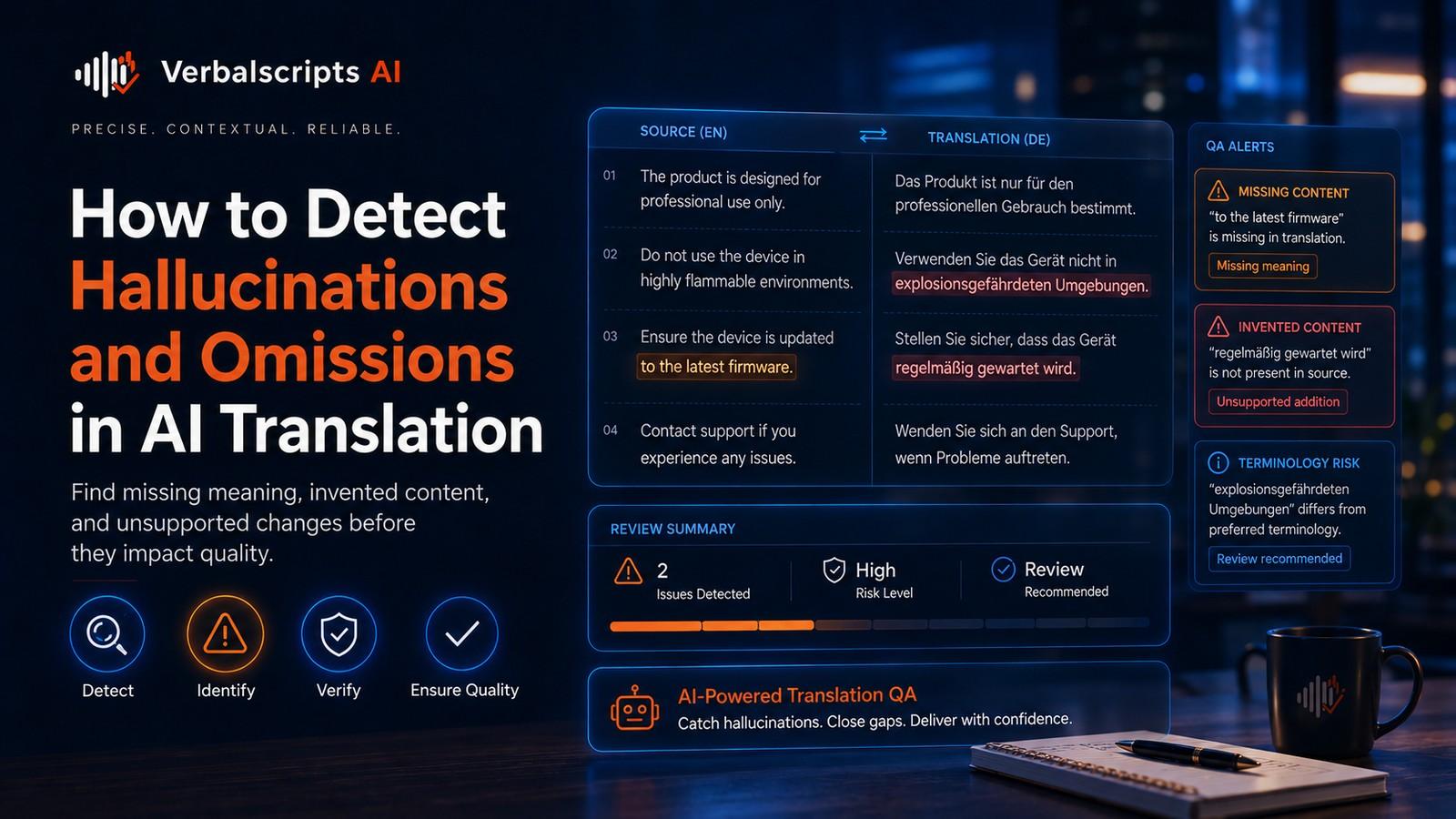
Before publishing a translated quote, verify:
- the correct speaker;
- source wording;
- intended meaning;
- names;
- numbers;
- level of certainty;
- no added interpretation.
This is especially important when a short quote is separated from the rest of the interview.
Sensitive interviews and trauma-informed handling
Some interviews involve traumatic, personal or emotionally difficult experiences. Translation should avoid making the speaker sound more detached, dramatic or certain than they were. Reviewers should preserve respectful language and avoid unnecessary normalization of culturally specific expressions. Access to the recording and transcript should also be limited to people who genuinely need it.
Interview translation across several target languages
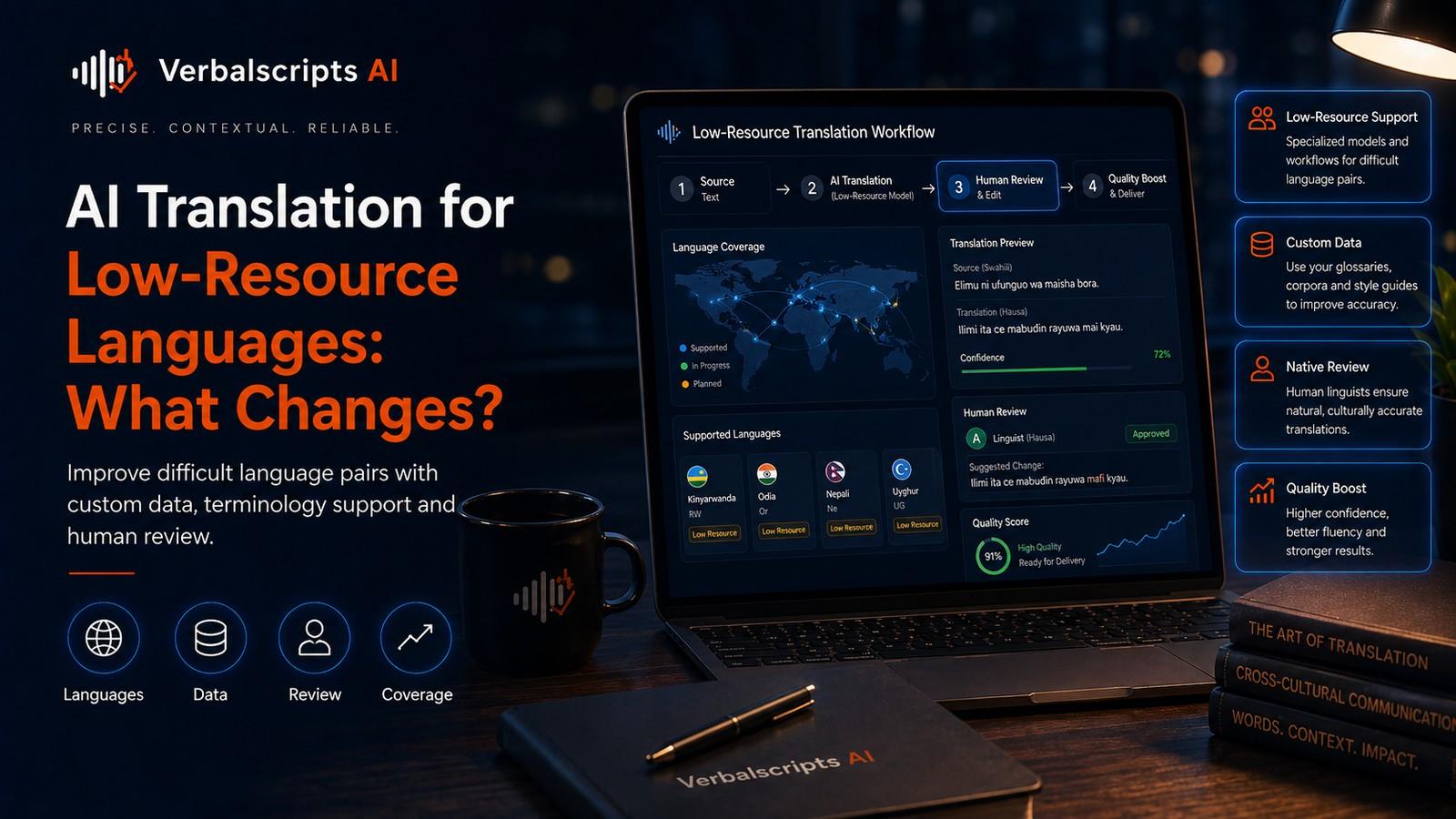
When one interview is translated into multiple languages, approve the source transcript first. This prevents a recognition error from being repeated ten times. A central terminology sheet can also keep names and recurring concepts consistent across all target versions. Each language still needs native review where the content is public or analytically important.
Summaries should not replace the interview
AI can generate summaries quickly, but summaries are interpretive. They select what seems important and compress uncertainty. For research, legal or journalistic work, retain the full translated interview and use the summary only as a navigation aid. This protects future reviewers from relying on a condensed version that may omit context.
Interviewer influence and question framing
The interviewer’s wording can affect the answer. Leading questions, clarification prompts and changes in topic are part of the interaction. Translating only answers may create the impression that statements were volunteered without prompting. Preserving the interview structure is therefore important whenever the context of a response matters.
Translation notes for difficult passages
A reviewer should have a place to explain passages that do not map cleanly into the target language. Short notes can document ambiguous terms, cultural references or reasons for retaining a source-language expression. These notes are especially valuable when several analysts or editors will later work from the translated interview.
Consistency across a study or interview series
When dozens of interviews cover the same topic, translation decisions should not restart with every file. Maintain a shared glossary, participant naming rules and transcript style guide. This reduces false differences between interviews that are created by inconsistent translation rather than by the speakers themselves.
Keep the original-language record
Even when the translated interview is the version most people will read, retain the source transcript and audio according to project policy. Future reviewers may need to revisit a phrase, confirm a quotation or create another target-language version. The source record preserves that possibility.
Reviewer decisions should be documented
When a reviewer resolves an ambiguous phrase, records a preferred name spelling or chooses how to render a recurring concept, that decision should be saved for later interviews in the same project.
Frequently asked questions
Can AI translate interviews accurately?
Yes, especially with clear audio and well-supported languages. Important interviews still benefit from review.
Should interview translations be verbatim?
It depends on the use case. Research and legal projects often need closer fidelity than editorial publication.
Can AI handle bilingual interviews?
Yes, but code-switching and language changes should be detected or reviewed carefully.
Should fillers be translated?
Only according to the project’s transcript style. Do not remove them automatically if they carry analytical or evidentiary value.
Is the audio still needed after translation?
Keep it when permitted. It is the authoritative source for resolving uncertainty.
Conclusion
AI interview translation is successful when it preserves the person behind the words.
Start with accurate transcription, keep speaker and timing information, translate in context and define how much cleanup is allowed. Human review should focus on the parts where nuance, uncertainty or publication risk matters most.
That approach makes AI useful without turning natural speech into something the speaker never actually said.
Research references
- Microsoft Learn, Speech translation quickstart:
- Microsoft Learn, Azure Speech language support: