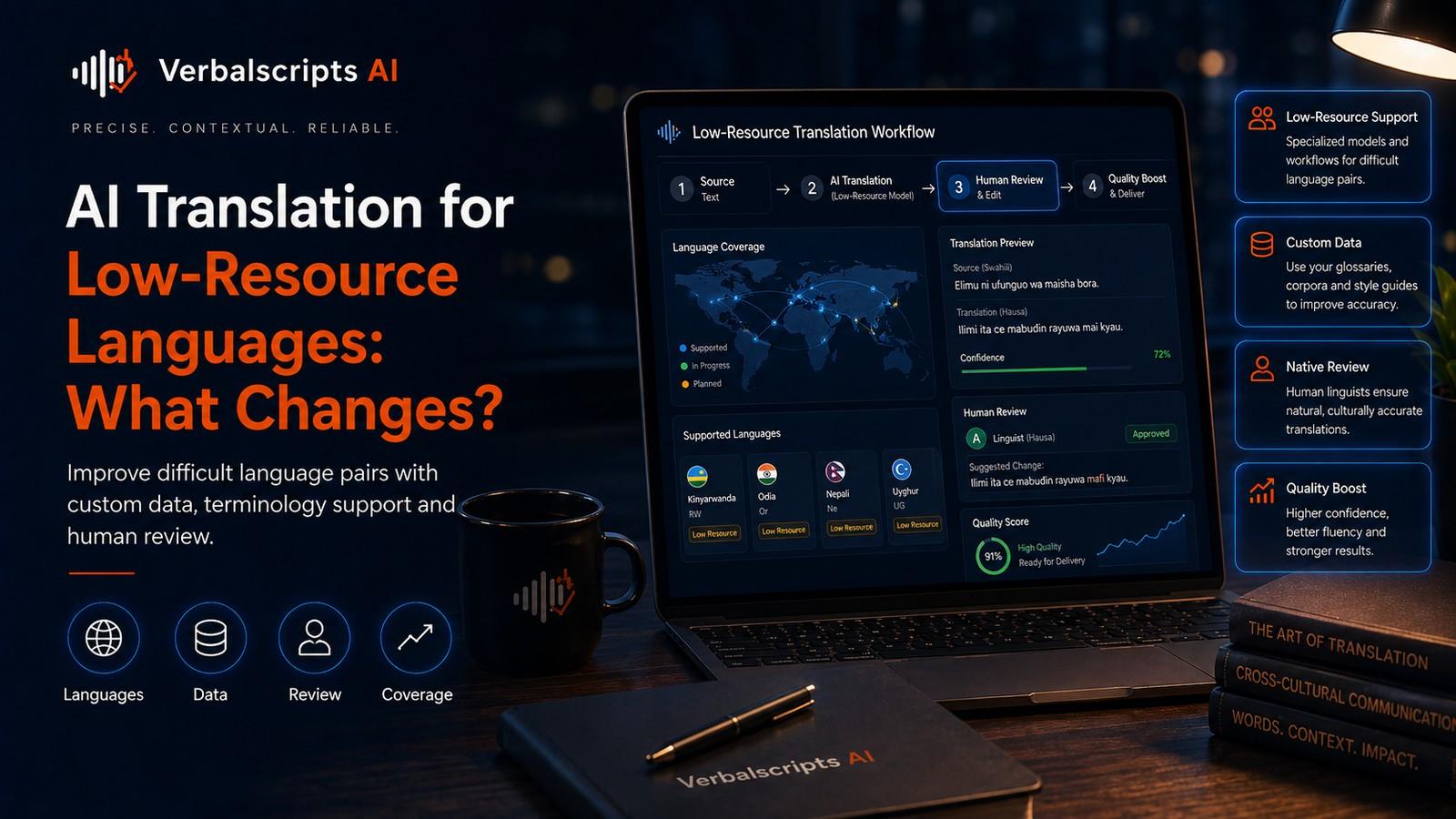
What changes when AI translates a low-resource language? There is less high-quality training and evaluation data, so models have fewer examples from which to learn vocabulary, grammar, terminology and translation equivalents. Quality can be less predictable, especially for specialized domains and dialects. Multilingual transfer, monolingual data, synthetic data, related-language resources and human review can improve results, but teams should test each language pair rather than assuming performance from a major language will transfer.
AI translation quality is not evenly distributed across the world’s languages.
For production multilingual workflows, see our AI Translation service for the delivery path behind the guidance in this article.
A language pair with vast amounts of clean parallel text, standardized spelling and active commercial demand is a very different machine-learning problem from a language with limited digital content, multiple orthographies, little aligned translation data and few evaluation benchmarks.
That is the core of the low-resource language challenge.
“Low-resource” describes a data situation, not the value, complexity or number of speakers of a language.
What is a low-resource language?
In machine translation, a language or language pair is low-resource when there is relatively little usable data for training, adapting or evaluating models.
Resources can include:
- parallel corpora;
- monolingual text;
- dictionaries;
- terminology databases;
- speech datasets;
- annotated linguistic data;
- quality benchmarks;
- human reviewer capacity.
A language can be widely spoken and still be underrepresented in high-quality digital datasets.
The amount of data also varies by pair. A language may have substantial translation data with English but very little direct data with another language.
The scale of the problem
The 2022 *Survey of Low-Resource Machine Translation* notes that roughly 7,000 languages are spoken worldwide and that almost all language pairs lack large parallel resources.
High-performing machine translation historically depended on enormous parallel datasets for a small set of language combinations. Modern multilingual models broaden coverage, but the underlying data imbalance has not disappeared.
In 2026, research continues to focus on ways to improve performance across hundreds of low-resource languages, showing that the challenge remains active even in the era of large multilingual models.
Why data quantity matters
Translation models learn patterns from examples.
With abundant data, a model can observe:
- frequent and rare vocabulary;
- many grammatical structures;
- named entities;
- idioms;
- formal and informal registers;
- spelling variation;
- domain terminology.
With limited data, some of these patterns may be absent or represented by only a few examples.
The model then relies more heavily on transfer from other languages and its broader multilingual representation.
Data quality can matter more than raw volume
A million noisy sentence pairs are not automatically better than a smaller carefully aligned corpus.
Low-resource datasets may contain:
- misaligned translations;
- OCR errors;
- duplicated text;
- inconsistent spelling;
- mixed languages;
- machine-generated translations;
- inappropriate domain content;
- encoding problems.
Data cleaning therefore has high leverage.
For community and enterprise projects, investing in curated parallel text, verified terminology and native-speaker evaluation can produce more value than collecting indiscriminate volume.
Multilingual transfer
One of the biggest advances in low-resource translation is multilingual modeling.
A single model trained across many languages can share representations. Knowledge learned from high-resource languages can sometimes benefit related or structurally similar low-resource languages.
This is called cross-lingual transfer.
The effect is not uniform. Typological distance, script, data balance and model architecture all matter.
A related high-resource language can be especially useful, but “related” should not be reduced to geography alone.
Pivot translation
When direct data for language A → language B is scarce, a system may translate through a high-resource pivot language such as English.
For example:
A → English → B
This increases coverage but creates two translation stages. Errors from the first stage can propagate into the second.
Direct multilingual models may avoid explicit pivoting, but the internal learning can still be influenced heavily by high-resource languages.
For high-stakes content, test whether the direct and pivot workflows preserve the same meaning.
Monolingual data
Parallel data is not the only useful resource.
Large amounts of target-language monolingual text can improve fluency and language modeling. Techniques such as back-translation create synthetic parallel data from monolingual corpora.
Low-resource MT research has extensively studied how to use monolingual data because it is often easier to obtain than professionally aligned translations.
The quality of synthetic data still needs control. Generating more data from a weak model can amplify its errors.
Synthetic data
Synthetic translation pairs can expand training material.
Potential uses include:
- back-translation;
- generating domain examples;
- terminology-focused sentences;
- paraphrasing;
- transliteration pairs.
Synthetic data is most valuable when combined with quality filtering and genuine native-language data.
It should not replace human-created evaluation sets. If the model is evaluated on data produced by similar systems, the benchmark may fail to represent real user language.
Related-language resources
Closely related languages can share:
- vocabulary;
- morphology;
- syntax;
- script;
- named entities.
Transfer can therefore help.
However, false friends and subtle grammatical differences create risk. A system may produce output that looks plausible because it resembles a related high-resource language while being unnatural or incorrect in the target language.
Native-speaker evaluation is essential to detect this.
Orthography and standardization
Some low-resource languages use multiple writing systems or have evolving spelling standards.
That affects:
- data matching;
- tokenization;
- search;
- glossary construction;
- evaluation;
- user acceptance.
A project must specify the target orthography and locale.
“Translate into Language X” may be insufficient if the community uses several scripts or regional conventions.
W3C language-tag guidance is useful for thinking about language, region and script as separate metadata dimensions. Script subtags such as zh-Hans and az-Latn illustrate why the writing system sometimes needs explicit identification.
Dialects and varieties
A model may claim support for a language while being trained primarily on one standard variety.
Users who speak another variety may see:
- unfamiliar vocabulary;
- standardized grammar that erases local forms;
- poor recognition of code-switching;
- inconsistent spelling;
- inappropriate formality.
Evaluation should therefore be performed at the level of the actual user population when possible.
Domain terminology is harder
General translation quality may look acceptable while legal, medical, agricultural, technical or financial terminology performs poorly.
This happens because domain data is scarce even for many high-resource languages. For a low-resource language, specialized parallel text may be nearly absent.
Teams can compensate with:
- curated glossaries;
- bilingual expert review;
- retrieval of approved reference texts;
- terminology-focused examples;
- domain-adapted training where data permits.
A glossary cannot teach the model the whole language, but it can protect high-value concepts.
Named entities and transliteration
Low-resource workflows often need special rules for names.
A model may have limited exposure to how personal, geographic or institutional names are normally transliterated.
Build an authoritative list for recurring entities, especially in:
- government;
- news;
- legal records;
- historical archives;
- healthcare;
- education.
Do not assume the model’s first transliteration is the official spelling.
Evaluation becomes more important, not less
The phrase “supports 100 languages” says little about quality in each language.
For low-resource deployment, test:
- adequacy;
- fluency;
- terminology;
- names;
- numbers;
- hallucinations;
- omissions;
- grammar;
- culturally appropriate phrasing.
Use native speakers who understand the domain.
Automatic metrics can support evaluation, but a benchmark should include representative real-world content.
Human review capacity
Low-resource language projects can face a practical bottleneck: there may be fewer professional translators or domain specialists available.
That makes reviewer management important.
Potential models include:
- professional linguist review;
- trained native-speaker reviewers;
- domain expert plus linguist;
- community validation;
- adjudication for disagreements.
Review guidelines should be specific enough that multiple reviewers score quality consistently.
Data collection as product infrastructure
For organizations that repeatedly translate a low-resource language, every reviewed project can improve future performance.
With appropriate permissions and privacy controls, teams can build:
- translation memories;
- glossaries;
- error taxonomies;
- approved corpora;
- named-entity lists;
- style guides;
- benchmark sets.
The key is to capture high-quality corrections in structured form.
Privacy and consent
Language-data scarcity does not justify careless data collection.
Training or evaluation data may contain:
- personal conversations;
- medical information;
- community-sensitive content;
- copyrighted works;
- private records.
Collect data with clear rights, consent and retention policies appropriate to the use case.
For community languages, governance should also consider who benefits from the data and whether local speakers have meaningful input.
A practical deployment workflow
Step 1: Define the exact target
Specify language, locale, script, domain and audience.
Step 2: Benchmark the model
Use representative source material before committing to production.
Step 3: Build terminology
Protect names, domain terms and recurring phrases.
Step 4: Translate with context
Avoid isolated segments when context matters.
Step 5: Run automatic QA
Check numbers, missing content, script contamination and formatting.
Step 6: Native-speaker review
Prioritize high-risk segments and a statistically useful sample of routine content.
Step 7: Measure errors
Classify them by type rather than recording only a pass/fail judgment.
Step 8: Improve data
Feed approved corrections into terminology, reference resources and future evaluations.
What not to assume
Do not assume speaker population equals data availability
A large language can still be digitally underrepresented.
Do not assume multilingual models equalize quality
Shared models help but do not erase training imbalance.
Do not assume English-centric evaluation transfers
A workflow that performs well for European language pairs may behave differently elsewhere.
Do not assume fluency means adequacy
A model can produce smooth target-language text that omits or changes meaning.
Do not assume one standard represents every community
Locale and dialect matter.
Cost and turnaround implications
Low-resource language projects may require more:
- terminology preparation;
- reviewer sourcing;
- quality sampling;
- adjudication;
- data cleanup;
- iterative testing.
AI can still reduce turnaround dramatically compared with fully manual translation, but the quality-control layer may be more substantial.
A realistic production plan prices and schedules that review rather than promising identical automation rates across all languages.
Frequently asked questions
What makes a language low-resource?
A shortage of usable digital data for training, adapting or evaluating language technology, not the size or importance of the language community.
Are low-resource translations always inaccurate?
No. Some language pairs can perform surprisingly well through multilingual transfer and modern models. Quality must be measured on representative data.
Can human review fix low-resource AI translation?
Human review can catch and correct errors, but it does not automatically solve systematic model gaps. Corrections should also improve terminology and future workflows.
Does adding more training data always help?
Only if the data is relevant and sufficiently clean. Misaligned or noisy data can reduce quality.
What is the best first step for a company?
Benchmark the exact language, locale, script and domain you plan to use, then build a small approved terminology set and review workflow before scaling.
Conclusion
Low-resource AI translation is not a separate technology so much as a different operating environment.
The model has fewer direct examples, evaluation is harder and linguistic variation may be poorly represented. Multilingual transfer, monolingual data and synthetic data expand what is possible, but high-quality native-language resources remain essential.
Organizations that treat low-resource translation as a measurable data-and-quality program (rather than a checkbox in a language list) can achieve far more reliable results.
Research references
- Haddow et al. (Computational Linguistics 2022), *Survey of Low-Resource Machine Translation*:
- Song et al. (LoResMT 2026), *Are Small Language Models the Silver Bullet to Low-Resource Languages Machine Translation?*:
- W3C, *Language tags in HTML and XML*: