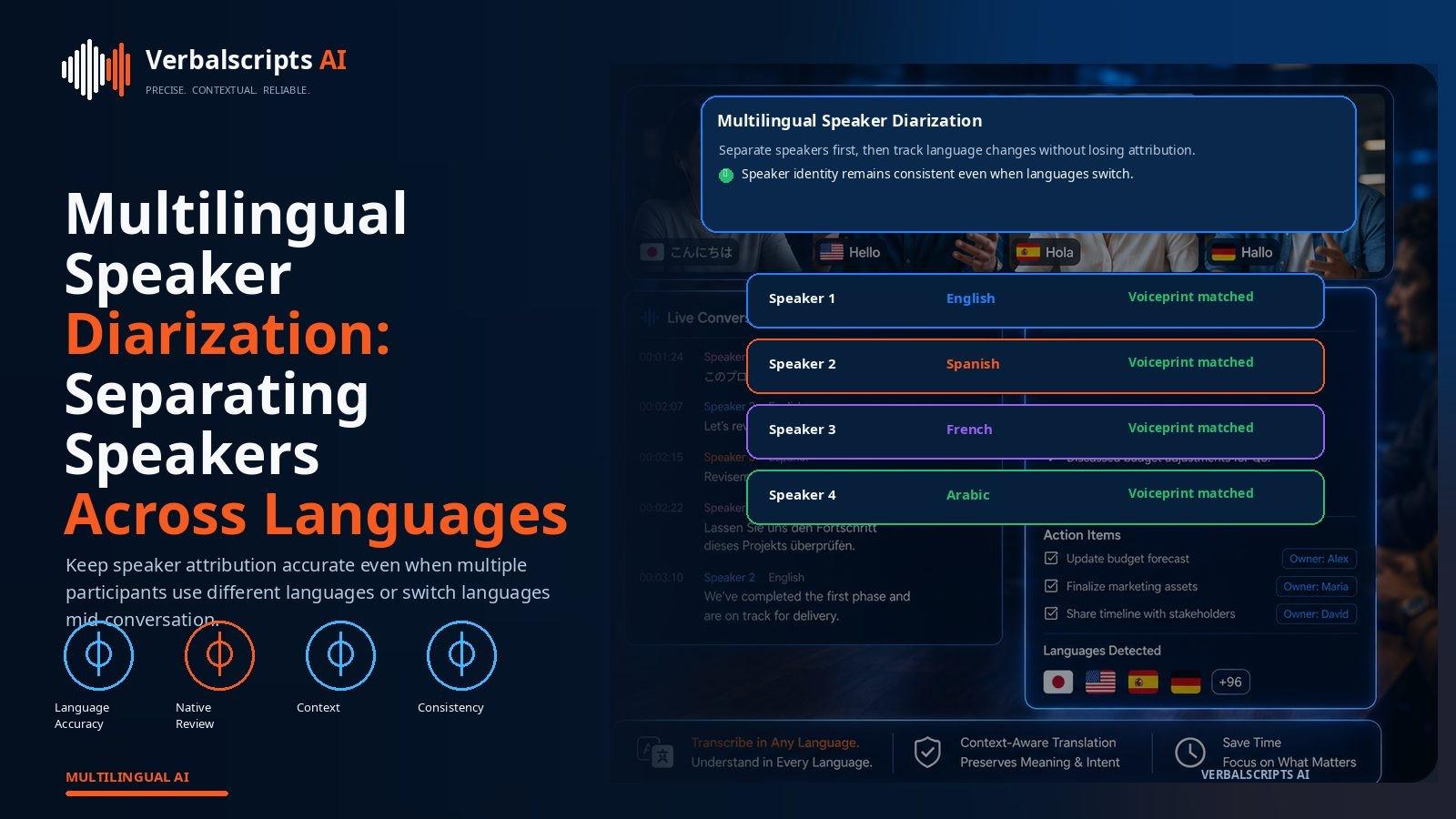
How does multilingual speaker diarization work? A diarization system analyzes acoustic speaker characteristics and groups speech segments that appear to come from the same voice, producing labels such as Speaker 1 and Speaker 2. Language identification can then label the language of each segment independently. Production systems can combine diarization, language ID and ASR to create transcripts with speaker, language and timestamp metadata. Human verification is valuable when speaker attribution matters or voices overlap.
| SEO title | Multilingual Speaker Diarization: Separating Speakers Across Languages |
|---|---|
| Slug | multilingual-speaker-diarization-languages |
| Meta description | Learn how multilingual speaker diarization separates speakers across languages, how it differs from language ID, and how to evaluate diarization quality. |
| Primary keyword | multilingual speaker diarization |
| Search intent | Technical / Informational |
| Hero image | 182-multilingual-speaker-diarization.jpg |
| Hero alt text | Multilingual diarization timeline showing different speaker clusters and language labels across an audio recording |
| Article body words | 2007 |
For production multilingual workflows, see our AI Translation service for the delivery path behind the guidance in this article.
Speaker diarization answers one question:
Who spoke when?
Language identification answers another:
Which language was spoken?
Multilingual recordings often require both. A meeting may contain four speakers using three languages. A bilingual interview may have one interviewer and one participant who both code-switch. If speaker and language metadata are conflated, the transcript becomes difficult to trust.
Google Speech-to-Text and Amazon Transcribe both provide speaker-diarization capabilities with configurable or expected speaker counts in supported workflows.
Diarization is not identification
Diarization:
- Speaker 1;
- Speaker 2.
Identification:
- Alice;
- Bob.
Naming speakers requires:
- participant metadata;
- voice enrollment;
- manual review.
Do not infer identity merely from acoustic clustering.
Diarization is not language ID
Speaker 1 may speak:
- English;
- Swahili.
Language can change without speaker change.
Store two independent labels.
Acoustic speaker embeddings
Diarization systems represent voice characteristics.
They compare segments and cluster similar voices.
Features can reflect:
- vocal tract;
- pitch patterns.
The system aims to identify speaker consistency, not demographic identity.
Voice activity detection
First detect:
- speech;
- non-speech.
Diarization should not assign:
- silence;
- music
as a speaker.
Segmentation
Audio is divided into speaker-homogeneous regions.
Hard cases:
- fast interruption;
- overlap.
Bad segmentation creates speaker attribution errors.
Clustering
Segments are grouped into speakers.
If speaker count unknown, model estimates or uses range.
Provider APIs may allow:
- minimum;
- maximum.
Google’s diarization configuration includes min/max speaker count fields.
Speaker-count configuration
If meeting has 3 known speakers, provide that information where supported.
Too broad a range can:
- split one speaker into two;
- merge speakers.
Do not hard-code wrong count.
Overlapping speech
When two people talk simultaneously, one timeline segment has two speakers.
Traditional diarization often struggles.
For legal interviews, manually review overlap.
Similar voices
Related or similar-pitch speakers can be confused.
Do not assume diarization is identity-grade.
Speaker labels should be quality-checked.
Channel separation
If each speaker has separate channel, use it.
A two-channel call recording:
- agent left;
- customer right.
This can be more reliable than acoustic clustering.
Multilingual effects
Speaker identity is primarily acoustic.
Language changes can alter:
- pronunciation;
- pitch;
- rhythm.
A speaker embedding should ideally remain stable across languages, but cross-language speaker behavior can challenge models.
Benchmark bilingual speakers.
Language-specific diarization?
Do not route diarization solely by language unless architecture requires.
Speaker clustering can usually happen before language ID.
But language metadata can help detect suspicious splits.
Architecture A
- VAD;
- diarization;
- language ID per segment;
- ASR.
Good when speakers use distinct languages.
Architecture B
- multilingual ASR;
- diarization integrated;
- language labels.
Simpler.
Test quality.
Interpreter scenario
Three roles:
- original speaker;
- interpreter;
- second participant.
Diarization helps distinguish rendition.
Transcript labels should be manually verified.
Meetings
Diarization improves:
- action-item attribution.
But meeting platforms with authenticated participants may use additional identity information.
Speaker labels are not always purely diarization.
Interviews
Two speakers is an easy diarization case.
Cross-talk and remote call channels still matter.
Call centers
Channel separation is ideal where possible.
Diarization can handle:
- conference calls;
- transfer.
Privacy policy should govern voice data.
Podcasts
Multiple hosts/guests.
Diarization helps:
- transcripts;
- subtitles.
Human name mapping produces publication-quality labels.
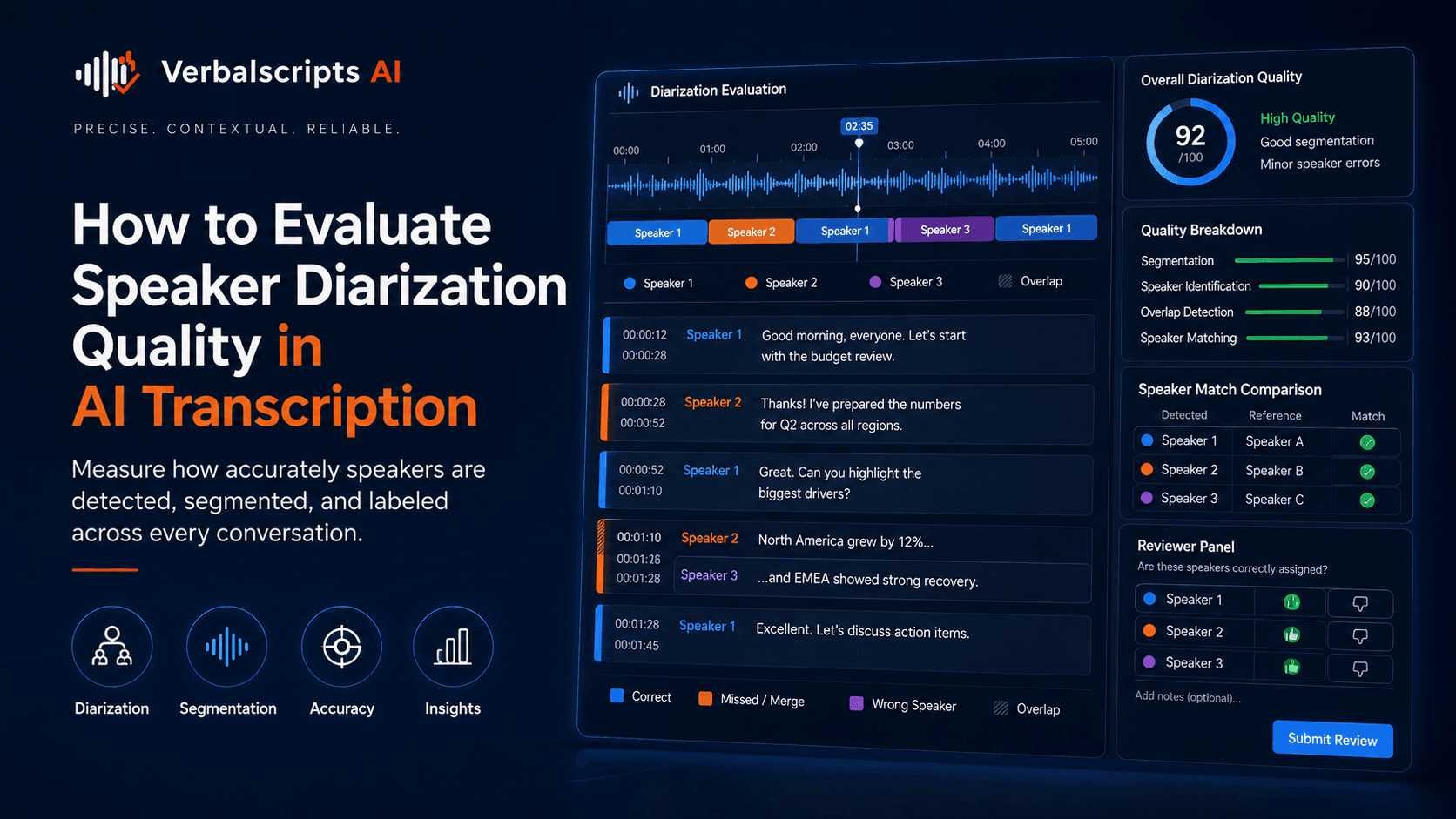
Diarization error rate
DER is a common metric.
It accounts for:
- missed speech;
- false alarm speech;
- speaker confusion.
Evaluation requires a time-aligned human reference.
Speaker confusion
The most visible error:
Correct words, wrong speaker.
For legal records, this can be critical.
Track separately from WER.
Word-level speaker labels
Some APIs return speaker labels aligned to words.
This enables:
- paragraph grouping.
Post-processing can merge consecutive words from same speaker.
Language + speaker schema
Store:
- start;
- end;
- speaker;
- language;
- text.
This supports:
- translation;
- search.
Code-switching
Language spans can change inside a speaker turn.
Do not split speaker merely because language changes.
Conversely, do not assign language based solely on speaker history.
Human verification
Map generic clusters to names.
Review:
- first minutes;
- overlap;
- similar voices.
For long files, correcting one cluster mapping can fix many labels.
Privacy
Voice can be sensitive/biometric depending on processing.
Diarization does not necessarily require identifying a person, but still process audio securely.
Avoid repurposing speaker embeddings without authorization.
Common failures
Speaker fragmentation
One person becomes Speaker 1 and 3.
Speaker merging
Two people become Speaker 1.
Language-induced split
Bilingual voice clusters separately.
Overlap loss
One speaker disappears.
Speaker diarization before versus after ASR
Some architectures diarize audio first and transcribe each speaker segment. Others use an integrated ASR model that returns speaker-tagged words. Neither is universally superior.
Diarize-first can simplify language routing when speakers use different languages. Integrated diarization can reduce stitching complexity. Benchmark:
- speaker confusion;
- word accuracy;
- overlap;
- latency.
The right architecture depends on the recording type.
Cross-language speaker consistency test
For bilingual speakers, create evaluation audio where the same person speaks both languages. Measure whether the diarization system keeps one cluster across the switch.
A system that creates Speaker 1 for English and Speaker 3 for the same person speaking Spanish may have good monolingual diarization but poor multilingual usability.
Mapping clusters to real names
A safe workflow can:
- produce generic clusters automatically;
- compare the first verified occurrence with participant metadata;
- map SPEAKER_00 to an approved display name;
- apply that mapping throughout;
- let reviewers correct errors.
Do not use voice identity recognition beyond the authorized project purpose.
Overlap annotation
For research or legal work, preserve overlap explicitly when both voices are intelligible. A simple convention can use:
- parallel lines;
- [overlapping].
For clean business notes, the transcript may instead prioritize the dominant intelligible speaker. The policy should be defined before review.
Diarization quality in downstream translation
Wrong speaker assignment can alter translation decisions:
- gendered agreement;
- formal address;
- attribution of commitments.
Therefore speaker QA is not merely cosmetic. In some languages and use cases, it directly affects target grammar and meaning.
Diarization quality is a prerequisite for trustworthy attribution
In many multilingual workflows, people focus on word accuracy and forget that the wrong speaker label can be more damaging than several lexical errors. If Speaker A’s statement is assigned to Speaker B, the transcript can misrepresent responsibility, consent or intent even when every word is correctly recognized.
For high-stakes interviews, meetings and legal recordings, verify speaker attribution separately from word accuracy.
Speaker embeddings across language changes
A robust diarization model should recognize the same speaker even when they change:
- language;
- speaking style;
- emotional state.
Code-switching can change rhythm and phonetic patterns. A model that relies too heavily on language-specific acoustic cues may fragment one bilingual speaker into several clusters.
Benchmark bilingual speakers explicitly rather than assuming monolingual DER generalizes.
Overlap and interruption handling
Real conversation includes:
- backchannels;
- interruption;
- simultaneous laughter;
- overlapping questions.
Diarization systems can miss one speaker during overlap or alternate labels rapidly. The transcript style should define how overlap is represented.
For research:
- preserve both intelligible speakers.
For ordinary business notes:
- the dominant intelligible speech may be enough.
For legal evidence:
- review every material overlap manually.
Known participant lists
If the meeting roster is known, use it to improve final labeling, but do not confuse roster with acoustic diarization.
A safe workflow:
- AI separates generic speaker clusters;
- reviewer maps clusters to roster names based on verified turns;
- system applies the mapping;
- reviewer checks ambiguous clusters.
This is different from automatically identifying a person by biometric voice recognition.
Diarization error rate in practice
DER conceptually includes:
- missed speech;
- false alarm speech;
- speaker confusion.
A low DER is useful, but users often care particularly about speaker confusion. For a two-person interview, a 3% speaker-confusion error may produce several materially wrong attributions.
Track the component errors, not only the total.
Speaker count estimation
If the model asks for a minimum/maximum speaker count, use realistic metadata.
Too low:
- distinct speakers merge.
Too high:
- one speaker fragments.
For open meetings, use broader ranges and human correction. For a known two-person interview, constrain aggressively.
Channel identification versus diarization
Separate channels are often stronger evidence than acoustic clustering.
If a call recording has:
- agent on channel 0;
- customer on channel 1,
preserve channels. Do not downmix and then ask diarization to reconstruct information the recording already contained.
Diarization remains useful for conference bridges or multiple people sharing a channel.
Language labels per speaker
Do not assume each speaker has one permanent language.
Store language on the segment, not as the only property of the speaker. A bilingual participant may use English for technical terminology and French for narrative explanation.
The data model can store:
- speaker identity;
- segment language;
- transcript;
- time.
Translation implications
Speaker metadata can affect translation in languages that encode:
- gender;
- formality;
- number.
Only provide verified and relevant speaker information. Do not infer sensitive attributes from voice.
When identity is unknown, translation should preserve ambiguity where possible.
Diarization correction propagation
If a reviewer discovers that Speaker 1 and Speaker 3 are actually the same person, update the cluster mapping centrally. Do not manually relabel each paragraph if the platform can reapply the correction.
Likewise, if Speaker 2 was misnamed, one entity update should correct all derived translations and summaries.
Reviewer interface
The ideal diarization QA tool should allow:
- click speaker color/cluster;
- listen to all segments for that cluster;
- merge clusters;
- split wrongly merged sections;
- assign display name;
- mark uncertain.
This is much faster than editing speaker labels line-by-line.
Multilingual diarization benchmark
Include:
- same speaker switching languages;
- speakers with similar voices;
- overlapping speech;
- short turns;
- phone audio;
- several speaker counts.
Report DER plus speaker-confusion rate.
Common operational incident
A multilingual meeting summary says “Maria approved the budget,” but the correct transcript shows Omar said it. The summarizer did not hallucinate; it trusted the wrong diarization.
This is why downstream systems should inherit speaker-confidence metadata and critical decisions should be checked against the audio when attribution matters.
Final design principle
Keep speaker, language, text and time as separate fields. They are correlated but not interchangeable. This simple data-model choice prevents many multilingual transcription and translation errors.
Implementation takeaway
For production use, treat speaker-confusion testing, bilingual speaker stability and overlap review as measurable parts of the workflow rather than assumptions. Define the relevant policy before processing content, keep the model or data configuration versioned, and verify results on representative material from the actual language, locale and domain. If automation produces a result that conflicts with a deterministic rule, authoritative terminology or qualified human evidence, escalate the item instead of averaging the disagreement away. The most durable multilingual systems preserve source-to-target traceability, record exceptions and feed reviewed corrections back into benchmarks, glossaries or routing rules. That discipline makes quality improvements reproducible when models, providers, reviewers or source content change.
Frequently asked questions
Does diarization know the speaker’s name?
Not inherently. It separates voices.
Can diarization work across languages?
Yes, but multilingual/bilingual speech should be tested for the model and recording conditions.
How many speakers can systems handle?
Limits vary. For example, Amazon Transcribe’s current documentation describes speaker partitioning with a configured maximum; check current service limits.
Is diarization accuracy included in WER?
No. Speaker attribution is a separate evaluation.
Should I use separate audio channels?
Yes when available; they can provide stronger speaker separation.
Conclusion
Multilingual diarization is easiest to understand when speaker identity and language identity remain separate dimensions.
Cluster voices, label languages independently, preserve timing and verify important speaker assignments. Use channel information when available and review overlap.
A transcript becomes much more useful when it can answer three questions accurately: what was said, who said it and in which language.
Research references
- Google Speech-to-Text speaker diarization:
- Amazon Transcribe speaker diarization:
- Azure Speech language support: