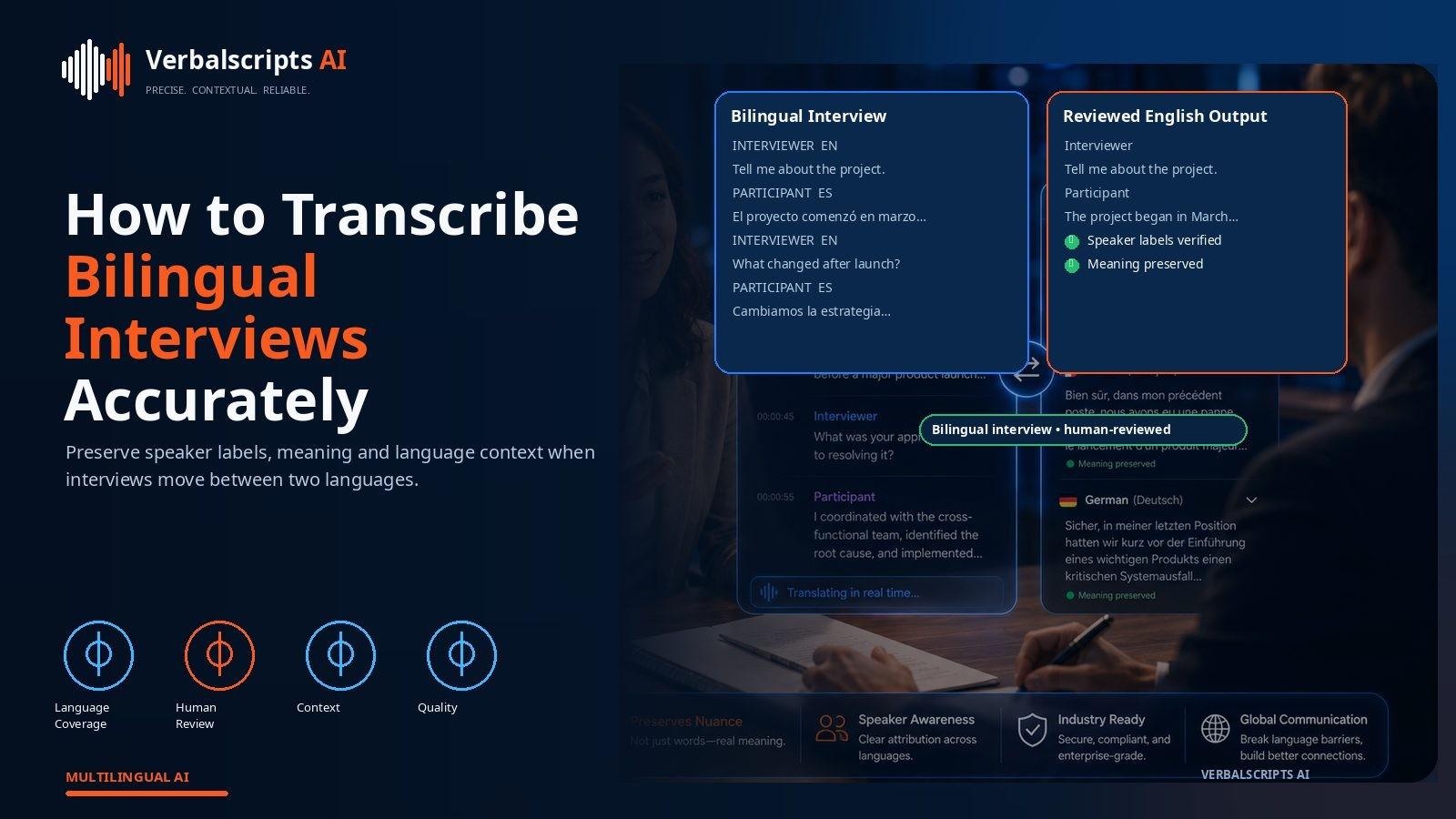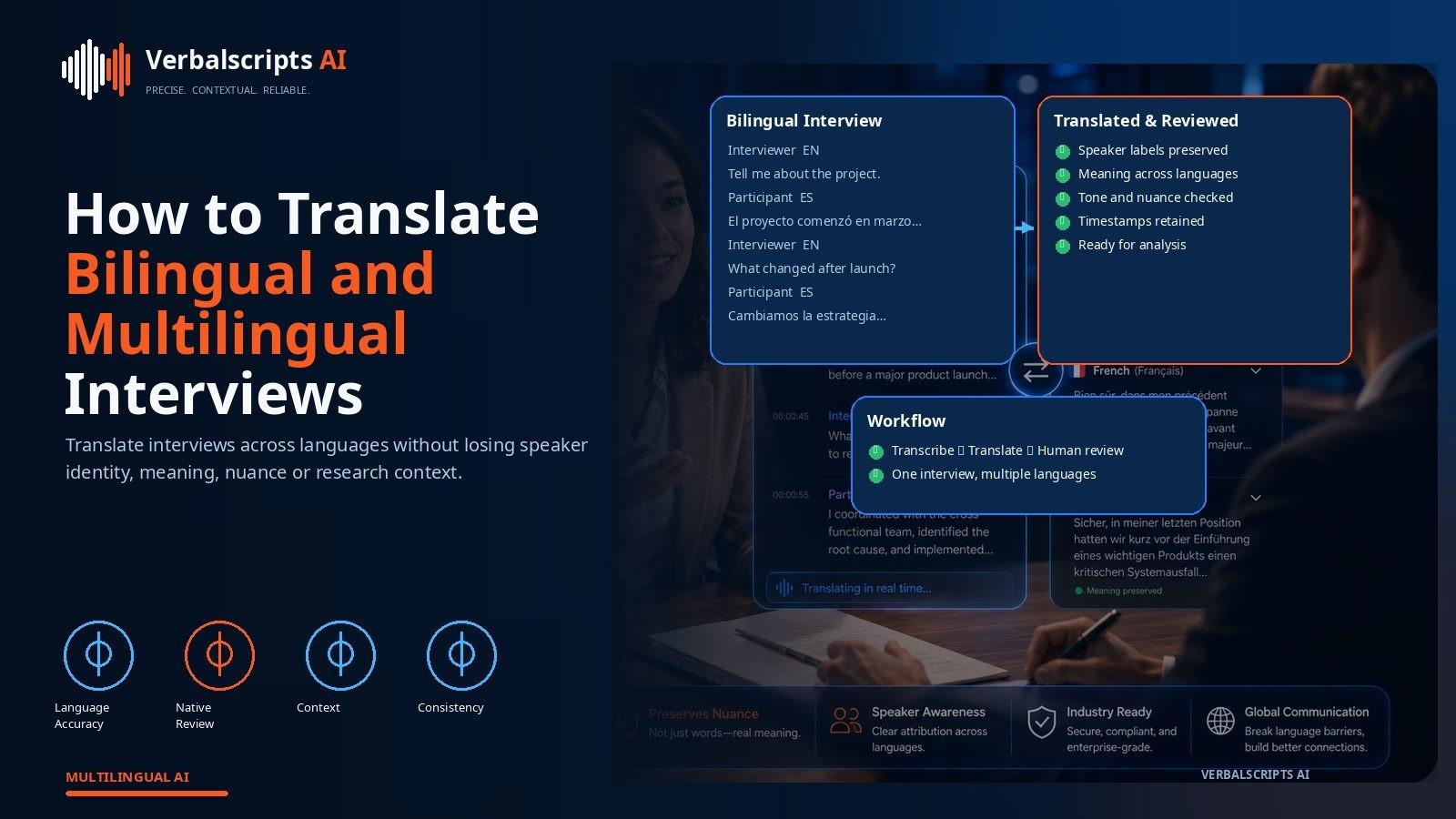
How should bilingual and multilingual interviews be translated? Start from a verified source transcript that preserves speaker labels, language changes and timestamps. Translate complete conversational turns with context, not isolated language fragments. Use an approved terminology and name list, decide whether code-switched source words should be retained or translated, preserve uncertainty and tone, then review important passages against the original audio. For research, legal and public quotation, keep the source and target aligned for traceability.
| SEO title | How to Translate Bilingual and Multilingual Interviews |
|---|---|
| Slug | translate-bilingual-multilingual-interviews |
| Meta description | Learn how to translate bilingual and multilingual interviews while preserving speaker meaning, code-switching, terminology, uncertainty and timestamps. |
| Primary keyword | translate bilingual interviews |
| Search intent | How-to / Informational |
| Hero image | 181-translate-bilingual-multilingual-interviews.jpg |
| Hero alt text | Multilingual interview translation editor showing language-tagged source turns aligned with a reviewed target transcript |
| Article body words | 1959 |
For production multilingual workflows, see our AI Translation service for the delivery path behind the guidance in this article.
Translating a multilingual interview is not simply translating each language separately and joining the results.
The interviewer’s question, the participant’s language choice, code-switched phrases, names, hesitations and conversational context all interact. A strong translation creates a coherent target-language interview while preserving what the source speakers actually communicated.
The source transcript should remain the record even when the target version normalizes all languages into one.
Prepare the source first
Before translation:
- correct obvious ASR errors;
- verify names;
- mark unclear audio;
- preserve language switches.
Do not translate a noisy draft.
A source error multiplied into five target languages becomes expensive.
Decide target strategy
Possible outputs:
Unified target
All source languages → English.
Best for:
- analysis;
- readers.
Parallel bilingual
Source + target.
Best for:
- review;
- legal;
- research.
Selective translation
Only non-dominant language translated.
Best for:
- bilingual audiences.
Define in advance.
Translate conversational context
An answer:
“The second one.”
requires the question.
Translate turns together.
Long context improves:
- pronouns;
- references;
- tone.
Speaker labels
Preserve:
- interviewer;
- participant;
- interpreter.
If target is unified English, labels still show interaction.
Timestamps
Keep timestamps linked to source audio.
Target may be longer but timestamp points to speech.
This enables:
- quote verification.
Code-switching strategy
Example:
“The meeting was fine, lakini budget ilikuwa tight.”
Target English:
“The meeting was fine, but the budget was tight.”
This is reasonable for a general translated transcript.
But research on language identity may require:
“The meeting was fine, [Swahili] lakini budget ilikuwa tight.”
with translation note.
Use case controls the decision.
Preserve culturally meaningful terms
A local term may have no exact equivalent.
Options:
- translated explanation;
- retained term + gloss;
- closest target equivalent.
Do not erase cultural concepts merely to create smooth English.
Names
Personal and place names need:
- official spelling;
- transliteration.
Check metadata.
Do not translate semantic components of a surname.
Quotations
If target will be quoted:
- verify against audio;
- preserve certainty;
- avoid polishing beyond meaning.
A publication quote should have traceable timestamp.
Tone
Multilingual speakers may change language for:
- emphasis;
- humor;
- identity.
A unified translation can lose that effect.
Where relevant, translator notes can preserve it.
Hesitation
For legal/research:
- keep “I think,” “maybe.”
Do not turn tentative statements into certainty.
Translation of interviewer questions
Questions can contain assumptions.
Translate fully.
A leading question matters to interpretation.
Interpreters in recording
If interview includes human interpreter:
- identify original;
- interpreter rendition.
Decide whether translation should use:
- original speech;
- interpreter speech.
For quality, original-language translation is preferable where reviewer can understand it; interpreter rendition can be cross-check.
Three or more languages
One reviewer may not cover all.
Workflow:
- language-specific source verification;
- target-language integration;
- final consistency.
Use shared glossary.
Terminology
Research interviews often repeat core concepts.
Approve terms before batch translation.
This prevents different languages from mapping same study concept inconsistently.
Translation memory
Across an interview series, reuse:
- questions;
- project terms.
Do not retranslate survey script differently every interview.
Research methodology
Translation can influence qualitative analysis.
Document:
- who translated;
- whether AI used;
- review;
- code-switch handling.
This increases methodological transparency.
Legal/evidentiary
Use:
- close fidelity;
- full source-target alignment;
- reviewer identity.
Do not summarize.
Journalism
Target can be more readable.
But published quotes must remain faithful.
Editorial shortening should be separate from translation.
Business interviews
Customer-research teams may prioritize clear meaning.
Clean translated transcript is useful.
Keep original for audit.
Human review
Ideal reviewer:
- target native/in-market;
- understands source languages;
- domain.
For multilingual projects, use coordinated specialists.
AI review
LLM can flag:
- missing source spans;
- inconsistent name;
- terminology.
It cannot replace all language expertise.
Quality metrics
Measure:
- target adequacy;
- term accuracy;
- quote verification.
A single BLEU/COMET score is not enough for interview nuance.
Common failures
Fragment translation
Code-switched pieces do not join naturally.
Language choice erased
Analytical information lost.
Over-smoothing
Speaker tone changes.
Source ASR errors
Target translates wrong source.
Name inconsistency
Same person spelled differently.
A workflow
- verify source transcript;
- define target strategy;
- build glossary/name list;
- translate turns with context;
- preserve alignment;
- run QA;
- bilingual/native review;
- verify quoted passages;
- export source and target.
Example source-target alignment
For long interviews, assign each speaker turn a stable identifier:
- INT-0012-Q;
- INT-0013-A.
The source-language turn, target translation, reviewer comments and publication quote all reference the same ID. This creates a traceable chain from the final quotation back to the audio timestamp.
If a source correction later changes the turn, the system can mark the target translation and derived quote as needing review instead of silently leaving outdated text.
Translating an interpreter-mediated interview
If the recording contains both original speech and a live interpreter, decide which stream drives the written translation. The interpreter’s rendition can provide useful evidence, but it may summarize, clarify or omit details.
For high-stakes work:
- transcribe both;
- translate directly from the original language where qualified resources exist;
- compare the interpreter rendition as a secondary check.
This avoids treating an interpreted statement as if it were an exact source transcript.
Preserving multilingual identity without reducing readability
A readable English translation can still record significant source-language behavior through lightweight notes when needed:
[participant switches to French]
or by retaining a culturally significant term on first occurrence with a short gloss.
Use such devices only when the language choice matters to analysis or publication. A target transcript overloaded with language labels can become difficult to read.
Review questions for every target turn
A bilingual reviewer can ask:
- Is the factual meaning complete?
- Is uncertainty preserved?
- Does the speaker sound more polished or certain than the source?
- Are code-switched concepts handled according to policy?
- Are names and numbers correct?
- Does the target flow naturally with the preceding question?
These targeted questions are more effective than general proofreading.
Coordinating translations across a study
If 50 interviews discuss the same concepts, use the same:
- concept glossary;
- question translations;
- participant naming rules;
- style.
This prevents analysts from mistaking translation variation for real differences between participants.
Establish an interview translation protocol before the project starts
A multilingual interview project should document decisions before the first file reaches the translator. At minimum, define:
- source languages and dialects;
- target language/locale;
- whether the source transcript is verbatim, clean verbatim or normalized;
- how code-switching is represented;
- whether culturally specific terms are retained, glossed or translated;
- whether interviewer questions are translated in advance;
- how unclear audio is marked;
- how participant names are handled;
- which passages require specialist review.
This protocol reduces variation between translators and makes the final corpus more suitable for research, publication or legal use.
Source-language preservation is a methodological safeguard
When the interview becomes a research dataset, the source transcript should remain available even if analysts work primarily from English translation. Translation is an interpretive transformation. A target phrase may legitimately choose one sense among several or smooth a culturally specific expression.
Keeping the source allows:
- bilingual adjudication;
- future retranslation;
- verification of quotations;
- methodological transparency.
If privacy policy limits access, keep the source under stronger permissions rather than discarding it.
Handling quotations inside interviews
An interviewee may quote another person or repeat a phrase in a third language. Mark quotations clearly and decide whether to:
- preserve original quote;
- translate it;
- show both.
For legal, oral-history or academic work, source quotation can be important evidence. For general media publication, a fluent target may be sufficient.
The translator should not accidentally make a quoted statement sound like the interviewee’s own direct assertion.
Consistency across interviewer prompts
If researchers use a structured interview guide across countries, prepare approved translations of the recurring questions in advance. This prevents each translator from subtly changing the construct being asked.
If the recorded interviewer deviates from the approved question, transcribe what was actually said. The approved guide is a reference, not a replacement for the audio.
Cultural annotation versus translation
Some concepts may need a brief note rather than forced substitution. Examples include:
- local institutions;
- culturally specific social roles;
- administrative categories;
- idioms with no natural equivalent.
A research translation can use a short bracketed or footnoted explanation if the methodology allows it. Marketing and media translations may prefer a natural functional equivalent.
The project should decide the annotation convention globally.
Quality checks for multilingual interview translation
For each translated turn, verify:
- source speaker is correct;
- source language span is correct;
- target captures full meaning;
- uncertainty and hedging remain;
- names/numbers are exact;
- cultural terms follow policy;
- terminology is consistent;
- no interviewer or interpreter content is omitted.
For published quotes, add an audio verification step.
Multi-reviewer projects
If one interview contains languages A, B and C and no single reviewer covers all three, use staged review:
- reviewer A/B verifies relevant source spans;
- reviewer B/C or source-specific linguists verify remaining spans;
- target-language editor checks final target continuity;
- project lead resolves cross-language terminology.
Stable segment IDs are essential so edits do not become misaligned.
Translation of emotion and discourse markers
Words such as:
- “well,”
- “actually,”
- “maybe,”
- “you know”
can carry discourse meaning beyond filler. In clean verbatim, some can be removed, but the rule should be consistent.
Likewise, laughter, long pauses or hesitation may matter in trauma interviews, journalism or legal evidence. Decide which paralinguistic cues are preserved.
Interview translation as a reusable corpus
A well-structured project can later support:
- qualitative coding;
- cross-language search;
- article quotations;
- subtitle creation;
- training/evaluation data.
Store source and target by segment with versioning. This makes later uses possible without retranslating from scratch.
Security and participant confidentiality
Interview recordings often contain personal data that is more identifying than text alone. Limit reviewer access to the minimum needed and use pseudonyms where the translation does not require true identities.
If participant consent covers only the original study purpose, do not automatically reuse reviewed transcripts for model training or benchmarking. Language data governance must follow the research or contractual permissions.
Example review decision
Source participant says a phrase that literally means “my heart became small,” a culturally natural expression of fear/anxiety.
A literal English translation may confuse readers. A publication-ready target could render the intended emotion naturally, while a linguistic research transcript might retain the source expression plus gloss.
Neither is inherently “more accurate.” The correct choice depends on the declared translation purpose. This is why interview translation guidelines matter.
Frequently asked questions
Should code-switching be visible in the translation?
Only if it matters to audience or analysis. Otherwise a unified target can be natural.
Is a human interpreter’s rendition enough?
It can help, but direct translation from the original speech is preferable for independent verification when possible.
Should the translation preserve fillers?
According to the transcript style and purpose.
Can AI handle three-language interviews?
It can, but source recognition and reviewer coverage become more complex.
Should source and target share timestamps?
Yes, target segments should remain linked to source audio timing.
Conclusion
Multilingual interview translation is a context-preservation task.
Verify the source first, translate complete conversational meaning, preserve speakers and timing, and make conscious decisions about language switches and cultural terms.
The target should be easy to read without pretending that the multilingual nature of the original never existed when that nature matters.
Research references
- DECM code-switching ASR benchmark:
- Burchell et al., Code-Switched LID:
- Microsoft Azure Speech language identification: