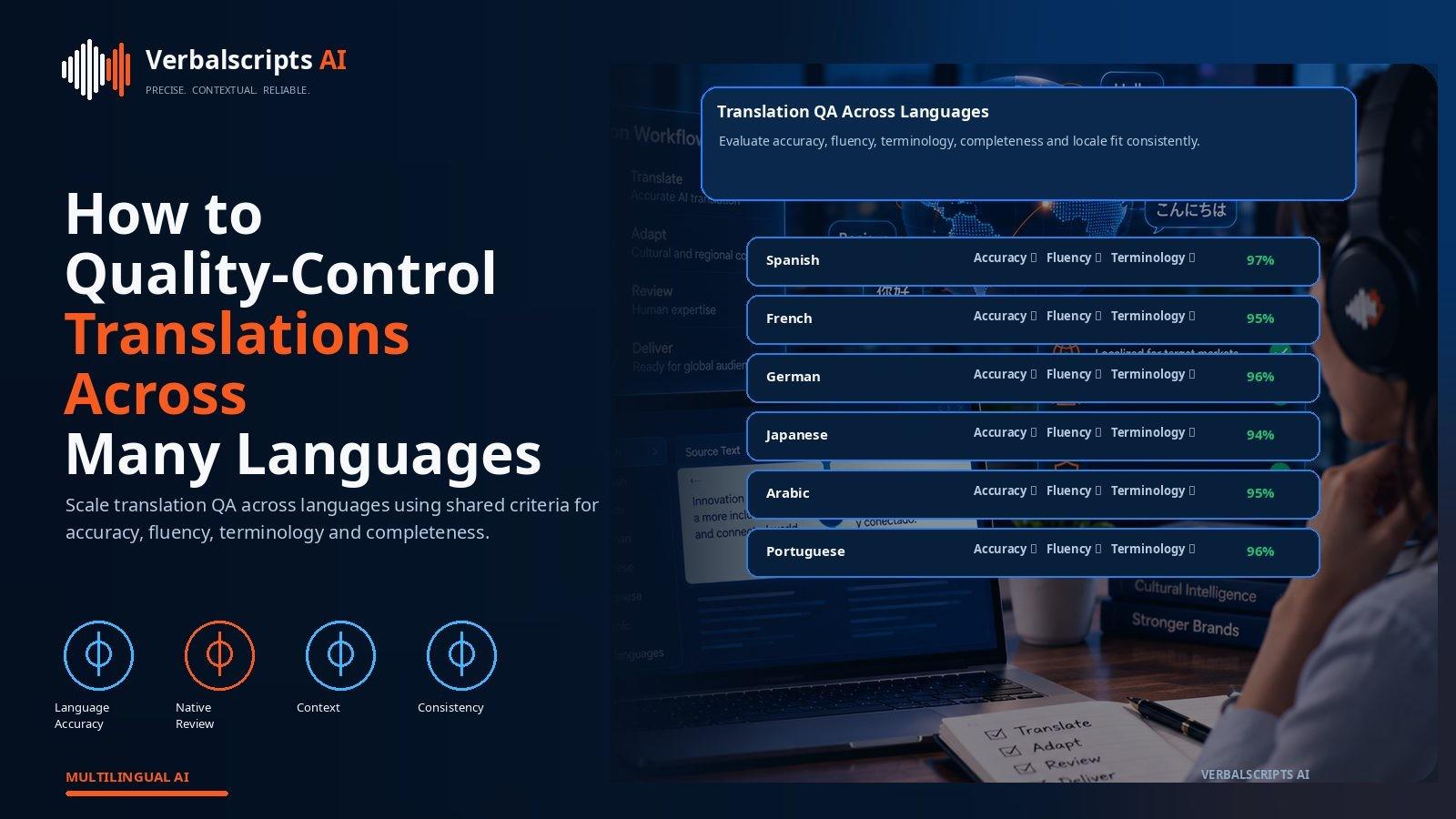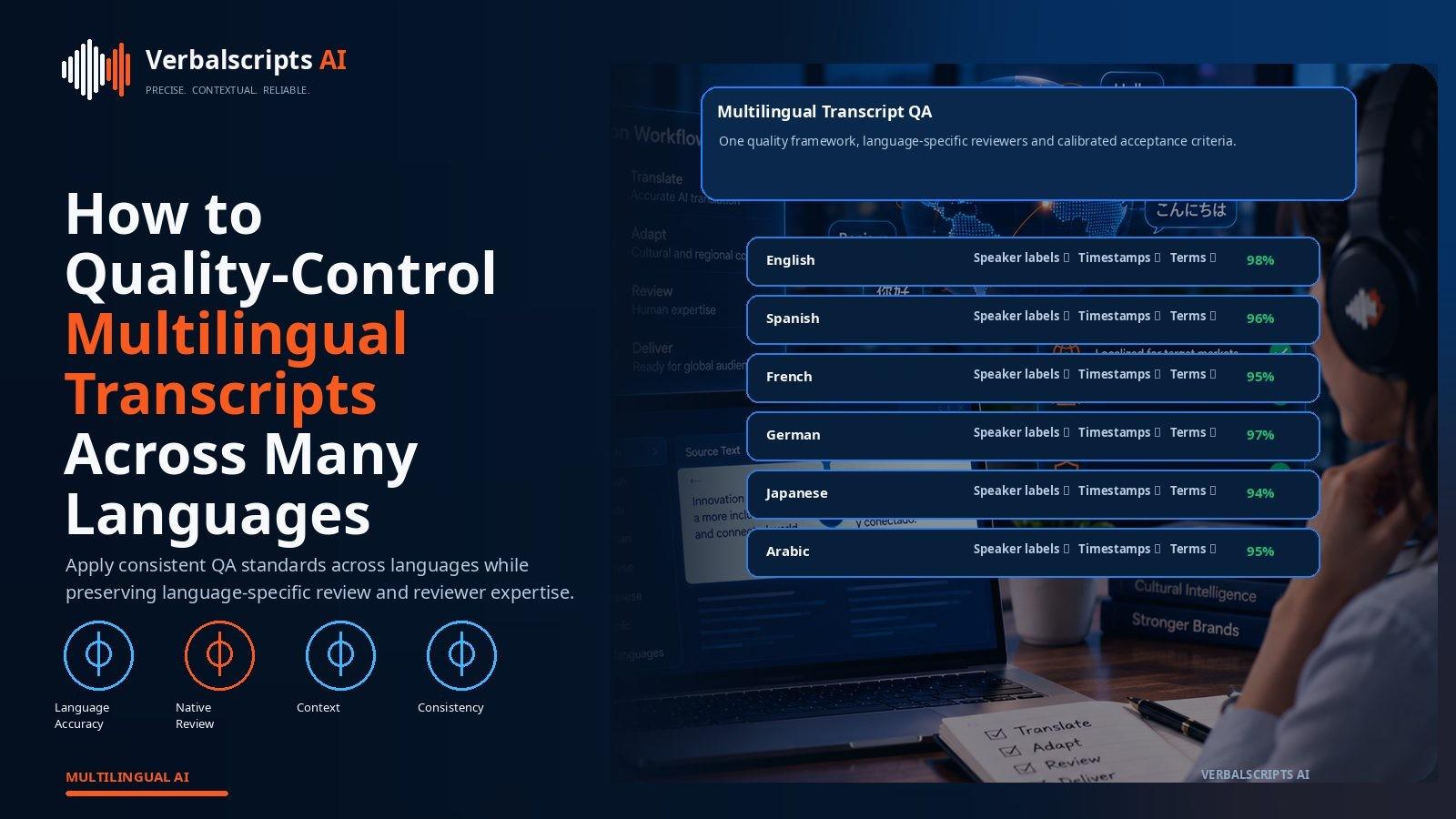
How do you quality-control transcripts across many languages? Use a common QA framework for completeness, speakers, timestamps, names and critical errors, then evaluate ASR accuracy per language using representative human reference data. Maintain language-specific transcript guides, native reviewer networks and terminology. Route low-confidence, code-switched and high-risk segments to humans, sample stable output, and report quality per language rather than hiding it in one global average.
| SEO title | Quality-Control Multilingual Transcripts Across Many Languages |
|---|---|
| Slug | quality-control-multilingual-transcripts-many-languages |
| Meta description | Learn how to QA multilingual transcripts across many languages using language-specific benchmarks, entities, diarization, sampling and native review. |
| Primary keyword | multilingual transcript quality control |
| Search intent | How-to / Enterprise |
| Hero image | 185-multilingual-transcript-quality-control.jpg |
| Hero alt text | Multilingual transcript quality dashboard showing WER, speaker accuracy, language ID and reviewer status across many languages |
| Article body words | 1999 |
For production multilingual workflows, see our AI Translation service for the delivery path behind the guidance in this article.
Quality-controlling one English transcript is straightforward: compare it with the audio.
At 30 languages, the organization must coordinate reviewers, different scripts, dialects, model performance, terminology and quality metrics that are not directly comparable.
Multilingual transcription QA therefore needs centralized standards plus language-specific expertise.
At scale, quality depends on operations as much as ASR model accuracy.
Global versus local rules
Global:
- timestamps;
- speakers;
- number handling;
- uncertainty marks.
Local:
- punctuation;
- script;
- word segmentation;
- dialect normalization.
Use one master guide + language addenda.
Language registry
For each language:
- code;
- locale;
- script;
- ASR;
- reviewer;
- baseline WER.
This is operational metadata.
Benchmark set
Create manually verified audio per language.
Include:
- clean;
- noisy;
- accents;
- domain.
Measure model changes against same set.
WER limitations
WER works well for many languages but tokenization matters.
For languages with:
- no whitespace;
- rich morphology,
CER or language-specific metrics may complement.
Do not compare raw WER across unrelated languages as if same difficulty.
Critical errors
Track separately:
- wrong name;
- wrong number;
- negation;
- speaker.
A low WER can still contain a critical entity error.
Language ID QA
If languages unknown, measure LID.
Wrong LID can create high WER.
Store:
- predicted language;
- confidence.
Code-switch QA
Create a special subset.
Measure minority-language terms.
Do not let dominant-language words hide poor code-switch performance.
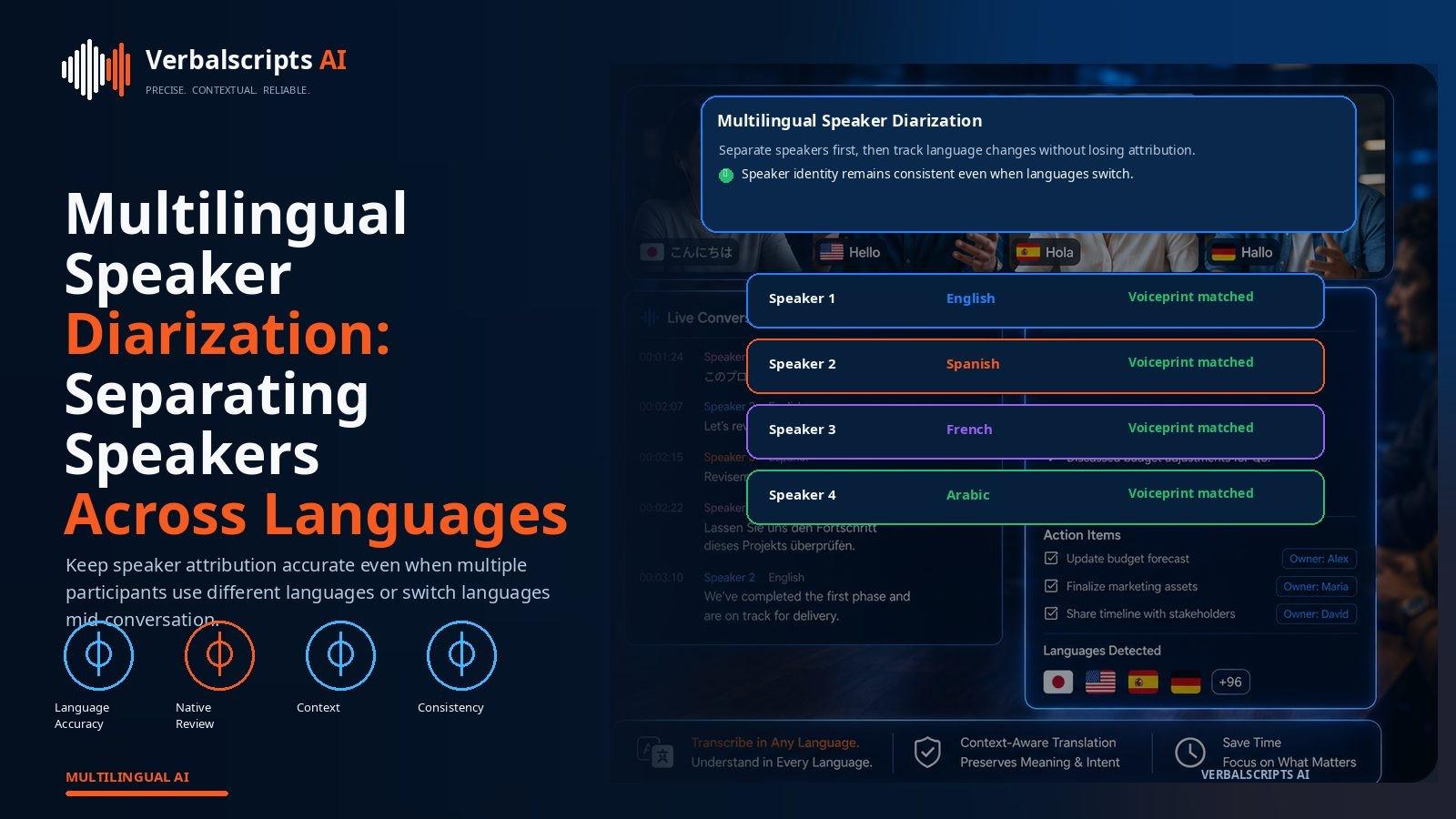
Diarization QA
Track:
- speaker confusion.
For interviews/meetings, correct speaker is part of transcript quality.
DER can be used when detailed reference exists.
Timestamp QA
Check:
- drift;
- missing time;
- segment.
For subtitle/media workflows, timing is critical.
Entity checklist
Across languages, verify:
- people;
- organizations;
- places;
- products.
Use project entity list.
Number normalization
Decide:
- spoken words;
- numerals.
Local conventions differ.
For source transcript, preserve accurate value.
Native reviewer network
Build reviewer roster:
- language;
- dialect;
- domain;
- security clearance where needed.
Do not recruit reviewer after urgent file arrives.
Reviewer training
Use:
- shared guide;
- examples;
- calibration.
Explain acceptable normalization.
Sampling policy
At scale:
100% review
High risk.
20% sample
New model/language.
2–5%
Stable low-risk.
Examples only; choose thresholds from data.
Risk-based routing
Review if:
- low confidence;
- named entities;
- code-switch;
- poor audio.
This reduces cost.
Reviewer edits
Store:
- ASR original;
- correction.
Analyze by language.
This reveals:
- recurring model weaknesses.
Quality dashboard
Metrics:
- WER/CER;
- critical errors;
- review rate;
- language-ID accuracy;
- diarization;
- TAT.
Show per language.
Control charts
Monitor quality over time.
Sudden edit rate increase can indicate:
- model update;
- audio source change.
Investigate.
Model updates
Before rollout:
- regression benchmark;
- pilot.
Do not assume newer model is better for every language.
Low-resource languages
Expect more human review.
Data scarcity can affect:
- vocabulary;
- accents.
Recent research on African low-resource ASR highlights these issues.
Tonal languages
WER may not capture tone-diacritic errors.
Use language-specific metric such as tone error where relevant.
2026 Yoruba research explicitly evaluates Tone Error Rate alongside WER.
Agglutinative languages
One morpheme error can make an entire long word wrong.
Character/morpheme analysis may be useful.
Scripts
QA should validate:
- correct script;
- Unicode.
Avoid Latin lookalike characters inside Cyrillic.
RTL transcripts
Check:
- logical order;
- display.
Use Unicode bidi-compliant tools.
Reviewer capacity
Forecast hours by language.
AI generation faster than human review.
Prioritize queue by:
- risk.
Audit trails
Store:
- model;
- reviewer;
- version.
For clients, generate QA summary.
Vendor benchmarking
If using several ASR providers:
- same audio;
- same reference.
Blind compare.
Choose by language/domain, not global average.
Privacy
Multilingual review may use distributed workforce.
Secure:
- access;
- files.
Reviewer geography may matter for policy.
Continuous improvement
Use reviewed data to:
- custom vocabulary;
- fine-tune if authorized.
Update guides.
Language-specific transcript test packs
Create a small “test pack” for every production language containing:
- names;
- numbers;
- local vocabulary;
- clean speech;
- noisy speech;
- several speakers;
- typical domain terms.
Run it whenever the ASR provider/model changes. This gives faster regression feedback than waiting for production reviewers to notice deterioration.
Normalization policy by language
The global guide might say “write numbers as numerals,” but language owners need to define how:
- dates;
- decimals;
- punctuation;
- script variants
appear locally.
Store these choices as language configuration so both automation and reviewers apply them consistently.
Quality weighting by transcript use
For a call-center analytics transcript, speaker segmentation and intent words may matter more than perfect punctuation. For a legal deposition, every word and speaker attribution matters.
Create use-case profiles so the same WER threshold is not used blindly for every transcript.
Cross-provider routing
A global platform can use provider A for one language and provider B for another if benchmarks support it. Maintain:
- approved provider;
- model;
- baseline WER;
- last test date.
Avoid vendor lock-in at the orchestration layer when multilingual quality varies by language.
Quality incidents
If a production language suddenly shows high reviewer edits:
- check audio-source changes;
- verify LID routing;
- confirm model/provider version;
- run the regression pack;
- compare with alternate model;
- increase review until resolved.
This turns multilingual transcript QA into an operational reliability discipline.
Build one transcript QA standard with language-specific modules
The global standard can define:
- source fidelity;
- speaker labels;
- timestamps;
- unclear-audio handling;
- critical entities.
Language modules define:
- spelling;
- punctuation;
- code-switching;
- dialect treatment;
- script.
This modular approach keeps the quality system coherent while respecting linguistic differences.
Establish baseline quality before automation
For every new language, manually transcribe a representative benchmark and evaluate the chosen ASR. Record:
- WER/CER;
- critical entity accuracy;
- diarization;
- reviewer edit time.
Do not set an automated review percentage until baseline data exists.
Sampling mathematics
If a language processes only 20 files/month, reviewing 5 files may be reasonable. If it processes 100,000 files, a percentage-based sample can become unnecessarily large or too small depending on risk.
Use statistical sampling goals and minimum counts rather than one global percentage.
For critical content, sample rates do not replace mandatory review.
Cross-language dashboard design
A useful dashboard can show:
- quality status: green/yellow/red calibrated locally;
- raw metric;
- review sample size;
- number of critical errors;
- model version;
- last benchmark date.
This avoids misleading comparisons while still giving management one view.
Reviewer capacity risk
A language can have strong ASR but weak operational quality if no reviewer is available when a high-risk file appears. Track reviewer coverage:
- primary;
- backup;
- specialist availability.
Language support is partly a people capability.
Script-specific QA
For non-Latin scripts, automated checks can detect:
- unexpected Latin contamination;
- invalid Unicode;
- missing diacritics;
- wrong script variant.
But allow legitimate foreign product names and codes.
Numeric/entity accuracy
Maintain a separate critical-data score. For example:
- names correct / names present;
- numbers correct / numbers present.
This often maps better to business risk than WER.
Diarization consistency
For multi-speaker transcripts, check whether a speaker is fragmented into several IDs across the file. A transcript can have low DER but still present confusing visual labels after post-processing.
Human QA should evaluate reader usability as well as the metric.
Model/provider matrix
At scale, use the best proven ASR per language rather than forcing one vendor. An orchestration layer can route:
- English legal calls → model A;
- Swahili interviews → model B;
- low-resource language → model C + full review.
Rebenchmark periodically.
Quality after source-channel change
If the organization replaces its call-recording system, run benchmarks again. New codec or microphone characteristics can change error rates without any ASR model update.
Audio-source metadata should therefore be part of monitoring.
Language incident playbook
When a locale fails quality:
- increase review;
- freeze automated publishing;
- inspect recent changes;
- run fixed benchmark;
- compare fallback model;
- correct affected outputs;
- update regression set.
This mirrors software incident management.
Customer-facing reporting
Avoid promising one “99% transcription accuracy” across every language. More responsible reporting can describe:
- review process;
- tested language coverage;
- final human-reviewed quality tier.
This is more meaningful than one aggregated percentage.
Continuous native feedback
Invite language reviewers to flag systematic product issues, not just edit text. They may notice:
- model consistently normalizes dialect;
- interface cannot represent a script;
- custom vocabulary ignores inflection.
Their expertise should influence engineering priorities.
Transcript acceptance profiles
Create named profiles such as:
Legal verbatim
- full review;
- speaker accuracy critical;
- uncertainty preserved;
- strict numbers/names.
Research clean verbatim
- full source fidelity;
- dialect/code-switch policy;
- timestamps by turn.
Call analytics
- high automation;
- intent/entity accuracy;
- sample audit.
Media captions
- transcript accuracy;
- timing;
- speaker/sound cues.
This makes quality requirements easy to reuse.
Language health score
A composite internal health score can include:
- benchmark quality;
- critical error rate;
- reviewer availability;
- model freshness;
- term coverage.
Do not expose it as “accuracy.” It is an operational indicator for deciding whether a locale can reduce review or needs attention.
Data drift detection
Track changes in:
- audio duration;
- codec;
- average SNR/noise;
- domain;
- speaker geography when appropriately available;
- code-switch rate.
A rising WER may reflect a changed input population rather than a model regression.
Human audit design
Auditors should receive a random reviewed file without seeing the first reviewer’s edits. Compare:
- missed critical errors;
- unnecessary edits;
- style compliance.
Then feed patterns back into reviewer calibration.
Quality-control automation for transcripts
Automate checks such as:
- timestamp order;
- impossible speaker IDs;
- empty segments;
- duplicate text;
- invalid language tag;
- unbalanced brackets in uncertainty markers;
- unexpected script.
Mechanical QA frees native reviewers to focus on listening.
Client feedback loop
If clients correct delivered names or terms, capture the correction as structured data rather than an email note. Update:
- entity list;
- glossary;
- benchmark.
Client feedback is one of the most valuable sources of production truth.
Long-form transcript consistency
For multi-hour hearings or interviews, one reviewer may not remember how a name was spelled two hours earlier. Use document-level search and entity lists to enforce consistency automatically.
Review queue prioritization
Prioritize by:
- critical/high-risk content;
- low-confidence speech;
- new language/model;
- standard reviewed content;
- stable audit samples.
A review queue should reflect risk, not only upload order.
Final standard
A multilingual transcript should not be considered “quality controlled” unless the organization can state:
- which model produced it;
- what automated checks ran;
- what human review level applied;
- what source/audio version it corresponds to.
Traceability is part of quality.
Implementation takeaway
For production use, treat language-specific test packs, critical entity accuracy and review incident response as measurable parts of the workflow rather than assumptions. Define the relevant policy before processing content, keep the model or data configuration versioned, and verify results on representative material from the actual language, locale and domain. If automation produces a result that conflicts with a deterministic rule, authoritative terminology or qualified human evidence, escalate the item instead of averaging the disagreement away. The most durable multilingual systems preserve source-to-target traceability, record exceptions and feed reviewed corrections back into benchmarks, glossaries or routing rules. That discipline makes quality improvements reproducible when models, providers, reviewers or source content change.
Frequently asked questions
Is WER enough?
No. Add entities, speaker, language and critical errors.
Can I compare WER between Chinese and English?
Not directly without considering tokenization and metric definition.
How do I QA 50 languages with small team?
Automated checks, sampling, risk routing and external/native reviewer network.
What languages need most review?
Those with lower measured ASR performance, high risk or new deployment.
How often should benchmark tests run?
Before model changes and periodically in production.
Conclusion
Multilingual transcript QA requires one quality system with many language-specific lenses.
Standardize what can be standardized (metadata, critical errors, review status) while evaluating each language with appropriate metrics and people.
The goal is not equal scores across languages. It is reliable, transparent performance for every language you claim to support.
Research references
- African low-resource ASR review:
- Yoruba Tone ASR (2026):
- Google speaker diarization:
- Google automatic language detection: