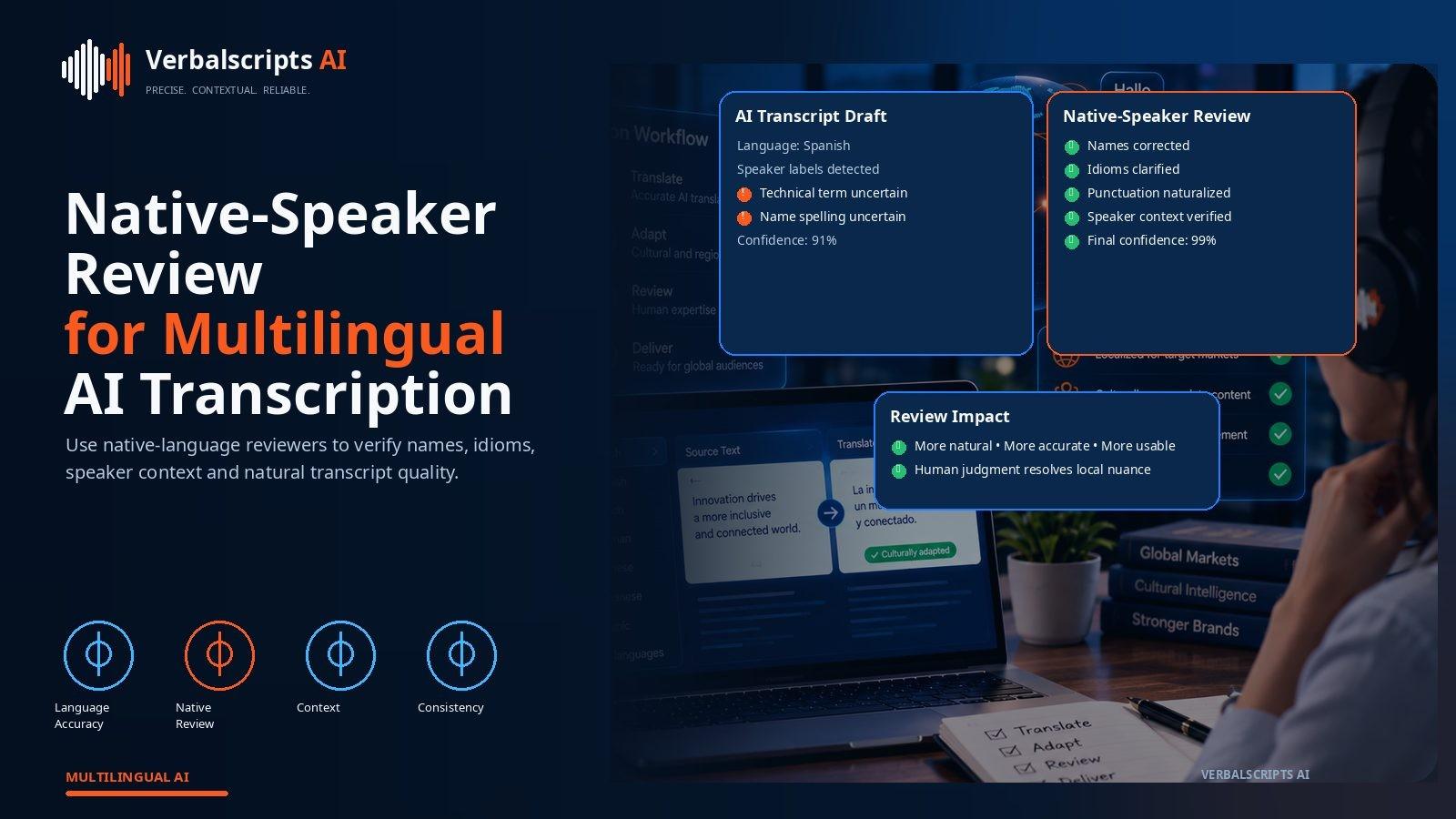
When is native-speaker review valuable for AI transcription? It is most valuable for low-resource languages, regional dialects, code-switched speech, difficult accents, specialized terminology, poor audio and high-stakes recordings. Reviewers should listen to the audio, not merely proofread the transcript, and should follow a written transcript style so they do not “correct” valid dialect forms unnecessarily.
| SEO title | Native-Speaker Review for Multilingual AI Transcription |
|---|---|
| Slug | native-speaker-review-multilingual-ai-transcription |
| Meta description | Learn why native-speaker and in-market review improves multilingual AI transcription for accents, dialects, names, code-switching and low-resource languages. |
| Primary keyword | native speaker transcription review |
| Search intent | Informational / Commercial research |
| Hero image | 183-native-speaker-multilingual-transcription-review.jpg |
| Hero alt text | Native-language reviewer listening to audio and correcting a multilingual AI transcript with speaker and language labels |
| Article body words | 1985 |
For production speech-to-text workflows, see our AI Transcription service for the delivery path behind the guidance in this article.
AI speech recognition has expanded language coverage dramatically, but quality remains uneven across languages, accents, dialects and domains. Native-speaker review adds the local linguistic knowledge needed to recognize real words, names and speech patterns that may be underrepresented in training data.
In multilingual transcription, human review is especially valuable because reviewers can distinguish between a genuine language variety and an ASR error.
For accuracy, reviewer competence and dialect/domain familiarity matter more than a simplistic native/non-native label.
Why target-language knowledge matters
ASR can output a plausible common word when the speaker actually used:
- local name;
- rare dialect word.
A reviewer familiar with language recognizes it.
Listening is mandatory
A transcript reviewer must have access to audio.
Target-only proofreading can fix grammar but cannot know what was spoken.
Review:
- waveform/audio;
- text;
- timestamp.
Names
Native/in-market reviewers know:
- common spellings;
- local places.
Still verify with authoritative metadata.
Do not rely solely on reviewer guess.
Dialect
A reviewer familiar with dialect can avoid “correcting” valid forms.
Example:
Dialect grammar may be systematic.
For research transcript, preserve.
Accent
Strong accent may cause ASR substitutions.
Native reviewer often understands pronunciation pattern.
But a speaker from one region may not understand every other accent.
Match reviewer where possible.
Code-switching
Bilingual reviewers can identify:
- language switch;
- borrowed term.
A monolingual reviewer may distort minority-language words.
For complex language pairs, use multiple reviewers.
Low-resource languages
Research on African low-resource ASR highlights:
- data scarcity;
- linguistic complexity;
- acoustic variability.
Human review can compensate in production while the organization builds better data.
Specialized domain
Native language + domain knowledge.
Medical words may be rare even to ordinary native speaker.
Use:
- clinician;
- legal specialist;
- engineer
when necessary.
Transcript style
Reviewers need policy:
- verbatim;
- clean verbatim;
- punctuation;
- fillers;
- numbers.
Without it, reviewers produce inconsistent transcripts.
Speaker labels
Review:
- diarization;
- names.
If ASR is correct but speaker wrong, transcript can still be unusable.
Timestamps
Correct timestamps make review efficient.
A reviewer can replay uncertain segment.
Do not require searching long files manually.
Confidence-guided review
Use ASR confidence to highlight likely problems.
But also sample high-confidence output.
Confidence can be miscalibrated.
Reviewer correction categories
Tag:
- acoustic recognition;
- name;
- dialect;
- language ID;
- speaker.
This shows model weaknesses.
Review coverage
Options:
Full review
High risk.
Targeted
Low confidence + entities.
Sampling
Stable low risk.
The review policy should reflect error consequence.
Native versus in-market
An in-market reviewer may know:
- current place names;
- slang.
A professional linguist outside market may have stronger formal language.
Choose by project.
Reviewer calibration
Give reviewers:
- same sample;
- style guide.
Compare:
- word choices;
- labels.
Resolve disagreement.
Adjudication
Hard audio may have no clear answer.
Use:
- second listen;
- native experts.
If still unclear, mark [inaudible].
Do not invent.
Reviewer fatigue
Listening review is tiring.
Use manageable:
- audio hours/day;
- breaks.
Fatigue increases missed errors.
Tools
Good review interface supports:
- speed control;
- rewind;
- keyboard shortcuts;
- waveform;
- timestamps.
Productivity affects cost.
Quality metrics
Measure:
- pre-review WER;
- post-review WER;
- edit rate.
High edits in one language may justify:
- model change;
- fine-tuning.
Reviewer feedback as data
With consent/rights, corrections can become:
- evaluation set;
- custom vocabulary;
- training data.
This turns review into improvement.
Privacy
Reviewers hear voices.
Controls:
- access;
- confidentiality;
- no unauthorized download.
Low-resource language reviewer networks can be distributed globally, so security process matters.
Fair compensation
Rare-language reviewers provide scarce expertise.
Plan:
- realistic rate;
- quality incentives.
Poorly compensated review harms both ethics and quality.
Common failures
Normalization bias
Reviewer rewrites dialect.
Name guessing
Reviewer substitutes familiar name.
No audio
Proofreader misses recognition error.
Overreliance confidence
High-confidence errors survive.
Reviewer mismatch
“Native” reviewer lacks relevant dialect/domain.
Native review of language-ID errors
A reviewer can often tell immediately that a segment labeled as Language A is actually Language B or code-switched. The interface should allow the reviewer to change the language label and trigger re-transcription with the correct model.
Simply editing the wrong-model transcript can be inefficient because every word may be distorted. Re-routing the segment first often produces a much better draft.
Building reviewer reference material
For recurring projects, give reviewers:
- participant/name list;
- local place names;
- domain vocabulary;
- known dialect notes;
- style examples.
This is especially valuable for low-resource languages where proper nouns or modern technical terms may be absent from generic ASR training.
Audit samples of reviewed work
Human review itself needs QA. Periodically select completed transcripts and have a second qualified reviewer inspect:
- difficult audio;
- names;
- code-switching;
- style compliance.
Do not use audit results only to grade people. Use them to improve guidelines, tooling and workload.
Measuring human value
Track model output before and after review. Useful language-level metrics:
- WER reduction;
- critical entity corrections;
- time per audio minute;
- percentage of segments accepted unchanged.
If one language requires 10 times more reviewer editing, the data justifies model adaptation or a different provider.
Reviewer capacity for long audio
Listening review is slower than text-only review. Forecast:
- real-time factor;
- audio complexity;
- speaker count.
A reviewer who can check clean lecture audio at 3× playback may need near-real-time listening for noisy code-switched interviews. Capacity planning should reflect the recording type.
Review priorities should reflect error impact
Native-speaker reviewers do not need to spend equal time on every word. Give them a prioritized list:
- names and numbers;
- low-confidence words;
- language switches;
- domain terminology;
- overlapping speech;
- speaker labels;
- ordinary punctuation/style.
This keeps human attention on errors that affect meaning.
Dialect-aware source guidelines
A reviewer needs to know whether the client wants:
- exact dialect transcription;
- standardized spelling;
- normalized grammar.
Without that instruction, reviewers can unintentionally erase legitimate variation. This is especially important in sociolinguistic research and oral history.
A clean business transcript can legitimately normalize speech, but the transformation should be transparent.
Review of proper nouns
ASR systems often struggle with rare names. Native reviewers can use:
- participant roster;
- organization directory;
- geographic gazetteer;
- client terminology list.
They should not “correct” names solely by familiarity. A less common spelling may be the authoritative one.
Low-resource language review program
For a language with weak ASR, start with 100% human review and capture correction data. After several months, analyze:
- percentage of unchanged segments;
- critical-error rate;
- recurring patterns;
- review minutes per audio hour.
If the system becomes stable, reduce review selectively. This is a measured maturity model rather than a one-time decision.
Native reviewer versus professional transcriber
A native speaker understands the language, but professional transcription also requires:
- careful listening;
- punctuation judgment;
- consistent style;
- timestamp discipline;
- handling unclear audio.
Recruit for both language competence and transcription skill. Provide training and calibration.
Quality calibration session
Use a 10–20 minute recording with known difficult areas. Have reviewers independently transcribe it and compare:
- word choices;
- code-switch labeling;
- names;
- unclear marks;
- punctuation.
Discuss differences and update the guide. Repeat when new reviewer cohorts join.
Reviewer escalation options
The interface should support:
- “unclear; second reviewer”;
- “terminology question”;
- “language/dialect uncertain”;
- “speaker attribution uncertain.”
The correct response to uncertainty is escalation or explicit marking, not guessing.
Listening ergonomics
Long audio review requires:
- playback speed;
- loop;
- keyboard shortcuts;
- waveform;
- timecode jump.
A poor tool increases fatigue and cost. Reviewer-interface quality is therefore part of ASR quality operations.
Native review of punctuation and written conventions
ASR punctuation may be acceptable syntactically but not match target-language writing conventions. Reviewers can correct:
- quotation style;
- sentence breaks;
- capitalization;
- paragraphing.
These editorial changes should be distinguished from lexical recognition errors when calculating WER.
Feedback data separation
Keep:
- raw ASR;
- human-corrected transcript;
- normalized client version.
This allows the model team to calculate true ASR errors without treating optional editorial cleanup as recognition failure.
Reviewer security
Native reviewer networks may be distributed globally. Apply:
- role-based access;
- time-limited links;
- confidentiality;
- project segregation.
If a reviewer only needs one file, do not expose the entire client archive.
Measuring reviewer consistency
Use periodic double-reviewed samples. Compare:
- critical-word agreement;
- transcript style;
- unclear marks.
A large discrepancy can indicate either weak guidelines or difficult audio. Investigate before attributing blame.
Reviewer value for model improvement
The most useful correction logs preserve:
- audio segment ID;
- model output;
- approved text;
- error category.
With appropriate rights, this becomes a targeted dataset for:
- custom vocabulary;
- fine-tuning;
- benchmark expansion.
Human review then improves future automation instead of remaining a recurring manual cost.
Reviewer coverage matrix
A multilingual transcription program should know whether every language has:
- at least one primary reviewer;
- one backup reviewer;
- dialect coverage where required;
- domain expertise for specialist projects.
A simple matrix can reveal that the system technically supports 40 languages but only 27 have reliable human fallback. That gap should affect the service tier and published claims.
Review sampling after model improvement
If a new ASR model cuts WER substantially, do not eliminate review immediately. Use a staged reduction:
- full review during initial deployment;
- full review of high-risk audio + 25% random sample;
- full review of high-risk + 5–10% sample;
- stable long-term audit.
Advance only when measured error rates remain within target.
Native review for multilingual names
Names may come from a third language not spoken in the recording. A Swahili interview can mention a Japanese company or Arabic person name. The source-language reviewer may know the speech but not the authoritative spelling.
Use entity metadata or client confirmation. Native review is strong evidence, not universal authority for every proper noun.
Review of transcription normalization
If the client requests normalized numbers, dates or punctuation, keep normalization changes distinguishable from ASR corrections. This helps engineers measure model performance accurately.
For example:
- ASR output: “twenty five dollars”
- normalized client text: $25
This is not an ASR error; it is formatting transformation.
Handling accents within the same language
A native-language reviewer may still struggle with an unfamiliar accent. Maintain escalation to:
- another regional reviewer;
- client subject expert;
- audio clarification.
Do not assume language fluency equals universal accent competence.
Quality notes for unclear speech
Reviewers should mark uncertainty with a defined convention rather than choose the most plausible word. This is particularly important for:
- court evidence;
- research quotes;
- medical records.
An explicit [inaudible] is more trustworthy than a confident invented sentence.
Reviewer learning resources
Maintain a short project reference pack containing:
- top 100 names/terms;
- common ASR mistakes;
- language-switch policy;
- difficult examples.
Update it from real corrections. This improves both speed and consistency.
Review incentives
If reviewers are measured only on speed, they may miss subtle errors. If measured only on edit count, they may over-edit. Use balanced signals:
- quality audit;
- turnaround;
- guideline compliance;
- escalation quality.
Operational incentives affect transcript quality.
Final production principle
Native-speaker review should reduce uncertainty, not hide it. The strongest reviewer is willing to say that a passage cannot be heard reliably, and the strongest workflow has a documented way to represent that result.
Frequently asked questions
Does every transcript need native review?
No. Use risk and measured ASR quality.
Is a native speaker always better than a trained non-native linguist?
Not automatically. Professional skill, dialect familiarity and domain matter.
Should reviewers edit grammar?
Only according to transcript style.
Can reviewers improve future ASR?
Yes if corrections are captured and used appropriately.
What should be reviewed first?
Names, numbers, low-confidence speech, speaker labels and domain terms.
Conclusion
Native-speaker review improves multilingual transcription because speech is local and variable.
Give reviewers the audio, define transcript style and use their expertise where model uncertainty is highest. Capture corrections systematically.
The objective is not to replace ASR with manual transcription. It is to use human linguistic knowledge as a targeted quality layer where multilingual models still have uneven coverage.
Research references
- African Low-Resource ASR review:
- Yoruba tonal ASR:
- Swahili Whisper fine-tuning: