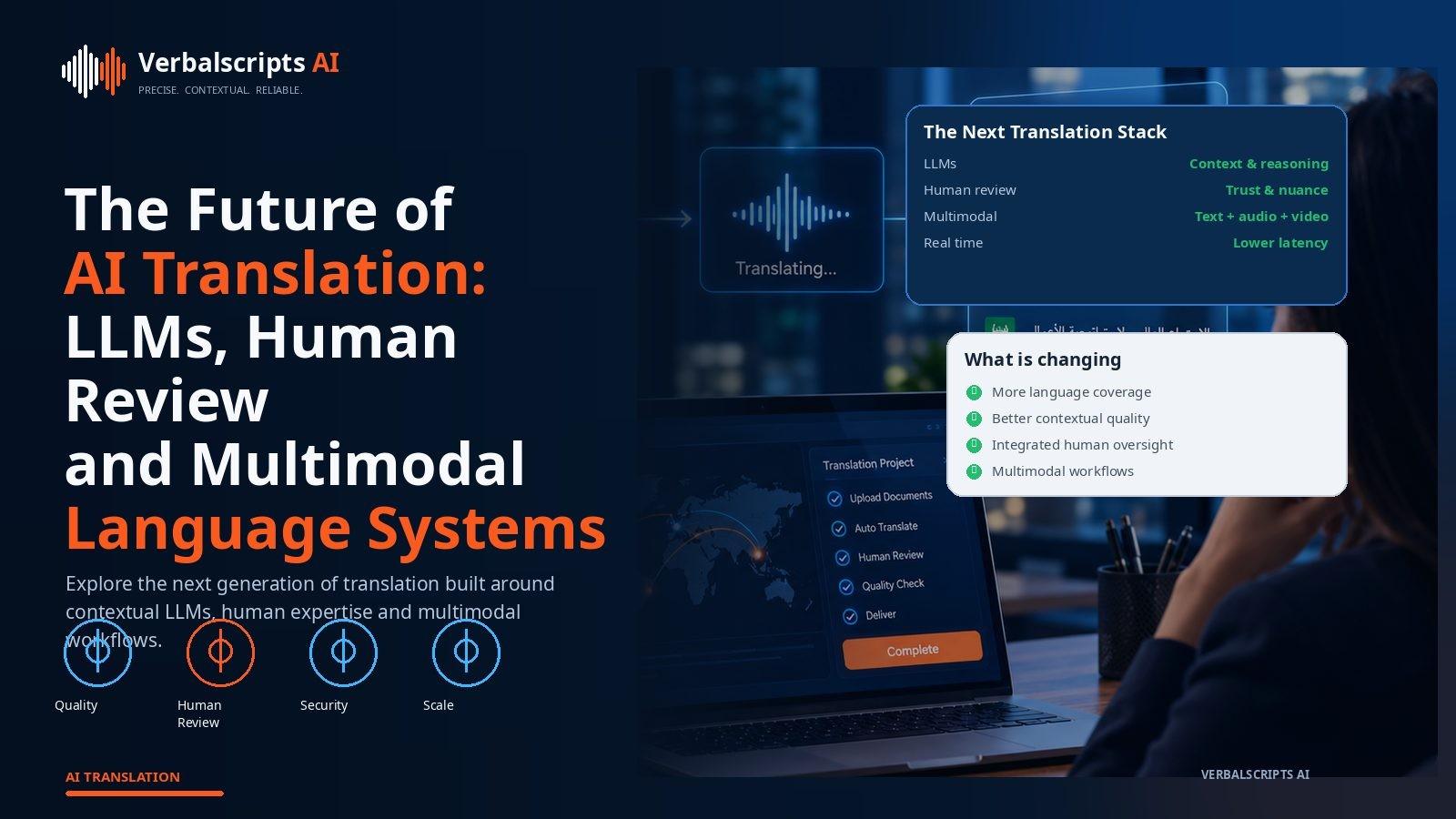
How can low-resource language translation be improved? Use multilingual pretrained models, transfer from related or high-resource languages, carefully curated parallel and monolingual data, synthetic/back-translated data, explicit terminology, and qualified native-speaker review. Benchmark the exact language pair and domain because low-resource performance varies widely. Invest in representative evaluation data before claiming production quality.
| SEO title | Low-Resource Language Translation: AI, Review & Data |
|---|---|
| Slug | low-resource-language-translation-ai-human-review-data |
| Meta description | Learn how low-resource language translation works, why data availability matters, and how multilingual transfer, synthetic data, terminology and human review improve quality. |
| Primary keyword | low-resource language translation |
| Search intent | Informational / Technical |
| Hero image | 197-low-resource-language-translation.jpg |
| Hero alt text | Low-resource translation workflow showing limited parallel data, multilingual transfer, terminology, synthetic data and human review |
| Article body words | 1926 |
For production multilingual workflows, see our AI Translation service for the delivery path behind the guidance in this article.
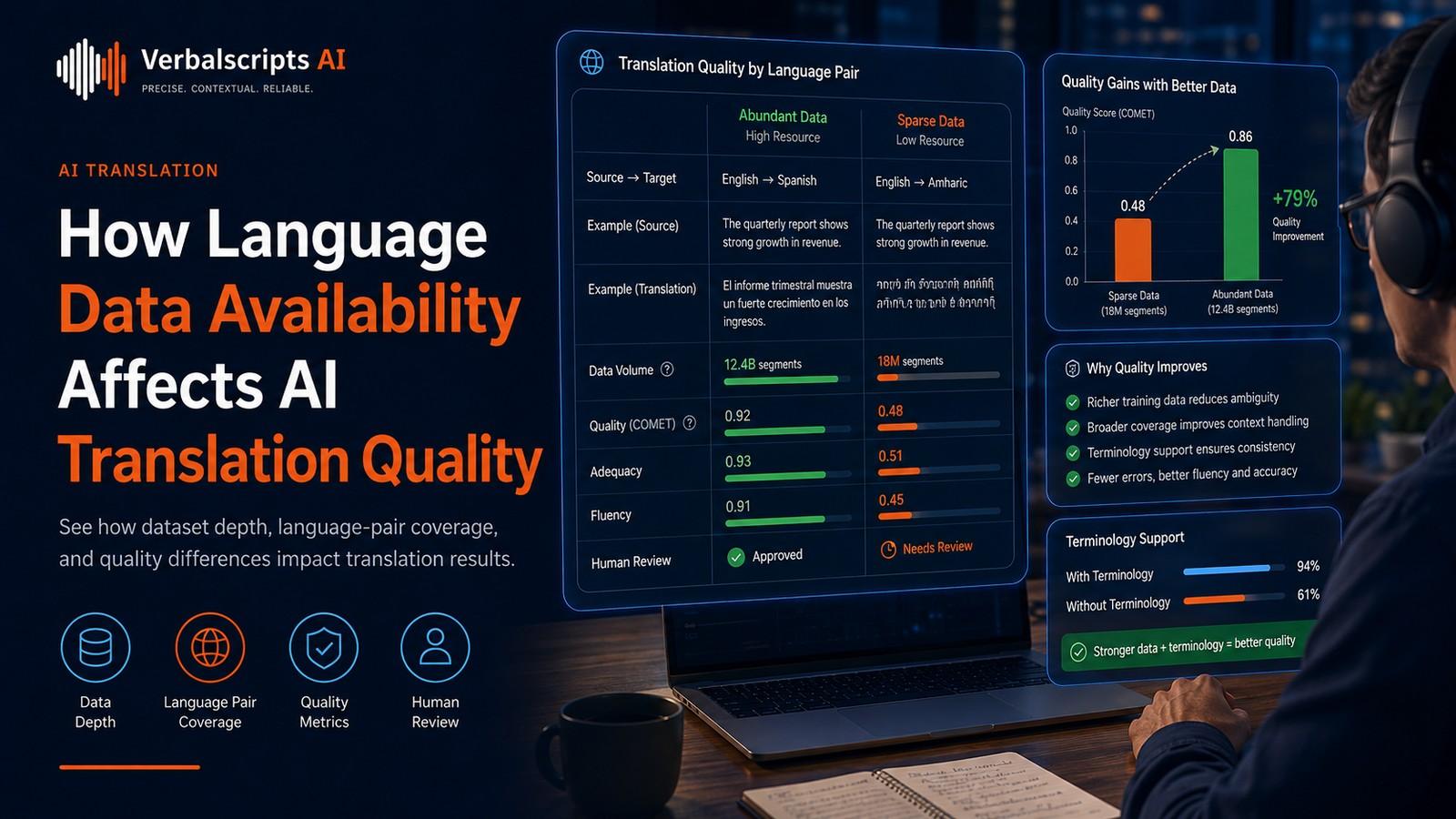
AI translation quality is strongly shaped by data availability.
A high-resource language pair may have hundreds of millions of translated sentence pairs, large monolingual corpora, professional terminology resources and mature benchmarks. A low-resource pair may have only a small collection of religious texts, government documents or automatically mined web data.
Modern multilingual and LLM systems can transfer knowledge across languages, but data imbalance remains a fundamental constraint.
The 2022 Survey of Low-Resource Machine Translation notes that around 7,000 languages are spoken worldwide and almost all language pairs lack significant MT training resources.
Low-resource is pair-specific
A language can have:
- good English parallel data;
- almost no Japanese parallel data.
So:
Language X → English
may be stronger than:
Language X → Language Y.
Resource level belongs to the translation direction/pair and domain.
Parallel data
Parallel corpus:
- source sentence;
- human translation.
This is the classical MT resource.
Quality dimensions:
- alignment;
- translation correctness;
- domain;
- diversity.
Noisy parallel data can hurt.
Monolingual data
Monolingual target text helps models learn:
- fluency;
- vocabulary.
Techniques such as back translation create synthetic parallel pairs.
Low-resource MT research has explored this extensively.
Multilingual pretraining
Models such as mBART and multilingual LLMs transfer representations across languages.
2022 ACL Findings research tested multilingual sequence-to-sequence models across 10 low-resource languages and specifically examined data amount, noise, pretraining coverage, domain mismatch and language typology.
This shows performance depends on more than model size.
Related languages
Closely related languages can provide:
- vocabulary;
- grammar.
Transfer may improve.
But false friends and orthographic differences can create errors.
Human evaluation remains essential.
Pivot translation
When direct pair data is scarce:
A → English → B.
Advantages:
- access to strong English-centered models.
Risks:
- error propagation;
- source nuance lost.
Direct multilingual models can sometimes outperform explicit pivoting.
Benchmark.
Synthetic data
Create:
- back translations;
- generated sentence pairs.
Benefits:
- scale.
Risks:
- model errors become training data;
- synthetic language lacks real variation.
Filter and mix with human data.
Data quality
The 2022 low-resource survey and subsequent multilingual research emphasize that resource quality matters.
Automatically mined web data can contain:
- wrong language;
- misalignment;
- machine translation;
- boilerplate.
Clean before training.
Domain
A general low-resource model may translate common sentences but fail on:
- agriculture;
- health;
- law.
Domain parallel data is often even scarcer.
Use glossary + human specialist.
Terminology
A small approved terminology list can protect high-value concepts even when training data is limited.
For public health, this may include:
- disease names;
- procedure.
A glossary is a practical low-data intervention.
Names
Named entities can be poorly represented.
Use:
- official spellings;
- transliteration lists.
Check target carefully.
Orthography
Some low-resource languages have:
- multiple scripts;
- evolving spelling.
Define target standard.
If users prefer another variety, a “correct” standard translation may still be unsuitable.
Tokenization
Shared multilingual tokenizers can represent low-resource languages inefficiently.
Words may break into:
- many fragments.
This increases sequence length and can weaken lexical modeling.
Model selection should include tokenizer behavior.
Language contamination
Multilingual models can output:
- related language words;
- English.
Check script/language purity.
This is especially visible in low-resource targets.
Hallucination
Low-resource conditions can increase uncertainty.
Monitor:
- unsupported target text;
- omissions.
HalOmi includes language pairs across resource levels and shows these pathologies need multilingual evaluation.
Human review
Native review is often the most important production control.
Reviewers can identify:
- wrong related-language word;
- unnatural standardization;
- missing cultural meaning.
Use domain expertise where needed.
Reviewer scarcity
Low-resource languages may also have fewer professional linguists.
Build:
- community reviewer programs;
- training;
- clear guidelines.
Compensate expertise fairly.
Evaluation data
A small high-quality benchmark is critical.
Include:
- real domain content;
- difficult terms;
- cultural items.
Do not evaluate only on translated English benchmark datasets.
Automatic metrics
COMET and LLM judges may have weaker calibration on underrepresented languages.
Validate with humans.
A metric trained mainly on high-resource pairs can mis-rank.
Community data governance
Data creation should involve speakers.
Questions:
- consent;
- licensing;
- ownership;
- benefit sharing.
The objective is language technology that serves the community.
Incremental improvement
A practical enterprise workflow:
- baseline model;
- native review;
- capture corrections;
- build termbase;
- expand benchmark;
- customize model if justified;
- reduce review only after measured improvement.
This turns production into data development.
Avoid exaggerated coverage claims
“Supports 150 languages” means the model can output them.
It does not prove:
- equal accuracy;
- domain readiness.
Publish language-specific quality where possible.
Evaluation before model customization
Do not jump immediately to fine-tuning. First identify whether errors are concentrated in:
- terminology;
- named entities;
- style;
- general grammar.
If 80% of errors are terminology-related, a glossary and human review may be faster and cheaper than custom training.
Fine-tune when the base model shows broader systematic weaknesses that examples/terminology cannot control reliably.
Building translation references
For a low-resource benchmark, have qualified human translators create references from representative source content. Use:
- clear guidelines;
- domain experts;
- second review.
One poor reference can make both model and automatic metric evaluation misleading.
Where multiple valid formulations are common, human adequacy scoring can supplement one-reference metrics.
Tokenizer audit
Inspect how the model tokenizes:
- common words;
- long morphologically rich words;
- punctuation;
- native script;
- names.
If ordinary target words become many rare fragments, inference can be less efficient and language modeling weaker.
Tokenizer inefficiency is a useful model-selection signal.
Domain adaptation through retrieval
For organizations without enough data to fine-tune, retrieval can provide:
- approved terminology;
- previous translations;
- reference passages.
This lets a general multilingual model use domain context without changing model weights.
Evaluate whether retrieval improves accuracy or merely encourages copying.
Human-review capacity as launch criterion
A language should not launch into high-risk production solely because the model produces output. Ensure:
- a qualified reviewer exists;
- escalation exists;
- glossary owners exist.
This creates a safe fallback while model performance matures.
Error reporting by type
For low-resource targets, distinguish:
- related-language contamination;
- untranslated source;
- grammar;
- terminology;
- hallucination;
- cultural mismatch.
Different error profiles require different interventions.
Long-term language asset strategy
Build and retain, where rights allow:
- gold evaluation set;
- termbase;
- style guide;
- reviewed source-target corpus.
These assets remain useful even when the underlying model changes.
Final principle
Low-resource translation should be treated as a program of progressive evidence. Start with a benchmark, deploy with strong review, capture corrections and reduce human intervention only when the data proves the workflow is stable.
Data collection priorities for low-resource MT
If the organization can fund only one type of new language resource, choose based on error analysis.
Possible investments:
- parallel corpus when semantic mapping is broadly weak;
- monolingual target text when fluency/grammar is weak;
- glossary when domain terms are the main problem;
- human evaluation set when you cannot reliably measure quality;
- culture-aware examples when local references repeatedly fail.
The best data is the data that addresses the measured bottleneck.
Community and domain experts
For a health translation project in a low-resource language, a general native speaker may not know the accepted local medical terminology. Pair:
- language expert;
- clinician/community health expert.
The final target must be both linguistically natural and clinically accurate.
Orthography choice and user acceptance
Some communities use multiple spelling systems or scripts. A translation engine may output a standard taught in schools while users prefer another variety in digital communication.
Decide the target orthography with community/market stakeholders and document it in the locale guide. Model quality should be evaluated against that target.
Reference-free quality estimation risks
When human references are scarce, reference-free metrics are attractive. But low-resource languages may be underrepresented in the evaluator itself.
Calibrate the metric on a small human-reviewed sample before using it to auto-approve output.
Pivot versus direct evaluation
If using A→English→B pivoting, compare:
- direct multilingual model;
- pivot system.
Evaluate not only average quality but:
- omissions;
- names;
- cultural terms.
The pivot route can lose distinctions in the intermediate language.
Machine contamination in web corpora
For some languages, a significant portion of online “parallel” text may itself be machine translated. Training repeatedly on synthetic targets can reinforce unnatural language.
Track data provenance and prefer human/curated sources for benchmarks and high-value adaptation.
Human-review style for low-resource targets
Avoid over-standardizing natural local language to mirror a high-resource source. Reviewers should follow a target-language style guide created for users, not a source-language template.
This is especially important when the AI already tends to produce source-like translationese.
Model routing policy
A low-resource target may use:
- strongest LLM;
- specialized provider;
- human-led translation.
Do not force it through the same cheap model used for high-resource internal content solely for platform simplicity.
Language launch checklist
Require:
- target orthography decided;
- critical termbase;
- native reviewer;
- benchmark;
- error threshold;
- security/data policy.
These basics make a low-resource language launch more trustworthy.
Final principle
The responsible objective is not to minimize human involvement as fast as possible. It is to build enough high-quality local evidence that automation can increase safely without lowering the language experience for users.
Benchmark maintenance
Keep a small permanent set of difficult target-language examples (names, morphology, rare senses and culturally specific content) and run it whenever the provider, prompt, glossary or tokenizer changes. Low-resource quality can shift noticeably after changes optimized for larger languages.
A stable regression set gives the team an early warning before the change reaches customers.
Commercial planning
Because reviewer effort may remain higher, budget low-resource translation by approved output cost, not raw model cost. A slightly more expensive model that cuts native-review time can be the better operational choice.
Track reviewer minutes and critical-error rate by language so investment decisions are evidence-based.
Implementation takeaway
For production use, treat representative human references, related-language contamination and review capacity as measurable parts of the workflow rather than assumptions. Define the relevant policy before processing content, keep the model or data configuration versioned, and verify results on representative material from the actual language, locale and domain. If automation produces a result that conflicts with a deterministic rule, authoritative terminology or qualified human evidence, escalate the item instead of averaging the disagreement away. The most durable multilingual systems preserve source-to-target traceability, record exceptions and feed reviewed corrections back into benchmarks, glossaries or routing rules. That discipline makes quality improvements reproducible when models, providers, reviewers or source content change.
Frequently asked questions
Are low-resource languages impossible for AI translation?
No. Modern multilingual models can be useful even with limited direct data, but quality varies and often needs stronger review.
What is the most valuable resource?
High-quality, representative parallel/evaluation data plus native expertise.
Does synthetic data replace human translation data?
No. It supplements it.
Is pivoting through English always bad?
No. It can be effective when direct resources are weak, but evaluate error propagation.
How should companies launch low-resource languages?
Pilot with native reviewers, build terminology and collect quality data before scaling.
Conclusion
Low-resource translation is not solved by one model upgrade.
Multilingual pretraining and synthetic data provide powerful transfer, but target-language data, terminology and human judgment remain critical. The most responsible strategy is to measure the actual language pair, invest in high-quality local resources and scale automation only as evidence supports it.
Research references
- Haddow et al., Survey of Low-Resource Machine Translation:
- Lee et al., Multilingual sequence-to-sequence models for low-resource MT:
- Nicolai et al., Multi-parallel low-resource MT:
- Yu et al., Multilingual dataset construction/resources:
- HalOmi: