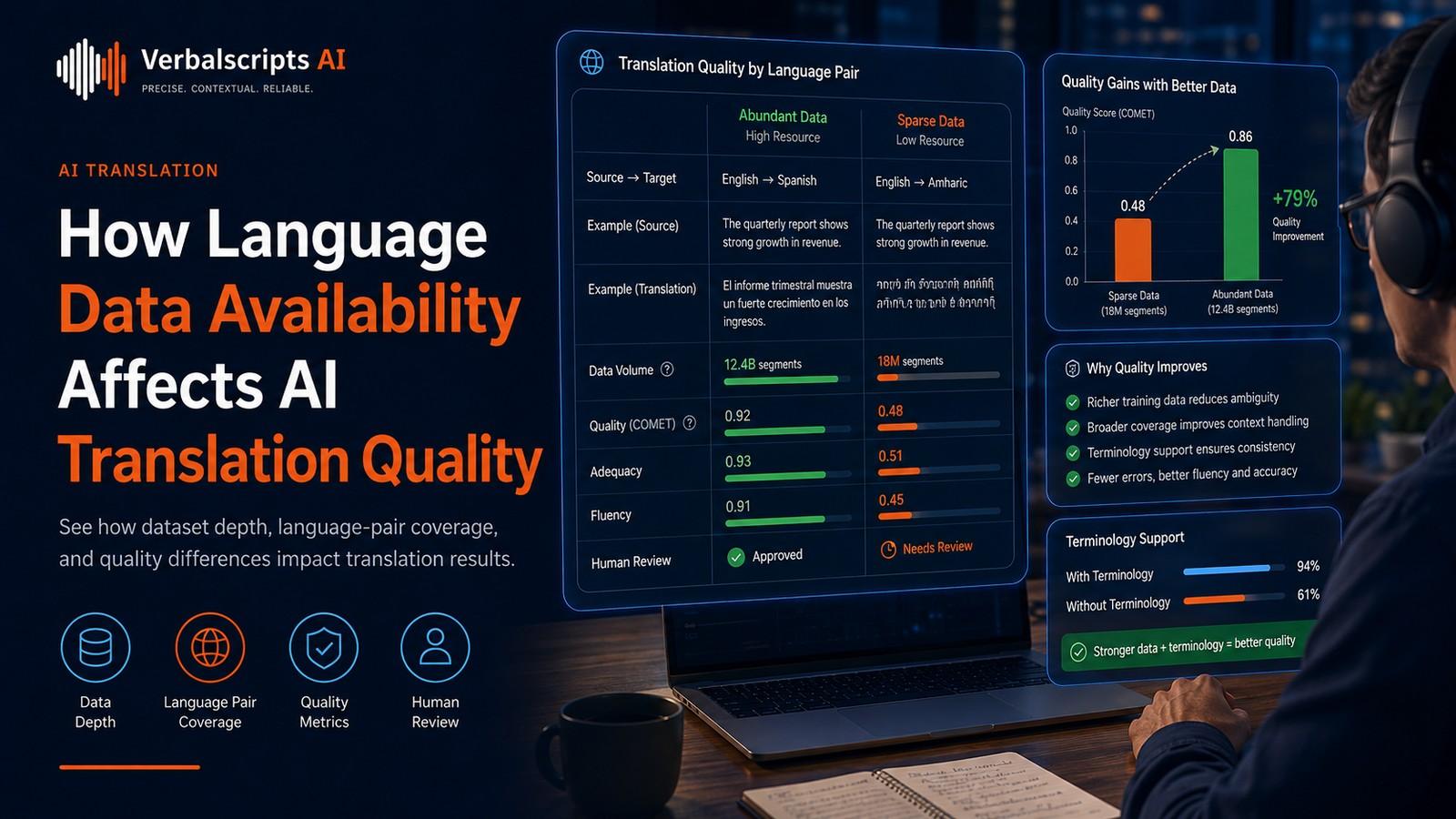
How does language data availability affect AI translation quality? High-quality parallel data teaches direct source-target mappings, monolingual data strengthens target-language fluency, domain data improves terminology and multilingual pretraining transfers knowledge from richer languages. When data is scarce, noisy or mismatched, models are more likely to produce mistranslations, source-language interference and terminology errors. Synthetic data and cross-lingual transfer help, but representative human evaluation remains essential.
| SEO title | How Language Data Availability Affects AI Translation Quality |
|---|---|
| Slug | language-data-availability-ai-translation-quality |
| Meta description | Learn how parallel data, monolingual data, domain coverage, quality, multilingual transfer and evaluation resources affect AI translation quality. |
| Primary keyword | language data translation quality |
| Search intent | Informational / Technical |
| Hero image | 199-language-data-ai-translation-quality.jpg |
| Hero alt text | Machine translation data dashboard comparing parallel corpus size, domain coverage, terminology and target-language quality |
| Article body words | 1925 |
For production multilingual workflows, see our AI Translation service for the delivery path behind the guidance in this article.
Machine translation is often described as a model problem, but model quality is inseparable from language data.
A system learns how languages correspond from combinations of parallel translations, monolingual text, multilingual pretraining and human preference/evaluation data. The distribution is highly uneven: some languages have enormous web and professional translation corpora, while many others have little aligned data at all.
That imbalance affects vocabulary, terminology, fluency, cultural knowledge and evaluation confidence.
The 2022 low-resource MT survey notes that almost all of the world’s language pairs lack significant parallel resources.
Parallel data
Parallel text is aligned translation.
Example:
English sentence ↔ Swahili translation.
It teaches:
- lexical equivalence;
- grammar reordering;
- idioms;
- terminology.
The quality of the translation pairs matters.
Quantity
More diverse high-quality parallel data usually improves:
- coverage;
- rare structures.
But returns diminish.
Billion-sentence noisy corpora can contain significant artifacts.
Alignment quality
Web-mined parallel data can be misaligned.
Examples:
- source sentence paired with unrelated target;
- partial translations.
Alignment noise teaches incorrect associations.
Use quality filtering.
Human versus machine-translated data
A corpus may include machine-generated target text.
This can be useful synthetic data.
But if not labeled/filtered, model may learn:
- translationese;
- errors.
Dataset provenance matters.
Domain
A general corpus may not contain:
- legal terms;
- medical procedures.
Domain-specific data improves:
- terminology;
- phrase patterns.
A small high-quality in-domain corpus can be highly valuable.
Monolingual target data
Target-language text teaches:
- fluency;
- collocations;
- style.
Back translation can convert monolingual text into synthetic parallel data.
This is a standard low-resource technique covered extensively in the low-resource MT literature.
Source monolingual data
Source-only text can also support:
- language representation;
- synthetic forward translation.
Value depends on architecture.
Multilingual pretraining
Large multilingual models learn shared representations.
Low-resource languages can benefit from high-resource neighbors.
But transfer is uneven.
The ACL 2022 study of pre-trained multilingual seq2seq models found performance depends on:
- fine-tuning data amount;
- noise;
- pretraining language coverage;
- domain mismatch;
- typology.
This directly connects data availability with translation quality.
Pretraining representation
A language can exist in a multilingual model but receive tiny pretraining share.
A language tag alone does not show coverage.
Evaluate real output.
Related-language transfer
Transfer may work well for:
- related languages.
But can cause:
- vocabulary contamination.
The model may output words from a close high-resource language.
Native review detects this.
Typological distance
Languages that differ substantially in:
- morphology;
- word order
can require more direct evidence.
The 2024 TACL morphosyntactic-divergence study shows structural divergence remains challenging for MT.
Tokenization data
Shared tokenizer learns vocabulary from training corpora.
High-resource languages may get:
- efficient tokens.
Low-resource scripts can fragment.
This raises:
- sequence length.
Tokenizer coverage is part of data equity.
Terminology data
Parallel corpora may not contain product-specific terms.
A glossary provides direct control without retraining.
Termbase quality is data availability too.
Named entities
Names change rapidly.
Training data is always incomplete.
Use:
- entity databases;
- retrieval.
Model pretraining cannot know every new product/person.
Cultural data
Models need examples of culturally specific references.
ACL 2026 culture-aware MT research demonstrates that cultural knowledge and correct translation use remain distinct challenges. Human references improve evaluation. This means cultural translation quality also depends on representative cultural data.
Noise
Types:
- wrong language;
- OCR;
- encoding;
- duplicate.
Data cleaning can yield large improvement.
Measure data quality, not only row count.
Deduplication
Duplicate content can:
- overweight sources;
- contaminate test.
Deduplicate exact and near-duplicate pairs.
Benchmark contamination
If evaluation set appears in training, scores are inflated.
Use private business benchmark.
Evaluation data
A low-resource language often lacks professional references and human quality data.
Then model and metric quality are hard to measure.
Invest in high-quality evaluation sets.
Synthetic data
Benefits:
- scale;
- domain.
Risks:
- feedback loop;
- artificial style.
Use filtering and mix with human data.
Back translation
Back-translated target monolingual data is a classic synthetic technique.
It can improve low-resource MT but the generator quality matters.
Multi-parallel data
The same content translated into several related languages can support multilingual transfer.
2022 COLING work on very low-resource Indigenous North American languages found gains from multilingual pretraining and strategic addition of monolingual data in a multi-parallel setting.
The result is context-specific but illustrates the potential.
Fine-tuning data size
Small supervised fine-tuning can adapt a multilingual model.
But noisy small data can harm.
Quality control is critical.
Human correction data
Post-edited translations are highly valuable.
They represent:
- real model errors;
- approved target.
Use for:
- evaluation;
- retrieval;
- training if rights allow.
Style data
If brand voice matters, provide:
- approved examples.
A model cannot infer proprietary style from public data.
Data freshness
New terminology:
- products;
- regulation.
Pretrained model can be stale.
Retrieval/glossary updates are faster than retraining.
Data governance
Track:
- source;
- license;
- consent;
- language.
The 2022 multilingual dataset survey warns that counting datasets alone can misrepresent true resources because quality and construction methods differ.
Data provenance for parallel corpora
For every source-target corpus, record:
- origin;
- license;
- human/machine translation;
- alignment method;
- domain;
- language/locale;
- quality filtering.
Without provenance, teams cannot explain why a model learned a strange terminology pattern or whether a corpus can legally be reused.
Parallel-data diversity
A million sentence pairs from one government domain may be less useful for general customer translation than a smaller corpus spanning:
- conversation;
- product;
- support;
- news.
Match data diversity to intended use.
Human translation style
Human references can contain their own “translationese” or outdated terminology. Data curation should not assume every professional translation is equally useful forever.
Refresh:
- product terms;
- market style.
Synthetic-data filtering
When generating synthetic parallel data, filter for:
- language correctness;
- semantic consistency;
- duplication;
- length anomalies.
Consider using a different model or quality estimator for filtering to reduce self-reinforcing errors.
Cross-lingual transfer analysis
When a low-resource language improves after adding related-language data, test for contamination. Create examples containing false friends and target-specific grammar.
Transfer is valuable only if the model remains faithful to the target language.
Data weighting by domain
Enterprise custom models may need:
- 70% general;
- 30% domain,
or another mixture.
Tune based on validation rather than simply adding every in-domain sentence with equal weight.
Evaluation-set governance
Keep the benchmark separate from:
- training;
- prompt examples;
- retrieval corpora where practical.
If the model sees the exact benchmark during customization, measured performance becomes optimistic.
Human preference and post-edit data
Reviewer corrections can be richer than raw reference translations because they reveal where the deployed model fails.
Store:
- model output;
- correction;
- error reason.
This supports both quality evaluation and targeted adaptation.
Data gaps as a product roadmap
A dashboard can show:
- language pair;
- domain;
- benchmark size;
- term coverage;
- reviewer availability.
These gaps should inform language expansion decisions. A language with no reliable evaluation data is not ready for unattended high-risk automation.
Final principle
Language data is not fuel measured only by volume. It is structured evidence about how meaning is expressed. Provenance, representativeness and quality determine how much value a corpus contributes to translation.
Parallel-data alignment checks
Use automated alignment scores to identify pairs where:
- source much longer than target;
- languages wrong;
- semantic similarity low.
Then human-sample the lowest-scoring buckets. Removing misaligned pairs can improve training more than adding another equally noisy web source.
Domain tags
Store domain labels with training data:
- legal;
- medical;
- support;
- news.
This supports:
- balanced sampling;
- domain adaptation;
- analysis.
A model team can then see whether a domain is underrepresented.
Locale specificity in data
French Canadian and France French data should not be treated as identical when market-specific terminology matters. Tag region/locale where known.
The model can still share language knowledge, while evaluation and retrieval choose the right market forms.
Cultural reference coverage
A parallel corpus can be large but culturally narrow. Include local:
- institutions;
- foods;
- holidays;
- social roles.
For culture-aware translation, human references and review are particularly important because automatic data mining may not capture the correct adaptation strategy.
Translation memory as high-quality data
Approved enterprise TM is often more valuable than scraped web parallel data because it contains:
- domain;
- product terminology;
- human corrections.
Clean it:
- remove obsolete entries;
- deduplicate;
- respect client rights.
Then use it for retrieval or adaptation.
Data contamination between clients
A managed service should not use one client’s proprietary translations to improve another client’s system without authorization. Maintain tenant boundaries for:
- TMs;
- termbases;
- fine-tuning data.
Language data can contain confidential business knowledge.
Evaluating data additions
When adding a corpus, run an ablation:
- baseline model;
- baseline + new data.
Compare on:
- general benchmark;
- target domain;
- critical challenge set.
If domain improves but general quality degrades, adjust sampling rather than assuming more data is automatically better.
Data versioning
Assign dataset versions. Model records should list exact versions used.
This allows reproducibility and helps diagnose why a later model behaves differently.
Human data quality feedback
Reviewers can mark source pairs in adaptation data as:
- poor source;
- poor reference;
- obsolete terminology.
Do not treat the training corpus as immutable. Curating language data is an ongoing quality process.
Final principle
Translation models learn the patterns the data makes available. If the corpus is misaligned, culturally narrow or dominated by one domain, the model will reflect those limitations no matter how sophisticated the architecture is.
Final data-quality rule
Every new corpus should earn its place through measurable benefit. If adding it does not improve the relevant benchmark (or introduces regressions), adjust its weight, clean it further or exclude it rather than assuming volume is inherently valuable.
A disciplined data program measures evidence before scale.
Implementation takeaway
For production use, treat corpus provenance, domain weighting, synthetic-data filtering and private evaluation as measurable parts of the workflow rather than assumptions. Define the relevant policy before processing content, keep the model or data configuration versioned, and verify results on representative material from the actual language, locale and domain. If automation produces a result that conflicts with a deterministic rule, authoritative terminology or qualified human evidence, escalate the item instead of averaging the disagreement away. The most durable multilingual systems preserve source-to-target traceability, record exceptions and feed reviewed corrections back into benchmarks, glossaries or routing rules. That discipline makes quality improvements reproducible when models, providers, reviewers or source content change.
Frequently asked questions
Is parallel data more important than model size?
Both matter, but high-quality language-pair/domain data can be decisive, especially in low-resource settings.
Can monolingual data improve translation?
Yes, through multilingual pretraining and synthetic-data methods such as back translation.
Does noisy data always hurt?
Sufficiently noisy or misaligned data can reduce quality; filtering is important.
Can synthetic data replace human data?
It supplements rather than fully replaces representative human-quality data.
What should companies collect first?
A high-quality evaluation set, glossary and reviewed production examples.
Conclusion
Translation quality grows from the language data ecosystem.
Parallel corpora teach mapping, monolingual text teaches fluency, domain resources teach terminology and human evaluation data tells you whether the system works.
Large multilingual models make transfer possible, but they do not erase resource inequality. Better data remains one of the most reliable ways to improve translation quality.
Research references
- Haddow et al., Survey of Low-Resource MT:
- Lee et al., Multilingual pretraining for low-resource MT:
- Nicolai et al., Multi-parallel low-resource translation:
- Luo et al., Morphosyntactic divergence (TACL 2024):
- Yu et al., Multilingual dataset construction: