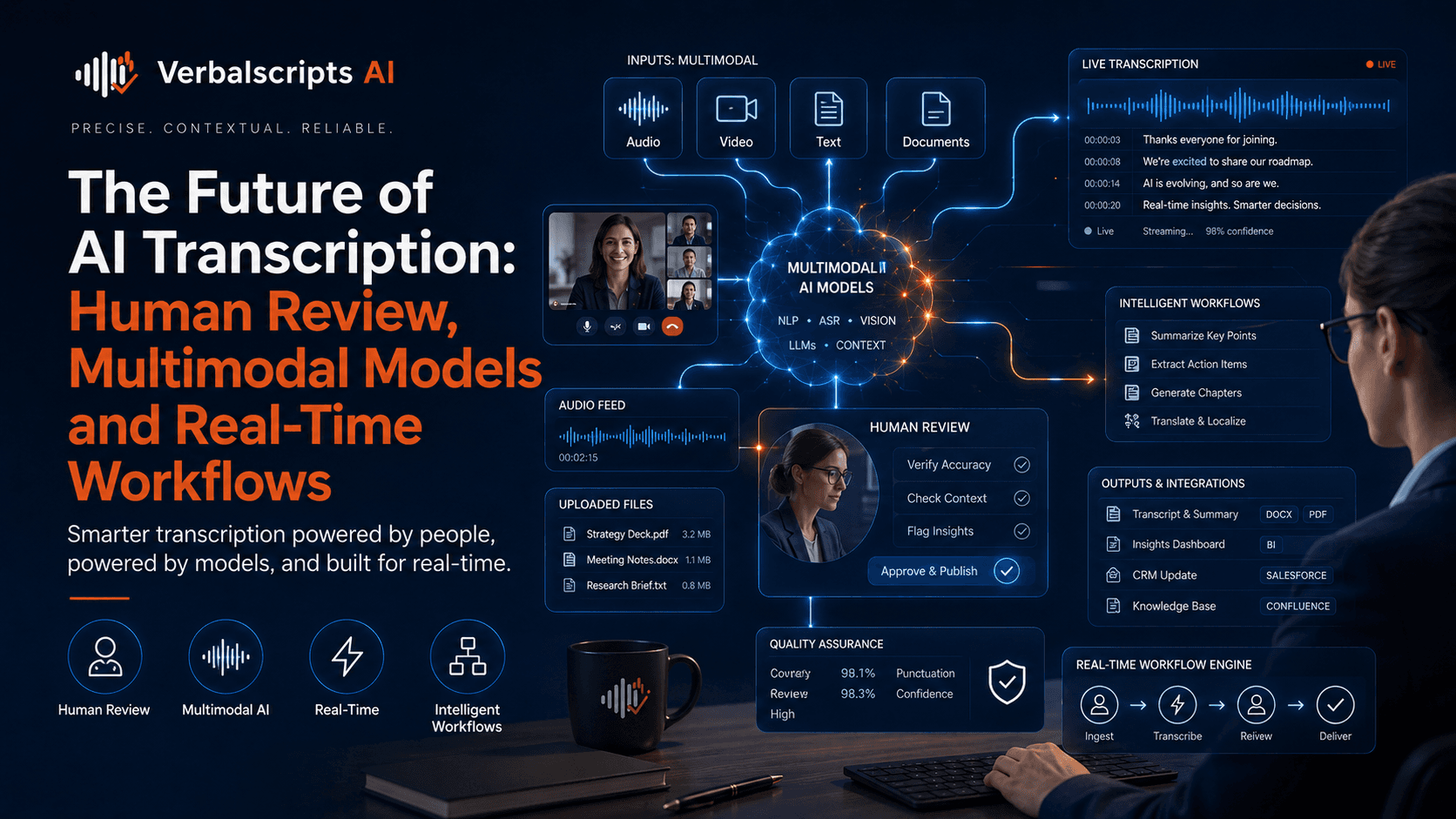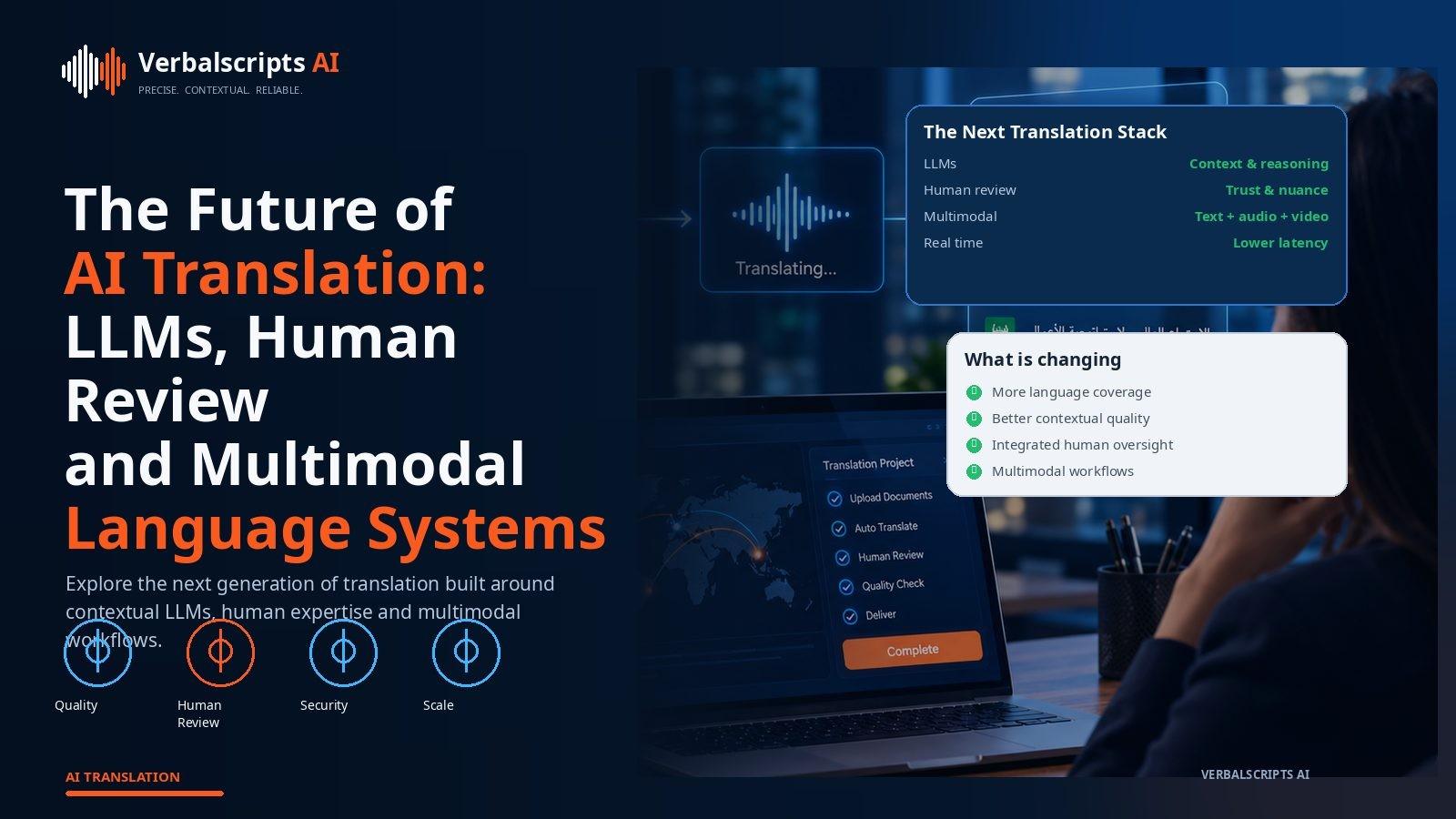
What is the future of AI translation? Translation systems will increasingly combine text, speech and visual context in unified multilingual models; use LLMs for context and controllability; deliver lower-latency speech translation; and integrate automated quality evaluation. Human experts will shift from translating every segment manually toward terminology, high-risk verification, cultural judgment and system governance. Progress will remain uneven across languages, particularly low-resource and culturally complex settings.
| SEO title | Future of AI Translation: LLMs, Human Review & Multimodal AI |
|---|---|
| Slug | future-ai-translation-llms-human-review-multimodal |
| Meta description | Explore the future of AI translation across LLMs, speech, multimodal systems, low-resource languages, real-time translation, evaluation and human review. |
| Primary keyword | future of AI translation |
| Search intent | Informational / Thought leadership |
| Hero image | 170-future-ai-translation-multimodal.jpg |
| Hero alt text | Future multilingual AI system connecting text, speech, video and human review across many languages |
| Article body words | 2066 |
For production multilingual workflows, see our AI Translation service for the delivery path behind the guidance in this article.
AI translation is moving from a specialized text function toward a general multilingual interface between people, documents, audio, video and software.
Large language models have expanded the ability to use document context, follow terminology instructions and adapt style. Multimodal speech systems are reducing the boundaries between transcription, translation and voice. At the same time, research continues to show difficult gaps in hallucinations, culture-aware translation, low-resource languages and reliable evaluation.
The future is therefore not “translation solved.” It is translation becoming more integrated, contextual and governed.
The next generation of translation is a workflow, not merely a model.
From NMT to LLMs
Neural machine translation made end-to-end translation dominant.
LLMs add:
- broad context;
- instruction following;
- reasoning-like capabilities;
- style control.
They can be asked to:
- use a glossary;
- preserve legal modality;
- translate for a specific locale.
This makes them flexible.
LLM challenges
Research continues to identify weaknesses:
- hallucination;
- over-translation;
- low-resource variability;
- benchmark contamination;
- cost/latency.
A 2025 TACL paper evaluating LLMs for MT notes strong performance but also persistent challenges and the need for rigorous evaluation.
Document-level translation
Future systems will increasingly understand:
- previous paragraphs;
- entities;
- terminology;
- document purpose.
This should improve:
- consistency;
- pronouns;
- ambiguity.
Evaluation also needs to become document-level.
Multimodal translation
A multimodal system can process:
- speech;
- text;
- visual context.
Meta’s SeamlessM4T research presented a massively multilingual multimodal translation model supporting speech-to-speech, speech-to-text, text-to-speech and text-to-text in a unified system.
This architecture points toward a future where separate transcription and translation APIs are less visible to the user.
Speech-to-speech
Real-time speech translation will become more natural.
Future improvements include:
- lower latency;
- better voice preservation;
- expressive prosody;
- stronger multilingual recognition.
Meta’s Seamless Communication research explores expressive and streaming speech translation.
Voice and authenticity
As speech translation preserves speaker characteristics, governance becomes more important.
Questions:
- speaker consent;
- disclosure;
- voice identity;
- misuse.
A technically impressive translated voice can blur whether the speaker actually said those words in that language.
Video translation
Multimodal models can use:
- visual objects;
- on-screen text;
- scene.
This can improve translation of ambiguous spoken language.
Future systems may localize:
- subtitles;
- graphics;
- voice
in one coordinated workflow.
Low-resource languages
Multilingual models can transfer knowledge across languages.
But low-resource translation remains difficult.
The 2022 low-resource MT survey emphasizes that almost all language pairs lack substantial parallel resources.
Recent 2026 work also cautions that general LLM progress does not automatically solve low-resource machine translation.
Data investment remains important.
Language data as infrastructure
Organizations and communities will need:
- high-quality corpora;
- terminology;
- speech;
- evaluation sets.
Model architecture alone cannot compensate for missing language coverage indefinitely.
Culture-aware translation
Future quality systems will evaluate culture explicitly.
ACL 2026 research shows models can recognize culture-specific knowledge but still fail to translate it appropriately.
Culture will become:
- benchmark dimension;
- review rubric.
Personalization
Translation could adapt to:
- organization glossary;
- reader level;
- preferred formality.
Enterprise systems will use retrieval of:
- approved translations;
- style guides.
Personalization must be controlled to avoid inconsistent meaning.
Adaptive translation
Cloud platforms increasingly support adaptive/custom translation methods.
Rather than retraining a complete model, systems can use:
- examples;
- terminology;
- context.
This lowers customization friction.
Agentic localization
AI agents may coordinate:
- source changes;
- terminology retrieval;
- translation;
- QA;
- reviewer routing;
- publishing.
The challenge becomes governance of the entire workflow.
Agents should not autonomously publish high-risk changes without appropriate approval.
Automatic evaluation
Evaluation will increasingly use:
- learned metrics;
- LLM judges;
- deterministic checks.
WMT metric research already tests metrics on high-quality LLM translation because older metrics struggle to distinguish subtle errors.
Translation quality estimation
Reference-free QE can help predict which segments need humans.
This enables:
- risk-based review.
The ideal system spends human effort only where expected value is high.
Human role evolves
Humans will focus more on:
- terminology;
- domain verification;
- culture;
- policy;
- training/evaluation data;
- edge cases.
Professional language expertise becomes supervisory and system-level.
Human review remains necessary
Why?
Because:
- models can be confidently wrong;
- accountability;
- contextual ambiguity;
- high-risk decisions.
The level of human intervention will vary.
Real-time collaboration
Meetings will increasingly support:
- multilingual speech recognition;
- live translated captions;
- voice translation.
Language barriers will become less visible in synchronous work.
Latency and code-switching remain challenges.
Translation embedded everywhere
Translation will become part of:
- CRM;
- support;
- productivity tools;
- media players.
Users may not think of it as a separate translation product.
Data governance
Embedded translation processes:
- customer conversations;
- sensitive documents.
Enterprise programs need:
- retention;
- regional controls.
Translation becoming invisible should not make data governance invisible.
Cost trend
Raw translation cost will likely continue to fall per unit for common languages due to competition and efficiency.
However, total spending may increase because organizations translate:
- more content;
- more languages.
Human specialist review will remain valuable for high-risk material.
Quality differentiation
When average fluency becomes commoditized, providers will differentiate on:
- reliability;
- terminology;
- security;
- workflow;
- human review;
- low-resource coverage.
The model is only one layer.
Standards and interoperability
Localization assets need portable:
- language tags;
- glossaries;
- translation memories.
Standards such as BCP 47 and Unicode remain foundational even in generative workflows.
What buyers should prepare now
Build:
- clean source content;
- termbase;
- style guides;
- benchmark sets;
- risk policy;
- review network.
These assets work across model generations.
What not to do
Do not wait for a “perfect” model while keeping:
- messy source;
- no terminology;
- no evaluation.
Better operational data creates immediate gains.
Five likely shifts
- LLM + specialist MT hybrid routing.
- Multimodal speech/text/video systems.
- Automated LLM-based QA.
- Human review focused on risk.
- More investment in low-resource data.
Near-term versus longer-term changes
In the near term, the biggest practical gains are likely to come from better orchestration around existing strong models:
- context retrieval;
- terminology;
- automatic QA;
- human routing;
- multimodal input.
Longer term, unified models may reduce the visible boundaries between ASR, translation and speech synthesis. Even then, enterprises will still need structured source/target records for auditability and content reuse.
Evaluation will become a competitive layer
As raw translation quality converges for common languages, the ability to detect rare but consequential errors becomes more valuable. Providers will differentiate through:
- quality estimation;
- domain benchmarks;
- human-review networks;
- transparent reporting.
A model that is slightly better on average but impossible to govern may be less useful than one integrated into a strong quality system.
More language coverage will expose evaluation gaps
Adding low-resource languages is not only a model-training challenge. It requires:
- native evaluators;
- terminology;
- benchmarks;
- cultural data.
The industry will need investment in evaluation infrastructure for underrepresented languages, not only new pretraining corpora.
Human experts as data stewards
Professional translators and language experts will increasingly curate:
- termbases;
- style guides;
- gold benchmarks;
- corrections;
- cultural policies.
These assets make AI behavior organization-specific. The human role shifts from generating every sentence manually toward defining and validating the multilingual system.
Multimodal governance
When the same model can translate text, speech and video, access boundaries become more complex. A video may contain faces, voices and on-screen confidential data simultaneously.
Future translation governance must therefore integrate:
- media privacy;
- voice consent;
- document security;
- model evaluation.
Multimodal capability makes workflow design more important, not less.
The likely future of professional language roles
Language professionals will spend less time on predictable first-pass translation and more time on:
- evaluating model output;
- curating terminology;
- writing target-language style guidance;
- resolving cultural and legal edge cases;
- designing benchmarks;
- supervising multilingual data.
This increases the value of language expertise at the system level even as raw generation becomes cheaper.
Models will become more context-connected
Future translators will increasingly retrieve:
- product documentation;
- entity databases;
- previous approved translations;
- locale rules.
The translation engine will not need to “know” every proprietary fact in its parameters. Retrieval allows current organizational knowledge to guide the target.
This can improve freshness and reduce the pressure to retrain models for every terminology change.
More real-time multimodal translation
Speech translation is moving toward:
- streaming;
- expressive target speech;
- multilingual meetings.
But real-time systems operate with less future context, so they face a fundamental latency-quality tradeoff. Post-event review will remain valuable for archived transcripts and subtitles even when live translation is excellent.
Evaluation as infrastructure
Organizations will increasingly maintain private multilingual benchmarks just as engineering teams maintain software test suites. Every model update will run through:
- critical terms;
- known hallucination cases;
- culture-sensitive examples;
- low-resource languages.
This makes model replacement faster because quality requirements are encoded in data.
Responsible expansion to underserved languages
The industry has an opportunity to improve language access, but coverage claims should be backed by:
- representative data;
- native review;
- transparent limitations.
A model that technically outputs a language but performs poorly in the contexts users need should not be marketed as equivalent to mature language pairs.
What will remain stable
Even as models change, several foundations will remain important:
- Unicode;
- language/locale metadata;
- high-quality data;
- terminology;
- human accountability.
Investments in these areas are model-agnostic and therefore among the safest long-term bets for multilingual organizations.
Translation agents and human approval boundaries
Future localization agents may be able to:
- detect source changes;
- select model;
- retrieve glossary;
- translate;
- run QA;
- create CMS drafts.
The important governance boundary is publication. High-risk or public content should have explicit approval policies even if every upstream step is autonomous.
The agent should be allowed to prepare work, not silently redefine what “approved” means.
Synthetic media and provenance
As translated voice and video become more realistic, content systems should preserve provenance:
- original recording;
- translated script;
- synthetic voice model/consent status;
- publication version.
This protects both audiences and creators. A viewer should be able to distinguish a genuine multilingual recording from an AI-generated rendition where context requires it.
More personalized translation
Future systems may adapt:
- reading level;
- terminology;
- formality
to an individual user. Personalization must not change factual meaning. Separate presentation preferences from semantic content and verify that all variants remain equivalent.
Evaluation of adaptive models
Adaptive systems can improve rapidly from examples, but that also means output can change as context/examples change. Enterprises will need versioned evaluation for:
- retrieval corpus;
- examples;
- terminology.
The “model version” alone will no longer describe the complete translator.
Open and proprietary model ecosystems
Organizations will likely use a mixture of:
- cloud proprietary models;
- open multilingual models;
- specialist models.
A provider-neutral benchmark and service layer gives flexibility as the market changes. The durable asset is the organization’s language data and quality system.
What success will look like
The strongest future translation systems will make multilingual access routine while making quality evidence more visible. Users may not care which model produced a sentence; organizations will care whether the system can show:
- source;
- version;
- terminology;
- evaluation;
- review status.
Trust will come from traceability as much as raw model intelligence.
Frequently asked questions
Will AI replace human translators?
It will automate more first-pass translation, while humans remain valuable for high-risk verification, creative work, terminology and governance.
Will one model translate every language equally?
Unlikely in the near term because language data and evaluation resources remain uneven.
What is multimodal translation?
Translation that can use or produce multiple modalities such as speech and text.
Will real-time voice translation become normal?
Technology is rapidly improving and already available in limited forms; quality and governance will determine adoption.
What should enterprises invest in?
Terminology, quality benchmarks, data governance and review workflows that remain useful regardless of model.
Conclusion
The future of AI translation is not a single super-translator.
It is a multilingual system connecting text, speech, video, enterprise data and human expertise. Models will become more contextual, multimodal and real-time. Quality assurance will become more automated. Humans will operate higher in the stack.
Organizations that build governance, terminology and evaluation now will be able to adopt the next model generation quickly without rebuilding their multilingual operations from scratch.
Research references
- Meta, SeamlessM4T:
- Meta, Seamless Communication:
- IWSLT 2024 Multilingual/Multimodal Speech Translation:
- TACL 2025, Salute the Classic:
- Haddow et al., Low-Resource MT Survey:
- Yuan et al., Culture-Aware MT (ACL 2026):