How can AI transcription be improved for low-resource languages? Start with a strong multilingual or self-supervised speech model, benchmark it on representative native speech, then improve performance with carefully transcribed local data, domain vocabulary, parameter-efficient or full fine-tuning where appropriate, language-specific text normalization and native-speaker review. Measure quality by language, dialect and acoustic condition rather than relying on a vendor “supported languages” list.
| SEO title | Low-Resource Language Transcription: Challenges & Solutions |
|---|---|
| Slug | low-resource-language-transcription-challenges-solutions |
| Meta description | Learn why low-resource language transcription is difficult and how multilingual ASR, self-supervised learning, fine-tuning, better data and human review improve results. |
| Primary keyword | low-resource language transcription |
| Search intent | Informational / Technical |
| Hero image | 196-low-resource-language-transcription.jpg |
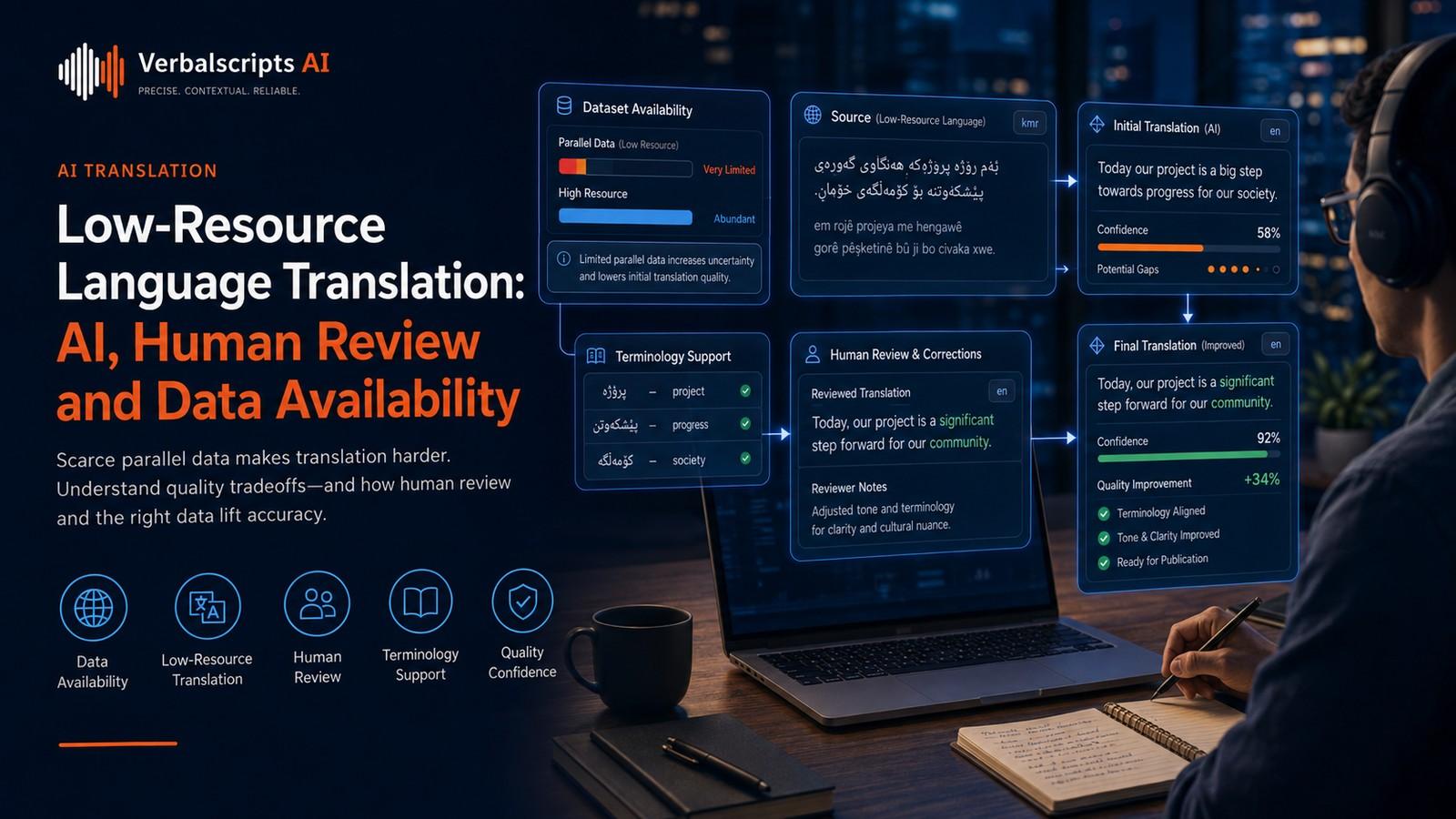
| Hero alt text | Low-resource speech recognition workflow showing limited training data, multilingual transfer, fine-tuning, native review and improved transcript quality |
| Article body words | 1916 |
For production speech-to-text workflows, see our AI Transcription service for the delivery path behind the guidance in this article.
Speech recognition works best when a language has abundant high-quality audio, accurate transcripts, diverse speakers and mature evaluation datasets. Many of the world’s languages do not have that infrastructure.
A low-resource language may have millions of speakers and still have very little machine-readable speech data. The challenge is not the language itself. It is the amount, quality and diversity of data available to train, adapt and evaluate AI systems.
A 2025 AfricaNLP review identifies data scarcity, linguistic complexity, limited computational resources, acoustic variability and ethical concerns as major obstacles for African low-resource ASR. Multilingual ASR research likewise emphasizes cross-lingual transfer and self-supervised learning as key strategies.
What “low-resource” means in speech recognition
A language can be low-resource because it lacks:
- labeled audio;
- large text corpora;
- pronunciation resources;
- standardized orthography;
- language models;
- benchmark data.
Different domains can also be low-resource.
A language may have broadcast speech data but almost no:
- call-center;
- medical;
- legal.
Resource level is task-specific.
Data scarcity
Supervised ASR traditionally needs large paired datasets:
audio + accurate transcript
Creating them requires:
- native speakers;
- transcription;
- QA.
This can be expensive.
Foundation speech models reduce the labeled-data requirement, but they still need target-language evidence.
Unlabeled audio
Self-supervised models can learn from audio without transcripts.
This is powerful for languages with:
- radio archives;
- podcasts;
- community recordings.
The model learns acoustic structure first and can then be adapted with a smaller labeled set.
Multilingual transfer
A multilingual ASR model trains on many languages.
Low-resource languages can benefit from:
- shared phonetic representations;
- related languages;
- common acoustic patterns.
The 2022 multilingual ASR survey identifies cross-lingual transfer as a central strategy for low-resource recognition.
Related-language transfer
Transfer can be stronger when languages share:
- phonology;
- morphology;
- script.
But similarity can also cause confusion.
Benchmark rather than assuming.
Foundation models
Large pretrained speech models such as Whisper, wav2vec-style systems and multilingual speech encoders have changed low-resource ASR because adaptation can begin from broad speech knowledge.
However:
- pretraining language distribution matters;
- dominant languages can still outperform.
“Foundation model” does not imply equality.
Fine-tuning
Fine-tuning uses target-language labeled speech.
A practical dataset can start with tens of hours, depending on baseline and task.
Quality matters more than indiscriminate volume.
Include:
- multiple speakers;
- real recording devices;
- natural domains.
Parameter-efficient fine-tuning
Methods such as:
- adapters;
- LoRA
can reduce training cost.
These approaches are useful when:
- compute limited;
- many language variants.
Evaluate carefully because smaller adaptation does not guarantee equal accuracy.
Transcription data quality
Bad labels teach bad speech recognition.
Create annotation guidelines for:
- punctuation;
- fillers;
- numbers;
- code-switching;
- names;
- incomplete speech.
Perform second-pass QA on training data.
Orthography
Some languages have:
- multiple spelling conventions;
- recent standardization;
- inconsistent diacritics.
Choose a target orthography.
If community uses several standards, document supported variant.
Diacritics and tone
Tonal languages may require:
- tone marks.
2026 Yoruba research shows explicit tone marking remains a difficult ASR target and argues for tone-aware tokenization and objectives.
This illustrates why low-resource ASR needs language-specific evaluation rather than only generic WER.
Agglutinative morphology
Low-resource agglutinative languages face lexical sparsity because one root can generate many forms.
Subword/character tokenization helps.
2026 morphology-aware representation research explicitly addresses severe vocabulary sparsity in low-resource agglutinative languages.
Dialects
One “language” dataset may represent only the standard variety.
Collect:
- regional speakers;
- conversational vocabulary.
Otherwise support claims may exclude real users.
Accent diversity
Include speakers across:
- regions;
- ages;
- genders;
- devices.
Do not build a test set from the same speaker pool as training.
Code-switching
Low-resource communities often interact with higher-resource languages.
Example:
- local language + English.
ASR must handle mixed speech.
Research benchmarks continue to show code-switching is difficult even for multilingual models.
Domain mismatch
A model trained on:
- news
may fail on:
- court audio.
Collect in-domain data or vocabulary.
Domain is often as important as language.
Custom vocabulary
Add:
- names;
- products;
- locations;
- specialist terms.
This can improve practical transcript accuracy.
It does not replace acoustic adaptation.
Text corpora
Text can improve:
- language model;
- vocabulary.
Sources:
- books;
- web;
- public documents.
Clean and respect licensing.
Noise and machine-translated text can introduce problems.
Synthetic speech
Text-to-speech can generate training audio.
Benefits:
- vocabulary coverage.
Risks:
- synthetic voices lack natural variation;
- model can overfit artifacts.
Use as supplement, not sole data.
Data augmentation
Useful transformations:
- noise;
- speed;
- reverberation.
Augmentation expands acoustic diversity.
Keep it realistic.
Active learning
Transcribe the samples the model finds most uncertain.
Workflow:
- run model on unlabeled audio;
- rank uncertainty;
- human transcribe priority segments;
- retrain.
This can use annotation budget efficiently.
Human review in production
Before model quality is mature:
- AI transcript;
- native reviewer.
Capture corrections.
This creates:
- deliverables;
- future evaluation/training data.
Community involvement
Language technology should involve speakers.
Important considerations:
- consent;
- compensation;
- governance;
- data ownership.
Low-resource should not mean “free data.”
The 2025 African ASR review explicitly highlights ethical issues including bias and privacy.
Evaluation set
Build a test set separate from training.
Include:
- dialects;
- noise;
- domains.
Keep it stable for regression.
Metrics
Use:
- WER;
- CER;
- language-specific metrics.
Track:
- names;
- critical terms.
Average metric can miss important errors.
Benchmark against human workflow
The question is not only:
Is WER 15%?
Also:
- How much human editing?
- Can reviewers understand output?
- Is it useful?
Track post-edit time.
Deployment tiers
Stage 1
AI draft + full native review.
Stage 2
AI + targeted review.
Stage 3
Automated low-risk with sampling.
Move only when data supports.
Compute constraints
Local research teams may have limited GPUs.
Strategies:
- PEFT;
- smaller models;
- cloud training;
- quantization.
Optimize for maintainability.
Privacy
Speech data contains:
- identity;
- personal content.
Apply secure collection and storage.
Research datasets need consent appropriate to release.
Prioritizing data collection by error category
After benchmarking, rank errors:
- names/entities;
- dialect vocabulary;
- acoustic noise;
- morphology;
- code-switching.
Collect data targeted to the largest business-impact category.
For example, if 30% of reviewer corrections are local place names, a custom vocabulary/entity list may outperform collecting 100 more hours of generic speech.
Public data and licensing
Low-resource projects often use community, broadcast or web audio. Before training:
- verify licensing;
- respect consent;
- remove data that should not be redistributed.
A technically useful corpus can still be inappropriate to use.
Annotation workforce design
Native transcribers should receive:
- orthography guide;
- code-switch rules;
- uncertainty markers;
- tool training.
Use a second-pass quality sample and adjudication. Inconsistent labels reduce the value of every training hour.
Model-size tradeoffs
The largest foundation model may have the best accuracy but be too expensive or slow for on-device/real-time use. Benchmark smaller models plus adaptation.
Measure:
- WER;
- latency;
- compute;
- reviewer effort.
A deployable model is an engineering compromise.
On-device and offline scenarios
Low-resource languages may be especially valuable in regions with limited connectivity. Consider:
- quantized models;
- local inference;
- intermittent sync.
Privacy can also improve when audio does not leave the device, though model updates and hardware constraints become harder.
Evaluation speaker separation
Ensure test speakers are not accidentally present in training data. Speaker leakage can inflate results.
For community datasets with limited participants, keep a strict speaker-disjoint evaluation split.
Continual learning
As production corrections accumulate, periodically evaluate whether new fine-tuning improves the locked benchmark without harming other dialects or domains.
Do not update the production model continuously from unreviewed corrections. Human-verified data and regression testing remain important.
Community success metrics
Beyond WER, ask:
- Can users complete the task?
- Does the transcript preserve local names?
- Are dialects represented respectfully?
- Is reviewer workload decreasing?
These measures reflect whether the system actually serves the language community.
Final principle
Low-resource ASR improves fastest when every scarce annotation hour is guided by real error evidence and community expertise. “More data” is useful; better targeted data is often more useful.
Choosing the first benchmark before training
If no benchmark exists, create it before collecting a massive training corpus. A 5–10 hour carefully selected evaluation set can reveal:
- which accents fail;
- whether names are the main issue;
- how code-switching behaves;
- which acoustic conditions dominate error.
Without a benchmark, data collection becomes guesswork.
Public benchmarks versus private benchmarks
Public datasets are useful for comparison with research, but private production benchmarks reflect:
- your microphones;
- your domain;
- your users.
Use both. A model can lead on a public benchmark and still underperform on your actual call-center audio.
Model adaptation decision tree
If errors are mostly:
- entities: custom vocabulary/entity hints;
- noise: audio preprocessing/data augmentation;
- dialect grammar: collect natural dialect speech;
- broad lexical/phonetic: fine-tune;
- code-switching: multilingual/code-switch data.
Do not prescribe fine-tuning for every problem.
Small-language reviewer network
For rare languages, build a reviewer network before demand spikes. Record:
- dialect coverage;
- domain knowledge;
- availability;
- secure-access eligibility.
A technically capable model without any human escalation can be risky for enterprise use.
Data documentation for communities
Where datasets may be shared or published, include a data statement describing:
- languages/varieties;
- collection context;
- intended use;
- known limitations;
- consent/licensing.
This supports responsible reuse and helps future teams understand what the dataset does not represent.
Avoiding extractive data practices
Language communities should not be treated merely as sources of “free low-resource data.” Pay annotators fairly, respect data rights and involve community experts in orthography and evaluation decisions.
Better governance often produces better data because participants understand the project’s goals.
Infrastructure constraints
If the target deployment needs offline or low-bandwidth operation, include those constraints in model selection from the beginning. A 10-billion-parameter cloud model may be irrelevant if the product must run on a low-cost device.
Test:
- model size;
- memory;
- real-time factor;
- power.
Review-assisted launch
A practical launch can combine:
- AI draft;
- native reviewer;
- correction capture.
Users receive quality immediately while the model team learns from production. As measured quality improves, the human layer can shift from full review to exception handling.
Quality transparency
Internally document:
- benchmark WER/CER;
- review requirement;
- known dialect limitations.
Externally, avoid one unsupported “accuracy” claim. Honest scope encourages customers to choose the right service level.
Final roadmap principle
Treat low-resource transcription as iterative language infrastructure: benchmark → data → model → review → corrections → better benchmark. Each cycle should reduce uncertainty and expand representative coverage.
Frequently asked questions
Does low-resource mean few speakers?
No. It means limited usable language technology data/resources.
Can a multilingual model solve low-resource transcription without fine-tuning?
Sometimes it provides a strong baseline, but quality should be benchmarked and often improves with local data.
How much data is enough?
There is no universal number. It depends on model, language, domain and target quality.
What is the highest-value data?
Representative, accurately transcribed speech from the actual users and conditions.
Should native speakers be involved?
Yes, in annotation, evaluation and governance.
Conclusion
Low-resource transcription is a data and systems challenge, not a deficiency of the language.
Start with multilingual/self-supervised models, collect a small but representative high-quality corpus, evaluate real speakers, involve native experts and grow the system iteratively.
The best path to better ASR is not simply a bigger model. It is better local evidence, better evaluation and a workflow that turns human corrections into long-term language infrastructure.
Research references
- Imam et al., African Low-Resource ASR (AfricaNLP 2025):
- Yadav & Sitaram, Survey of Multilingual ASR (LREC 2022):
- Olusanya, Yoruba tone ASR (2026):
- Liu et al., Agglutinative morphology representations (2026):