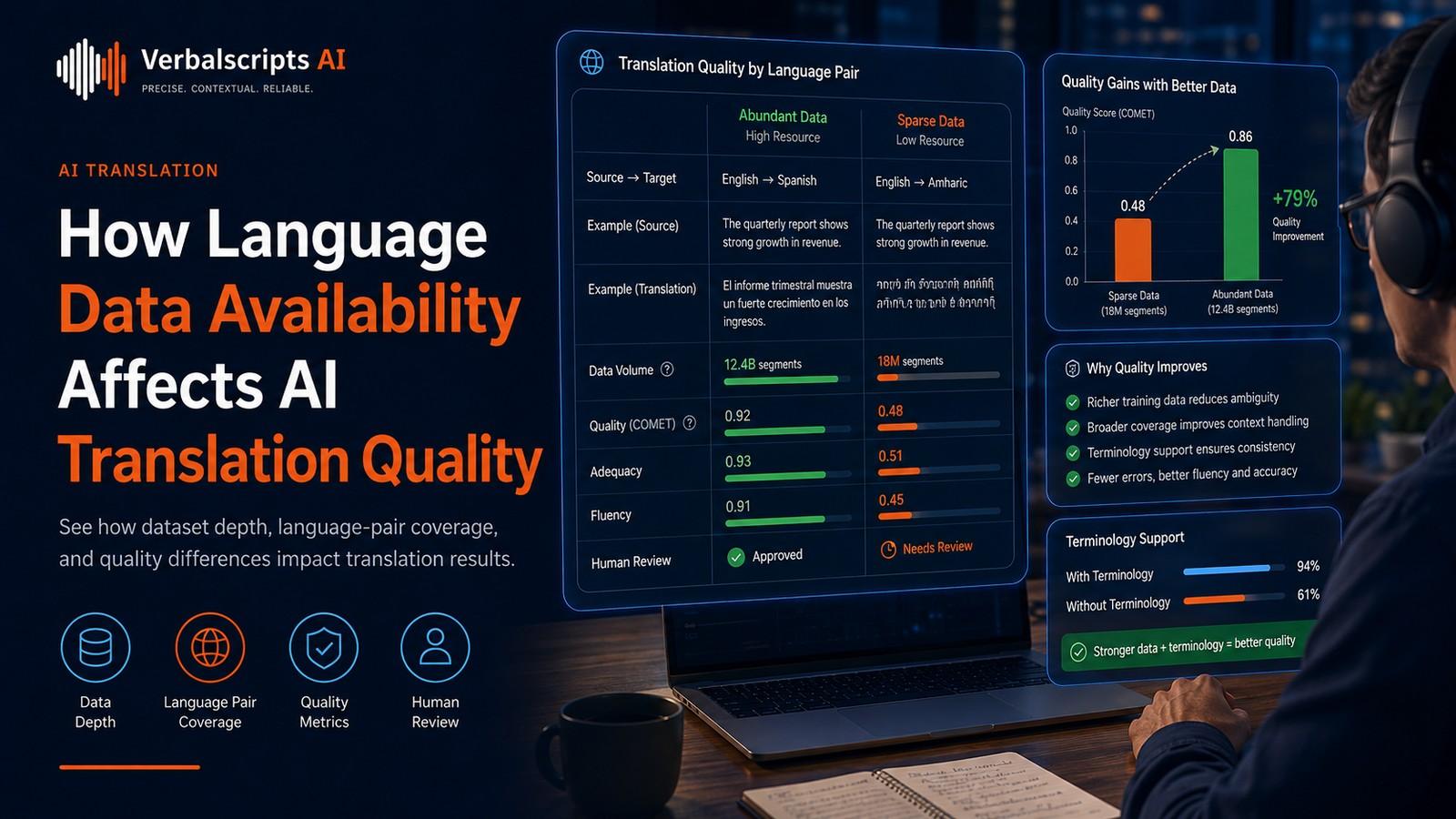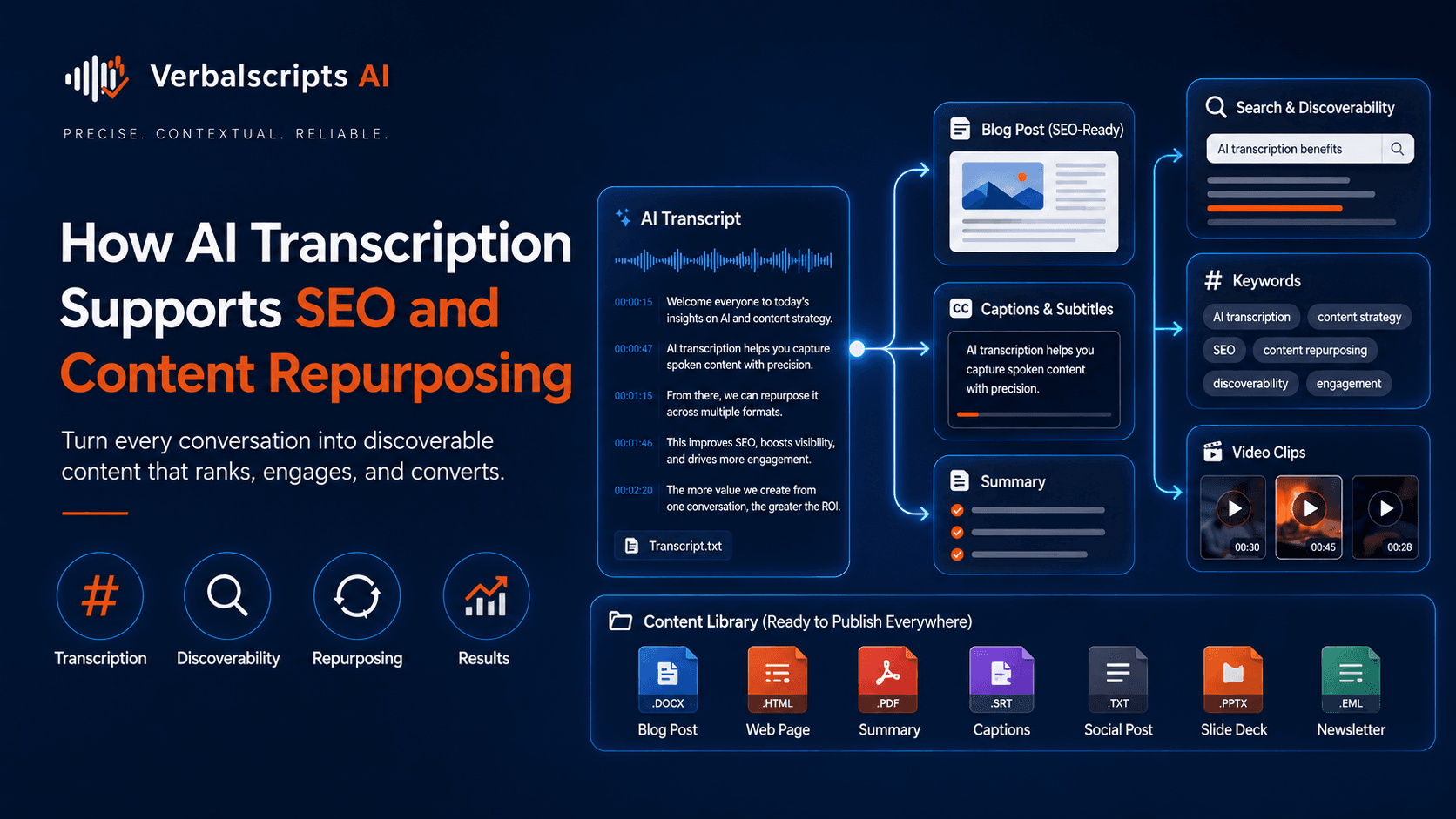
How does language data availability affect AI transcription accuracy? More representative speech and text data generally gives models better coverage of pronunciation, vocabulary, accents and acoustic conditions. However, noisy labels, narrow speaker demographics or mismatched domains can limit accuracy even when the dataset is large. Multilingual pretraining and self-supervised learning reduce the need for labeled data, but target-language evaluation and adaptation remain essential for underrepresented languages.
| SEO title | How Language Data Availability Affects AI Transcription Accuracy |
|---|---|
| Slug | language-data-availability-ai-transcription-accuracy |
| Meta description | Learn how speech-data quantity, transcript quality, accent coverage, domains and text resources affect AI transcription accuracy across languages. |
| Primary keyword | language data transcription accuracy |
| Search intent | Informational / Technical |
| Hero image | 198-language-data-ai-transcription-accuracy.jpg |
| Hero alt text | ASR training-data dashboard comparing speech hours, speaker diversity, domain coverage and transcription error rates across languages |
| Article body words | 1920 |
For production speech-to-text workflows, see our AI Transcription service for the delivery path behind the guidance in this article.
Speech recognition is a data-intensive technology.
A model must learn how a language sounds across speakers, accents, microphones, speaking rates and environments, and how those sounds map to written text. If one language has tens of thousands of diverse labeled hours and another has only a few dozen hours of read speech, their production accuracy is unlikely to be equal.
The quantity of data matters, but the type and quality of data often matter just as much.
Research on multilingual ASR identifies the lack of large speech datasets as a central reason most languages do not have equally strong speech-recognition systems.
Labeled speech hours
Traditional supervised ASR learns from:
audio + transcript
More labeled hours expose the model to:
- more words;
- more speakers;
- more conditions.
But raw hour count is an incomplete metric.
Speaker diversity
1000 hours from 20 speakers is different from:
1000 hours from 10,000 speakers.
For general-purpose ASR, diversity helps:
- accents;
- voices;
- speaking rates.
Match target population.
Gender/age diversity
Voices differ acoustically.
Datasets should represent the users expected.
Do not collect demographic attributes unnecessarily; use ethical, consented dataset design.
Accent coverage
A model may perform well on the dominant accent in training.
Underrepresented accents can see higher error.
Evaluate separately.
Dialect vocabulary
Audio data must contain real dialect vocabulary.
Read standard-language scripts do not teach:
- local words;
- grammar.
Natural conversational data is valuable.
Domain coverage
ASR for:
- legal;
- medical;
- call-center
requires vocabulary and acoustics from those domains.
General YouTube speech is not enough.
Domain mismatch can dominate.
Recording condition
Training needs:
- phone;
- room;
- headset
matching production.
A clean studio benchmark can overstate real performance.
Noise diversity
Real audio includes:
- background;
- reverberation.
Augmentation can simulate.
But real representative noise remains useful.
Transcript quality
Incorrect labels train errors.
Problems:
- misspellings;
- wrong speaker;
- inconsistent numbers;
- missing words.
Invest in annotation QA.
One hour of high-quality transcription can be more valuable than several hours of noisy labels.
Orthographic consistency
The same spoken word should not be transcribed three ways without rule.
Inconsistent spelling increases apparent vocabulary.
This matters in:
- newly standardized languages;
- dialectal data.
Punctuation
End-to-end systems may learn punctuation from transcripts.
Inconsistent punctuation reduces output quality but may not affect lexical WER strongly.
Define annotation standard.
Code-switching labels
If real users code-switch, training should represent it.
Otherwise the model may force minority-language words into dominant language.
Text-only resources
ASR can use text for:
- decoder language model;
- vocabulary;
- rescoring.
A language with abundant text but limited labeled audio may still benefit.
Unlabeled speech
Self-supervised learning uses audio without transcripts.
This has transformed low-resource ASR.
Models learn broad acoustic representations and require less labeled target data.
The multilingual ASR survey identifies this as a major opportunity.
Pretraining language representation
A multilingual foundation model may claim support for a language but have seen far less of it during pretraining.
Data imbalance can translate into performance imbalance.
Support list does not show training distribution.
Cross-lingual transfer
Related and high-resource languages can help.
Shared phonetic features transfer.
But typologically/dialectally distant languages may benefit less.
Measure.
Vocabulary sparsity
Names and specialized words remain rare even in high-resource languages.
Add:
- custom vocabulary;
- domain text.
Data availability is local at the word/domain level too.
Tonal features
For tonal languages, training transcripts may or may not include tone marks.
The 2026 Yoruba study shows that label representation itself can change evaluation and model difficulty.
Agglutinative languages
Rich morphology generates many surface forms.
Text coverage must include enough morphological variety or useful subword units.
2026 morphology-aware research highlights vocabulary sparsity as a central challenge.
Dataset noise
Web-mined audio can contain:
- wrong transcript;
- wrong language;
- music.
Cleaning can produce larger gains than adding more noisy hours.
Quality should be quantified.
Dataset duplication
Repeated clips inflate hour count.
Deduplicate.
Test contamination can make benchmark look artificially good.
Keep train/test speakers and recordings separate.
Evaluation data availability
A language can have a model but no strong benchmark.
Then accuracy claims are uncertain.
Invest in:
- human reference set.
Evaluation data is as important as training data for deployment decisions.
Word Error Rate
WER requires accurate reference transcripts.
If human references contain inconsistencies, the metric is noisy.
For languages without whitespace or with rich morphology, complement with other metrics.
Critical entity metrics
For real applications, measure:
- names;
- numbers;
- keywords.
A model with 8% WER but 40% name error can still fail.
Data curves
Plot quality versus labeled hours.
This can show:
- whether more data helps;
- when returns diminish.
Use it to budget data collection.
Active learning
Select uncertain audio for labeling.
This increases information per annotation hour.
Production feedback
Capture human corrections.
With proper consent/rights, use them to:
- benchmark;
- train.
Production can become continuous data improvement.
Fairness
Quality gaps across language communities can create unequal access.
Report:
- per-language metrics.
Do not hide small-language performance.
Data quality score
An internal dataset can receive a score across:
- transcript accuracy;
- speaker diversity;
- domain relevance;
- audio quality range;
- licensing clarity;
- metadata completeness.
This helps teams decide whether to add a corpus to training, evaluation or neither.
A huge low-quality dataset should not automatically outrank a smaller curated one.
Representative sampling
When manual QA of millions of hours is impossible, sample by:
- source dataset;
- language;
- speaker;
- recording condition.
Estimate label error and duplication rates.
If one source has unusually high noise, filter or downweight it.
Speaker and utterance deduplication
Duplicate speech can enter corpora through:
- reuploads;
- podcast clips;
- repeated prompts.
Deduplicate at:
- file hash;
- acoustic similarity;
- transcript similarity.
This reduces training bias and evaluation contamination.
Curriculum and sampling strategies
Training can balance:
- clean speech first;
- noisy speech later;
- high-resource/low-resource language proportions.
There is no one universal sampling schedule. The important point is that raw corpus size should not determine every training example equally.
Language-model text normalization
If speech transcripts use one number style but text corpora use another, align normalization or teach the model both intentionally.
Inconsistent text representation can make decoder probabilities less useful.
Production error-data value
A five-second segment where the model failed on a common real customer utterance can be more valuable than a minute of easy read speech.
Use production error frequency and business impact to select new training examples.
Bias and representativeness review
Ask which users are missing:
- rural speakers;
- older speakers;
- specific accents;
- noisy environments.
Do not assume a national-language corpus represents every user of that language.
Data lifecycle
Training data needs:
- provenance;
- version;
- deletion process where applicable.
If a dataset is later withdrawn, the organization should know which model versions used it.
Final principle
The relationship between data and ASR quality is not “more hours = better accuracy.” The stronger rule is: more representative, accurately labeled and well-governed data gives the model a better chance to generalize.
Label error analysis
Human transcripts can contain systematic annotation mistakes, such as:
- consistently missing fillers;
- inconsistent hyphenation;
- wrong number normalization;
- misheard local names.
A model trained on inconsistent labels may appear to “make errors” when it actually predicts another plausible annotation.
Audit the annotation process before blaming the model.
Recording-device distribution
If 80% of future users record on mobile phones, a training corpus dominated by broadcast microphones is mismatched even if it is large.
Track dataset hours by:
- codec;
- sample rate;
- channel;
- environment.
Representative acoustics improve transfer to production.
Vocabulary coverage metrics
Measure how often evaluation words or subwords appear in training text. Rare critical vocabulary can be identified before model deployment.
For entity-heavy applications, maintain a separate entity coverage list.
Long-tail vocabulary
Language follows a long-tail distribution. Even massive data cannot include every future:
- name;
- address;
- product.
This is why ASR needs project-level vocabulary and entity injection in addition to pretraining.
Data balancing across dialects
If one dialect has 90% of the data, the model may treat it as the default. Balance sampling or collect more underrepresented speech.
Do not over-sample a tiny dataset so aggressively that the model memorizes speakers. Use held-out speaker evaluation.
Quality-adjusted hour count
An internal planning metric can weight hours by:
- transcript QA;
- relevance;
- speaker diversity.
For example, 100 hours of double-reviewed in-domain speech may be considered more valuable than 500 hours of weak auto-captions.
This is a planning tool, not a universal scientific metric.
Data deletion impact
If consent is withdrawn or a dataset license changes, the team should know which model versions used the data. Maintain dataset-to-model lineage.
Future model retraining may need to exclude the withdrawn corpus.
Benchmark freshness
A benchmark created five years ago may not contain:
- new products;
- contemporary names;
- current slang.
Keep a stable core for comparison and add a rolling challenge set for freshness.
Human-review cost as data signal
If one data-source subgroup creates much more reviewer work, inspect whether training lacks that condition. Review costs can identify data gaps even before formal WER analysis.
Final principle
Data availability influences ASR through coverage, not only volume. The closer the training and evaluation evidence matches the people, vocabulary and acoustics of production, the more reliable the transcript will be.
Data collection should follow production demand
If users increasingly submit phone calls rather than studio recordings, the next dataset should reflect phone acoustics. If new terminology drives errors, collect or generate those contexts rather than more generic speech.
Production distribution should continually influence the data roadmap.
Final quality rule
Never claim that a language is “fully covered” because the training corpus reached a particular number of hours. Coverage is demonstrated through representative evaluation across speakers, domains and recording conditions.
Implementation takeaway
For production use, treat data coverage, annotation consistency and production-distribution drift as measurable parts of the workflow rather than assumptions. Define the relevant policy before processing content, keep the model or data configuration versioned, and verify results on representative material from the actual language, locale and domain. If automation produces a result that conflicts with a deterministic rule, authoritative terminology or qualified human evidence, escalate the item instead of averaging the disagreement away. The most durable multilingual systems preserve source-to-target traceability, record exceptions and feed reviewed corrections back into benchmarks, glossaries or routing rules. That discipline makes quality improvements reproducible when models, providers, reviewers or source content change.
Frequently asked questions
Does more data always improve ASR?
Not if the data is noisy, duplicated or mismatched.
Is unlabeled audio useful?
Yes, especially for self-supervised pretraining.
What data is most valuable?
Representative speech with accurate transcripts from target users and conditions.
Can text data improve speech recognition?
Yes, it can improve vocabulary/language modeling even without audio.
Why do language support lists not tell me accuracy?
They indicate capability, not training distribution, domain fit or evaluation results.
Conclusion
AI transcription accuracy reflects the language data ecosystem behind the model.
Quantity matters, but diversity, transcript quality, domain match, orthography and evaluation coverage determine how useful that quantity is.
Multilingual foundation models reduce the barrier to entry. Reliable deployment still depends on representative target-language data and honest per-language measurement.
Research references
- Yadav & Sitaram, Survey of Multilingual ASR:
- Imam et al., African Low-Resource ASR:
- Olusanya, Yoruba Tone ASR:
- Liu et al., Agglutinative morphology: