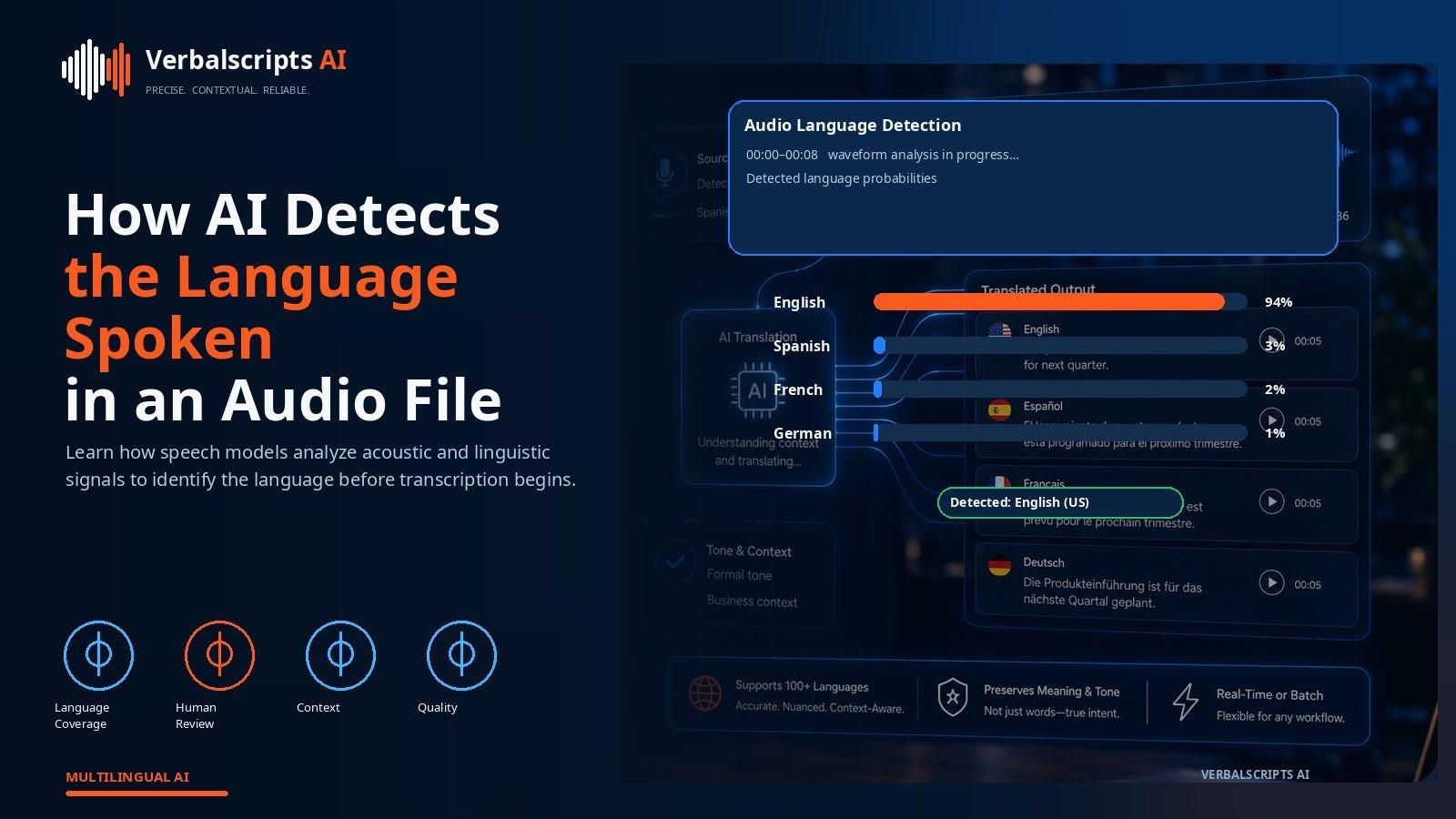
How does AI detect the language in audio? A speech-language identification model analyzes acoustic patterns learned from labeled speech, such as phoneme sequences, rhythm and other language-specific cues. Production APIs commonly ask developers to provide a small candidate set of likely languages, then choose the best-fitting language and return a language code or confidence. Continuous systems can re-evaluate language across a stream, while simpler systems identify only the initial language.
| SEO title | How AI Detects the Language Spoken in an Audio File |
|---|---|
| Slug | how-ai-detects-language-spoken-audio |
| Meta description | Learn how spoken-language identification works, including acoustic features, candidate languages, confidence, streaming detection and common failure cases. |
| Primary keyword | AI language detection audio |
| Search intent | Informational / Technical |
| Hero image | 176-ai-language-detection-audio.jpg |
| Hero alt text | Speech language identification interface comparing candidate languages and selecting the best match from an audio waveform |
| Article body words | 1922 |
For production speech-to-text workflows, see our AI Transcription service for the delivery path behind the guidance in this article.
Before an AI system can transcribe speech accurately, it often needs to know which language the speaker is using. Spoken-language identification, commonly called language ID or LID, predicts a language from the acoustic and linguistic patterns in an audio signal.
The task sounds simple when comparing English with Japanese. It becomes harder with closely related languages, short utterances, proper names, accents and code-switching.
Current Google Speech-to-Text documentation recommends restricting candidate languages to the minimum necessary because a smaller list improves selection reliability. Azure Speech similarly requires candidate languages for its LID workflows.
Language identification versus speech recognition
Language ID answers:
Which language is this?
ASR answers:
What words were spoken?
The two tasks can be separate or integrated.
A system may:
- detect Spanish;
- route audio to Spanish ASR.
A multilingual model may predict:
- language;
- words
together.
Acoustic clues
Languages differ statistically in:
- sound inventories;
- syllable patterns;
- rhythm;
- stress;
- phoneme sequences.
LID models learn these patterns from training data.
They do not usually identify a language from a hard-coded rule such as “rolled r = Spanish.”
Lexical clues
If a model jointly recognizes speech, recognized words can help.
Hearing clear tokens such as:
- “bonjour”;
- “gracias”
provides language evidence.
But named entities can look/sound foreign inside otherwise monolingual speech.
One keyword should not always cause a language switch.
Candidate language lists
A production system often knows the likely possibilities.
Example:
A Canadian contact center may expect:
- English;
- French.
Giving the model two candidates is easier than asking it to distinguish every supported language.
Google’s current automatic language recognition allows a limited candidate set in supported Speech-to-Text V2 configurations and recommends minimizing alternatives.
Why large candidate lists hurt
Closely related languages share:
- sounds;
- words.
Adding irrelevant alternatives increases classification competition.
Use business context.
If your product only serves 5 languages, detect among those 5.
Short utterances
Audio:
“Okay.”
This gives little language evidence.
A short international name may be impossible to classify confidently.
For voice commands, use:
- user locale;
- previous turn;
- app setting
as prior information.
Long audio
A long monolingual recording provides more evidence.
However, a 60-minute file may contain:
- multilingual speakers;
- quoted phrases.
File-level language ID can miss local changes.
At-start identification
At-start LID identifies the language near the beginning and keeps it.
Useful for:
- one-language calls.
Advantages:
- lower complexity.
Problem:
- language changes later are missed.
Continuous language identification
Continuous LID can switch predicted language during longer audio.
Azure Speech documents continuous LID scenarios.
This is useful for:
- multilingual meetings;
- call routing.
The switch granularity and latency should be tested.
Segment-level LID
A pipeline can divide audio into utterances and detect each.
This works when language changes occur between complete turns.
It is weaker for within-sentence code-switching.
Token-level language ID
The hardest case identifies the language of individual words.
Research on code-switched language identification continues to show significant difficulty.
This is necessary when:
“I’ll send the matatu schedule later.”
contains words from different languages.
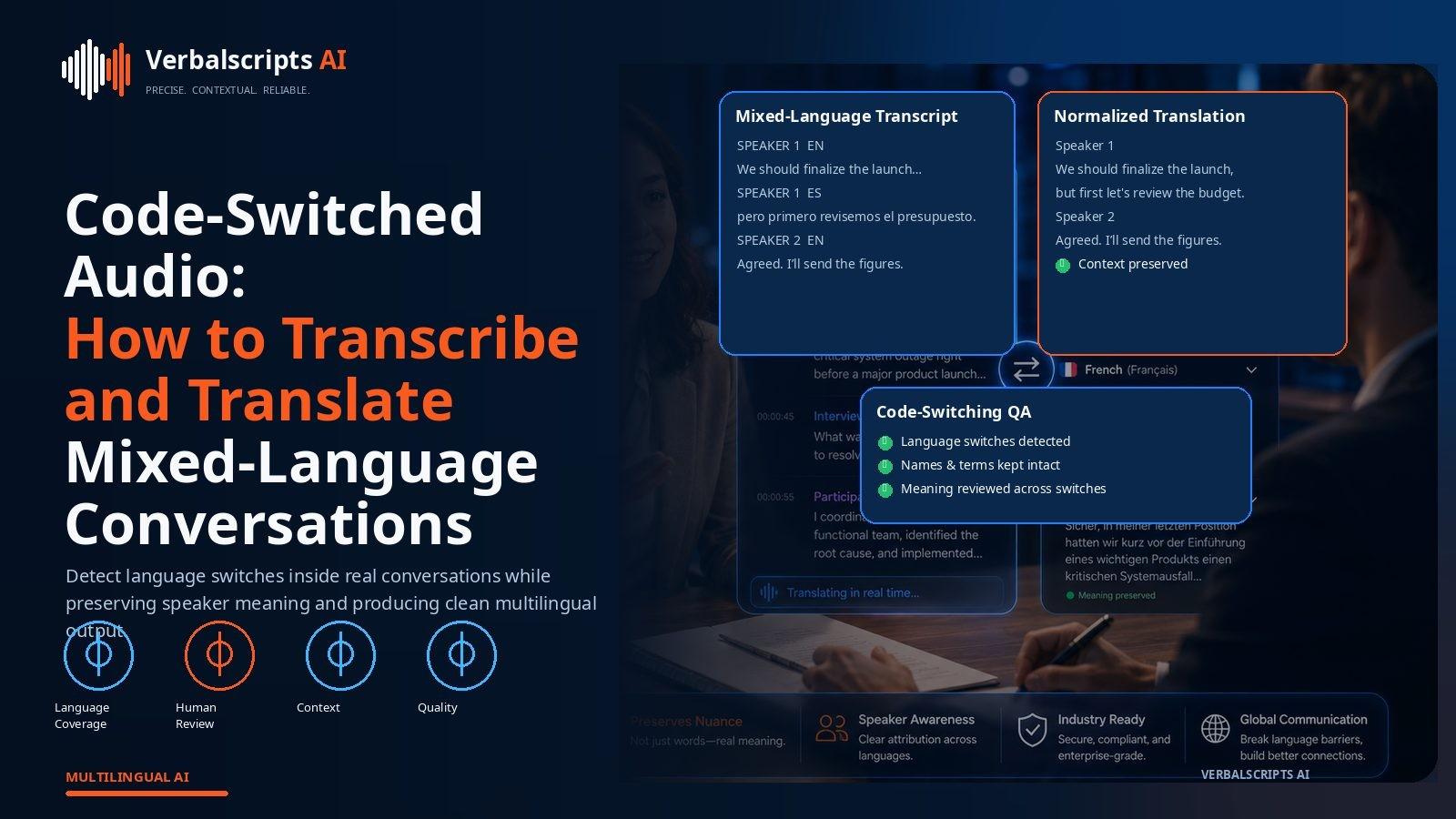
Code-switching
Code-switching is common in multilingual communities.
A monolingual LID assumption can produce:
- wrong language;
- foreign-word mistranscription.
Code-switched ASR needs models/data designed for mixing.
The 2024 DECM benchmark shows that even state-of-the-art multilingual ASR models face challenges on bilingual code-switched speech.
Similar languages
Difficult pairs include languages with shared:
- vocabulary;
- phonology.
The model may need longer context.
Use locale metadata when available.
Dialect versus language
A dialect may be classified as the parent language.
Language ID is not always designed to distinguish:
- dialect;
- accent.
Do not expect a generic LID endpoint to provide fine sociolinguistic labels.
Confidence scores
Some systems expose confidence.
Use it for routing:
- high confidence → ASR;
- low confidence → ask user / human / multilingual model.
Calibrate.
A 0.8 score in one service is not universally equivalent.
Language priors
Context can provide prior probabilities.
Examples:
- user selected language;
- country;
- call queue;
- previous messages.
Combine priors carefully.
Do not use location to override clear speech evidence automatically.
Audio quality
Noise reduces LID performance.
So do:
- very low bitrate;
- music;
- multiple speakers.
Preprocessing can help.
Music and non-speech
A language model should first detect:
- speech presence.
Do not try to identify language from instrumental audio.
Songs can mix languages.
Proper names
A name can contain phonetic patterns from another language.
LID should use broader context.
For short utterances containing only a name, return uncertainty.
Implementation pattern
- validate audio;
- create candidate list;
- run LID;
- check confidence;
- route to ASR;
- monitor transcript language;
- re-run if mismatch.
Language mismatch detection
After ASR, a text-based language detector can verify:
- output looks like predicted language.
If LID says French but transcript is mostly English, flag.
This cross-check catches routing errors.
Real-time routing
In streaming customer support:
- detect first seconds;
- select ASR;
- translate;
- continue monitoring.
Latency tradeoff:
Longer LID sample improves confidence but delays response.
Tune by product.
Privacy
Language ID still processes voice/audio.
Apply the same:
- consent;
- security;
- retention
as ASR.
Do not treat it as metadata-only processing.
Evaluation
Create a labeled test set.
Measure:
- accuracy;
- confusion matrix;
- performance by duration;
- performance by accent.
Include:
- 1 sec;
- 5 sec;
- 30 sec.
Test code-switching separately.
Confusion matrix
A confusion matrix shows:
- which languages are confused.
If Spanish is frequently labeled Portuguese, target improvements there.
Overall accuracy alone hides pattern.
Choosing the candidate-language list programmatically
A product can construct candidate languages from:
- account preferences;
- current workspace;
- known customer market;
- meeting settings.
For example, a European support queue might provide English, French and German rather than the provider’s full catalog. If the user changes preferred language, update the candidate set.
Keep the rule transparent and allow manual override.
LID error recovery
After the first transcript appears, run a text-language check. If the transcript contains low confidence and resembles another candidate language, reprocess the segment with the alternative ASR.
This “detect → transcribe → verify” loop can outperform one irreversible early decision, especially on short audio.
Benchmarks by clip duration
Report LID accuracy at several durations:
- 1–2 seconds;
- 5 seconds;
- 15 seconds;
- full utterance.
A system that is excellent at 30 seconds may be unusable for one-word voice commands. Duration-specific measurement should match the product.
Closely related languages
When the candidate set contains closely related languages, inspect the confusion matrix and consider a fallback such as asking the user to confirm language. Wrong confident auto-routing can create a frustrating loop where every subsequent utterance is transcribed by the wrong model.
Ethical metadata use
Location or customer profile can be used as a weak prior for likely language only when appropriate. Do not infer sensitive personal identity from language use. A user located in one country may speak any language, and multilingual users frequently change preferences.
The system should privilege explicit user settings and direct speech evidence over demographic assumptions.
Open-set language detection
Candidate-list LID is a closed-set problem: the model must choose among provided languages. Real systems can receive a language outside the list.
If the provider always selects the “closest” candidate, the output can be confidently wrong. Add an open-set policy:
- low confidence → unknown;
- transcript language mismatch → retry;
- user override.
Do not force a supported-language label when the evidence does not fit.
Language identification and dialect codes
Some provider APIs accept one locale per language in a candidate list. For example, a streaming service may prevent selecting both en-US and en-AU as separate candidate “languages” in the same mode.
This reflects an important distinction: LID is often designed to identify the language, not fine-grained accent variety. Handle acoustic locale selection separately when needed.
Latency budget
For real-time applications, decide how long the system can wait for language evidence.
A voice assistant may need a decision within a second or two. A meeting transcription system can use a longer window.
Measure:
- time to first language decision;
- error at that duration;
- reclassification behavior.
A slow but highly accurate LID model may not fit an interactive product.
Language-ID ensemble
For difficult workflows, combine:
- acoustic LID;
- text LID after partial ASR;
- user/account prior.
Do not simply majority-vote. Give higher weight to explicit user preference and direct acoustic/text evidence than to inferred geography.
Short-clip fallback
For clips such as “yes,” “no,” a name or a number, language may be inherently unidentifiable. The correct technical response can be to carry forward the previous conversation language rather than pretending the clip itself contains enough evidence.
Uncertainty handling is part of accurate LID.
Regression set
Maintain examples of:
- historically confused language pairs;
- short names;
- code-switching;
- noisy clips.
Run them after provider/model changes. Language routing errors can otherwise appear suddenly even when ASR model quality is unchanged.
Production policy for uncertain LID
Define explicit bands, calibrated on your data:
- high confidence → automatic routing;
- medium → route to multilingual model and verify transcript;
- low → user/human confirmation.
The actual numeric thresholds depend on the provider and should not be copied between systems.
Language detection for recorded archives
Batch archives can use more context than live systems. Run LID on:
- several segments across the file;
- not only the first seconds.
This avoids misclassifying a file whose introduction contains music, a foreign quote or a different speaker from the main content.
Candidate languages from document metadata
A video may have:
- filename;
- event locale;
- uploader setting.
Use these as hints, not unquestionable truth. A wrongly labeled upload should still be recoverable through acoustic evidence and manual override.
Monitoring real-world confusion pairs
Track every manual LID correction. If users repeatedly change:
- Portuguese ↔ Spanish;
- closely related regional languages,
create targeted evaluation and routing rules.
Operational error data is often more useful than generic benchmark accuracy.
Avoid overclaiming language detection
A language-ID system cannot reliably infer:
- nationality;
- ethnicity;
- exact dialect
from a short clip merely because it predicts a language. Product interfaces and analytics should not turn a language prediction into sensitive identity assumptions.
Frequently asked questions
How much audio is needed to identify a language?
It depends on language pair, quality and model. More natural speech generally provides more evidence than a one-word clip.
Can AI detect any language automatically?
No. It can detect only languages represented and supported by its model, and accuracy varies.
Does language ID detect dialects?
Usually not reliably unless the service specifically models those varieties.
Can it detect language changes in the same recording?
Continuous or segment-level LID can; within-sentence code-switching remains harder.
Should I provide candidate languages?
Yes when possible. It improves the practical classification problem.
Conclusion
Spoken-language identification is a routing system built on acoustic evidence and context.
Constrain candidate languages, handle uncertainty, test short audio and distinguish language detection from dialect and code-switching.
A correct LID decision gives ASR the best chance to succeed. A wrong one can degrade everything downstream, so treat language detection as a measurable quality stage.
Research references
- Google Speech-to-Text automatic language detection:
- Azure Speech language identification:
- Amazon Transcribe streaming language ID:
- Code-Switched LID Is Harder Than You Think (EACL 2024):
- DECM code-switching ASR: