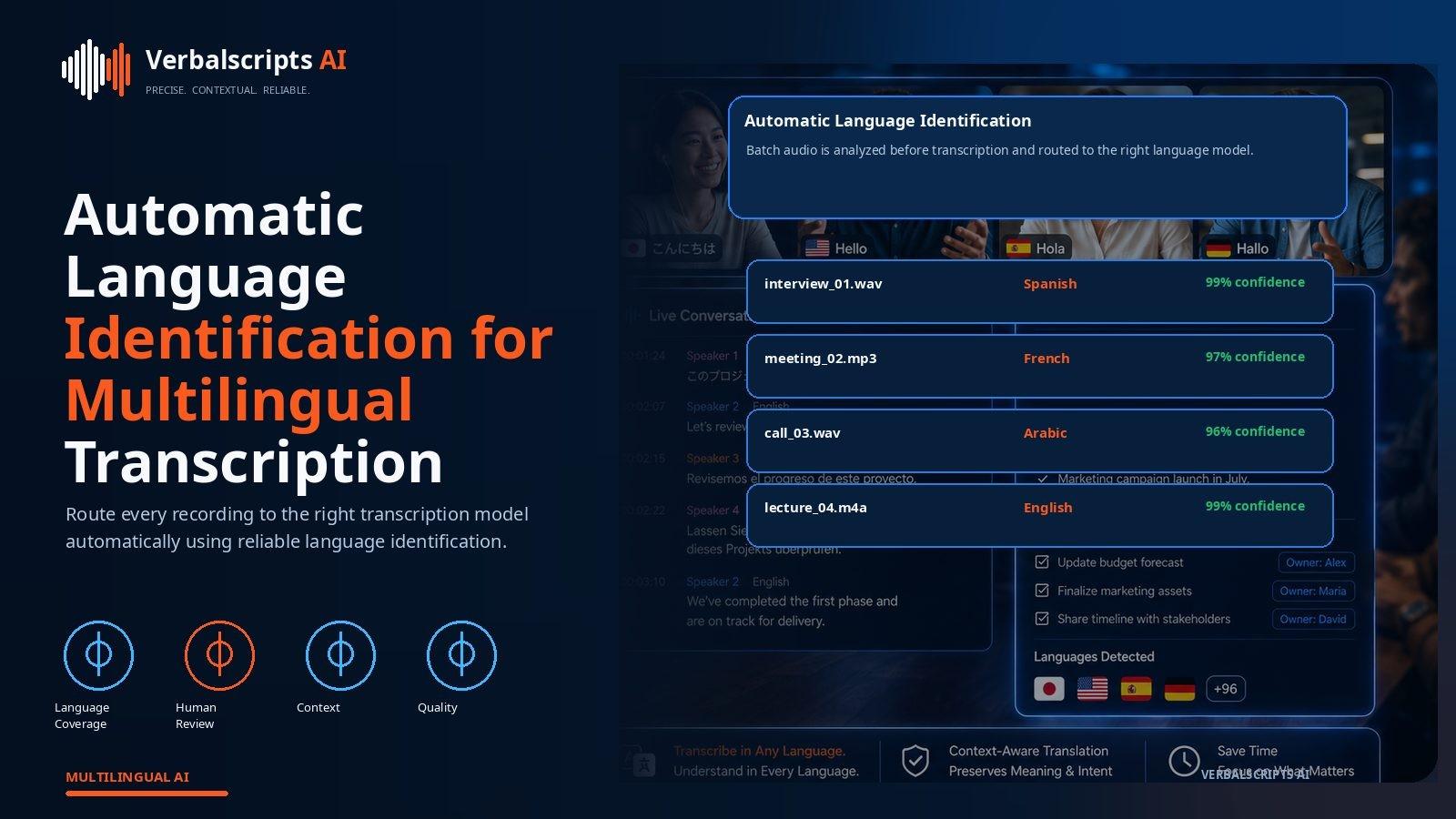
How is automatic language identification used in multilingual transcription? The system receives audio plus a list or universe of possible languages, predicts the most likely language, then routes the speech to an appropriate ASR model or enables multilingual recognition. For recordings where language can change, continuous or segment-level identification is used. Reliable workflows constrain candidates, preserve confidence, verify the transcript language afterward and route uncertain/code-switched segments to multilingual models or human review.
| SEO title | Automatic Language Identification for Multilingual Transcription |
|---|---|
| Slug | automatic-language-identification-multilingual-transcription |
| Meta description | Learn how automatic language identification fits into multilingual transcription, including candidate sets, continuous LID, code-switching, QA and routing. |
| Primary keyword | automatic language identification transcription |
| Search intent | Technical / Informational |
| Hero image | 177-automatic-language-identification-transcription.jpg |
| Hero alt text | Multilingual transcription router using language identification confidence to select speech recognition models |
| Article body words | 1936 |
For production speech-to-text workflows, see our AI Transcription service for the delivery path behind the guidance in this article.
Automatic language identification is the control layer that decides how multilingual audio should be transcribed. A wrong LID decision can send a recording to the wrong ASR model and produce a transcript that looks like nonsense. A well-designed LID layer can route files, reduce manual sorting and support multilingual real-time applications.
Production design is therefore about more than model accuracy: candidate lists, switching behavior, fallback and confidence handling matter.
LID should be evaluated as its own stage rather than judged only from the final transcript.
LID architecture patterns
Pre-routing
LID first, ASR second.
Best when:
- separate monolingual models.
Joint multilingual ASR
One model predicts text across languages.
Simpler routing.
Hybrid
LID chooses a multilingual model family or candidate set.
Many production systems use hybrid approaches.
Batch-file LID
For an archive:
- classify file;
- store language;
- queue ASR.
Efficient for:
- one-language recordings.
If files contain multiple languages, one label is insufficient.
Streaming LID
For live audio:
- detect language;
- begin transcription.
Amazon Transcribe documents language identification for streaming transcriptions, including single-language and multi-language modes.
Streaming LID must balance latency and confidence.
Continuous LID
Continuous identification allows language changes.
Use when:
- speaker changes;
- conversation bilingual.
Azure Speech documents continuous LID and candidate configurations.
Test switching delay.
Candidate configuration
Good candidate set is:
- mutually plausible;
- small.
Bad:
- all supported languages.
Google explicitly advises restricting candidates in its current multiple-language recognition feature.
Business rules
A support queue may know:
- market;
- preferred language.
Use that context to reduce candidates.
But preserve override if speech contradicts the metadata.
LID confidence
Use confidence to trigger:
- fallback;
- second model;
- user prompt.
Do not force one label when evidence is weak.
Similar-language confusion
Analyze confusion pairs.
Examples:
- languages/varieties sharing phonology.
Mitigation:
- longer context;
- text verification;
- user preference.
ASR feedback
After transcription, run a text LID model.
If acoustic LID and transcript language disagree:
- flag;
- retry.
This feedback loop improves reliability.
Code-switching
The recording may contain:
- two languages in one turn.
A single LID label cannot represent it.
Use:
- multi-language ASR;
- token language ID.
Research shows this remains difficult.
Matrix language
Code-switching research distinguishes a matrix language that supplies grammatical structure.
2024 EMNLP work on automatic matrix-language determination showed that typical acoustic LID is not the same as identifying a code-switched utterance’s matrix language.
This is a reminder that language identity is not one universal concept.
Speaker-specific language
In meetings:
- Speaker A English;
- Speaker B Spanish.
Diarization can separate speakers first.
Then LID per speaker segment.
This can improve routing.
Segmentation order
Possible:
LID → diarization
Simple global classification.
diarization → LID
Useful if speakers use different languages.
Test both.
Silence
Exclude silence/non-speech.
A system should not assign a language to:
- music;
- noise.
Voice activity detection is a useful preprocessing step.
Minimum duration
Very short segments have low information.
Avoid switching models on every one-word utterance.
Use hysteresis:
- require several seconds/segments before switching.
Hysteresis
Without stability rules, LID may oscillate:
English → Spanish → English.
Use:
- confidence threshold;
- consecutive evidence.
This improves live captions.
Metadata storage
Store:
- predicted language;
- confidence;
- candidate set;
- timestamp.
This allows QA.
Human override
Reviewers should be able to correct language.
That correction should propagate to:
- re-transcription.
Do not lock the original AI guess.
Quality metrics
Measure:
- file LID accuracy;
- segment F1;
- switching delay;
- code-switch recall.
Choose metric by architecture.
Test dataset
Include:
- accents;
- short clips;
- noisy audio;
- names;
- code-switch.
Do not test only clean read speech.
False confidence
A system can be confidently wrong.
Calibrate on domain.
Monitor production corrections.
Language coverage
A supported ASR language may not be supported by automatic LID in the same mode.
Read provider documentation.
Do not assume support tables are identical.
Cost
LID may be:
- included;
- separate.
Google Cloud notes language detection can be integrated in certain translation requests without separate charge; speech-service billing differs by product.
Use current provider pricing.
Privacy
LID processes raw audio.
Apply:
- retention;
- access.
Store only needed metadata afterward.
Example call-center flow
- caller speaks;
- LID chooses English/Swahili;
- ASR starts;
- transcript confidence monitored;
- language switches if repeated evidence;
- agent sees transcript.
Escalate uncertain calls.
Designing switching rules for streaming LID
Continuous language identification can become unstable if the system changes language after one ambiguous word. Use a state machine with:
- minimum evidence duration;
- confidence threshold;
- consecutive predictions;
- cooldown before another switch.
This reduces “language flapping” and makes live captions more coherent.
Segment boundaries matter
If voice activity detection creates segments that are too short, LID has little acoustic evidence. If segments are too long, one segment may contain a genuine language switch.
Tune VAD and LID together using real conversations rather than default settings alone.
Human QA of language labels
For a multilingual benchmark, native reviewers can annotate language spans independently. Measure disagreement because some borrowed words and code-switch boundaries are genuinely ambiguous.
A language-ID model should not be penalized for an annotation distinction that humans cannot agree on reliably. Clear annotation rules matter.
LID monitoring dashboard
Useful production views:
- predicted-language share;
- confidence distribution;
- manual overrides;
- confusion pairs;
- ASR failure rate after each LID.
A sudden shift from 5% to 40% “unknown/other” can indicate an upstream microphone or model change.
Fallback to user selection
For applications where wrong language creates severe friction, a manual selector remains valuable. Automatic detection should reduce work, not eliminate user control.
A good product can auto-suggest:
“We detected French. Continue?”
This is better than silently locking a low-confidence choice.
Automatic LID as an operational service
Treat language identification as a service with its own API contract:
Input:
- audio;
- candidate languages;
- context.
Output:
- language;
- confidence;
- time span;
- alternatives.
Consumers should not receive only one bare language code because they need enough information to decide whether to trust or override it.
Candidate-list source governance
Where do candidate languages come from?
Possible sources:
- product configuration;
- user-selected preferences;
- market queue;
- previous turn.
Document the source. If a business team changes its supported-language list, LID behavior changes even if the model does not. This configuration should be versioned.
Code-switch metrics
For continuous LID, evaluate:
- segment language accuracy;
- switch precision;
- switch recall;
- detection delay.
A system that identifies both languages somewhere in the file but detects every switch 10 seconds late may still be unusable for real-time captions.
False-switch suppression
Borrowed words and names can trigger false language changes. Require minimum span duration or multiple tokens before switching unless the product truly needs token-level identification.
This stabilizes live transcription.
LID and custom vocabulary constraints
Some cloud services restrict which features can be combined with automatic LID. For example, language identification modes may have limitations around custom language models or redaction.
The architecture must consult current provider documentation and fall back cleanly when a requested feature combination is unsupported.
Auditability
Store the candidate list and chosen language with each job. If a transcript is later reported as nonsensical, operations can see whether the problem was:
- wrong candidate configuration;
- LID error;
- ASR error.
Without this metadata, root-cause analysis becomes guesswork.
Relationship between LID and transcription cost
A wrong language decision wastes:
- ASR compute;
- reviewer time;
- downstream translation.
It can be economically worthwhile to spend a small extra step on LID verification before processing a long file.
For a 3-hour recording, a 5-second confirmation step is cheap compared with retranscribing the entire audio.
Batch-language identification strategy
For files expected to be monolingual:
- sample beginning, middle and end;
- compare predictions.
If they disagree, classify the file as potentially multilingual and use a different pipeline.
This detects recordings where the opening announcement is in one language and the main session in another.
Multi-language output metadata
When a provider returns several languages in one stream, preserve:
- language per segment;
- confidence;
- candidate set.
Do not flatten the result into one file-level language label.
Quality review of short utterances
For short commands, evaluate user-level task success alongside LID accuracy. If “yes,” “cancel” and product names can be handled correctly using conversation context, the product may succeed even when the isolated clip has low language-identification confidence.
Metrics should reflect the use case.
Deployment testing
Before enabling automatic LID for all users:
- shadow-run it without changing routing;
- compare predicted language with known settings/human corrections;
- tune candidate sets;
- enable for a percentage of traffic;
- monitor overrides.
This staged rollout reduces the risk of widespread wrong-language transcripts.
LID configuration as a versioned artifact
Store a version for:
- candidate languages;
- preferred language rules;
- switch thresholds;
- provider/model.
When production behavior changes, teams can tell whether the cause was a model update or a configuration change. This is especially important because a harmless business edit to the candidate list can materially alter transcription accuracy.
Final operational principle
Language identification should be allowed to say “uncertain.” A system that always returns one confident language may appear simple, but explicit uncertainty creates safer routing, better user recovery and more trustworthy multilingual transcripts.
Testing candidate-list changes
Before adding or removing a language from a production candidate list, replay a historical sample and compare:
- LID accuracy;
- time to decision;
- downstream WER.
A broader list can help new users while reducing discrimination between similar languages. Treat candidate-list changes as model configuration changes that require testing.
Final QA rule
If language identification and the resulting transcript disagree materially, do not manually “fix” the transcript first. Revisit the routing decision, because the wrong speech model may be responsible for every downstream word.
Implementation takeaway
For production use, treat candidate-language configuration, switching stability and LID auditability as measurable parts of the workflow rather than assumptions. Define the relevant policy before processing content, keep the model or data configuration versioned, and verify results on representative material from the actual language, locale and domain. If automation produces a result that conflicts with a deterministic rule, authoritative terminology or qualified human evidence, escalate the item instead of averaging the disagreement away. The most durable multilingual systems preserve source-to-target traceability, record exceptions and feed reviewed corrections back into benchmarks, glossaries or routing rules. That discipline makes quality improvements reproducible when models, providers, reviewers or source content change.
Frequently asked questions
Is LID necessary with multilingual ASR?
Not always, but explicit language signals can improve routing and analytics.
What is continuous LID?
Language identification that can change prediction during an ongoing audio stream.
How many candidate languages should I include?
As few as the use case realistically needs.
Can LID handle code-switching?
Some systems can detect multiple languages, but within-sentence code-switching is still challenging.
Should a human be able to change the detected language?
Yes, especially in transcription operations.
Conclusion
Automatic language identification is the traffic controller of multilingual transcription.
A production design constrains candidates, stores confidence, prevents unstable switching, verifies ASR output and handles code-switching as a special case.
When LID is treated as a measurable routing component, multilingual transcription becomes more reliable and easier to debug.
Research references
- Google Speech-to-Text automatic language detection:
- Azure Speech language identification:
- Amazon Transcribe streaming language ID:
- Iakovenko & Hain, Matrix Language determination (EMNLP 2024):
- Burchell et al., Code-Switched LID (EACL 2024):