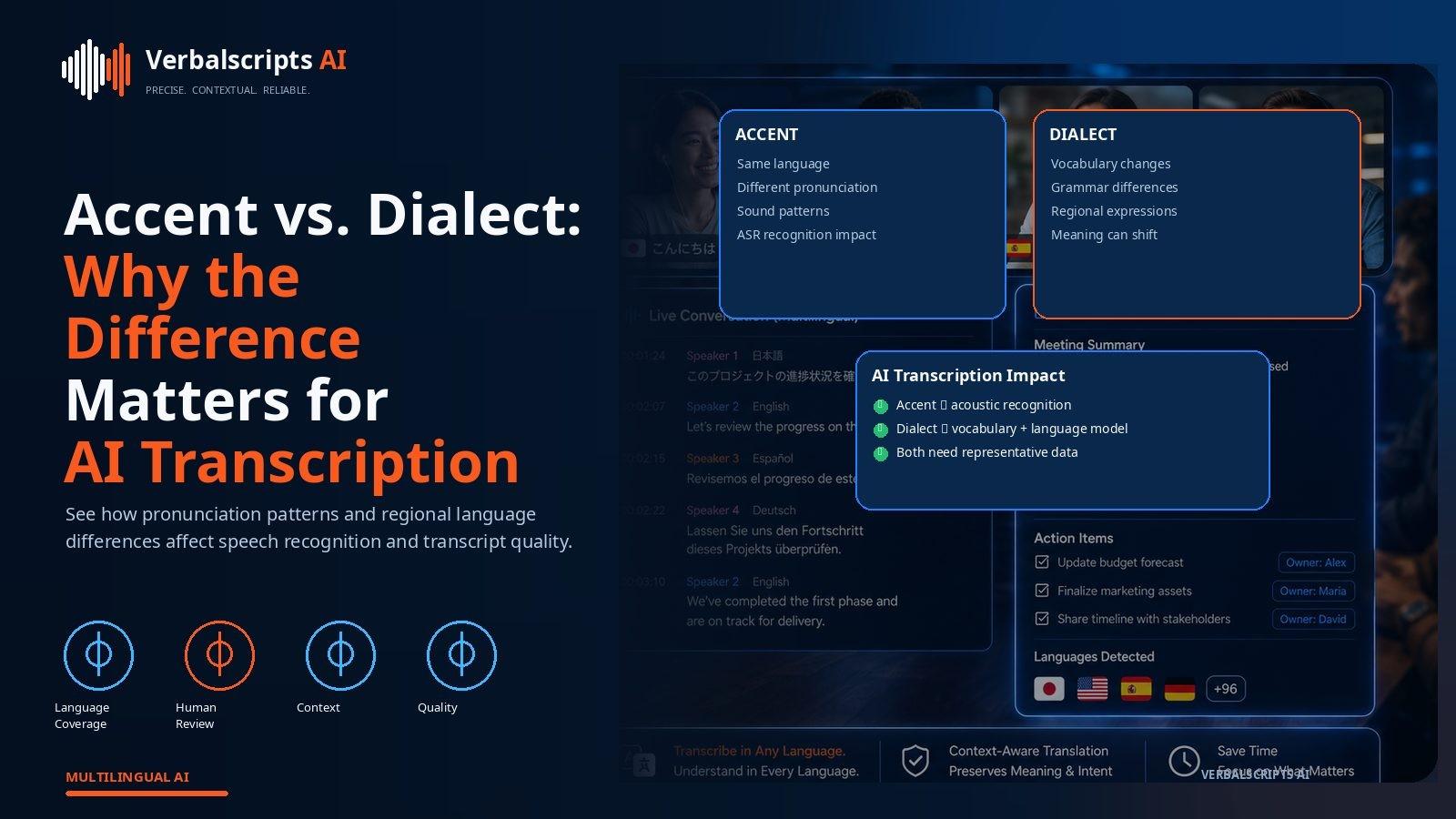
What is the difference between an accent and a dialect in AI transcription? An accent describes patterns of pronunciation. A dialect is a broader language variety that may differ in pronunciation, vocabulary and grammar. ASR can fail on an accent because sounds differ from training data; it can fail on a dialect even when pronunciation is clear because the model may not know local words or structures. Evaluation should therefore record both acoustic and linguistic variety rather than labeling every regional error as an “accent problem.”
| SEO title | Accent vs. Dialect: Why It Matters for AI Transcription |
|---|---|
| Slug | accent-vs-dialect-ai-transcription |
| Meta description | Learn the difference between accent and dialect and how pronunciation, vocabulary and grammar affect AI transcription quality and evaluation. |
| Primary keyword | accent vs dialect AI transcription |
| Search intent | Informational |
| Hero image | 175-accent-vs-dialect-ai-transcription.jpg |
| Hero alt text | Speech recognition comparison showing pronunciation differences for accents and vocabulary/grammar differences for dialects |
| Article body words | 1936 |
For production speech-to-text workflows, see our AI Transcription service for the delivery path behind the guidance in this article.
AI transcription systems are often described as having difficulty with “accents,” when the real challenge may include dialect vocabulary, grammar, code-switching or all three.
The distinction matters because the technical solution is different. Better acoustic training helps pronunciation variation. A dialect may also require language-model vocabulary and grammar coverage. A multilingual community may require language identification and code-switch handling.
The correct diagnosis leads to better data and model adaptation.
Accent
Accent relates to sound.
Features can include:
- vowel quality;
- consonants;
- rhythm;
- stress;
- intonation.
A speaker can have a strong accent while using standard vocabulary and grammar.
Dialect
Dialect includes:
- pronunciation;
- vocabulary;
- grammar.
Example:
A dialect may use a local word the standard language rarely uses.
ASR needs both acoustic and lexical coverage.
Why models fail on accents
Speech models learn mappings from:
- acoustic signal;
- text.
If training audio heavily represents one accent, unfamiliar acoustic patterns can cause substitutions.
The recognizer may hear a known word as a different word.
Why models fail on dialects
The model can hear sounds correctly but still prefer:
- standard vocabulary;
- standard grammar.
Rare local words may be replaced with more frequent words.
Accent data
Improving accent performance requires representative:
- speakers;
- microphones;
- genders/ages;
- regions.
Do not collect one speaker and call an accent “covered.”
Dialect data
Dialect datasets need:
- natural vocabulary;
- conversational domains;
- grammar.
Read speech from standard-language scripts will not capture real dialect usage.
Code-switching
Dialect communities may also code-switch.
This is separate again.
Example:
Swahili-English mixed conversation.
A monolingual recognizer may treat English words as Swahili errors.
Use multilingual ASR.
Evaluation labels
For an ASR benchmark, store:
- language;
- locale;
- accent;
- dialect;
- domain.
Use labels carefully and ethically.
Do not infer sensitive identity beyond what participants consent to.
WER by subgroup
Calculate WER per accent/dialect group.
Average WER can hide disparities.
Example:
- overall: 8%;
- accent A: 5%;
- accent B: 19%.
The system is not equally reliable.
Error analysis
Classify:
Acoustic substitution
Sound mapping issue.
Lexical substitution
Unknown local word.
Grammatical normalization
Dialect form changed.
Code-switch error
Embedded language mishandled.
This guides fixes.
Custom vocabulary
A vocabulary list can help dialect-specific:
- place names;
- products.
It does not solve acoustic mismatch.
Fine-tuning
If provider supports customization, accent/dialect data can improve:
- acoustic representation;
- lexical probabilities.
Evaluate on speakers not in training set.
Multilingual foundation models
Large multilingual speech models can generalize across accents because they see broader data.
But “multilingual” does not guarantee dialect parity.
Test.
Human transcription review
Native/dialect-aware reviewer can recognize:
- local word;
- pronunciation.
A standard-language reviewer may “correct” real dialect into something else.
Use reviewers who understand the speech community for high-fidelity transcription.
Verbatim policy
Decide whether to preserve dialect grammar.
Example:
Raw speech:
“He be working…”
Depending on dialect, this can have systematic grammatical meaning.
Normalizing it can erase meaning.
Research/evidence should preserve.
Business transcript normalization
For meeting minutes, a clean standard-language transcript may be preferred.
Make normalization a documented editorial choice.
Do not call the dialect “incorrect grammar.”
Names
Accent and local language can affect proper names.
Participant lists improve ASR.
Names deserve manual checks.
Telephony
Phone audio compresses frequencies.
Accent variation plus telephony can amplify error.
Test on actual channel.
Background noise
Do not attribute every error to accent.
Control for:
- mic;
- noise;
- SNR.
Fairness analysis should avoid confounds.
Accent adaptation
Useful techniques:
- diverse training;
- augmentation;
- fine-tuning.
Foundation speech models can reduce data needs but do not remove need for evaluation.
Low-resource dialects
Some dialects have:
- little written data;
- no standardized spelling.
This makes ASR evaluation difficult.
Work with language community.
Product language claims
Be careful with claims such as:
“Supports all English accents.”
Define:
- tested populations;
- conditions.
Transparent model cards or evaluation reports are more meaningful.
Customer experience
Accent bias can cause:
- failed voice command;
- wrong caption;
- longer support interaction.
Measure user outcomes.
Data ethics
Accent/dialect datasets relate to identity.
Use:
- informed consent;
- privacy;
- appropriate compensation;
- community respect.
Avoid collecting demographic data unnecessary to ASR evaluation.
Example error diagnosis
Audio contains a local word pronounced clearly.
If ASR outputs a phonetically similar standard-language word, ask:
- Did the acoustic model mishear the sounds? → accent/acoustic problem.
- Did it hear the sounds but prefer a more frequent standard word? → dialect/vocabulary problem.
- Was the word from another language? → code-switching problem.
Each diagnosis suggests a different intervention.
Data-collection design
For accent coverage, collect the same or comparable prompts from many speakers so acoustic variation can be isolated.
For dialect coverage, collect natural spontaneous speech that contains real local vocabulary and grammar.
Using only read standard sentences from dialect speakers tests accent much more than dialect.
Evaluation without stigmatizing language varieties
Do not label target speech as “bad grammar” because it differs from a prestige standard. The reference transcript should represent the project’s chosen transcription policy and respect systematic dialect forms.
For clean business notes, the organization may intentionally normalize the transcript. That is an editorial transformation and should be separated from the accuracy benchmark.
Product escalation
If one accent subgroup has much higher WER:
- verify recording conditions are comparable;
- inspect recurring phonetic substitutions;
- collect targeted data;
- test fine-tuning;
- repeat blind benchmark.
Do not hide the gap behind a global average.
User fallback design
Voice products should provide alternatives when recognition fails:
- text input;
- repeat prompt;
- human agent.
Fair speech technology is not only a model-training problem; it is also product design that avoids trapping users in repeated recognition failures.
Acoustic benchmark design for accents
To isolate accent performance, try to control other variables:
- similar microphone quality;
- similar speaking task;
- similar background noise.
If one accent group is recorded on studio microphones and another on phones, a WER difference cannot be attributed cleanly to accent.
Fair evaluation requires comparable conditions.
Dialect benchmark design
To test dialect rather than only pronunciation, include natural speech with:
- local vocabulary;
- grammar;
- discourse patterns.
Read speech from a standard-language script mostly tests accent. Spontaneous speech better represents dialect.
Product vocabulary and dialect interaction
A customer may use a local word for a product concept while documentation uses the standard term. ASR can recognize the local word correctly but downstream intent detection may fail.
Maintain mappings between:
- dialect term;
- standard concept;
- product intent.
This improves the end-to-end voice experience without rewriting the transcript.
Accent adaptation without stereotyping
Do not create one “accent model” based on a caricature. Collect diverse speakers within the target variety because real speech varies by:
- region;
- age;
- education;
- individual.
Model adaptation should represent actual users rather than a stereotyped pronunciation list.
Reporting limitations
When publishing internal ASR performance, state:
- dataset;
- speaker count;
- audio condition;
- variety labels;
- metric.
A statement such as “works with African accents” is too broad to be scientifically or operationally useful.
User-controlled correction
Voice products can learn from explicit user corrections such as:
“No, I said X.”
With appropriate privacy/consent, these interactions can reveal accent or dialect failures more directly than offline benchmarks.
The product should also offer a non-voice fallback so recognition inequality does not prevent task completion.
Building a representative accent corpus
For each speech variety, collect:
- multiple speakers;
- spontaneous and read speech;
- multiple devices;
- several topics.
Record only demographic metadata necessary for the evaluation purpose and handle it according to privacy policy.
The goal is to represent acoustic diversity, not to create a stereotype label.
Error examples by cause
Accent/acoustic: “sheet” repeatedly recognized as another acoustically similar word because vowel realization differs from training data.
Dialect/lexical: a local term is consistently replaced by a common standard-language term even though the sounds are clear.
Code-switch: an English technical noun inside another language is forced into a phonetic local-language sequence.
These patterns require different interventions.
Fairness thresholds
A product team can define an internal rule such as:
- investigate any major speaker-variety WER gap beyond the expected confidence interval;
- prioritize gaps that prevent task completion.
Do not chase identical WER mathematically if the datasets differ, but do not ignore persistent disparities.
User experience compensation
If ASR is weaker for a particular variety, product design can reduce harm while the model improves:
- easier correction;
- confirmation of critical names/numbers;
- text fallback;
- human escalation.
This is often faster than waiting for perfect acoustic parity.
Language-community review
When adapting a model to a regional variety, involve people who speak it in:
- data design;
- transcript guidelines;
- error analysis.
They can identify legitimate vocabulary and grammar that an outside team might mistakenly classify as noise.
Accent robustness in real products
A production voice system should periodically sample failed interactions rather than relying only on a static benchmark. Users change, microphones change and new geographic markets appear.
With appropriate privacy controls, categorize failures into:
- acoustic/noise;
- accent pronunciation;
- dialect vocabulary;
- code-switching;
- entity.
This prevents every error from being blamed on “accent” and directs investment to the actual cause.
Final rule
If a system performs differently across speech varieties, report the gap, investigate it and offer user correction/fallback. Reliable ASR is not achieved by asking users to sound more like the training data.
Confidence communication
Do not show users a generic “accent confidence” score. Instead, use recognition confidence internally and offer practical correction when the transcript is uncertain. Public labels about a person’s accent can be misleading and unnecessary. The system should communicate uncertainty about the transcription, not make judgments about the speaker.
Implementation takeaway
For production use, treat accent/dialect diagnosis, representative benchmarking and user fallback paths as measurable parts of the workflow rather than assumptions. Define the relevant policy before processing content, keep the model or data configuration versioned, and verify results on representative material from the actual language, locale and domain. If automation produces a result that conflicts with a deterministic rule, authoritative terminology or qualified human evidence, escalate the item instead of averaging the disagreement away. The most durable multilingual systems preserve source-to-target traceability, record exceptions and feed reviewed corrections back into benchmarks, glossaries or routing rules. That discipline makes quality improvements reproducible when models, providers, reviewers or source content change.
Frequently asked questions
Is every regional pronunciation a dialect?
No. Accent concerns pronunciation; dialect is broader.
Can accent cause transcription errors even if the language is supported?
Yes. Support lists do not guarantee equal performance across accents.
Can a glossary fix accent problems?
Not primarily. It helps lexical terms but not acoustic recognition.
Should AI normalize dialect?
Only if the project requires it. Preserve dialect for research/evidentiary use.
How should companies test accent fairness?
Use representative speakers and report WER/errors by relevant speech groups.
Conclusion
Accent and dialect are different sources of ASR variation.
Accents change how words sound. Dialects can also change which words and grammatical forms are used. Code-switching adds another layer.
Diagnose the actual failure, build representative data and evaluate subgroups. That produces better transcription systems than treating every non-standard speech pattern as one generic “accent” problem.
Research references
- African low-resource ASR review:
- DECM code-switching ASR benchmark:
- Google Speech-to-Text language support:
- Azure Speech language support: