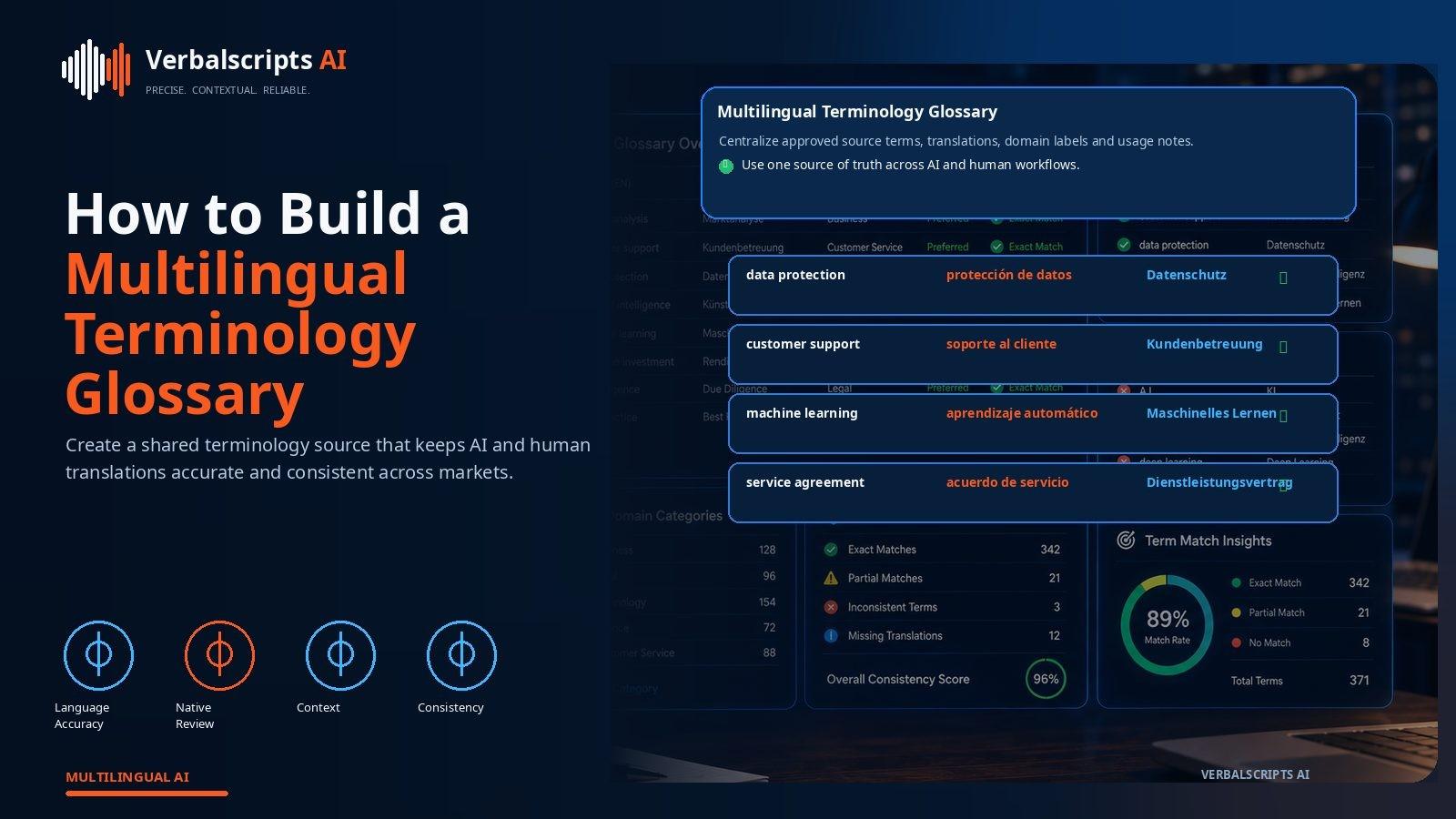
How do you build a multilingual terminology glossary? Create one concept record for each important idea, assign a stable concept ID and source definition, then add approved terms by language and locale with status, grammatical metadata, variants and usage notes. Assign owners, version changes and expose the glossary to AI translation and QA tools. Use a central database or termbase rather than one spreadsheet per language.
| SEO title | How to Build a Multilingual Terminology Glossary |
|---|---|
| Slug | build-multilingual-terminology-glossary |
| Meta description | Build a multilingual terminology glossary with concept IDs, definitions, locale-specific translations, governance, status, variants and QA integration. |
| Primary keyword | multilingual terminology glossary |
| Search intent | How-to / Enterprise |
| Hero image | 187-multilingual-terminology-glossary.jpg |
| Hero alt text | Multilingual termbase showing one concept linked to approved translations across many languages and locales |
| Article body words | 1975 |
For production multilingual workflows, see our AI Translation service for the delivery path behind the guidance in this article.
A multilingual glossary should not be a collection of independent bilingual spreadsheets.
At scale, terminology is concept management. One product concept can have names in 20 or 100 languages, with different grammatical forms, regional variants, official translations and status. The glossary should connect all of those expressions to one shared definition.
This structure makes AI translation more consistent and human review much easier.
The source word is not the concept. The concept should remain stable even if the source label changes.
Why concept-oriented terminology matters
Suppose product uses:
workspace
Definition:
shared environment containing projects and users.
One concept ID:
VS-TERM-001
Then:
- English: workspace;
- French: approved term;
- German: approved term.
If English product later changes label to “hub,” the concept can remain linked.
Source term versus concept
Words are ambiguous.
account:
- login account;
- bank account.
Create two concept IDs.
This prevents one translation rule applying to different meanings.
Core fields
Every concept:
- concept ID;
- definition;
- domain;
- source term;
- status;
- owner.
Every language entry:
- language/locale;
- approved term;
- grammatical info;
- variants;
- prohibited forms;
- note.
Definitions
Write definitions that distinguish nearby concepts.
Avoid circular:
Workspace: a workspace.
Better:
Collaborative container in the application that contains projects and member permissions.
Definitions help AI disambiguate.
Domain
Examples:
- legal;
- speech AI;
- billing;
- ecommerce.
Domain prevents collisions.
Language and locale
Use language tags where appropriate.
fr-FR can differ from fr-CA.
Do not store one “French” entry if product markets require distinction.
Script
Some languages use multiple scripts.
Store script in language tag or metadata.
Example:
- Serbian Latin/Cyrillic.
This affects display and transliteration.
Preferred term
One primary approved form.
Do not mark five synonyms all “preferred.”
If alternatives allowed, explain when.
Forbidden term
Record:
- deprecated;
- wrong market;
- misleading.
QA can search for these.
Abbreviations
Store:
- full term;
- acronym;
- first-use rule.
Acronym may remain English even if full term translated.
Grammar
Useful:
- part of speech;
- gender;
- plural;
- lemma.
Inflected languages need this.
Usage examples
Add a native example sentence.
It shows:
- grammar;
- context.
Use approved real content where possible.
Visual context
For UI term, attach:
- screenshot;
- component.
This prevents ambiguity such as “Home.”
Authority/source
For legal/medical term, record:
- standard;
- regulator;
- client approval.
This makes term decisions defensible.
Status
Workflow:
candidate → reviewed → approved → deprecated.
Only approved entries should control production.
Ownership
Assign:
- concept owner;
- language owner.
Concept owner decides meaning.
Language owner decides local term.
Governance
Changes require:
- proposal;
- review;
- effective date.
Notify translators/reviewers.
Versioning
Record version.
Projects store:
- termbase version.
This helps reproduce output.
Import/export
AI providers may accept simpler glossary formats.
Generate:
- CSV;
- TSV
from master termbase.
Do not let vendor format become master.
Translation API integration
At runtime:
- detect source term;
- retrieve target entry;
- provide to model.
If provider supports native glossary, upload it.
LLM retrieval
For large glossary:
- retrieve only relevant terms per segment/document.
This reduces prompt size.
QA integration
After translation:
- check required terms;
- forbidden;
- consistency.
Use morphology-aware matching.
Terminology extraction
AI can identify candidate terms from corpus.
Rank by:
- frequency;
- domain specificity;
- variation.
Human owners approve.
Existing translations
Mine translation memory for variants.
If one concept has 7 existing target forms, prioritize reconciliation.
Quality metrics
Track per language:
- glossary coverage;
- term accuracy;
- override;
- forbidden occurrence.
This measures termbase value.
Scaling to 100 languages
Central termbase needs:
- search;
- permission;
- workflow;
- API.
A spreadsheet becomes fragile.
Use terminology-management system or database.
Locale gaps
Not every concept needs 100 translations on day one.
Track:
- missing target.
Translate when locale launches.
Avoid machine-filling terms without review just to show 100% coverage.
Reviewer access
Reviewers need glossary inside tool.
Do not make them open separate PDF.
Terminology should appear contextually.
Source-writing use
Glossary also improves source authors.
Writers should use approved source terms.
This reduces localization ambiguity.
AI assistant use
Internal AI/chatbots can use same glossary.
Terminology becomes enterprise language infrastructure across:
- support;
- documentation;
- translation.
Concept modeling example
Consider three source strings:
- “member”;
- “team member”;
- “workspace member.”
They may all use the word “member,” but the product may define different concepts. Create separate concept records if their roles differ.
Each concept can point to:
- UI screenshots;
- permission definition;
- target terms.
This prevents AI from applying one global target word where the product needs a distinction.
Termbase validation rules
Automate data-quality checks on the glossary itself:
- duplicate concept IDs;
- two preferred terms for same locale;
- missing definition;
- target identical to forbidden term;
- deprecated term marked active.
A broken glossary can propagate errors faster than no glossary because the AI treats it as authoritative.
Bulk terminology import
When migrating existing spreadsheets:
- normalize language codes;
- deduplicate source terms;
- cluster likely concepts;
- preserve legacy variants;
- assign owners;
- approve high-priority terms first.
Do not mark every imported row as “approved.” Migration is an opportunity to clean years of accumulated inconsistencies.
Linking terminology to source content
When a term changes, search the source corpus as well as translations. If writers continue using the deprecated source label, the localization system will repeatedly encounter ambiguity.
Terminology management should therefore connect to authoring, not only translation.
Term usage analytics
Track:
- where a term appears;
- which content uses deprecated variants;
- which locales have missing approved targets.
Usage data helps product/localization teams prioritize which term decisions matter most rather than spending equal effort on obscure vocabulary.
Build terminology from concepts, not English strings
An English source label can change without the underlying concept changing. If the termbase is keyed only by source text, a rebrand can accidentally create a new concept and duplicate every target translation.
Use a stable concept ID, then store:
- preferred source labels over time;
- target terms;
- aliases.
This separates product semantics from wording.
Termbase architecture example
A relational design can include:
Concept table
- concept ID;
- definition;
- domain;
- owner;
- priority.
Term table
- concept ID;
- language tag;
- term;
- status;
- grammatical metadata;
- preferred/forbidden;
- source/authority.
Context table
- screenshot;
- example sentence;
- product location.
This structure supports both human review and AI retrieval.
Critical-term coverage
Before launching a locale, compute coverage only for the terms that matter most.
Example:
- P0 critical: 100% required;
- P1 product: 95%;
- P2 editorial: can grow over time.
A raw “70% of all glossary terms translated” metric can be misleading if all critical terms are complete.
Synonym governance
Some locales legitimately use two forms:
- long technical term in documentation;
- shorter UI label.
Store them as context-dependent preferred variants, not competing “preferred” terms without explanation.
The AI request should include the content type so the correct variant is retrieved.
Termbase and translation memory interaction
If the termbase changes, historical TM entries may contain the old target term. Do not delete the TM. Flag matching segments for review or apply safe term substitution with human verification.
Approved historical sentences remain valuable context even when one term evolves.
Entity versus terminology
Personal names, company names and product IDs may belong in an entity database rather than a linguistic termbase. Link the systems where useful:
- concept terminology controls meaning;
- entity records control identity and official spellings.
This prevents the glossary from becoming an unmanageable mixture of concepts and every client name ever encountered.
AI-assisted candidate mining
Use frequency and variation analysis to find terms that:
- occur often;
- have multiple existing translations;
- generate reviewer edits.
These are high-value candidates. Human domain owners then decide whether the word deserves controlled status.
Reviewer context
When a reviewer clicks a term, show:
- definition;
- target;
- example;
- status;
- owner.
Do not expect them to search a separate spreadsheet during every edit.
Terminology change governance
A target-language owner can propose a change, but strategic terms may need:
- product approval;
- legal approval;
- brand approval.
Record the rationale and effective date.
Public glossary versus internal glossary
Some organizations publish customer terminology. Keep confidential entries separate:
- internal codenames;
- unreleased products;
- client-specific terms.
Access control should apply at termbase level where necessary.
Metrics
A healthy termbase should show:
- low reviewer override on approved terms;
- declining forbidden-term occurrence;
- fast resolution of high-priority candidates;
- high coverage in active locales.
The goal is fewer language decisions repeated in production.
Terminology onboarding for a new locale
A new language should not begin by translating the entire global termbase blindly. Start with:
- brand terms;
- core product concepts;
- terms present in launch content.
Then expand based on usage.
This reduces language-owner workload and avoids translating concepts that may never appear in that market.
Locale-specific definitions
Sometimes a source concept needs additional explanation in a locale because no direct term exists. Store a local usage note such as:
Use target term X; first occurrence in consumer content may include short descriptive explanation.
This gives AI and reviewers a consistent adaptation rule.
Inflection templates
For morphologically rich languages, the termbase can store:
- lemma;
- grammatical gender/class;
- common inflected examples.
Do not enumerate every surface form. Give the translation system enough metadata to produce correct grammar and the QA system enough information to recognize valid variants.
Terminology for subtitles and voice
Short timed media may need a concise target variant even when documentation uses a long formal term. Store:
- formal term;
- approved short variant;
- content context.
This prevents subtitle editors from inventing abbreviations that conflict with product language.
Termbase review after product analytics
If users repeatedly search a different word from the official product term, the organization may need:
- search alias;
- content explanation;
- terminology reconsideration.
Terminology governance should learn from real user language without changing product names impulsively.
Preventing glossary leakage across clients
A managed translation service must isolate client-specific termbases. One customer’s proprietary product name should never appear as a glossary suggestion in another customer’s project.
Treat terminology as potentially confidential data.
API rate and termbase size
Provider glossary systems can impose size/format limits. Keep the rich master termbase internally and generate smaller domain-specific exports where needed.
This also improves precision by reducing irrelevant term matches.
Localization-team workflow
When a translator encounters a new concept:
- search termbase;
- if missing, translate provisionally according to policy;
- create candidate term;
- language owner reviews;
- high-impact concept owner approves;
- approved entry propagates.
This turns ad hoc discoveries into organized vocabulary growth.
Final principle
A multilingual glossary is successful when reviewers spend less time asking “how do we translate this?” and more time handling genuinely contextual language. The system should make recurring decisions once and reuse them everywhere.
Frequently asked questions
Should the glossary be English-centered?
Use a source language operationally, but concept definitions should be independent enough to support multilingual meaning.
How many terms can a termbase handle?
Potentially thousands/millions; quality of governance matters more than raw count.
Should every variant be stored?
Store variants that help recognition or QA, not every possible inflected form when morphology can handle it.
Can AI approve terminology?
It can recommend, but important terms need human/domain approval.
Who owns a term?
Usually business/domain owner for concept plus language owner for local form.
Conclusion
A multilingual glossary is a map from concepts to approved language.
Build it around stable definitions and IDs, not source words. Add locale-specific forms, governance and ownership. Integrate it with AI generation and QA.
This turns terminology from a translation afterthought into reusable multilingual infrastructure.
Research references
- Microsoft Learn, Localization overview:
- Google Cloud glossaries:
- AWS custom terminology:
- WMT 2023 Terminology Shared Task:
- W3C language tags: