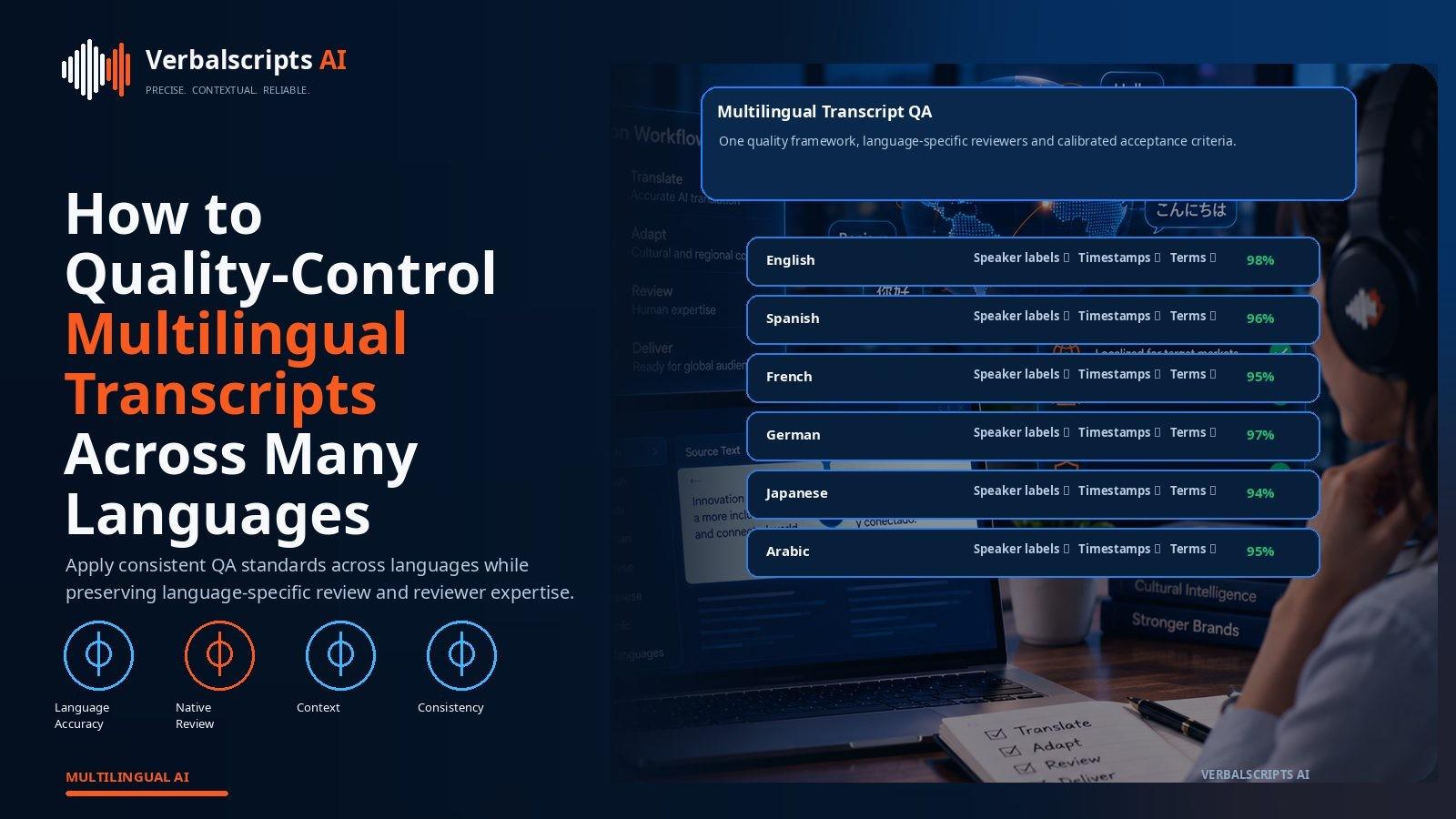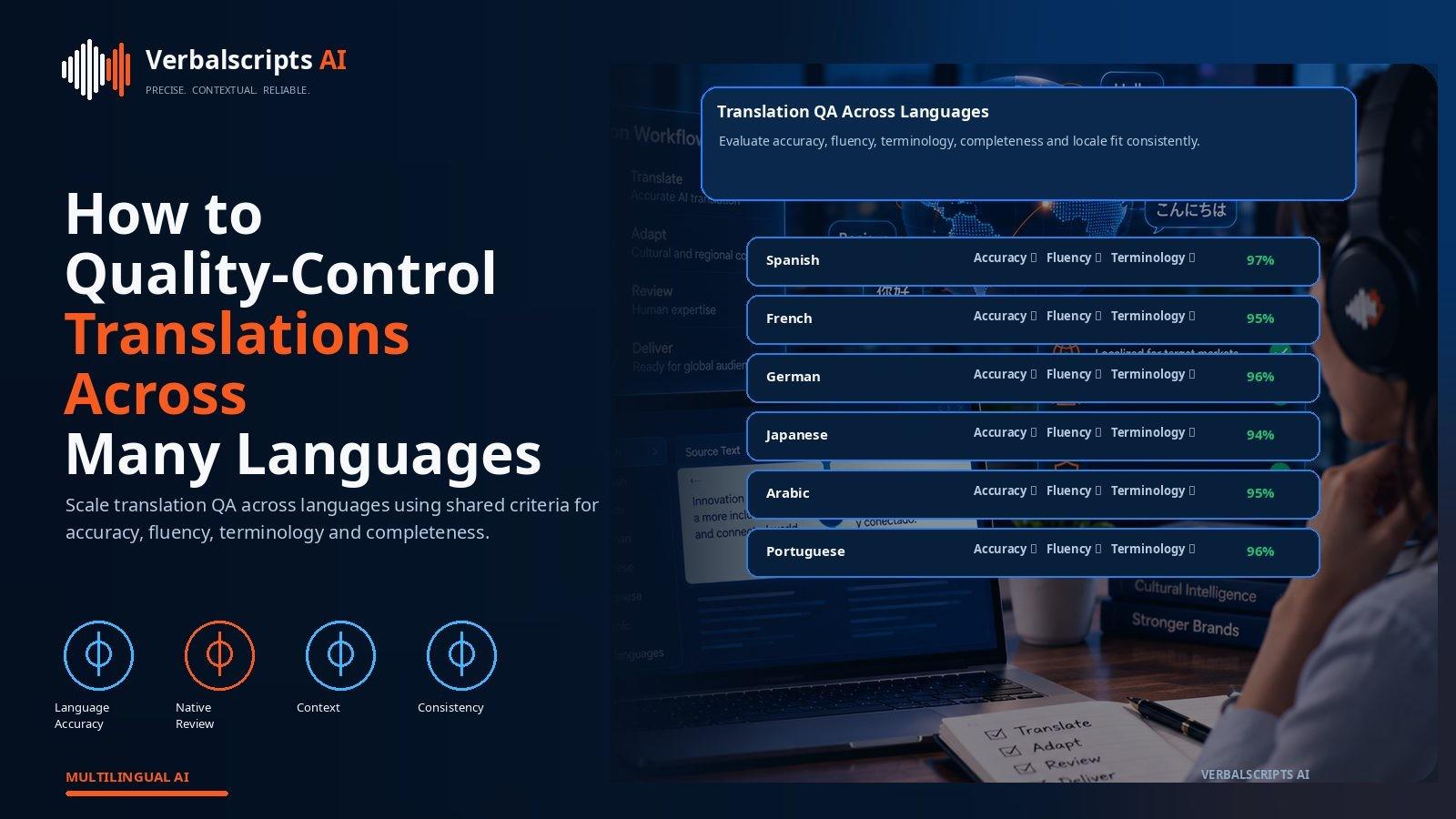
How do you quality-control translations across many languages? Define one global error framework and risk policy, then localize the linguistic rules through locale-specific glossaries and style guides. Use automated checks for numbers, placeholders, terminology and completeness; use automatic metrics or LLM judges for triage; and use qualified native/bilingual reviewers for sampled or high-risk content. Track quality per language, content type and model so weak locales cannot hide behind global averages.
| SEO title | How to Quality-Control Translations Across Many Languages |
|---|---|
| Slug | quality-control-translations-many-languages |
| Meta description | Learn how to QA translations across many languages with shared quality standards, locale reviewers, terminology, sampling, automation and dashboards. |
| Primary keyword | multilingual translation quality control |
| Search intent | How-to / Enterprise |
| Hero image | 186-multilingual-translation-quality-control.jpg |
| Hero alt text | Global translation quality dashboard comparing critical errors, terminology and review status across many languages |
| Article body words | 1923 |
For production multilingual workflows, see our AI Translation service for the delivery path behind the guidance in this article.
A multilingual translation program becomes difficult when quality decisions are made independently in every language.
One reviewer treats a synonym as a major terminology error. Another rewrites every sentence for style. One locale has a mature glossary while another has no approved vocabulary. An overall “average quality” score can hide serious failure in a smaller market.
Quality control across many languages therefore needs a shared operating model with local expertise.
Consistency of the QA process matters as much as consistency of the translation itself.
Global quality framework
The global layer should define:
- accuracy;
- omission/addition;
- terminology;
- fluency;
- style;
- locale;
- severity.
A simplified MQM-inspired taxonomy works well.
Everyone uses the same concepts.
Locale-specific interpretation
Some rules are local.
Example:
- punctuation;
- formal pronoun;
- word spacing.
Create locale addenda.
A “style error” should reflect local guide.
Quality tiers
Classify content.
Tier 1: low risk
AI + automated checks + sample.
Tier 2: customer-facing
AI + human review/sampling.
Tier 3: high risk
Full bilingual + specialist.
This prevents reviewing every blog post like a medical label.
Language tiers
Also classify language maturity:
Mature
Strong model + glossary + reviewers.
Developing
New or moderate data.
High-attention
Low-resource or quality gaps.
Content risk and language maturity combine.
Centralized terminology
One concept-based termbase supports every locale.
Each term has:
- concept ID;
- definition;
- language target;
- owner;
- status.
This makes 50-language changes manageable.
Style guides
Use:
- global brand core;
- locale guide.
Reviewers should not invent tone policy.
Automated checks
Every language can receive:
- placeholder validation;
- number comparison;
- source-target completeness;
- forbidden term search;
- script validation.
Some checks need language-specific rules.
Language/script validation
If target Japanese contains large unexplained Russian/Cyrillic blocks, flag.
But borrowed Latin product names may be valid.
Create script policies.
Machine metrics
Metrics such as COMET can monitor:
- system changes.
Do not compare absolute scores blindly across languages.
Calibrate against human quality for each pair.
LLM judge
Can apply common rubric in many languages.
Benchmark it per language.
Low-resource/cultural content can challenge judge.
Use it for routing.
Human sample
Use stratified sampling.
Include:
- language;
- domain;
- content risk;
- AI confidence.
Random-only sample may miss critical categories.
New-language launch
Review more heavily during first phase.
Example:
- 100% of first 20k words;
- then reduced if quality stable.
Thresholds should be data-driven.
Reviewer calibration across languages
Reviewers cannot compare actual wording across languages, but can align on:
- severity;
- error categories;
- acceptance.
Use translated examples of the same error concepts.
Locale owner
Each strategic locale should have someone who decides:
- terminology;
- style.
This prevents reviewer disputes.
Quality dashboard
Per language:
- major/critical errors;
- term accuracy;
- review pass rate;
- edit rate;
- turnaround.
Drill down by:
- model;
- domain.
Global average danger
Suppose:
- English→Spanish: 1M words at 99% pass;
- English→Amharic: 10k words at 70%.
Global weighted pass looks excellent.
The smaller language is failing users.
Show unweighted locale views.
Critical-error rate
Track separately.
One wrong medical dose outweighs 100 minor punctuation problems.
Quality thresholds should include:
- zero critical in reviewed high-risk.
Reviewer edit rate
Useful but ambiguous.
High edit rate may mean:
- poor AI;
- over-editing reviewer.
Combine with categorized errors.
Quality drift
A provider updates model.
One language improves, another declines.
Regression set should include every priority locale.
Source changes
A source rewrite can affect quality.
Example:
marketing becomes idiomatic.
Monitor quality by content cohort.
Reviewer changes
A new reviewer can shift scores.
Calibration and audits catch this.
Vendor comparison
Use same test content.
Blind review.
Compare per language.
Do not select vendor based on strongest average.
Cross-language consistency
Some content needs semantic consistency across locales.
Examples:
- legal promise;
- feature definition;
- price.
Use a source-of-truth definition.
Do not back-translate all languages mechanically as only check.
Multi-market SEO
Keyword choices differ.
Translation quality rubric for SEO content should include:
- natural local query language.
Do not force same keyword literal translation.
Cultural fit
High-visibility pages benefit from in-market review.
2026 culture-aware MT research confirms cultural translation remains a distinct challenge.
Low-resource quality
Use higher human review.
Also invest in:
- evaluation data;
- terminology.
A small high-quality test set is valuable.
Incident workflow
If one locale has a critical error:
- remove/correct;
- search similar content;
- root-cause;
- update rule;
- re-evaluate.
Do not treat it as isolated typo if systemic.
Quality governance meeting
Review periodically:
- languages below threshold;
- critical incidents;
- model changes;
- term disputes.
Multilingual quality needs ownership.
A cross-language quality council
A monthly or quarterly council can include:
- localization lead;
- several locale owners;
- AI/engineering;
- content/domain representatives.
Review:
- critical incidents;
- languages with declining quality;
- glossary changes;
- model updates.
The council should make decisions, not only present dashboards. Assign an owner and deadline for every issue.
Benchmark normalization
Because metric distributions vary by language, a global dashboard can store both:
- raw metric;
- human-calibrated risk band.
Example:
- green = historically correlated with publishable quality for this language/domain;
- yellow = sample review;
- red = mandatory review.
This is more actionable than comparing a German COMET score directly with a Japanese score.
Source-language quality as a multilingual variable
If the English source uses inconsistent terminology, every language can appear to have a terminology problem. Track source defects separately and fix them upstream.
A multilingual quality program should be willing to reject a source string for clarification rather than forcing 50 language teams to interpret it independently.
Cross-locale consistency audits
Periodically select critical concepts and compare how they appear across locales:
- feature definition;
- pricing condition;
- privacy promise;
- safety instruction.
The target words need not look structurally similar, but the business meaning should be consistent. A concept-level audit is particularly valuable after major product or policy changes.
Quality budgets
Organizations can assign a review budget by risk and locale. Instead of “review 10% everywhere,” allocate more human review to:
- new languages;
- high-error languages;
- critical pages.
This makes quality investment responsive to evidence rather than equal by volume.
Cross-language adjudication framework
When a global concept is disputed, separate two questions:
- Is the target semantically equivalent to the source concept?
- Is it the best local expression?
The global domain owner helps answer the first. The locale owner answers the second. A quality lead arbitrates when business consistency and local naturalness conflict.
This prevents global stakeholders who do not speak the target language from dictating awkward wording solely for visual similarity.
Quality calibration packets
Create a packet for every reviewer containing:
- error taxonomy;
- severity examples;
- glossary;
- locale style guide;
- ten benchmark segments with approved decisions.
Reviewers periodically repeat a subset to ensure scoring remains aligned.
Machine-evaluation calibration by language
For every automatic metric or LLM judge, measure how well it predicts:
- human pass/fail;
- major errors;
- critical errors.
A metric can have strong overall correlation but weak critical-error recall. Use it only for the decisions it is validated to support.
Cross-language quality incident analysis
A single source change can create different target errors. For example, a new ambiguous product term may be:
- mistranslated in Spanish;
- copied in English in Japanese;
- translated inconsistently in Arabic.
Root cause is one source terminology problem. Incident analysis should look across locales rather than treating each target separately.
Reviewer preference control
Track edits categorized as:
- required;
- preference.
If one language shows far more preference edits than others, review the style guide or reviewer behavior. Uncontrolled stylistic editing makes quality data difficult to compare and increases cost.
Quality goals for translated UI versus long-form content
UI:
- terminology;
- length;
- functional clarity.
Long-form:
- discourse;
- consistency;
- naturalness.
Use the same accuracy standard but different secondary metrics. A universal scorecard can hide these content-specific needs.
Language launch gates
Before a language is declared production-ready, require:
- minimum benchmark size;
- no unresolved critical errors;
- termbase coverage;
- locale guide;
- reviewer availability;
- model/provider approved.
This makes quality part of the launch definition.
Mature-language review reduction
Once a language shows stable performance over multiple periods, reduce sampling cautiously. Keep:
- random audit;
- all high-risk review;
- automatic checks.
If error rate rises, automatically increase review again.
Quality ownership
Each dashboard alert should have a responsible owner. It is not enough to know that Japanese quality is yellow; someone must investigate and close the issue.
Operational accountability is what turns multilingual measurement into quality control.
Quality weighting by business impact
A multilingual program can map error categories to business consequences.
For example:
- wrong product term → support burden;
- wrong price → revenue/legal risk;
- awkward grammar → brand quality;
- wrong date → missed deadline;
- cultural mismatch → conversion/reputation.
This helps decide which metrics deserve hard release gates.
Benchmark refresh strategy
Keep two sets:
Stable regression set
- rarely changes;
- supports model comparisons over time.
Rolling production challenge set
- adds recent real errors;
- reflects new products and language trends.
The stable set gives comparability; the rolling set prevents the benchmark from becoming obsolete.
Multilingual source QA
Before translation, run source-quality checks:
- ambiguous pronouns;
- inconsistent terminology;
- unexplained acronyms;
- malformed sentences.
A source issue affecting 50 languages should be fixed once upstream instead of discussed 50 times downstream.
Review sampling by traffic
For web content, combine risk with usage. A high-traffic pricing page deserves more frequent multilingual audit than an old low-traffic blog post, even if both are customer-facing.
Traffic should not replace criticality; legal/safety pages remain high priority regardless of views.
Cross-language release coordination
For global launches, decide whether:
- all locales publish simultaneously;
- Tier-1 first;
- targets publish when individually approved.
Each approach has tradeoffs. The quality system should represent locale readiness explicitly rather than forcing a launch manager to track it manually.
Translation rollback
Maintain previous approved target versions. If a new model or terminology release introduces a serious defect, roll back affected locales quickly.
Rollback is a localization reliability feature analogous to software rollback.
Reviewer disagreement data
Track which categories cause most disagreements:
- terminology;
- formality;
- style;
- cultural adaptation.
Use that data to improve the global/locale guides.
Final maturity model
A mature multilingual QA operation can answer in minutes:
- Which locales are below threshold?
- Which model/version produced them?
- Which critical errors occurred?
- Which reviewers are available?
- Which source changes made targets stale?
If those questions require days of manual spreadsheet work, quality operations have not yet scaled with language count.
Frequently asked questions
Should all languages use the same quality score threshold?
The acceptance principle can be shared, but metric distributions and linguistic rules may differ. Calibrate per language.
Can one reviewer cover several languages?
Only if qualified. Locale ownership should reflect actual expertise.
How do you QA a long-tail language with little volume?
Review a larger percentage and maintain representative benchmark data.
Which errors should be automated?
Numbers, placeholders, completeness, strict terms and script/format rules.
How do you prevent smaller languages being ignored?
Report quality per locale and include minimum per-language standards.
Conclusion
Quality control across many languages is a governance and measurement system.
Standardize error concepts and risk, localize linguistic rules, automate deterministic checks and keep qualified people in the loop. Most importantly, measure each language independently.
Scale should increase access without creating a hidden two-tier quality system between major and smaller languages.
Research references
- WMT 2024 Metrics Shared Task:
- MQM scoring models:
- Culture-Aware MT (ACL 2026):
- Survey of Low-Resource MT: