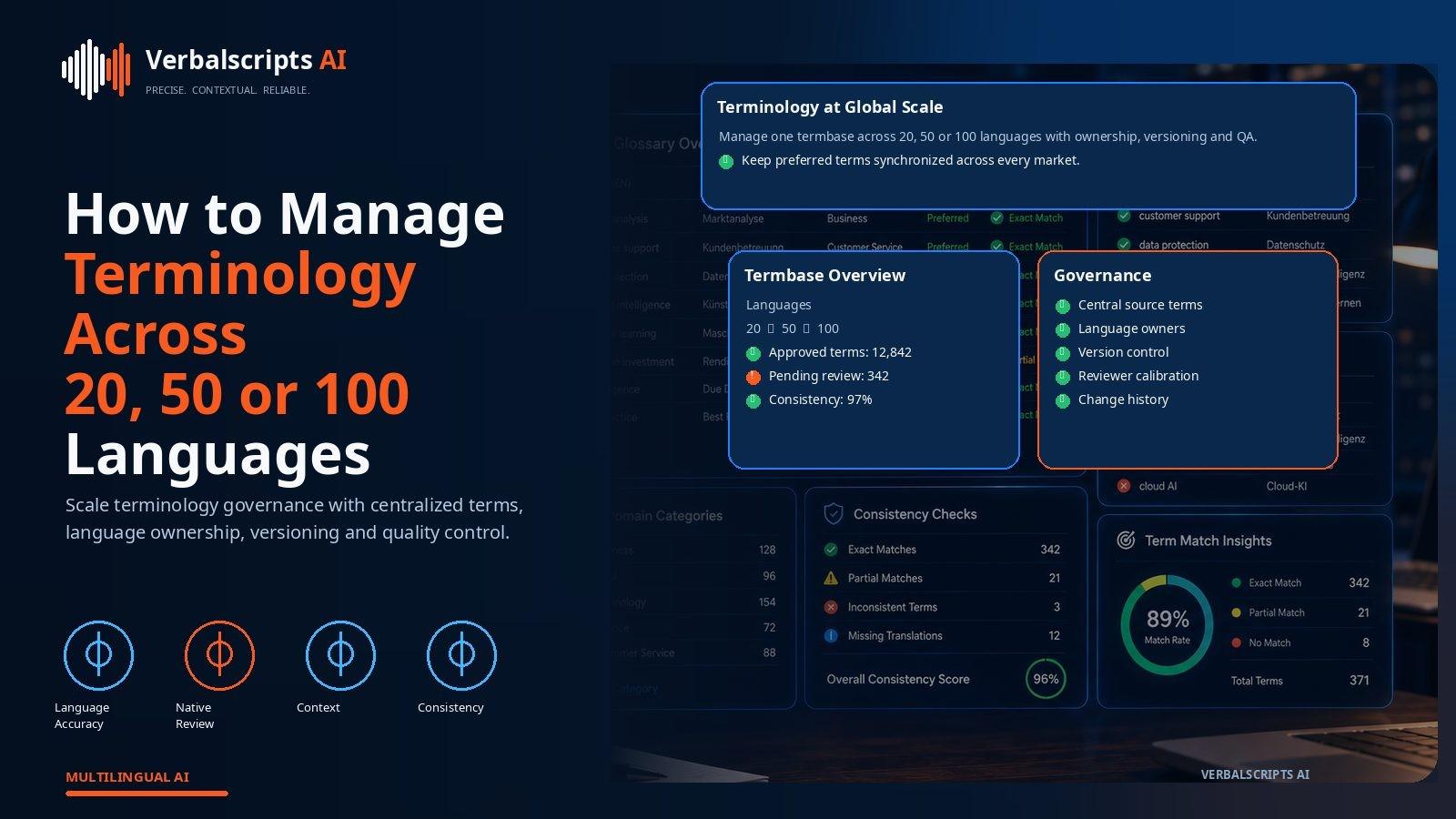
How do you manage terminology across dozens of languages? Centralize terminology around stable concept IDs and definitions, assign target terms by locale, designate concept and language owners, use approval statuses and versioning, integrate the termbase with translation/authoring systems, automate coverage and forbidden-term checks, and roll changes out through a controlled release process. Measure coverage, accuracy and reviewer overrides per language.
| SEO title | How to Manage Terminology Across 20, 50 or 100 Languages |
|---|---|
| Slug | manage-terminology-20-50-100-languages |
| Meta description | Learn how to manage terminology across dozens of languages using concept-based termbases, locale owners, workflows, versioning, QA and automation. |
| Primary keyword | manage multilingual terminology |
| Search intent | How-to / Enterprise |
| Hero image | 188-manage-terminology-100-languages.jpg |
| Hero alt text | Enterprise terminology governance dashboard showing concept coverage, approvals and quality across 100 language locales |
| Article body words | 1996 |
For production multilingual workflows, see our AI Translation service for the delivery path behind the guidance in this article.
Terminology management becomes a governance problem at scale.
At five languages, a localization manager can coordinate changes by email. At 100 languages, one product rename creates 100 translation decisions, reviewer tasks, software updates and QA checks.
The answer is a concept-based termbase plus a controlled change workflow.
The key is to manage one concept across many languages, not many isolated word pairs.
Scale math
1,000 concepts × 50 languages = 50,000 language entries.
Manual spreadsheets become:
- hard to search;
- easy to conflict;
- impossible to audit.
Use database/terminology system.
Concept layer
One row/entity:
- ID;
- definition;
- domain.
Language children:
- target term;
- locale;
- status.
This prevents duplicate concepts.
Language owners
Each language/locale needs:
- accountable reviewer.
They approve new terms.
For lower-volume locales, external linguist can fill role.
Concept owners
Product/domain owner decides:
- what feature means.
Linguist should not guess product semantics.
Workflow states
Example:
- proposed;
- domain reviewed;
- sent to locales;
- language approved;
- published;
- deprecated.
The system tracks progress.
Coverage dashboard
For each concept:
- 37/50 locales approved.
For each locale:
- 95% critical terms covered.
This makes gaps visible.
Priority levels
Terms:
P0
Brand/legal/safety.
Require all active locales.
P1
Customer-facing product.
P2
Long-tail content.
Prioritization helps launch.
Product rename
When “Project Space” becomes “Workspace”:
- concept stays same or new? decide;
- update source label;
- notify locale owners;
- approve local changes;
- scan existing content;
- publish.
Do not automatically retranslate without context.
Deprecation
Keep deprecated target term for QA.
Mark:
- do not use after date.
Search existing translations.
Terminology release notes
Tell teams:
- changed terms;
- effective date;
- affected product.
Reviewers need update.
AI integration
Translation system retrieves relevant approved terms.
Do not send all 50,000 entries in every prompt.
Use:
- source match;
- semantic retrieval.
Exact versus flexible enforcement
P0 product name:
- exact.
Descriptive marketing concept:
- flexible.
Store enforcement type.
Morphology
Target term changes form.
QA should support:
- lemma.
Do not force ungrammatical exact strings.
Translation memory update
When term changes:
- old TMs contain old form.
Update rules:
- flag;
- batch replace with review.
Do not destroy historical data blindly.
Source content governance
Writers should use approved source terminology.
If source uses 3 synonyms, target term control becomes harder.
Integrate term checker into authoring.
Search
Termbase needs:
- source;
- target;
- definition;
- ID.
Support fuzzy search.
API
Expose terminology via internal API.
Applications can use same terms:
- help center;
- chatbot.
This creates enterprise consistency.
Permissions
Not everyone should approve.
Roles:
- propose;
- approve;
- publish.
Record audit trail.
Versioning
Termbase version can be:
- global release;
- entry history.
A translation record should reference version/time.
Conflicts
Two business units may use same source term differently.
Use:
- domain-specific concepts.
Do not force one global translation where meanings differ.
Regional differences
Spanish terms may differ:
- Mexico;
- Spain.
Store locale-specific.
A “global Spanish” term can exist only if business chooses it.
Reviewer override
If translator rejects term:
- submit exception;
- reason.
High override rate means term may be bad.
Metrics
Coverage
approved entries / required.
Compliance
correct term occurrences.
Time to approve
workflow speed.
Override rate
term usability.
SLA for terms
For product launches:
- P0 translation due in 2 days.
Terminology can become launch dependency.
Plan.
Low-resource languages
Term creation may need:
- community experts;
- domain explanation.
Do not auto-generate without validation.
Terminology can help compensate for weak model domain coverage.
Script variants
Some languages use:
- multiple scripts.
Termbase should distinguish.
Example:
- Serbian Latin/Cyrillic.
Transliteration
Names may use romanization rules.
Store approved forms.
Link to entity database.
Scaling people
100 languages do not require 100 full-time employees.
Use:
- core localization team;
- vendor network;
- locale owners on demand.
System coordinates decisions.
Terminology council
For strategic terms, small cross-functional group:
- product;
- brand;
- legal;
- localization.
Avoid committee for every minor word.
Change blast-radius analysis
Before publishing a terminology change, calculate:
- number of source occurrences;
- number of target locales;
- active pages/documents;
- UI components;
- TMs.
A global product rename can touch tens of thousands of strings. Blast-radius analysis helps schedule reviewers and avoid half-completed migrations.
Terminology release workflow
A controlled release can use:
- concept decision approved;
- Tier-1 locales translated;
- language QA;
- product strings updated;
- documentation updated;
- remaining locales;
- deprecated-term scan.
Keep old and new versions during the transition so QA can distinguish legacy content from newly noncompliant content.
Resolving locale disagreements
Sometimes two countries using the same language prefer different terms. Do not force one global target simply for database simplicity.
Store:
- language-neutral default where appropriate;
- locale overrides.
The termbase should represent real linguistic requirements, not flatten them.
AI proposals for missing locales
AI can draft a target for a locale with no approved term and attach:
- definition;
- related-language forms;
- context examples.
Mark the result candidate, not approved. This speeds language-owner work without making machine suggestions policy.
Governance metrics for large programs
In addition to translation accuracy, monitor the health of the terminology operation:
- median approval time;
- number of P0 terms missing a locale;
- deprecated terms still live;
- reviewer overrides;
- unresolved disputes.
These metrics show whether the organization can actually keep 100-language terminology current.
Operating model for 100 languages
A scalable team can use three layers:
Central terminology team
Owns:
- concept definitions;
- tools;
- governance;
- priority.
Locale owners
Own:
- target-language terms;
- local usage.
On-demand domain experts
Resolve:
- legal;
- medical;
- engineering concepts.
This avoids asking one global linguist to approve 100 languages while keeping one source of truth.
Batch term creation
For a new product launch with 200 new concepts:
- source/product owner approves definitions;
- Tier-1 languages receive terms first;
- AI can draft candidate translations for remaining locales;
- language owners approve;
- coverage dashboard tracks gaps;
- production translation retrieves approved entries only.
This is faster than translating concepts ad hoc inside every document.
Priority-based translation of terms
Not every locale needs all 200 terms before launch if some features are not available in that market. Link terminology coverage to product availability.
A termbase should support:
- required locale list per concept;
- not applicable status.
This avoids treating intentionally irrelevant terms as missing.
Conflict-resolution SLA
Terminology disputes can block launches. Define response targets:
- P0 legal/brand term: resolve within 1 business day;
- normal product term: within several days.
The exact SLA varies, but unresolved terminology should be visible rather than lost in email threads.
Automated propagation
When a term becomes approved:
- update AI glossary exports;
- update reviewer tools;
- flag deprecated occurrences;
- notify affected locale teams.
Automation makes the governance decision operational immediately.
Bulk validation after rebrand
A rebrand can affect:
- UI;
- help;
- website;
- subtitles;
- TM.
Run a corpus search across all locales for:
- old source;
- deprecated target variants;
- transliterations.
Use content IDs to distinguish historical archives that should remain unchanged.
Termbase analytics by business impact
Rank unresolved terms by:
- frequency;
- page traffic;
- product criticality;
- languages affected.
This focuses scarce language-owner time where it saves the most downstream work.
Reviewer override workflow
If a linguist believes an approved term is wrong:
- use the term for current job if policy requires, or flag/block if unsafe;
- submit a terminology issue;
- owner adjudicates;
- change propagates globally.
Avoid silent local deviations that destroy consistency.
Vendor coordination
Every vendor should receive the same current termbase version. Track which jobs used which version. A vendor cannot be held accountable for a term change that was never distributed.
Resilience and backup
Terminology infrastructure can become business-critical. Back up:
- database;
- audit history;
- attachments.
Test exports. A termbase outage during a major launch can affect every translation workflow.
Final scaling principle
As language count grows, the organization should make fewer individual terminology decisions per project, because more decisions are resolved centrally in advance. That is the operational benefit of terminology management at scale.
Terminology platform requirements at large scale
A 100-language program benefits from features such as:
- concept-centric data;
- role-based approval;
- bulk import/export;
- history;
- API;
- locale filters;
- attachments/context;
- workflow notifications.
A spreadsheet can still be exported for convenience, but it should not be the only authoritative system.
Language-owner workload planning
If a product adds 500 concepts and 50 locales, that is 25,000 potential target decisions. Prioritize:
- which concepts are actually needed per locale;
- criticality;
- launch date.
AI candidate generation can reduce drafting time, but human approval capacity remains a planning constraint.
Parallel approval
Language owners can work concurrently once the concept definition is stable. Do not begin locale term creation before product teams agree what the source concept means.
A disputed English label propagated into 100 languages creates enormous rework.
Quality gates for term publication
Before a target term becomes approved, require:
- definition reviewed;
- locale correct;
- spelling/diacritics checked;
- no conflict with another concept;
- usage example if high risk.
Automated validation can catch duplicates and missing fields; language owners judge the term.
Terminology change impact on search and SEO
Changing a public term can affect:
- internal search;
- organic search;
- help-center findability.
Consider maintaining old target forms as search aliases even after they become deprecated in visible content.
Translation vendors and sync
If external vendors cache glossaries, define synchronization:
- version number;
- effective date;
- API/webhook or scheduled export.
A central termbase is only useful if production tools receive updates promptly.
Emergency terminology changes
Security incidents, regulatory changes or rebrands may require urgent global term replacement. Maintain:
- P0 notification channel;
- affected-content search;
- rapid locale approval;
- rollout report.
This is easier when term usage is indexed by content ID.
Term deletion versus deprecation
Do not hard-delete a historical term simply because it is no longer preferred. Deprecation preserves:
- history;
- QA matching;
- audit.
Delete only when the entry itself was invalid or data policy requires removal.
Business continuity
Have a read-only termbase export available if the primary terminology platform is unavailable. Translation operations should not be forced to invent critical terms during an outage.
Final scaling rule
At 100 languages, the goal is not “more translators.” It is a stronger decision system in which product meaning is defined centrally and language decisions are distributed to qualified locale owners with automation around them.
Implementation takeaway
For production use, treat term-change blast radius, locale-owner workflow and terminology platform resilience as measurable parts of the workflow rather than assumptions. Define the relevant policy before processing content, keep the model or data configuration versioned, and verify results on representative material from the actual language, locale and domain. If automation produces a result that conflicts with a deterministic rule, authoritative terminology or qualified human evidence, escalate the item instead of averaging the disagreement away. The most durable multilingual systems preserve source-to-target traceability, record exceptions and feed reviewed corrections back into benchmarks, glossaries or routing rules. That discipline makes quality improvements reproducible when models, providers, reviewers or source content change.
Frequently asked questions
Can a spreadsheet handle 20 languages?
It can initially, but workflow/versioning quickly become difficult.
How do we manage 100 reviewers?
Use locale ownership, workflow notifications and priority.
Should one term be identical across regions?
Only when appropriate. Local language conventions can differ.
How do AI systems access the termbase?
Provider glossary export or runtime retrieval into prompts.
What metric matters most?
Critical-term coverage and compliance.
Conclusion
Managing terminology across 20, 50 or 100 languages requires a system, not a larger spreadsheet.
Center the system on concepts, assign ownership, automate workflow and QA, and treat terminology changes like product changes with versions and release management.
This gives AI and humans a shared multilingual vocabulary that remains coherent as the organization grows.
Research references
- Microsoft Learn, Localization overview:
- Google Cloud glossaries:
- WMT 2023 Terminology Shared Task: