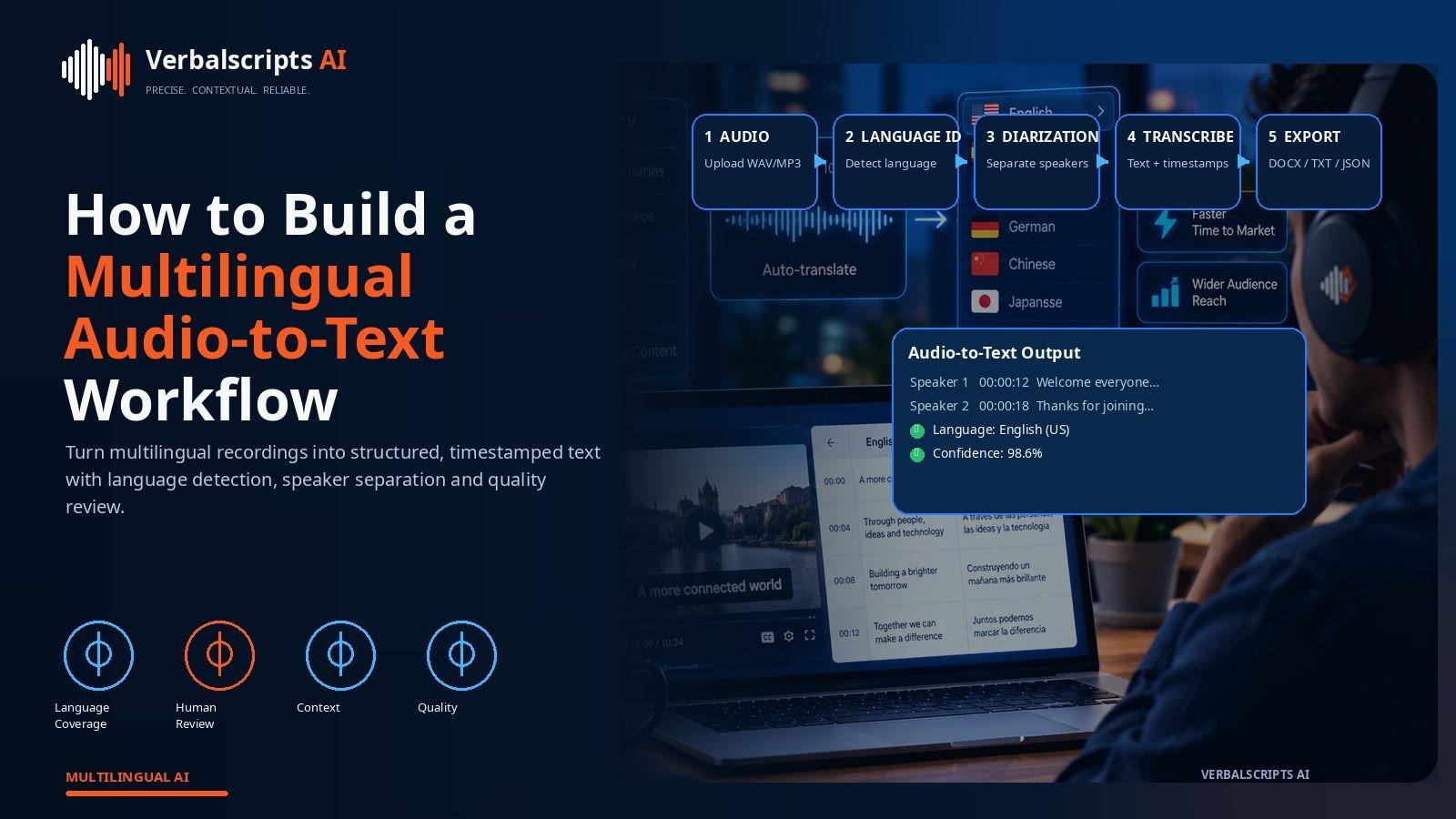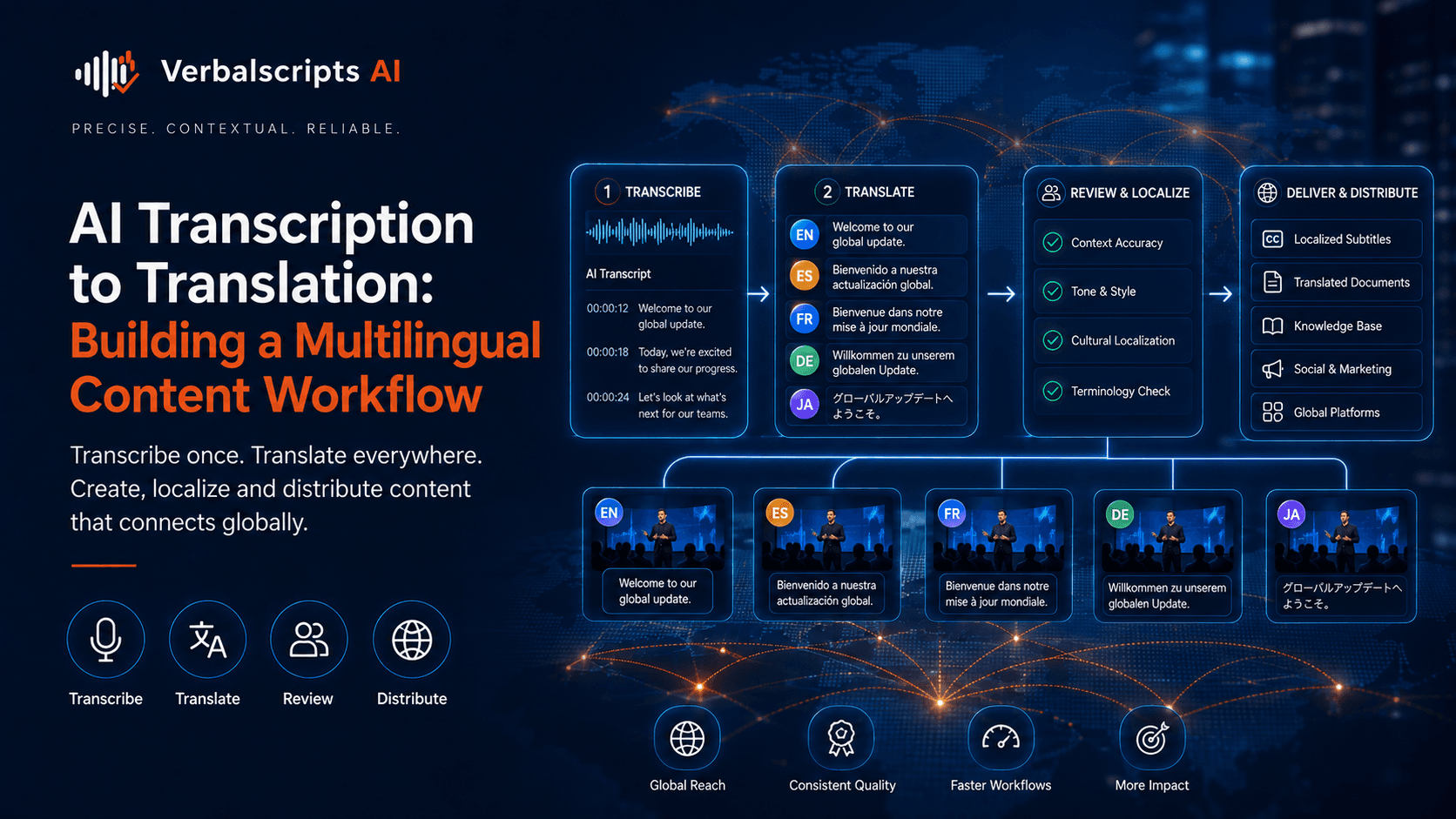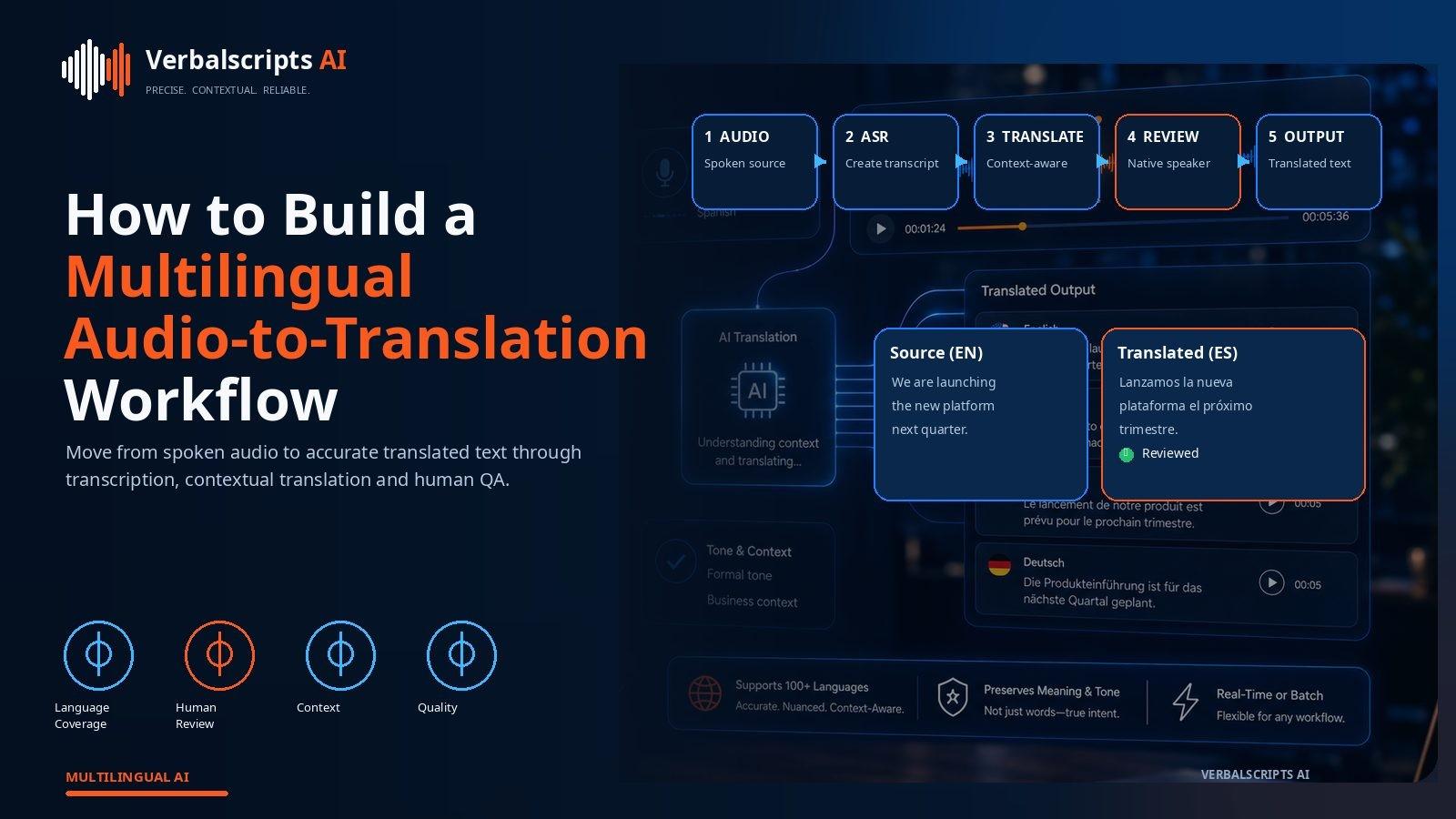
How do you build a multilingual audio-to-translation workflow? Normalize the recording, identify likely source languages, perform language identification and diarization, generate a timestamped source transcript, correct critical recognition errors, translate with context and glossary support, run source-target QA, route difficult segments to native or domain reviewers, and export translated transcripts or subtitles while preserving source timing and speaker metadata.
| SEO title | How to Build a Multilingual Audio-to-Translation Workflow |
|---|---|
| Slug | build-multilingual-audio-to-translation-workflow |
| Meta description | Build a multilingual audio-to-translation pipeline with language ID, transcription, diarization, translation, terminology, QA and target-language review. |
| Primary keyword | multilingual audio translation workflow |
| Search intent | How-to / Technical |
| Hero image | 173-multilingual-audio-translation-workflow.jpg |
| Hero alt text | Audio-to-translation pipeline showing spoken languages, transcript, speaker labels, target translations and review |
| Article body words | 1968 |
For production speech-to-text workflows, see our AI Transcription service for the delivery path behind the guidance in this article.
Multilingual audio translation is easiest to manage when speech recognition and translation are treated as separate quality stages even if a single model performs both internally.
The system needs to recognize the spoken language, preserve speaker and timing information, create an accurate source representation and then produce target-language text. Errors need to be traceable to the stage where they occurred.
For high-stakes audio, review the source transcript before translation; otherwise recognition errors can be multiplied across every target language.
Define deliverable
Possible outputs:
- translated transcript;
- subtitle;
- summary;
- translated audio.
The target affects:
- timing;
- editing.
Source language metadata
Collect:
- likely languages;
- locale;
- code-switching.
Use candidate lists where possible.
Language identification
LID can determine:
- file;
- segment.
Continuous LID is useful for multilingual sessions.
Azure documents both at-start and continuous language identification.
Multilingual ASR
A multilingual ASR model can handle many languages.
However, performance differs.
Benchmark:
- actual accent;
- audio.
Speaker diarization
Preserve speaker boundaries.
A translation without speakers can be unusable for interviews.
Keep:
- start/end;
- speaker ID.
Source transcript
Create one high-quality source transcript.
This becomes:
- review source;
- target translation source.
Correct:
- names;
- numbers.
This gives all targets a stronger foundation.
Why transcript-first helps
If ASR hears:
fifteen
as:
fifty
every target will receive wrong number.
One source correction fixes all.
Direct speech translation
End-to-end speech translation can reduce latency.
Best for:
- live interaction.
For archived deliverables, source transcript still provides:
- auditability.
Translation context
Translate full:
- speaker turns;
- paragraphs.
Do not translate one ASR fragment at a time.
Speech segmentation may break sentence meaning.
Punctuation
ASR punctuation helps create translation units.
Review sentence boundaries in difficult audio.
Terminology
Provide:
- bilingual glossary;
- entity list.
Term control at target stage can correct source recognition only if source term is recognized enough to identify it.
Better source ASR remains important.
Multiple targets
Use one verified transcript.
Translate to:
- French;
- German;
- Japanese.
Store each target with same segment IDs.
This supports aligned multilingual data.
Target locale
Specify:
- locale.
Business/audio dialogue needs correct formality.
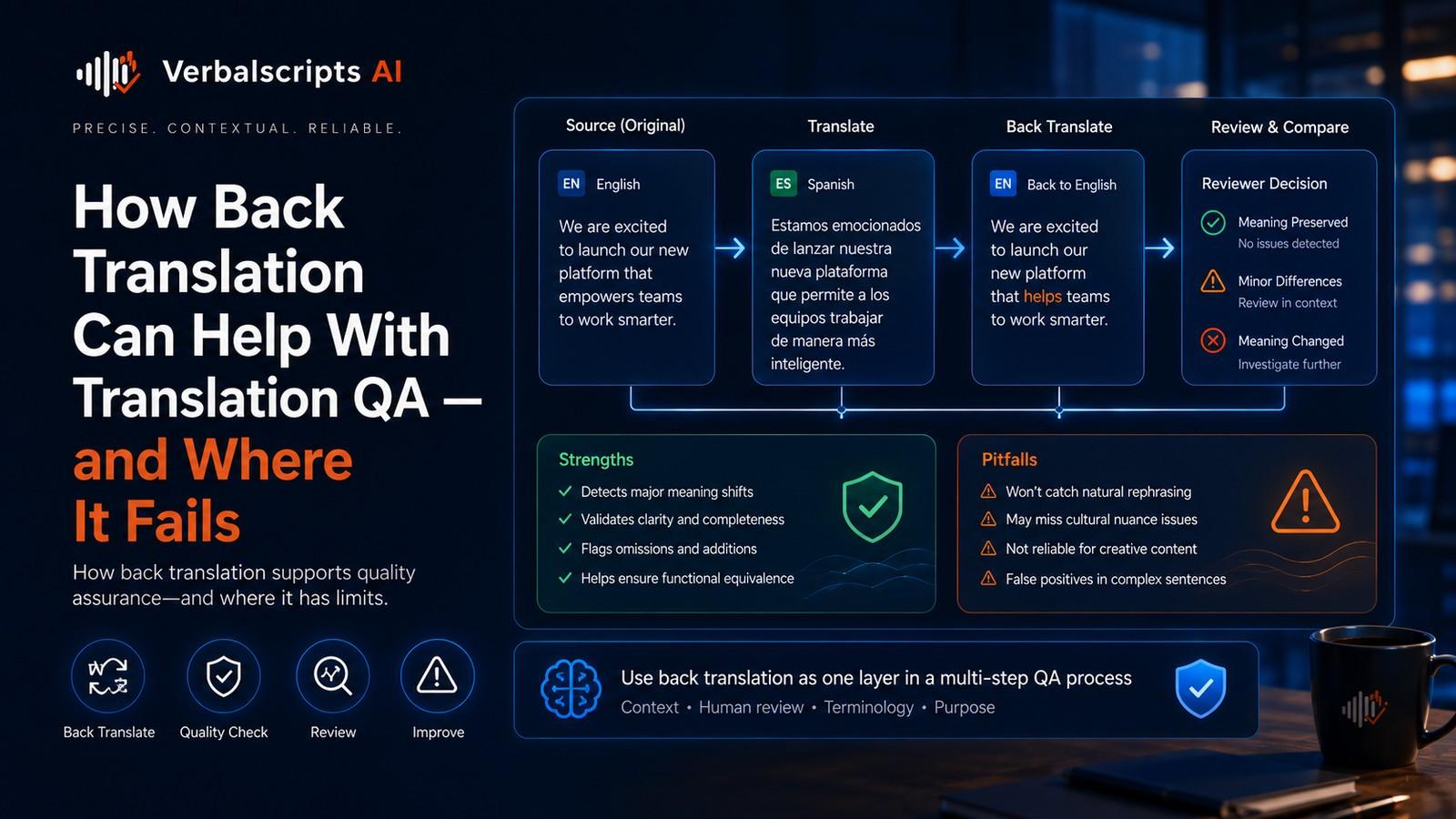
Translation quality
Check:
- adequacy;
- names;
- numbers;
- terminology.
Automatic metrics can triage.
Human review for high-risk.
Audio-grounded review
When target seems suspicious, reviewer should access audio.
Source transcript itself may be wrong.
A three-pane interface is ideal:
- audio;
- source;
- target.
Code-switching
Source transcript can tag:
- language spans.
Translation choices:
- translate all to one target;
- preserve certain source phrases.
Define policy.
Quoted language
Speaker may quote another language intentionally.
Example:
She said, “bonjour.”
If target is English, do you translate the quoted word?
Depends on context.
Human guidelines needed.
Named entities
Handle:
- transliteration;
- official target forms.
The same entity should be consistent across targets.
Numbers
Preserve:
- values;
- units.
Language translation does not imply currency conversion.
Subtitle output
If target is subtitles:
- preserve timecodes;
- resegment for reading speed.
Translation may expand.
Translation summary
If producing summary:
- keep transcript separately.
Summary is derivative.
Do not use summary as authoritative evidence.
Human review tiers
Low risk
AI + sample.
Public
Bilingual review.
Legal/medical
Source verified + specialist target review.
Error tracking
Record stage:
- LID;
- ASR;
- diarization;
- MT.
This improves model selection.
Quality metrics
Track:
- WER;
- LID;
- term accuracy;
- translation errors.
Do not combine into one “accuracy %.”
Provider routing
An architecture can choose:
- speech provider;
- translation provider.
The best speech model and text translator may differ.
Abstract behind service layer.
Cost
Costs:
- speech minutes;
- translation characters;
- review.
Multiple target languages mainly multiply translation/review, not source transcription.
Privacy
Audio and transcripts contain personal data.
Minimize retention.
Control reviewers.
Scaling
Batch jobs:
- transcript once;
- target many.
Cache source.
If target glossary changes, retranslate affected targets without rerunning ASR.
Common failure patterns
Translating raw ASR without review
Errors propagate.
Losing segment IDs
Targets cannot be aligned.
One language for whole file
Code-switching mishandled.
No target locale
Register inconsistent.
Target reviewer cannot access source
Accuracy cannot be verified.
Alignment IDs across target languages
Give every source segment a stable ID such as SEG-000124. The French, Arabic and Japanese translations reference that same ID.
This enables:
- source-target comparison;
- correction propagation;
- multilingual search;
- audit.
If a source transcript correction changes SEG-000124, the workflow can automatically mark all target translations of that segment as stale.
Translation after source correction
Source correction should trigger targeted retranslation, not full-file reruns.
Example:
- reviewer fixes one product name in three source segments;
- system invalidates only the corresponding targets;
- target QA runs again.
This reduces cost and avoids introducing new changes into already approved segments.
Multiple target review strategies
For ten target languages, human review can be tiered:
- strategic markets: full review;
- stable markets: risk-based sampling;
- internal-only targets: automated QA.
All languages still receive the same deterministic checks for numbers, missing text and glossary-critical terms.
Audio evidence for target reviewers
A bilingual target reviewer may need the audio only for ambiguous source segments. The review interface can link a translated segment directly to the original waveform.
This is particularly helpful for:
- names;
- laughter/sarcasm;
- unclear negatives;
- code-switching.
Failure attribution
Classify every major correction as:
- ASR;
- language ID;
- speaker;
- translation;
- terminology;
- formatting.
Over time, the data shows whether investing in a better speech model or a better translation model will produce more benefit.
Output reuse
A reviewed target transcript can become:
- subtitles;
- meeting notes;
- searchable knowledge;
- article draft.
Keep those derivatives linked to the reviewed translation version so later source corrections can be propagated systematically.
Separate source verification from target translation review
A common cost mistake is asking the target translator to diagnose poor ASR while also translating. For difficult audio, create a verified source transcript first. The target reviewer then works from a stable source.
This is especially valuable when the same recording needs several target languages. One source correction benefits every target rather than each translator independently discovering the same speech error.
Example multilingual webinar workflow
A webinar contains English, French Q&A and one Spanish participant. The project needs German subtitles.
A reliable pipeline:
- diarize speakers;
- identify languages by turn;
- transcribe each source segment in its original language;
- source-review names, numbers and product terms;
- translate every reviewed segment into German;
- resegment the German for subtitles;
- review in video.
The German viewer receives one coherent target language, while the project retains the multilingual source record.
Translation-memory reuse in audio
Repeated audio content can occur in:
- intros/outros;
- compliance disclaimers;
- training modules.
Once the source transcript and target translation are approved, reuse them when the exact content recurs. Do not retranscribe and retranslate identical recorded language simply because it appears in another file.
Confidence propagation
Do not treat target translation confidence as independent of the source. If an ASR segment has low confidence, even a high translation-quality score should not auto-approve the target.
A combined risk score can use:
- ASR confidence;
- entity flags;
- translation evaluator;
- content risk.
This makes the routing system sensitive to upstream uncertainty.
Speaker metadata and grammatical effects
In some target languages, speaker identity or relationship affects:
- gender agreement;
- formality;
- pronouns.
Preserve known speaker metadata and give the translator only information that is authorized and relevant. Do not infer sensitive attributes from voice.
Batch architecture
For large audio libraries:
- transcribe source once;
- store reviewed source;
- create target-language jobs independently;
- track each target status.
This allows a French translation to be updated without touching Japanese and allows future languages to be added without rerunning ASR.
Final deliverable status
Mark outputs clearly:
- source transcript unreviewed;
- source reviewed;
- target machine;
- target human-reviewed.
Multilingual audio projects produce many derivative files. Status metadata prevents a draft from being mistaken for a final transcript.
Translation style after multilingual source normalization
When several source languages are translated into one target, the final target can sound inconsistent because each source language influences sentence rhythm differently. Add a target-only editorial pass after fidelity review.
The editor should normalize:
- punctuation;
- formality;
- speaker-label formatting;
- recurring terminology.
Do not alter factual meaning or make speakers sound more polished than the approved transcript style permits.
Cross-target consistency
If the recording is translated into many target languages, critical entities and terminology should come from one shared concept resource. The French reviewer and Japanese reviewer should not independently decide how to represent the same product name or organization.
This is especially important when target scripts require transliteration.
Reprocessing strategy after ASR model changes
Do not automatically retranscribe an approved source corpus because a new ASR model launches. Compare the new model against the reviewed source benchmark.
If existing source transcripts are already human-approved, preserve them. Use the new model for new audio and selectively reprocess only where there is a clear business reason.
Media synchronization
For translated subtitles or captions, target text may require different segmentation while source timestamps remain the anchor. Store both:
- source segment timing;
- target cue timing.
This allows a target subtitle editor to split one source sentence into two cues without losing alignment to the original transcript.
Translation incident example
If the target mistranslates a name because the ASR source spelled it incorrectly, classify the root cause as ASR/entity recognition. Correct the source first, then retranslate all targets. Fixing only one target leaves every other language vulnerable to the same source defect.
Final QA checklist
For each target language, verify:
- every source segment has a target or documented exception;
- target speaker labels match source;
- numbers and named entities match;
- glossary rules pass;
- low-confidence ASR segments received appropriate review;
- target locale is correct;
- final transcript or subtitle file opens and renders correctly.
A translation pipeline is finished only when the target artifact and its source linkage both pass.
Final maintenance note
When the speech recognizer, translation model or terminology changes, re-run a fixed sample of multilingual recordings end to end. A component can improve in isolation while the combined pipeline regresses. End-to-end tests should verify source accuracy, target meaning, speaker attribution and file integrity together.
Implementation takeaway
For production use, treat source verification, aligned target IDs and end-to-end regression testing as measurable parts of the workflow rather than assumptions. Define the relevant policy before processing content, keep the model or data configuration versioned, and verify results on representative material from the actual language, locale and domain. If automation produces a result that conflicts with a deterministic rule, authoritative terminology or qualified human evidence, escalate the item instead of averaging the disagreement away. The most durable multilingual systems preserve source-to-target traceability, record exceptions and feed reviewed corrections back into benchmarks, glossaries or routing rules. That discipline makes quality improvements reproducible when models, providers, reviewers or source content change.
Frequently asked questions
Is direct speech translation better?
For live latency. Transcript-first is better for reviewable deliverables.
Should every transcript be manually corrected?
Not for low risk. Correct high-risk/low-confidence segments.
Can one source transcript feed many target languages?
Yes, and this is a core scaling advantage.
What happens to timestamps after translation?
They remain tied to source audio; subtitle segmentation may need adaptation.
Can speech and translation use different providers?
Yes. A modular pipeline can benchmark each stage independently.
Conclusion
A multilingual audio-to-translation workflow should preserve traceability.
Recognize language, separate speakers, produce a structured source transcript, translate in context and keep target versions aligned to the same source timeline.
This modular design makes quality measurable and prevents one speech-recognition error from becoming an invisible multilingual mistake.
Research references
- Azure Speech language identification:
- Google Speech-to-Text language detection:
- Google speaker diarization:
- Meta SeamlessM4T: