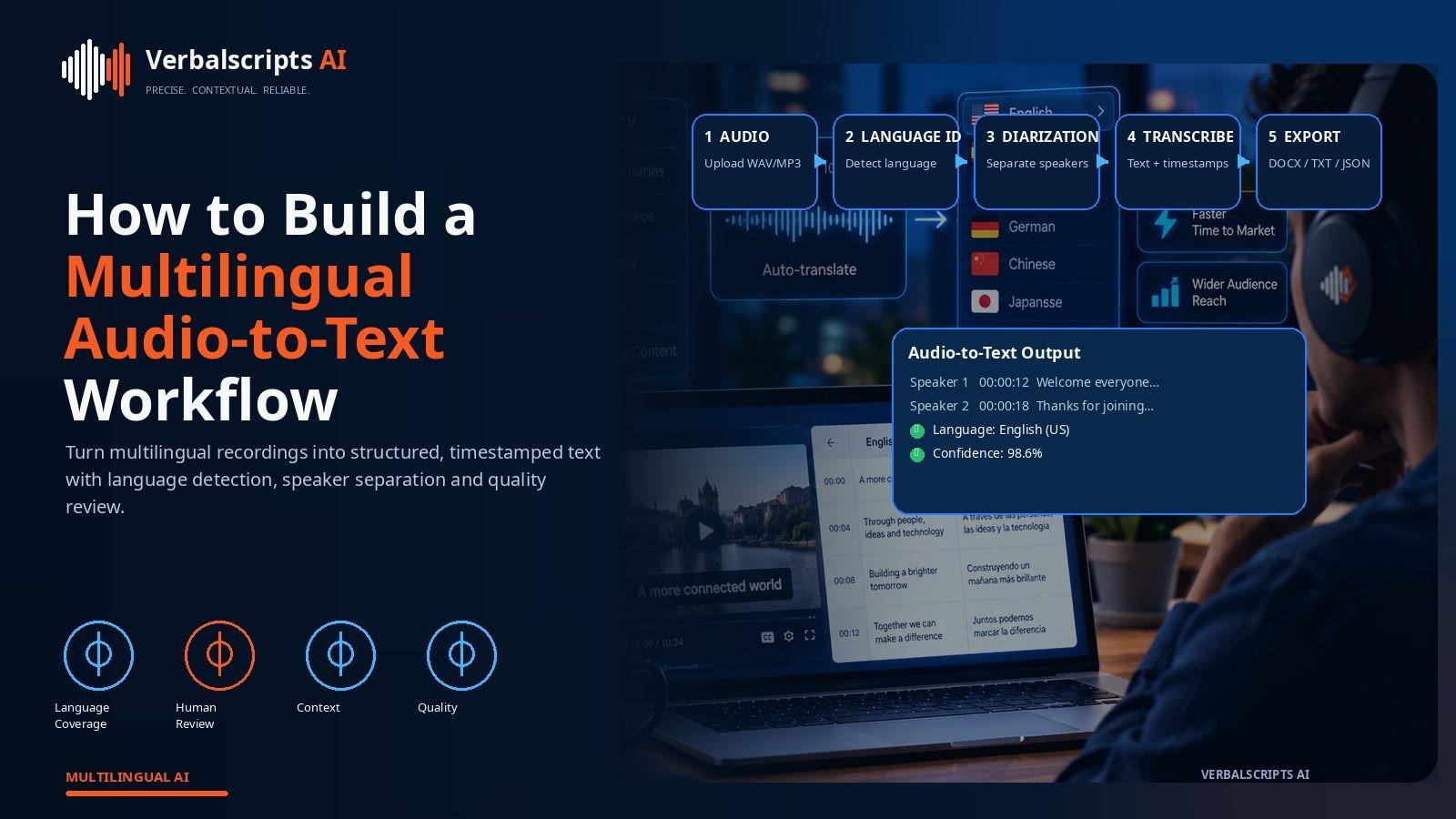
How do you build multilingual audio-to-text? Ingest and normalize the audio, identify or constrain the likely spoken languages, run language identification, route segments to suitable ASR models, enable diarization where speakers matter, apply domain vocabulary, preserve word/segment timestamps and confidence, then route low-confidence or high-risk output to native reviewers. Export a structured transcript that retains language and speaker metadata.
| SEO title | How to Build a Multilingual Audio-to-Text Workflow |
|---|---|
| Slug | build-multilingual-audio-to-text-workflow |
| Meta description | Build a multilingual audio-to-text workflow with language detection, diarization, ASR, terminology, confidence routing, native review and export. |
| Primary keyword | multilingual audio to text |
| Search intent | How-to / Technical |
| Hero image | 172-multilingual-audio-to-text-workflow.jpg |
| Hero alt text | Multilingual audio-to-text pipeline showing audio intake, language detection, diarization, ASR, review and transcript export |
| Article body words | 1961 |
For production speech-to-text workflows, see our AI Transcription service for the delivery path behind the guidance in this article.
A multilingual audio-to-text system must answer several questions before it can transcribe a word:
- What language is being spoken?
- Is there one language or several?
- How many speakers are present?
- Which speech model should handle the audio?
- What happens when confidence is low?
The best workflow makes these decisions explicitly and logs them for quality review.
A candidate-language strategy is often more reliable than unconstrained language detection.
Step 1: define use case
Different audio:
- call center;
- interview;
- meeting;
- media;
- field recording.
Define:
- latency;
- accuracy;
- speaker labels;
- output.
Step 2: collect metadata
Before processing:
- source region;
- expected languages;
- speaker count;
- domain.
Metadata can improve routing.
Step 3: validate audio
Check:
- format;
- duration;
- channels;
- corruption.
Reject unreadable files early.
Step 4: normalize
Possible preprocessing:
- sample rate;
- channel conversion;
- volume.
Avoid aggressive noise filtering that damages speech.
Step 5: candidate languages
If customer operates in Kenya, likely languages may be:
- English;
- Swahili.
Do not ask model to select from 100 languages unnecessarily.
Google currently recommends limiting candidate language codes to the minimum needed for automatic speech-language recognition.
Step 6: language identification
LID predicts language.
Modes:
- beginning of file;
- continuous;
- segment.
Azure Speech supports at-start and continuous language identification with candidate-language configuration.
Choose based on expected switching.
Step 7: route ASR
Possible architectures:
One multilingual ASR
Simpler.
Language-specific models
May perform better.
Route based on LID confidence.
Step 8: code-switch handling
If one utterance contains two languages, file-level LID fails.
Use:
- multilingual ASR;
- token/segment language labels.
Research shows code-switched LID and ASR remain difficult.
Add review.
Step 9: diarization
If multiple speakers:
- enable speaker diarization.
Provide expected speaker range if platform supports it.
Google and Amazon expose speaker partitioning features.
Step 10: channel separation
Contact-center audio may record:
- agent on one channel;
- caller on another.
Use channels when available.
They can be more reliable than diarization.
Step 11: speech recognition
Request:
- timestamps;
- confidence;
- punctuation.
Keep raw output for QA.
Step 12: custom vocabulary
Add:
- product names;
- people;
- locations.
Provider customization differs.
Verify effect with benchmark.
Step 13: punctuation
Punctuation improves transcript readability.
For data pipelines, store both:
- normalized text;
- word timestamps.
Step 14: confidence routing
Low-confidence words/segments can trigger human review.
But confidence is model-specific.
Calibrate thresholds against real errors.
Step 15: entity QA
Check:
- names;
- numbers;
- dates.
These are high-value errors.
Step 16: human review
Use native reviewers for:
- low-resource;
- accents;
- code-switching.
A reviewer needs audio access.
Step 17: structured output
A JSON segment might contain:
- speaker;
- language;
- start;
- end;
- text;
- confidence;
- review status.
This enables search and downstream translation.
Step 18: transcript formats
For users:
- DOCX/TXT.
For media:
- SRT/VTT.
For systems:
- JSON.
Do not discard structure for convenience.
Step 19: versioning
Store:
- ASR model;
- language config;
- date.
If model changes, you can compare.
Step 20: monitoring
Track:
- WER by language;
- LID accuracy;
- diarization error;
- review rate;
- latency.
Global WER hides weak languages.
Word error rate
WER is:
substitutions + deletions + insertions / reference words.
Use representative manually transcribed evaluation sets.
LID accuracy
Measure:
- correct language;
- switching detection.
If LID is wrong, ASR routing may cascade into poor transcription.
Diarization quality
Speaker error affects usability.
A word may be correct but assigned to wrong person.
Evaluate separately.
Low-resource strategy
For lower-resource languages:
- benchmark multilingual models;
- fine-tune where possible;
- collect approved data;
- review more.
African NLP research continues to document the performance gap caused by limited data.
Scaling
Queue audio by:
- language candidate set;
- domain.
Use batch processing.
Keep each file independently retriable.
Security
Audio can contain:
- PII;
- voice identity.
Apply:
- access;
- encryption;
- retention.
Reviewers should not download sensitive audio to uncontrolled devices.
Common failures
Wrong LID
All later text degrades.
Overbroad candidate list
Model chooses similar wrong language.
Mixed speech
One-language routing misses code-switch.
Speaker merge
Dialogue becomes confusing.
Confidence misuse
System trusts score not calibrated to domain.
Example JSON schema
A structured segment can look conceptually like:
- file_id;
- speaker_id;
- language;
- start_ms;
- end_ms;
- text;
- confidence;
- review_status.
This allows downstream translation, search and subtitle tools to reuse the same transcript. A DOCX can be generated for human users while JSON remains the system-of-record representation.
Language routing with fallbacks
A production router can use rules such as:
- if language known from client metadata, use it;
- otherwise run LID against a constrained list;
- if confidence high, route to best ASR;
- if confidence low, use multilingual model or human triage;
- after ASR, run text-language verification.
The last step catches cases where acoustic LID chose the wrong language.
Word-level versus segment-level confidence
Word confidence can help reviewers focus on:
- rare names;
- noisy phrases.
Segment confidence can help route entire turns.
Do not expose raw confidence as a user-facing “accuracy percentage.” Calibrate it against human-corrected output and use it as a workflow signal.
Transcript normalization layers
Store:
- raw ASR;
- corrected source;
- normalized display.
For example, the speaker’s “twenty twenty-six” may be stored semantically as the same value while the display transcript follows project style. Keeping layers separate is especially useful for legal/research work where exact source wording may matter.
Benchmarking new microphones and channels
ASR quality can change when an organization moves from:
- Zoom audio;
- call-center telephony;
- mobile uploads.
Treat recording source as a model input variable. When a new channel launches, run representative benchmark audio before assuming the existing WER baseline still applies.
Reviewer workflow
A native reviewer should be able to:
- jump to timestamps;
- slow playback;
- view LID;
- correct speaker;
- mark unclear.
Every correction should retain the original ASR token/segment so quality analytics can learn from it.
Voice activity detection and segmentation
Before language identification or ASR, a pipeline often uses voice activity detection (VAD) to separate speech from silence and background noise. VAD settings affect every later stage.
Segments that are too short:
- give LID too little evidence;
- split sentences unnaturally;
- create excessive requests.
Segments that are too long:
- may contain speaker or language changes;
- increase latency.
Tune VAD on real recordings rather than accepting one default configuration for interviews, meetings and phone calls.
Channel-aware processing
If stereo audio contains different speakers on different channels, preserve that structure. A call center may record:
- channel 0 = agent;
- channel 1 = customer.
Channel separation can be more reliable than diarization and allows language ID per channel. Do not downmix to mono before checking whether the channels contain useful information.
Example fallback tree
A practical routing rule can be:
- source language known with high-confidence metadata → language-specific ASR;
- unknown language, candidate set ≤5 → LID + language-specific ASR;
- mixed-language expected → multilingual ASR;
- LID confidence low → multilingual ASR + human review;
- transcript fails language/text validation → retry alternate model.
This turns uncertainty into predictable system behavior.
Transcript post-processing
After ASR, normalize carefully:
- whitespace;
- punctuation;
- repeated fragments;
- obvious decoder artifacts.
Keep the raw transcript. If a post-processing model changes text, store the normalized version separately. This makes it possible to determine whether a later error originated in ASR or cleanup.
Names and custom dictionaries
Before high-value jobs, gather:
- participant names;
- organizations;
- local place names;
- product vocabulary.
If the ASR provider supports phrase hints or custom vocabulary, use them. Then independently check these entities after recognition.
Proper names are sparse by nature, so even high-resource language models benefit from project context.
Reviewer interface requirements
A strong audio-to-text reviewer tool should support:
- keyboard rewind;
- variable speed;
- waveform;
- speaker/language correction;
- search;
- low-confidence highlights;
- timestamp editing.
Reviewer productivity is a technical requirement because it directly affects the cost of multilingual quality.
Acceptance criteria
For each use case, define:
- lexical error threshold;
- critical entity tolerance;
- diarization quality;
- required review.
A call-analytics transcript may tolerate small filler errors while a legal transcript does not. The workflow should express those differences explicitly.
Operational monitoring
Monitor:
- files/hour;
- LID override rate;
- average confidence;
- reviewer backlog;
- failure rate by audio source.
A sudden increase in language overrides or low-confidence segments can reveal a microphone, routing or provider problem before customers report it.
Multi-tenant language configuration
For a SaaS product serving many customers, candidate languages and transcript rules may differ per account. Store configuration by tenant/project rather than globally:
- allowed languages;
- default locale;
- diarization setting;
- transcription style;
- custom vocabulary;
- retention.
This prevents a customer using English/French from accidentally inheriting another customer’s Spanish/German language options or terminology.
Observability per stage
A production dashboard should show:
- VAD segment count;
- LID decisions;
- ASR latency;
- low-confidence percentage;
- diarization status;
- review corrections.
If a transcript suddenly degrades, operations can locate the stage responsible. A single “job failed” metric is too coarse.
Cost-aware routing
Use lower-cost models for stable, low-risk language/audio combinations and stronger models for:
- noisy audio;
- code-switching;
- high-risk content.
The routing policy should be validated on quality and not based on cost alone. Track reviewer effort to see whether a cheaper model truly saves money.
Export validation
Before delivery:
- transcript opens;
- encoding correct;
- target language metadata correct;
- timestamps monotonic;
- speaker IDs valid;
- no empty segments.
For subtitle output, validate SRT/WebVTT syntax separately.
Continuous improvement
Every manual correction can update:
- vocabulary;
- language-routing rules;
- benchmark data;
- reviewer guide.
The workflow becomes more accurate when corrections are captured structurally rather than left only in the final DOCX.
Final acceptance checklist
Before marking a multilingual transcript complete, verify that the expected duration was processed, the detected language is plausible for every segment, speaker labels are internally consistent, all required names have been checked, low-confidence sections have a review status and the exported file preserves UTF-8/Unicode correctly.
For downstream translation, confirm that every source segment has a stable ID and timestamp. This small amount of structure prevents major rework later.
Implementation takeaway
For production use, treat language routing, confidence handling and structured transcript metadata as measurable parts of the workflow rather than assumptions. Define the relevant policy before processing content, keep the model or data configuration versioned, and verify results on representative material from the actual language, locale and domain. If automation produces a result that conflicts with a deterministic rule, authoritative terminology or qualified human evidence, escalate the item instead of averaging the disagreement away. The most durable multilingual systems preserve source-to-target traceability, record exceptions and feed reviewed corrections back into benchmarks, glossaries or routing rules. That discipline makes quality improvements reproducible when models, providers, reviewers or source content change.
Frequently asked questions
Should I detect language automatically?
If known, specify it. If unknown, use a constrained candidate set.
Can Google Speech-to-Text detect multiple candidate languages?
Current V2 automatic language recognition can use up to a small candidate list in supported configurations; check provider limitations.
Can ASR identify speakers?
Diarization separates speakers; naming them usually requires metadata or manual verification.
What metadata should I save?
Language, speaker, timestamps, confidence, model/version and review status.
How should low-confidence output be handled?
Route to human review or secondary model rather than silently publishing it.
Conclusion
A robust multilingual audio-to-text system is a routing and quality pipeline.
Constrain the language problem, preserve speaker and timing information, benchmark per language, and use humans strategically for uncertainty and underrepresented speech.
The structured transcript becomes the foundation for translation, analytics and searchable multilingual knowledge.
Research references
- Google Speech-to-Text automatic language detection:
- Azure Speech language identification:
- Amazon Transcribe streaming language ID:
- Google speaker diarization:
- Amazon speaker diarization: