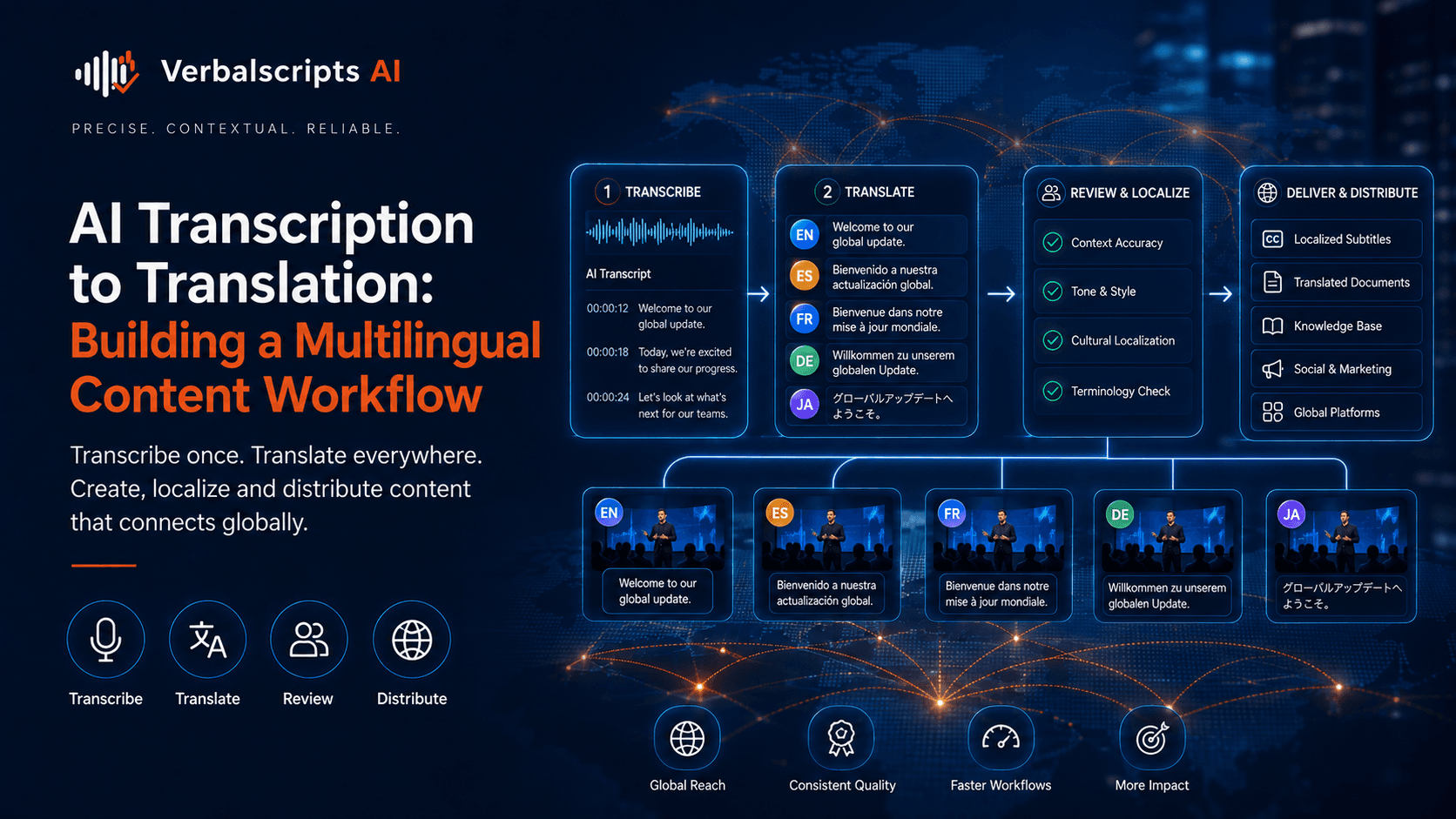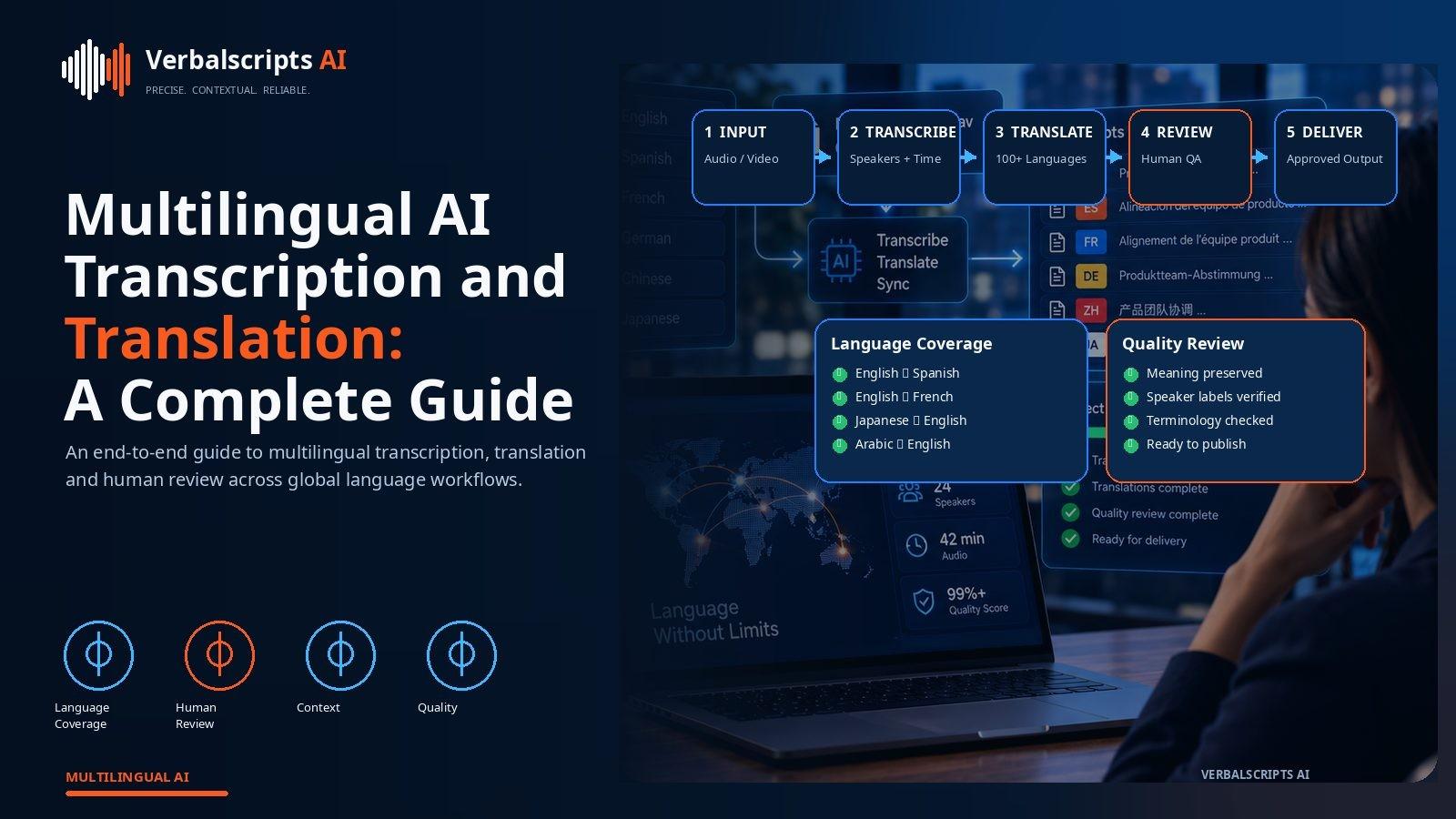
What is multilingual AI transcription and translation? It is a workflow that converts speech from one or more languages into written text and, when required, translates that text into one or more target languages. Core components include automatic speech recognition (ASR), language identification, speaker diarization, punctuation, terminology handling, machine translation and quality assurance. Human review is especially valuable for difficult audio, code-switching, low-resource languages and high-stakes content.
| SEO title | Multilingual AI Transcription & Translation: Complete Guide |
|---|---|
| Slug | multilingual-ai-transcription-translation-guide |
| Meta description | A complete guide to multilingual AI transcription and translation, covering ASR, language detection, diarization, translation, QA and human review. |
| Primary keyword | multilingual AI transcription |
| Search intent | Informational / Commercial research |
| Hero image | 171-multilingual-ai-transcription-translation-guide.jpg |
| Hero alt text | Multilingual speech AI workflow showing audio, language detection, speaker diarization, transcription, translation and human review |
| Article body words | 1977 |
For production speech-to-text workflows, see our AI Transcription service for the delivery path behind the guidance in this article.
Multilingual speech workflows combine two challenging tasks: determining what people said and converting that meaning into another language.
A modern system may need to identify the spoken language, separate speakers, transcribe accents and dialects, recognize names and technical terminology, detect code-switching, translate the transcript and preserve timestamps. Each stage can introduce errors, so reliable production workflows need more than one model call.
Multilingual speech quality should be measured at both the recognition and translation stages.
Transcription versus translation
Transcription
Speech → text in the same language.
Example:
French audio → French text.
Translation
Meaning → another language.
Example:
French text → English text.
Speech translation
Speech → translated text or speech.
Example:
French audio → English captions.
Keeping these distinctions clear helps diagnose errors.
The multilingual pipeline
A typical pipeline:
- ingest audio/video;
- detect language;
- separate speakers;
- speech-to-text;
- normalize punctuation/numbers;
- translate;
- QA;
- export.
Some end-to-end multimodal models combine stages internally, but the conceptual error sources remain.
Audio quality
ASR performance depends on:
- microphone;
- noise;
- reverberation;
- compression;
- cross-talk;
- distance.
Multilingual models do not eliminate acoustic problems.
Improve recording quality first when possible.
Source language
If known, specify it.
Automatic language identification is useful for unknown content.
Google Speech-to-Text currently supports automatic recognition from a provided candidate list in certain V2 configurations and recommends constraining the candidate list because fewer alternatives improve language selection probability.
Azure Speech also provides language identification based on a candidate set.
This shows a practical lesson: automatic language detection works better when the system has useful prior information.
Locale
Speech recognition often needs a locale:
- en-US;
- en-GB.
Locale affects:
- pronunciation;
- vocabulary.
Do not treat all speakers of one language as acoustically identical.
Accent
An accent affects pronunciation.
It does not necessarily change grammar or vocabulary.
Models trained on limited accents may produce higher word error rates for underrepresented speech.
Evaluate representative speakers.
Dialect
A dialect can differ in:
- pronunciation;
- vocabulary;
- grammar.
Dialect is a broader linguistic variety.
Transcription systems need real dialect data.
Code-switching
A speaker may alternate languages within one conversation or sentence.
Research shows code-switched speech remains challenging for ASR and language identification even with multilingual models.
This matters in:
- Kenya;
- India;
- multilingual workplaces;
- bilingual families.
Do not force every utterance into one language if real speech is mixed.
Language identification
Language ID can operate at:
- file;
- segment;
- token.
File-level detection is easiest.
Token-level code-switch detection is hardest.
The necessary granularity depends on the recording.
Speaker diarization
Diarization answers:
who spoke when?
It separates speakers but may not know their names.
Google and Amazon speech services expose diarization features with speaker-count configuration.
For interviews, speaker separation makes translated text far easier to use.
Speaker identification
Diarization labels:
- Speaker 1;
- Speaker 2.
Speaker identification maps those clusters to real people.
Identification may require:
- participant metadata;
- manual verification.
Do not guess identities from voice automatically in sensitive use cases unless the system is explicitly authorized for that purpose.
ASR
Automatic speech recognition produces:
- words;
- timestamps;
- confidence.
Multilingual ASR models can cover many languages but quality is uneven.
Word error rate should be measured per language.
Word Error Rate
WER measures:
- substitutions;
- deletions;
- insertions
relative to a reference transcript.
Formula conceptually:
(S + D + I) / N
WER is useful but does not reflect all downstream impact.
One wrong name can matter more than five filler-word errors.
Character Error Rate
CER is useful for languages where character-level evaluation is informative.
It can also help with scripts and morphology.
Do not compare WER values across languages without considering tokenization.
Normalization
Raw speech recognition may normalize:
- “twenty dollars” → $20;
- dates;
- punctuation.
Define output standard.
For legal verbatim, aggressive normalization may be inappropriate.
Punctuation
Speech has no visible punctuation.
Models infer:
- commas;
- periods;
- question marks.
Punctuation affects translation because sentence boundaries guide meaning.
Names
Names are frequent multilingual errors.
Use:
- participant list;
- custom vocabulary;
- terminology.
Review them manually.
Domain terms
Medical, legal and technical audio needs domain vocabulary.
Speech systems may support custom speech or hints.
Even if recognition cannot be customized, translation glossaries can improve target terminology after the source is corrected.
Translation stage
Translate from verified source transcript when quality matters.
Use:
- paragraph/turn context;
- glossary;
- target locale.
Preserve:
- speakers;
- timestamps.
Direct speech translation
Some systems translate speech without exposing a source transcript.
This is useful for live conversation.
For audited work, preserving a transcript is better for traceability.
Multiple target languages
Once the source transcript is approved, translate into many languages.
This is more efficient than independently processing audio for every target.
The source transcript becomes multilingual infrastructure.
Native-speaker review
Use reviewers for:
- low-resource languages;
- dialects;
- code-switching;
- public content.
They can verify both ASR and translation when qualified.
Multilingual quality control
Track separately:
- ASR WER;
- language-ID error;
- diarization error;
- translation accuracy.
A good translation cannot repair a bad transcript automatically.
Error propagation
Example:
Audio: Ngong Road
ASR: long road
Translation: correct translation of long road.
The final output is wrong because the first stage failed.
Root-cause analysis should trace backward.
File formats
Outputs may include:
- DOCX;
- TXT;
- JSON;
- SRT;
- VTT.
Keep structured metadata when downstream use requires it.
Privacy
Multilingual audio may contain:
- biometric voice;
- personal data;
- confidential content.
Apply:
- secure storage;
- retention;
- authorized reviewers.
Low-resource languages
Data scarcity affects both:
- ASR;
- MT.
Research on African low-resource ASR identifies:
- data scarcity;
- linguistic complexity;
- acoustic variability;
- computational constraints.
Expect higher need for human review.
Model evaluation
Test with your actual:
- accents;
- microphones;
- domains.
Do not rely solely on provider language support tables.
“Supported” does not mean equal accuracy.
Real-time versus batch
Real-time
- meetings;
- calls.
Prioritize latency.
Batch
- interviews;
- archives.
Prioritize quality and review.
Choose architecture accordingly.
A practical workflow
- classify audio;
- identify candidate languages;
- run diarization;
- transcribe;
- correct names/low confidence;
- translate;
- run QA;
- native/domain review;
- export;
- capture corrections.
A multilingual speech quality scorecard
A complete scorecard should separate stages:
| Stage | Example metric |
|---|---|
| Language identification | accuracy/F1 |
| Speaker diarization | DER/speaker confusion |
| ASR | WER/CER + entity accuracy |
| Translation | adequacy/term accuracy |
| Final transcript | human acceptance |
This helps teams avoid blaming the translation model when the real defect was a misidentified language or speaker. It also makes vendor comparisons fairer because each component is judged on its own job.
Example: bilingual customer call
A call begins in Swahili, switches to English for product terminology and includes two speakers. A robust pipeline can:
- identify the candidate languages;
- separate agent/customer channels;
- transcribe in original speech;
- preserve English product names;
- translate the Swahili content for an English-speaking supervisor;
- keep timestamps and both original/translated text.
The supervisor receives a usable English record without losing the original source needed for review.
Choosing between end-to-end and modular systems
End-to-end multimodal model
Advantages:
- lower integration complexity;
- potential low latency.
Modular pipeline
Advantages:
- independent benchmarking;
- easier human correction;
- provider flexibility.
A regulated or audit-heavy workflow often benefits from modular records even if an end-to-end model is used internally. Save the source transcript so the final translation can be traced.
Language launch checklist for speech
Before claiming support for a new language, test:
- clean speech;
- phone speech;
- several accents/dialects;
- names/numbers;
- domain terms;
- multiple speakers;
- code-switching where common.
Record reviewer availability and expected quality tier. A provider support table is a starting point, not the acceptance test.
Improvement loop
Human-corrected transcripts and translations can improve:
- custom vocabulary;
- benchmark sets;
- termbase;
- model adaptation where permitted.
The important operational principle is to capture corrections in structured form rather than delivering the corrected file and discarding the information.
Multilingual speech benchmark design
A useful benchmark should not contain only one recording per language. For every strategic language, include several acoustic and linguistic conditions:
- clean close-mic speech;
- phone or compressed audio;
- at least two relevant accents or dialects;
- names and numbers;
- domain terminology;
- multiple speakers;
- one realistic noisy sample.
For multilingual markets, include code-switched examples as a separate benchmark category.
Keep the benchmark fixed across model updates. When a new model appears, compare not only average WER but the distribution of errors across conditions. A global improvement can still hide a regression on telephony, a particular accent or names.
Quality routing by stage
A production pipeline can route segments differently depending on where uncertainty appears.
Language-ID uncertainty
Use a multilingual recognizer or ask a reviewer to confirm the language before retranscription.
ASR uncertainty
Replay the source audio, apply vocabulary hints or route to a stronger speech model.
Translation uncertainty
Keep the source transcript fixed and send only the target segment to bilingual review.
Speaker uncertainty
Review the diarization rather than retranscribing all words.
This staged routing avoids paying for full manual review when only one component is problematic.
Example data model
A robust record can include:
- audio_id;
- segment_id;
- speaker_id;
- source_language;
- source_text_raw;
- source_text_reviewed;
- target_locale;
- target_text;
- start_ms;
- end_ms;
- asr_model;
- translation_model;
- review_status.
This may look detailed, but the structure makes reprocessing and audit much easier. If only the French translation changes, the original speech metadata remains stable.
Human review should match the stage
A single reviewer does not always need to verify everything. A native source-language reviewer may correct the transcript; a bilingual target reviewer then handles translation; a domain expert reviews only critical terms.
For low-risk languages with strong ASR and translation quality, one bilingual reviewer may cover both stages.
Multilingual output consistency
If the same source segment is translated into ten languages, keep all targets linked to the same reviewed source version. This prevents one target from being based on an old transcription while the others use a corrected source.
When the source changes, automatically mark every dependent target as stale and re-evaluate only those segments.
Operational value beyond translation
A structured multilingual transcript can feed:
- semantic search;
- topic analysis;
- training data;
- customer-insight systems;
- subtitle generation.
Preserving metadata at transcription time therefore creates much more value than delivering a plain text file and discarding the speech structure.
Governance recommendation
Before deploying multilingual speech AI, document:
- which languages are approved for machine-only use;
- which require human review;
- what data may be retained;
- what happens to low-confidence audio;
- how model updates are tested.
This converts language support from a feature list into an operational service standard.
Frequently asked questions
Can AI transcribe multiple languages in one recording?
Yes, but mixed-language and code-switched audio is harder than monolingual speech.
What is the difference between language ID and ASR?
Language ID predicts the spoken language; ASR predicts the words.
What is diarization?
Separating the recording into speaker-specific segments.
Should translation happen directly from audio?
For live use it can. For high-quality deliverables, a source transcript improves review.
Are multilingual models equally accurate for every language?
No. Data availability and model coverage vary substantially.
Conclusion
Multilingual AI transcription and translation is a chain of language technologies.
Language detection, diarization, speech recognition and translation each need their own quality controls. The most reliable workflow preserves the source transcript, keeps speaker/timing metadata and uses native or specialist review where model performance is uncertain.
That architecture turns multilingual audio into trustworthy, reusable text rather than a black-box translation.
Research references
- Google Speech-to-Text language detection:
- Google Speech-to-Text diarization:
- Azure Speech language identification:
- Amazon Transcribe language identification:
- DECM code-switching ASR benchmark:
- African low-resource ASR review: