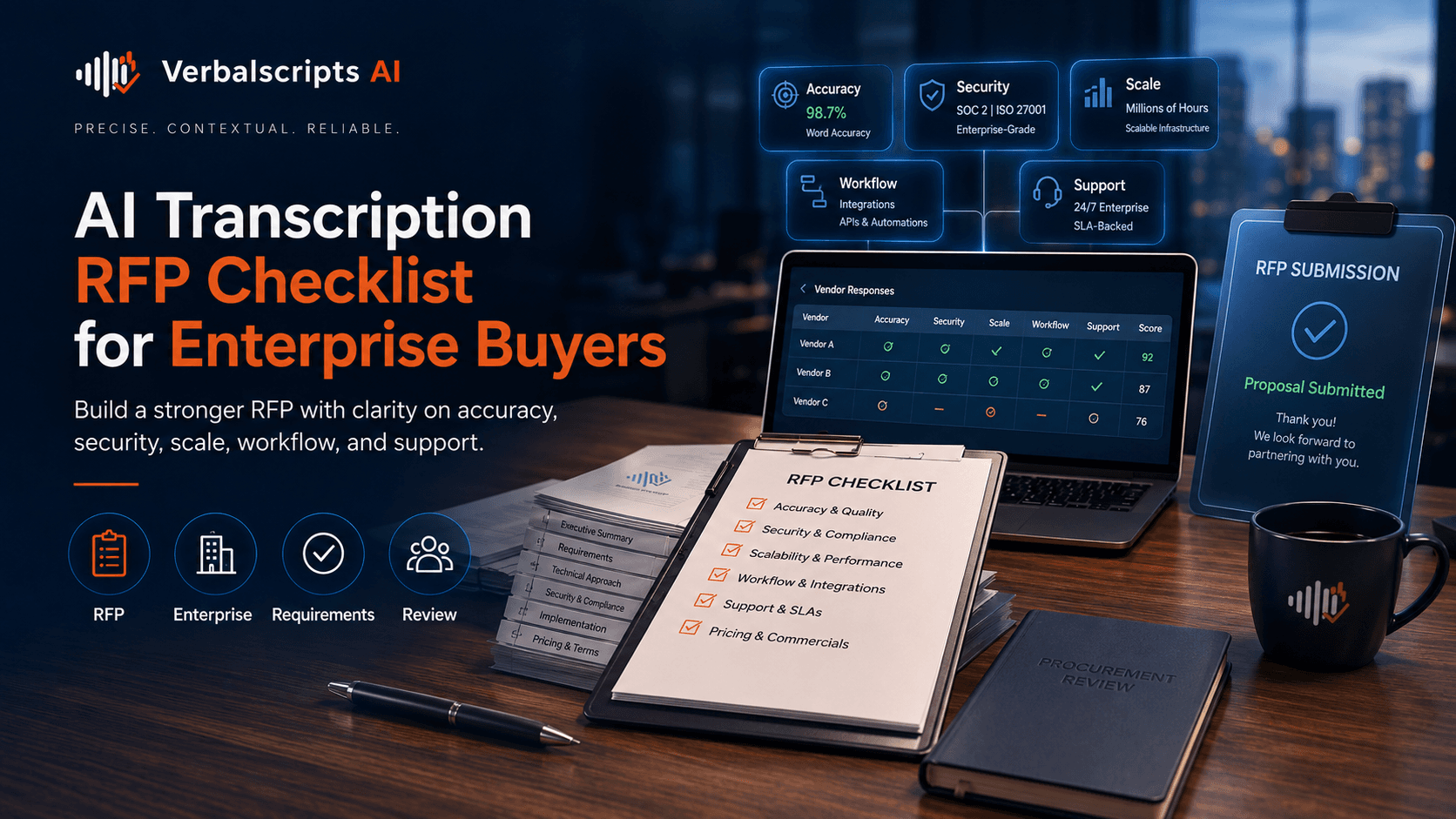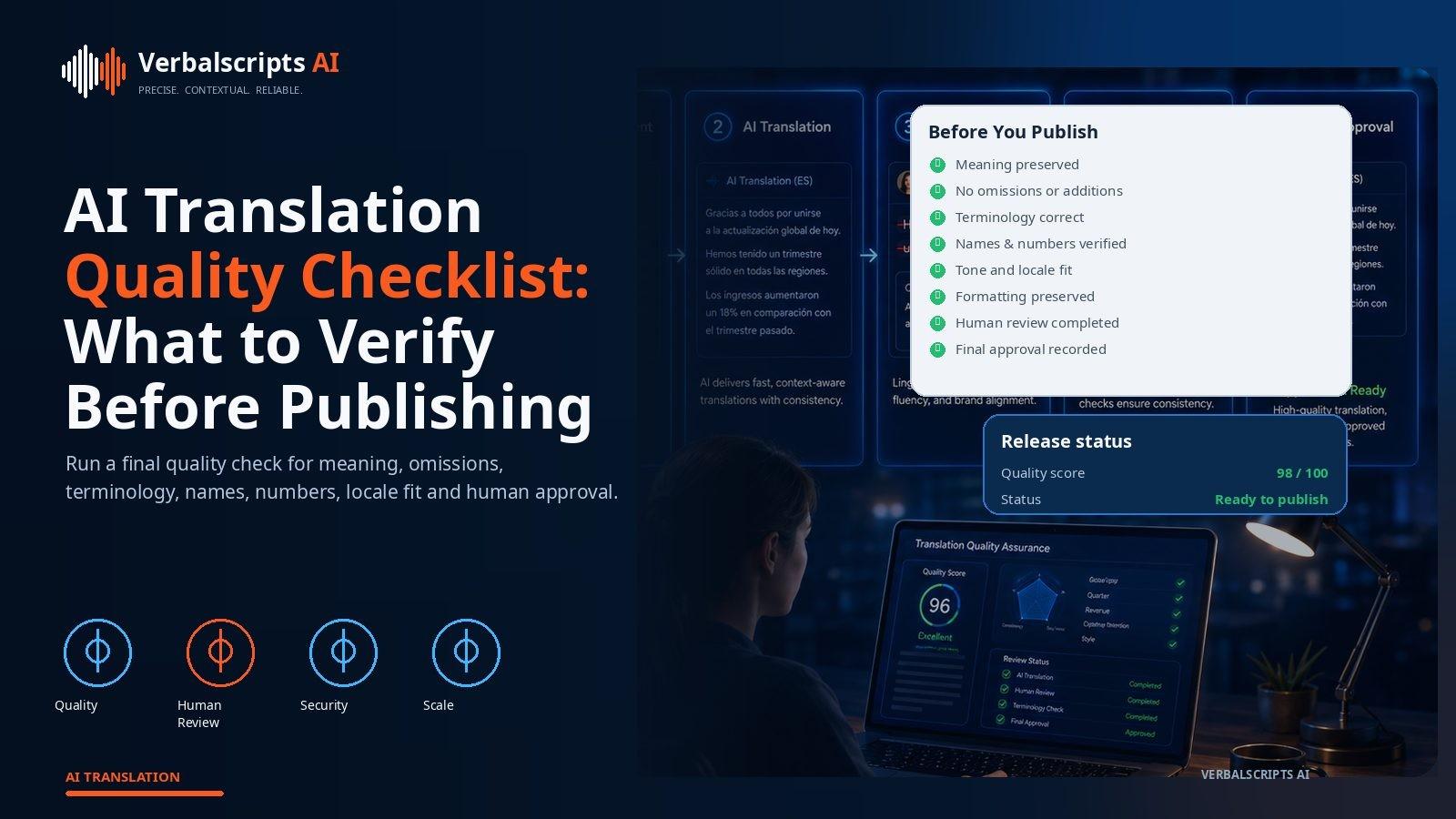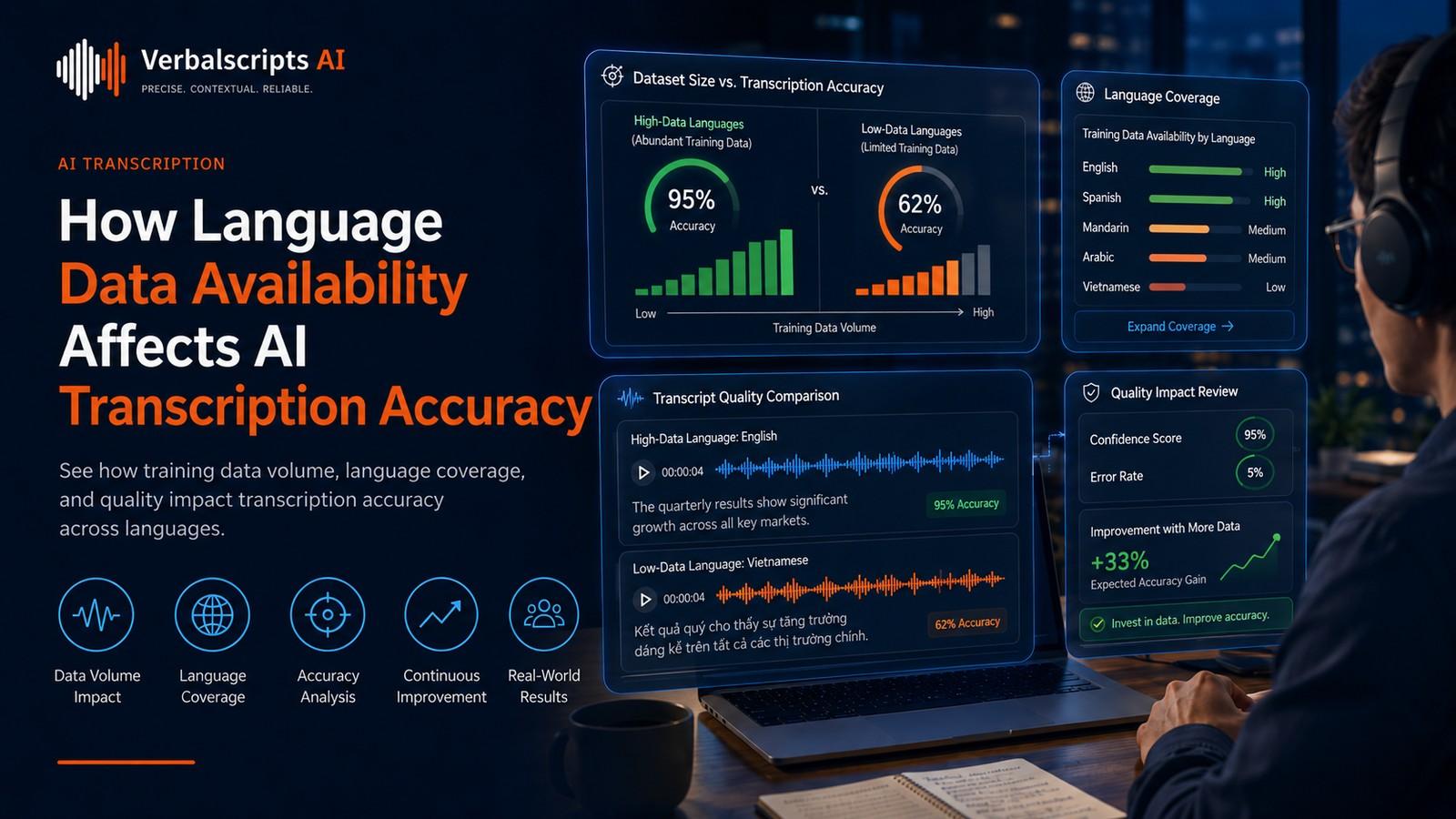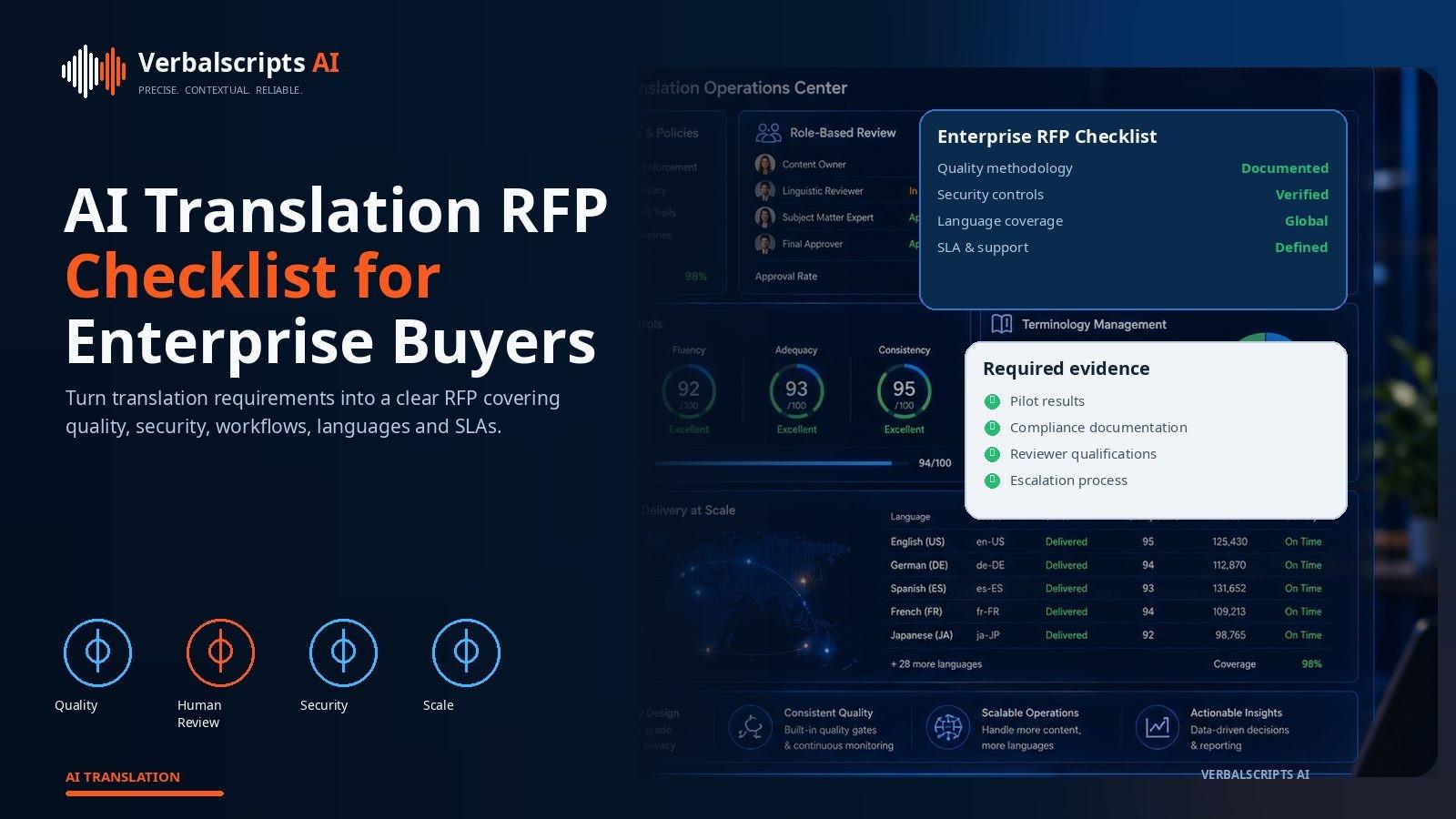
What should an AI translation RFP include? Include company and use-case context, exact language pairs/locales, expected volumes and formats, quality and human-review requirements, terminology and style-guide support, security/privacy controls, data retention, APIs and integrations, batch capacity, service levels, pricing structure, pilot requirements, references and contract terms. Require vendors to explain how each capability is implemented and to complete a representative translation test.
| SEO title | AI Translation RFP Checklist for Enterprise Buyers |
|---|---|
| Slug | ai-translation-rfp-checklist-enterprise-buyers |
| Meta description | Use this AI translation RFP checklist to evaluate quality, languages, human review, security, privacy, APIs, pricing, SLAs and vendor governance. |
| Primary keyword | AI translation RFP checklist |
| Search intent | Commercial investigation |
| Hero image | 166-ai-translation-rfp-checklist.jpg |
| Hero alt text | Enterprise translation RFP checklist covering language quality, security, review, integrations, pricing and SLA requirements |
| Article body words | 1988 |
For production multilingual workflows, see our AI Translation service for the delivery path behind the guidance in this article.
An enterprise translation RFP should do more than ask vendors for a language list and price per word.
AI translation combines software, data processing, human services and quality management. A procurement document should therefore test the provider across all four areas: language capability, workflow, security/governance and commercial delivery.
The strongest RFP makes requirements measurable so vendors cannot answer every question with “yes.”
The RFP should separate mandatory requirements from scored preferences.
1. Business context
Describe:
- organization;
- use cases;
- audiences;
- current workflow;
- pain points.
This prevents generic responses.
Example:
We translate legal, product and support content into 24 locales and require both API automation and human-reviewed output.
2. Scope
State estimated:
- words/characters;
- pages;
- audio minutes;
- documents/month;
- target languages.
Include:
- average;
- peak.
Providers need peak volume to size operations.
3. Language pairs
List exact directions.
Example:
- English → French (France);
- English → French (Canada);
- Swahili → English.
Ask vendor to indicate:
- supported;
- human reviewer available;
- benchmark data;
- expected turnaround.
4. Content types
List:
- marketing;
- technical;
- legal;
- medical;
- financial;
- UGC.
Quality and reviewer needs differ.
5. File formats
Require exact support for:
- DOCX;
- PDF;
- scanned PDF;
- PPTX;
- XLSX;
- HTML;
- JSON;
- SRT/VTT;
- audio/video.
Ask what is:
- native;
- converted;
- OCR.
6. Quality methodology
Ask:
- how quality is measured;
- human rubric;
- automatic metrics;
- critical-error definition;
- sampling.
Request sample reports.
Avoid accepting “99% accuracy” without methodology.
7. Human review
Specify required levels:
- bilingual review;
- native/in-market;
- specialist;
- second review.
Ask:
- reviewer qualification;
- vetting;
- calibration;
- confidentiality.
8. Terminology
Ask support for:
- glossary;
- termbase;
- custom terminology;
- forbidden terms;
- do-not-translate.
Require import/export.
Ask who owns term data.
9. Style guides
Ask:
- locale-specific rules;
- AI prompt integration;
- reviewer access.
Can vendor operationalize existing brand guides?
10. Translation memory
Ask:
- reuse;
- leverage;
- ownership;
- export.
AI may generate content, but approved historical translations remain valuable.
11. AI models
Ask vendor to describe:
- model families;
- routing;
- custom models;
- updates.
You do not necessarily need proprietary details, but you need change governance.
12. Quality regression
Ask:
- how model updates are tested;
- rollback;
- client notification.
This is critical for embedded APIs.
13. Hallucination/omission QA
Ask how the provider checks:
- missing text;
- unsupported additions;
- numbers;
- entities.
High-quality answers should mention specific controls.
14. Security
Require details:
- encryption;
- SSO/MFA;
- RBAC;
- logging;
- secure development;
- incident response.
Your security team may supply a separate questionnaire.
15. Data retention
Ask exact periods for:
- source;
- target;
- temporary;
- logs;
- backups.
Ask:
- configurable?
- deletion?
- evidence?
16. Model training
Ask:
- is customer data used for training?
- opt-in/opt-out?
- consumer vs enterprise differences?
Require contract language.
17. Data residency
Ask:
- storage;
- processing;
- reviewer region.
If specific geographic requirements exist, state them as mandatory.
18. Privacy
Ask:
- DPA;
- GDPR support;
- data-subject requests;
- subprocessor list.
Include regulatory requirements relevant to your organization.
19. API
Ask for:
- REST;
- authentication;
- rate limits;
- batch;
- webhooks;
- SDKs;
- idempotency.
Require sandbox.
20. Integrations
List required:
- CMS;
- TMS;
- cloud storage;
- help desk.
Ask whether native or custom.
21. Batch capacity
Ask:
- files/job;
- size;
- target count;
- throughput;
- queue behavior.
Benchmark peak scale.
22. Availability
For API workflows ask:
- uptime;
- planned maintenance;
- regional failover.
Require historical or committed SLA.
23. Turnaround
For human service ask:
- standard;
- rush;
- peak capacity.
Clarify whether turnaround starts after successful upload and complete instructions.
24. Support
Require:
- support hours;
- priority definitions;
- response targets;
- escalation.
Ask for named account contact if needed.
25. Incident response
Ask about:
- security incidents;
- translation quality incidents;
- notification.
A mass mistranslation can be a business incident even without a breach.
26. Pricing
Request:
- raw API rates;
- human review;
- specialist;
- minimums;
- rush;
- project management;
- formatting;
- storage.
Ask for total cost example.
27. Volume discounts
Ask thresholds.
But compare total cost of quality, including review.
28. Pilot
Require a pilot with:
- representative files;
- languages;
- terminology;
- review.
Define acceptance.
29. References
Request customers with:
- similar domain;
- scale;
- security.
Verify where possible.
30. Implementation
Ask for:
- timeline;
- resources;
- onboarding;
- migration.
Translation memory/terminology migration can be significant.
Mandatory versus scored
Example:
Mandatory
- EU data region;
- no training use;
- English→Arabic.
Scored
- dashboard;
- CMS integration.
Vendors failing mandatory requirements should not win on price.
Evaluation weighting
Example:
| Category | Weight |
|---|---|
| Quality | 30 |
| Security/privacy | 20 |
| Language/service | 15 |
| Technology | 15 |
| Support/SLA | 10 |
| Price | 10 |
Adjust.
RFP evidence
Require:
- documentation;
- sample;
- test;
- policy.
Avoid checkbox answers.
Contract transition
RFP commitments should flow into:
- MSA;
- DPA;
- SLA;
- order form.
Otherwise the sales answer may not be enforceable.
RFP response template for quality evidence
Require vendors to populate a structured table:
This prevents long marketing narratives from hiding missing capabilities. For every “yes,” the vendor should describe how the feature works and where its limits are.
For quality, ask for:
- human rubric;
- example error report;
- benchmark methodology;
- review escalation process.
Create a separate pilot dataset
The pilot should not be the entire production corpus. Select representative material with permission to share and include known difficult cases.
Keep a human-approved gold or review rubric internally. Vendors should not receive every expected answer in advance, except approved terminology that would exist in the real workflow.
Security and privacy scoring should be independent
A linguistically superior vendor may still be unusable because of data-handling requirements. Let security/privacy teams evaluate their mandatory controls independently, then combine the results with translation quality after gates are passed.
This avoids the procurement mistake of trading privacy requirements against a low price.
Require transition and exit plans
The RFP should ask:
- how existing TMs/glossaries are imported;
- who owns new language assets;
- how data is exported at termination;
- deletion timing after exit.
Migration is part of total cost and operational risk.
Ask for capacity evidence
If the requirement includes rush handling of 2 million words or 200 hours of audio, ask the provider to explain:
- reviewer capacity;
- concurrency;
- peak-period planning;
- historical comparable project.
A theoretical API throughput number does not prove human-review capacity.
Contractual traceability
Mark which RFP answers must become contractual commitments. These may include:
- no model-training reuse;
- region;
- retention;
- turnaround;
- support SLA;
- pricing.
If a requirement matters enough to determine the award, it should not disappear between the RFP and final contract.
Suggested RFP requirement language for quality
An RFP can state:
The bidder shall describe its translation-quality evaluation methodology, including error categories, severity, sampling, reviewer qualifications and handling of critical errors. Generic accuracy percentages without methodology will not be scored as evidence.
This forces comparable answers.
Suggested requirement language for AI data use
A procurement team may state:
The bidder shall disclose whether customer source content, translated output, reviewer corrections or metadata are used to train, fine-tune or otherwise improve shared models, and identify available opt-out or enterprise controls.
Exact legal wording should be reviewed internally, but the requirement prevents ambiguity.
Suggested pilot scoring
Pilot scoring can separate:
- accuracy/adequacy: 35;
- terminology: 15;
- fluency/style: 10;
- document/layout: 10;
- security/privacy: mandatory gate;
- workflow/support: 15;
- price: 15.
This keeps linguistic quality central without ignoring operations.
RFP timeline realism
Give vendors enough time to:
- configure terminology;
- complete security forms;
- perform translation tests.
A rushed RFP can favor vendors with aggressive sales teams rather than vendors with stronger quality systems.
Stakeholder participation
Include:
- localization;
- engineering;
- security/privacy;
- legal/procurement;
- business users.
Each should score the areas they understand. A single procurement score cannot fairly judge both API architecture and Arabic translation naturalness.
Final negotiation checklist
Before award, verify that material commitments from the winning response appear in:
- MSA;
- DPA;
- SLA;
- statement of work;
- pricing schedule.
An excellent RFP is wasted if the final contract silently omits the requirements that differentiated the vendor.
Example mandatory requirements section
An enterprise buyer could list:
- target languages A–H must be supported with human review;
- restricted data must not be used for shared model training;
- source/target files must be deletable according to the defined retention schedule;
- SSO/MFA required for reviewers;
- glossary import/export required;
- API and batch document processing required.
Each requirement should be marked pass/fail before weighted scoring.
Example vendor quality test instructions
Give all vendors the same:
- source files;
- glossary;
- style guide;
- requested locale;
- turnaround window.
Do not allow one vendor extra context unless it would also be available in production. Otherwise the test is not comparable.
Have reviewers score output blind to vendor identity.
Commercial response template
Request prices for a common scenario, for example:
- 1 million source words/month;
- 10 target languages;
- 70% standard documentation;
- 20% marketing;
- 10% legal;
- defined review tiers.
This exposes how different pricing models affect total cost better than collecting disconnected unit rates.
Implementation risk scoring
Ask vendors to identify:
- customer engineering effort;
- expected onboarding time;
- required cloud setup;
- migration tooling.
Score implementation risk separately from steady-state features. A technically powerful platform can still be a poor fit if deployment would take a year.
Proof-of-concept acceptance criteria
Before the pilot begins, define success:
- no critical errors;
- terminology compliance ≥ target;
- document layout pass rate;
- API error rate;
- reviewer TAT;
- security approval.
Predefined criteria reduce selection bias after results arrive.
Award memo
The procurement team should retain a concise memo summarizing:
- scored results;
- mandatory gates;
- pilot findings;
- limitations accepted;
- final commercial assumptions.
This becomes the baseline for future vendor reviews and renewals.
RFP scoring governance
Before responses arrive, decide:
- who scores each category;
- whether scores are averaged or adjudicated;
- how conflicts are resolved.
Language-quality reviewers should not score penetration-testing documentation; security reviewers should not judge Japanese naturalness. Assign expertise to the relevant section.
Normalize pricing submissions
Give vendors a pricing spreadsheet/template so each bidder prices the same scenario. This reduces the work of comparing:
- per-character;
- per-word;
- per-page;
- project fees.
Require providers to list assumptions and excluded costs.
Post-award validation
After contracting, confirm that production onboarding still matches the RFP:
- same region;
- same review process;
- same terminology support;
- same SLA.
Treat the first production month as monitored implementation rather than assuming the procurement process alone guarantees success.
Implementation takeaway
For production use, treat mandatory procurement gates, standardized pilots and contractual traceability as measurable parts of the workflow rather than assumptions. Define the relevant policy before processing content, keep the model or data configuration versioned, and verify results on representative material from the actual language, locale and domain. If automation produces a result that conflicts with a deterministic rule, authoritative terminology or qualified human evidence, escalate the item instead of averaging the disagreement away. The most durable multilingual systems preserve source-to-target traceability, record exceptions and feed reviewed corrections back into benchmarks, glossaries or routing rules. That discipline makes quality improvements reproducible when models, providers, reviewers or source content change.
Frequently asked questions
How many vendors should an RFP include?
Enough for meaningful competition, but not so many that evaluation becomes superficial.
Should the RFP require a translation test?
Yes. It is one of the most valuable evidence sources.
Should price be the largest score?
Usually not for high-risk enterprise translation.
Do we need a separate security questionnaire?
Often yes.
What should be mandatory?
Requirements whose failure makes the provider unusable, such as data region or required language pair.
Conclusion
A strong AI translation RFP converts vague vendor claims into measurable evidence.
Specify the languages, risk, formats, quality, data handling and operations your organization actually needs. Require a real pilot and detailed answers.
The objective is not the longest feature list. It is choosing a provider that can deliver multilingual quality safely and repeatedly at enterprise scale.
Research references
- NIST AI Risk Management Framework:
- NIST Privacy Framework:
- European Commission, GDPR principles:
- ISO 17100:2015: