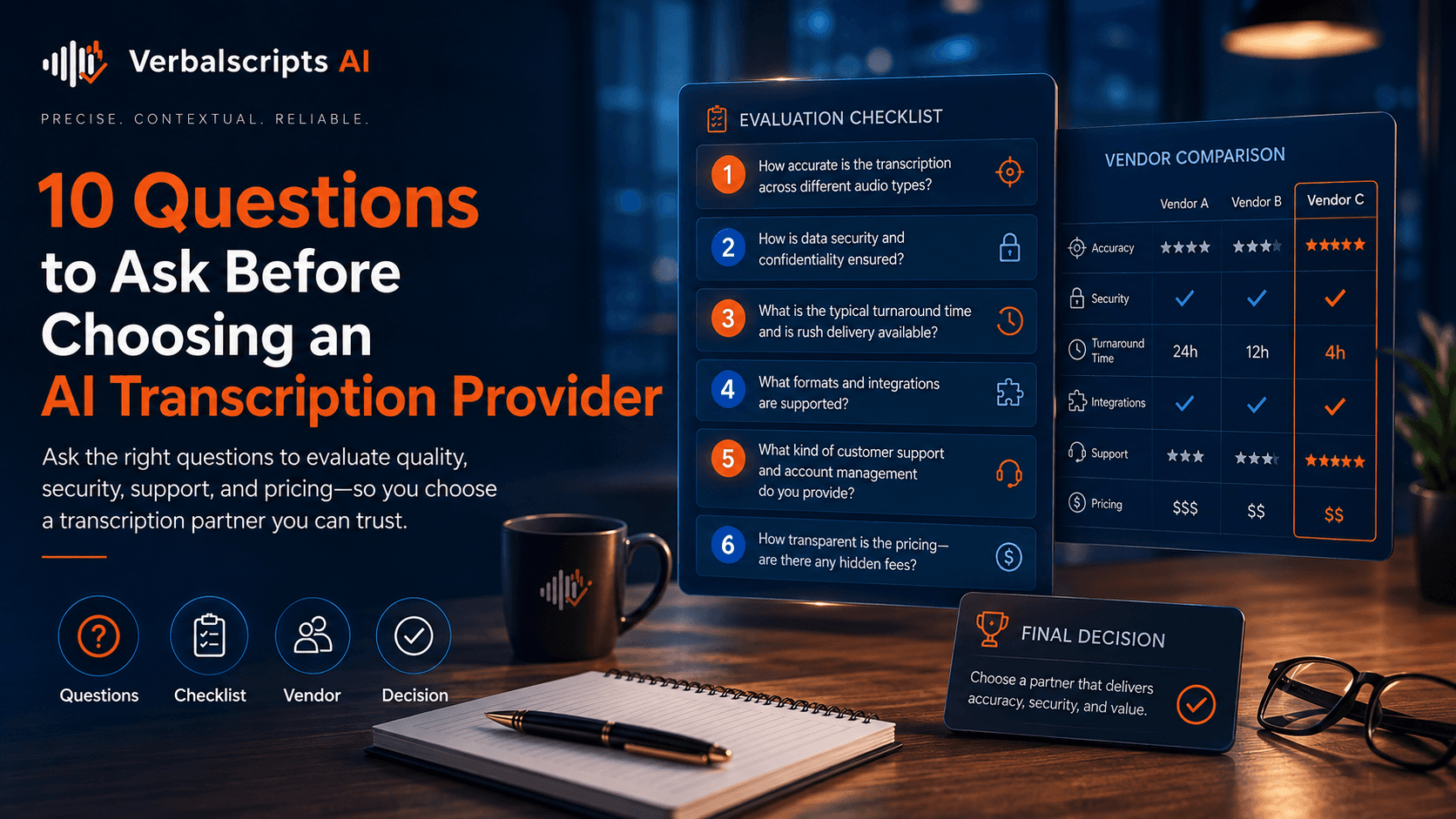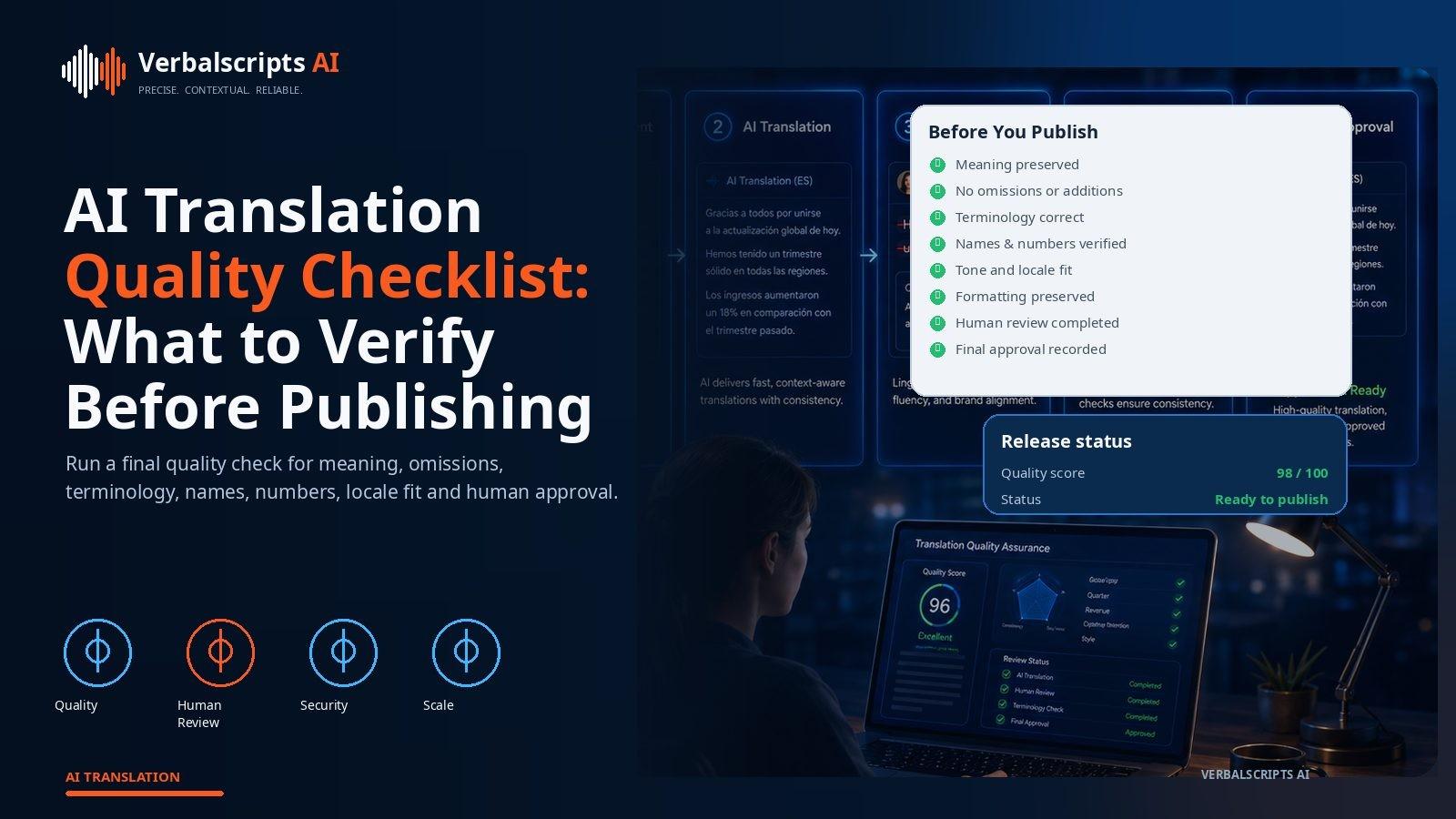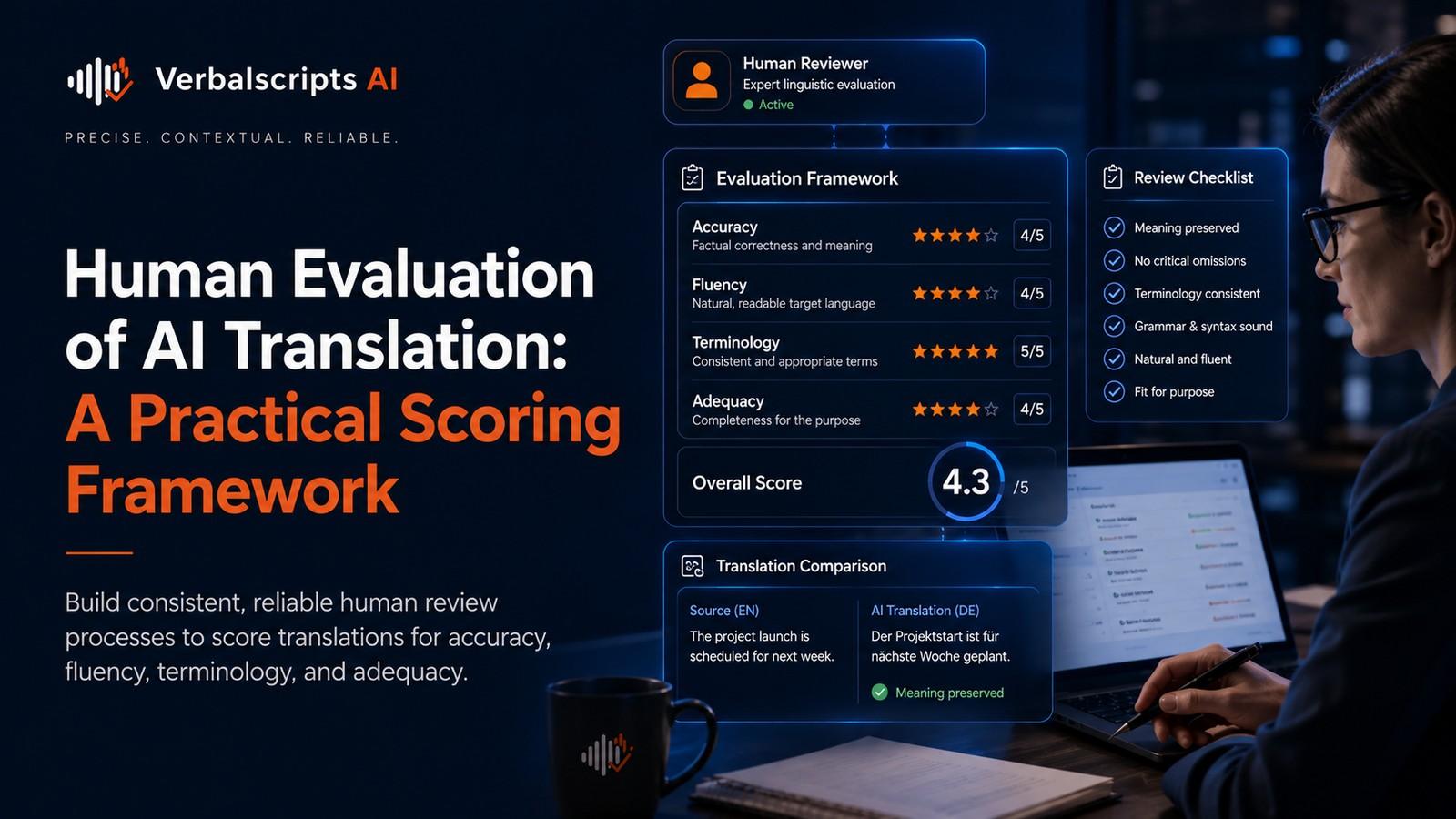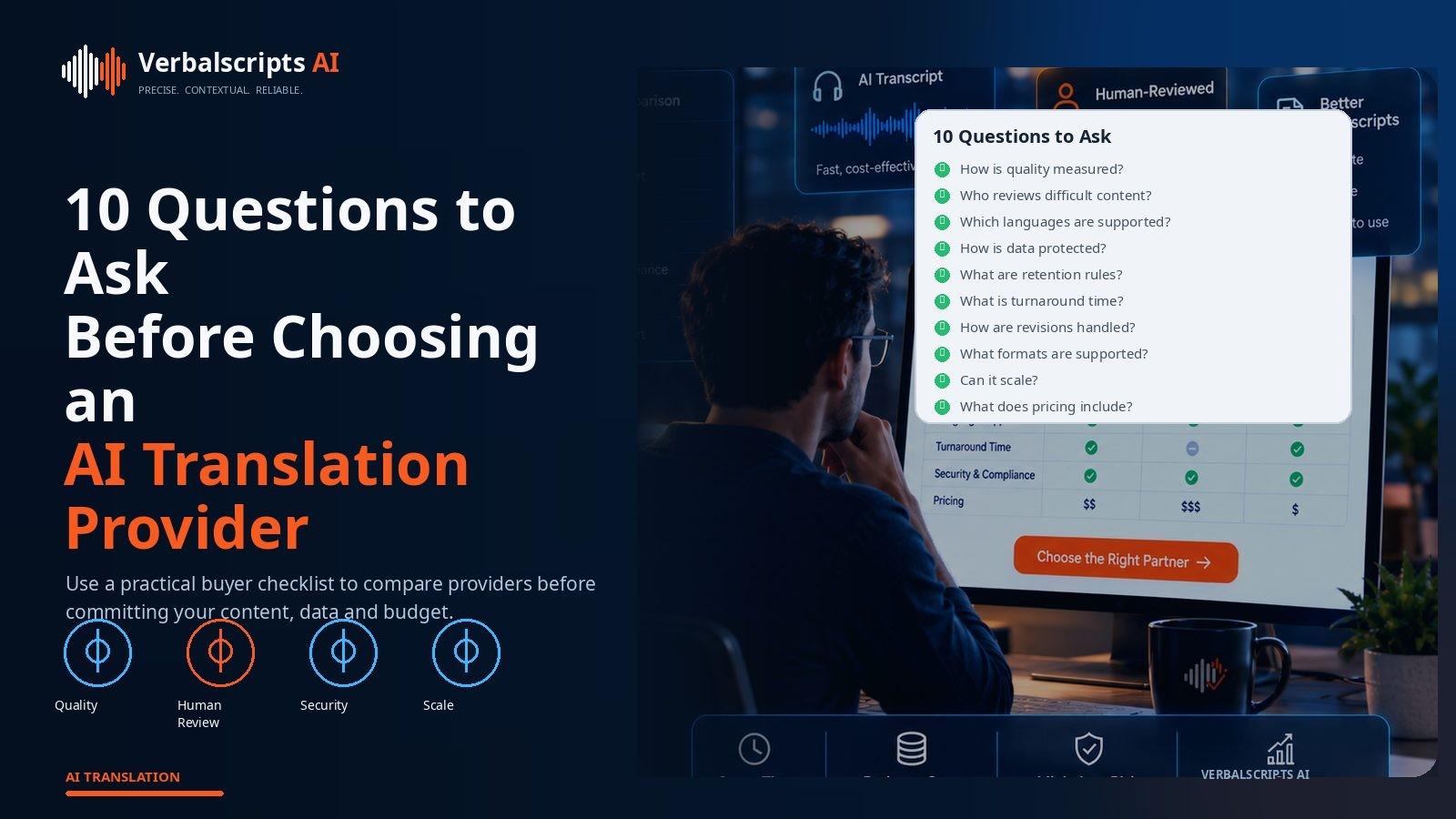
Before choosing a provider, ask:
| SEO title | 10 Questions to Ask an AI Translation Provider |
|---|---|
| Slug | questions-choose-ai-translation-provider |
| Meta description | Ask these 10 questions before choosing an AI translation provider, covering quality, languages, human review, security, retention, pricing and SLAs. |
| Primary keyword | AI translation provider questions |
| Search intent | Commercial investigation |
| Hero image | 165-ai-translation-provider-questions.jpg |
| Hero alt text | Enterprise buyer checklist with ten questions about translation quality, security, language coverage, review and pricing |
| Article body words | 1936 |
For production multilingual workflows, see our AI Translation service for the delivery path behind the guidance in this article.
The fastest way to evaluate an AI translation provider is to ask questions that force the company to describe how the service works in production.
Marketing pages tend to emphasize language count, speed and AI. Buyers need to know what happens when the source is confidential, the PDF is scanned, the model mistranslates a legal term or the client needs 40 languages by Friday.
The following ten questions expose those differences.
- How do you measure translation quality?
- Which language pairs and locales have you tested?
- What human review is available?
- How do you control terminology?
- How do you handle confidential data?
- What are your retention and deletion policies?
- Which document/audio formats do you support?
- What are your API, batch and integration capabilities?
- What exactly is included in pricing?
- What SLAs and escalation support do you provide?
Ask for evidence, not adjectives.
1. How do you measure translation quality?
A weak answer:
“Our AI is 99% accurate.”
Ask:
- benchmark?
- languages?
- domain?
- human scoring?
- critical errors?
Good providers can describe:
- automatic metrics;
- human evaluation;
- QA checks;
- reviewer process.
Quality should be measurable.
Ask for a pilot
Provide your content.
A real benchmark is stronger than vendor benchmark.
Include:
- terminology;
- difficult files;
- target languages.
Blind-review the output.
2. Which language pairs and locales have you actually tested?
“200 languages” can hide uneven quality.
Ask:
- English → Japanese?
- Swahili → English?
- Arabic locale?
Translation is directional.
Locale matters.
Low-resource evidence
If you need a lower-resource language, ask:
- sample;
- reviewer network;
- quality data.
Do not infer quality from the provider’s strongest European languages.
3. What human review is available?
Ask what “human reviewed” means.
Questions:
- bilingual review?
- native target?
- specialist?
- second reviewer?
- full document?
A quick target proofread is not equivalent to bilingual verification.
Reviewer qualification
For legal/medical:
- domain credentials?
- confidentiality?
Ask how reviewers are calibrated.
4. How do you control terminology?
Ask:
- glossary?
- termbase?
- do-not-translate?
- forbidden terms?
- API glossary?
Test your own glossary.
WMT research shows terminology needs dedicated evaluation.
Ownership
Can you export terminology?
Do you own language assets?
Avoid lock-in.
5. How do you handle confidential data?
Ask for specifics:
- encryption in transit;
- encryption at rest;
- access control;
- MFA/SSO;
- region;
- subprocessor.
Security is architecture.
Model training
Ask explicitly:
Is our content used to train or improve models?
Provider terms may differ by product.
6. What are your retention and deletion policies?
Ask:
- source retention;
- target retention;
- logs;
- backup;
- reviewer copy.
Can retention be configured?
Can you delete on demand?
GDPR includes storage limitation.
Evidence
Ask for:
- DPA;
- retention documentation.
Do not accept “we delete data securely” without time periods.
7. Which formats do you support well?
A provider may support:
- DOCX;
- PDF;
- PPTX;
- XLSX;
- audio;
- video.
Test your hardest format.
Scanned PDF
Ask:
- OCR?
- tables?
- handwriting?
- output layout?
Media
Ask:
- timestamps;
- speaker labels;
- subtitles;
- captions.
8. What API, batch and integration capabilities do you provide?
Developers need:
- REST API;
- authentication;
- webhooks;
- batch;
- rate limits.
Content teams need:
- CMS/TMS.
Ask about:
- error handling;
- idempotency;
- SDKs.
Limits
Published cloud limits can change.
Provider should document current constraints.
9. What exactly is included in pricing?
Ask:
- raw AI?
- human review?
- QA?
- formatting?
- project management?
- revisions?
- rush?
Compare like-for-like.
Unit
Could be:
- character;
- word;
- page;
- minute;
- project.
Define counting.
10. What SLAs and escalation support do you provide?
SLA can cover:
- uptime;
- turnaround;
- support response;
- quality;
- security incidents.
Ask:
- severity levels;
- escalation path;
- account contact.
If translation fails during launch, know whom to call.
Bonus: What happens when the model changes?
Providers update AI.
Ask:
- notification?
- regression tests?
- version pinning?
- rollback?
Enterprise quality can shift after an upgrade.
Bonus: Can we export our data?
You should be able to export:
- translation;
- glossary;
- memory;
- project records.
Portability reduces lock-in.
Score the answers
Create 0–5 scoring for each question.
Weight:
- quality;
- security;
- review
higher for high-risk work.
Do not let a low price compensate for a failed mandatory requirement.
Require written answers
For enterprise procurement, document answers in:
- RFP;
- security questionnaire;
- contract.
Verbal assurances are difficult to enforce.
Pilot before contract
A pilot should test:
- 3–5 representative languages;
- important formats;
- glossary;
- review;
- support.
Measure:
- accuracy;
- edits;
- turnaround;
- cost.
Turn the ten questions into procurement evidence
For each answer, request one of:
- documentation;
- screenshot;
- sample report;
- contract clause;
- test output;
- API sandbox result.
For example, if a vendor says it supports custom terminology, provide a glossary containing a deliberately difficult product term and verify the output. If it claims deletion within 24 hours, request the retention policy and contractual commitment.
Evidence makes evaluation reproducible across vendors.
Question scoring template
Score each of the ten questions from 0–5:
- 0: unsupported or unacceptable;
- 1: major gaps;
- 3: adequate with limitations;
- 5: fully meets requirement with evidence.
Apply mandatory gates first. A provider that fails a required data-residency rule should not remain in the competition because it scores highly on UI or price.
Ask about what the provider does not support
Mature vendors can explain limitations such as:
- scanned handwriting;
- a low-resource language without specialist review;
- a document format that loses annotations;
- maximum target count per job.
A provider that claims everything works equally well should be tested more carefully. Honest limitations make project design safer.
Ask how client feedback changes the system
A useful managed provider should describe how corrections feed into:
- terminology;
- style guides;
- reviewer instructions;
- model routing.
If every project starts from zero, the client pays repeatedly for the same corrections.
Ask for a difficult sample, not only your cleanest file
Include:
- names;
- numbers;
- tables;
- rare terminology;
- ambiguous sentence;
- one scanned page.
The goal of a pilot is to find failure modes before contracting, not to create a flattering demo.
Question 11: How do you handle source changes?
Translation programs fail when the target becomes stale. Ask whether the provider can:
- identify changed segments;
- reuse unchanged approved text;
- mark target versions outdated;
- trigger selective review.
This is essential for websites, documentation and product strings that change continuously.
Question 12: How do you handle critical errors after delivery?
Ask for a real incident process:
- severity classification;
- immediate correction;
- search for related outputs;
- root-cause analysis;
- preventative action.
A provider that can only “redo the file” may not have mature quality operations.
Question 13: What data do we own?
Clarify ownership/export of:
- source files;
- final translations;
- reviewer corrections;
- glossaries;
- translation memories;
- model/customization assets where applicable.
These resources can become valuable intellectual property.
Question 14: How do you benchmark low-resource languages?
A generic claim such as “all languages use the same model” is not evidence. Ask:
- sample size;
- native reviewers;
- domain;
- known limitations.
Quality transparency matters more when public benchmarks are limited.
Question 15: What happens at termination?
Ask:
- export process;
- data deletion;
- language asset handoff;
- support during migration.
A good exit plan is part of vendor selection, not something to negotiate only after a relationship goes wrong.
Final due-diligence rule
For every important answer, ask “How do you know?” If the provider can show a test, policy, log, benchmark or contract clause, the answer is evidence. If it can only repeat a marketing phrase, keep investigating.
Use the questions as a live demo script
Instead of letting the vendor control the demonstration, ask them to show:
- upload a real DOCX/PDF;
- apply your glossary;
- route it to human review;
- display review history;
- delete the project;
- show API documentation;
- export language assets.
A guided demo converts several abstract questions into observable evidence.
Ask for the current supported-language matrix
Language support can differ across:
- text translation;
- document translation;
- speech;
- custom terminology;
- human review.
Request a matrix showing which features are available for each required language. “We support Swahili” is not enough if the feature you need (say, native legal review or streaming speech) is unavailable.
Ask how quality changes with scale
A provider may deliver an excellent 5-page sample because a senior linguist reviewed it manually. Ask how the same process works for:
- 10,000 pages;
- 20 languages;
- a 24-hour deadline.
Request reviewer-capacity and QA details for the real volume.
Ask how reviewers are paid and managed
For managed human review, quality depends on people. While you do not need private compensation details, ask whether reviewers are:
- vetted;
- trained;
- given realistic deadlines;
- measured for quality.
A sustainable reviewer network is part of service reliability.
Ask what happens when terminology conflicts with natural grammar
A mature provider should explain how strict terms, inflected terms and contextual exceptions are handled. If the answer is “the glossary always forces the exact word,” test it on an inflected language.
Ask for proof of deletion and data isolation
For sensitive workflows, request:
- deletion logs/certification capability;
- tenant-isolation explanation;
- retention timeline.
This moves privacy from policy language into operational assurance.
Shortlisting rule
After the first due-diligence round, remove providers that fail non-negotiable requirements. Conduct deeper pilots only with vendors that remain viable. This saves reviewer and procurement time and prevents attractive pricing from keeping unsuitable options alive.
Red flags in provider answers
Be cautious if a provider:
- refuses to distinguish raw AI from reviewed output;
- gives one accuracy percentage for every language;
- cannot explain where data is stored;
- claims no limits on file size, throughput or review capacity;
- cannot name who owns terminology decisions;
- cannot export your approved language assets.
One red flag may have an explanation. Several suggest weak operational maturity.
Keep a due-diligence record
Store:
- vendor answers;
- evidence links;
- pilot scores;
- security approval;
- pricing;
- limitations;
- final decision.
This record makes renewals faster and protects institutional knowledge when procurement or localization staff change.
Final shortlist rule
The best provider is the one that meets mandatory controls, performs strongly on your content and can operate at your scale. Feature count and model brand should be secondary to those three facts.
Implementation takeaway
For production use, treat evidence-backed due diligence, hard limitations and production-scale capacity as measurable parts of the workflow rather than assumptions. Define the relevant policy before processing content, keep the model or data configuration versioned, and verify results on representative material from the actual language, locale and domain. If automation produces a result that conflicts with a deterministic rule, authoritative terminology or qualified human evidence, escalate the item instead of averaging the disagreement away. The most durable multilingual systems preserve source-to-target traceability, record exceptions and feed reviewed corrections back into benchmarks, glossaries or routing rules. That discipline makes quality improvements reproducible when models, providers, reviewers or source content change.
Frequently asked questions
What is the most important question?
“How do you measure quality on my language pair and content?”
Should I ask about model names?
Yes, but process and results matter more than brand.
How do I verify security claims?
Use security documentation, DPA, certifications where relevant and your internal security review.
Is human review always required?
No. Ask whether it is available when risk requires it.
Should an enterprise provider offer an SLA?
For business-critical workflows, clear support and service commitments are valuable.
Conclusion
The right questions turn an AI translation sales conversation into due diligence.
Ask for measurable quality, exact data handling, real language evidence and a defined human-review process. Test the service with your own files.
A strong provider will welcome specificity because it understands that reliable translation is a workflow, not just a model.
Research references
- NIST AI Risk Management Framework:
- European Commission, GDPR principles:
- ISO 17100:2015:
- WMT 2023 Terminology Shared Task: