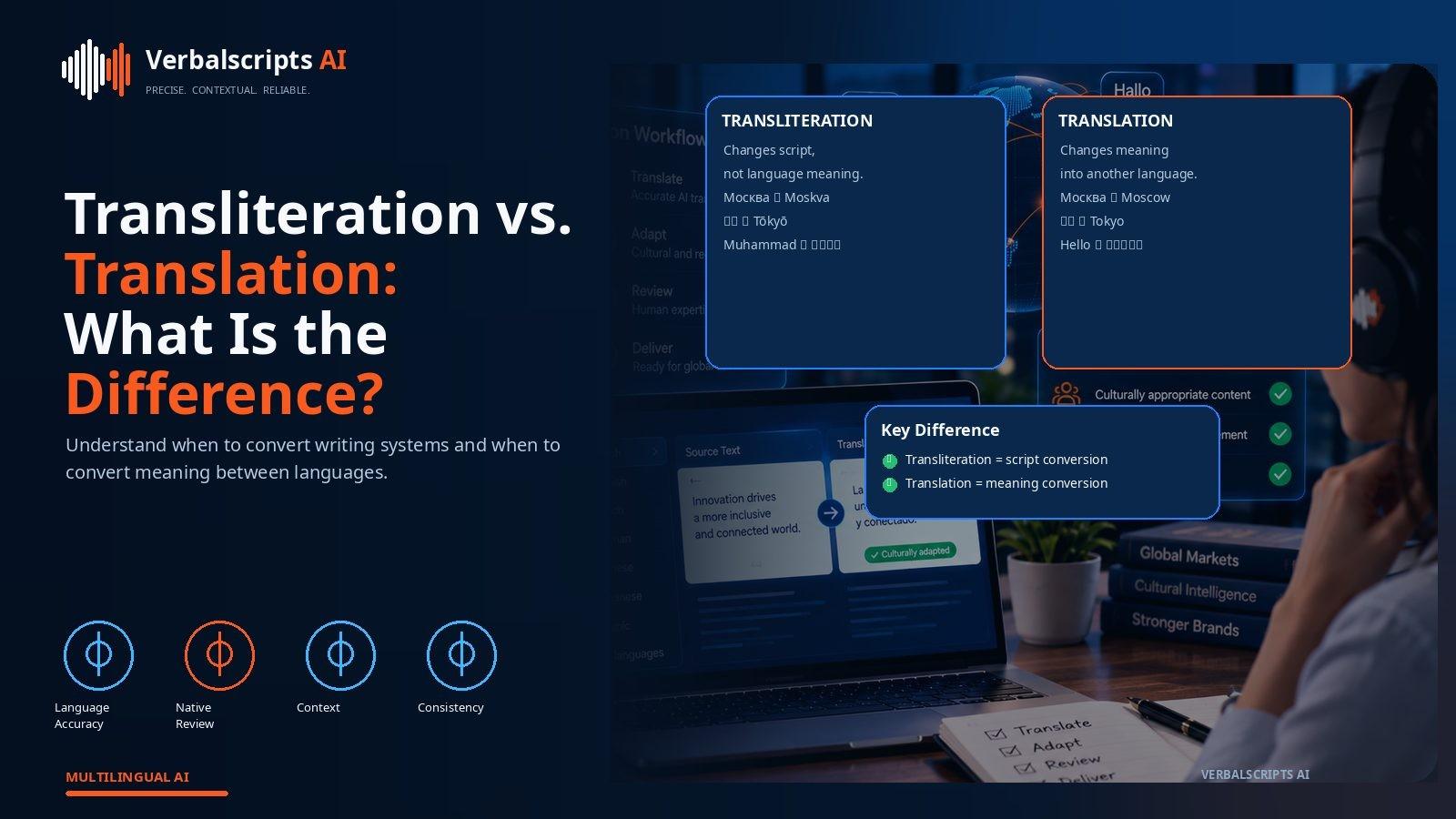
What is the difference between transliteration and translation? Translation converts meaning between languages. Transliteration converts the written representation of a word or name from one script to another while generally preserving pronunciation or spelling relationships. Romanization is transliteration into the Latin script. A personal name usually needs transliteration rather than translation, while a sentence needs translation.
| SEO title | Transliteration vs. Translation: What Is the Difference? |
|---|---|
| Slug | transliteration-vs-translation-difference |
| Meta description | Understand transliteration vs. translation, romanization, script conversion, names, examples and when each process should be used. |
| Primary keyword | transliteration vs translation |
| Search intent | Informational |
| Hero image | 189-transliteration-vs-translation.jpg |
| Hero alt text | Comparison graphic showing semantic translation versus script transliteration of the same word across writing systems |
| Article body words | 1941 |
For production multilingual workflows, see our AI Translation service for the delivery path behind the guidance in this article.
Translation and transliteration both transform language, but they answer different questions.
Translation asks:
What does this mean in another language?
Transliteration asks:
How can this word be written in another script?
Confusing the two creates common errors in names, maps, search systems and multilingual documents.
ICU’s Unicode documentation states explicitly that transliteration (transformation between writing systems) is not translation.
Translation example
Arabic sentence meaning:
Welcome to the conference.
Translation into English produces the English meaning.
The target words are not trying to imitate Arabic sounds.
Transliteration example
A person name written in Cyrillic is represented in Latin letters.
Meaning is not translated.
The target is a script representation.
Romanization
Romanization = into Latin/Roman alphabet.
Uses:
- passports;
- maps;
- libraries;
- search.
Several romanization systems may exist for one script/language.
Transliteration standards
Systems differ in goals.
Reversible
Aim to reconstruct source script.
Pronunciation-oriented
Help target readers pronounce.
Official
Government/institution standard.
A model-generated spelling may be plausible but not official.
Names
Personal names should usually:
- preserve official spelling;
- or transliterate.
Do not translate name meaning.
Exception:
historical figures with established target-language conventional names.
Place names
Places may have:
- endonym;
- exonym;
- romanization.
Example:
A city can have a conventional English name different from direct transliteration.
Use authoritative geographical naming policy.
UNGEGN maintains information on romanization systems for geographical names.
Product names
Brand may choose:
- original script;
- transliteration;
- localized brand.
Follow brand policy.
Do not let AI translate a trademark literally.
Search
Search systems may index:
- native script;
- romanized form.
Useful for users who cannot type source script.
Store aliases.
Transliteration is language-specific
Converting Cyrillic character-by-character without knowing language can be wrong.
The same script serves:
- Russian;
- Ukrainian;
- Serbian.
Rules differ.
Chinese romanization
Pinyin represents Mandarin pronunciation.
It does not translate Chinese meaning.
A Chinese name may use an official spelling.
Japanese romanization
Japanese has romanization systems such as Hepburn.
Kanji readings are not always predictable from characters alone.
Lexical context matters.
Arabic romanization
Arabic script represents several languages.
Arabic, Persian, Urdu transliteration rules differ.
Diacritics may be omitted in ordinary script, creating pronunciation ambiguity.
Transliteration versus transcription
In linguistics, “transcription” can mean representing sounds using a phonetic system.
In speech services, transcription means speech → written language.
Keep project terminology clear.
Transliteration in NLP
ICU provides transliteration transforms for many script conversions.
These deterministic rules can be preferable to LLM generation when a standardized mapping exists.
AI transliteration
Neural systems can learn:
- names;
- pronunciations.
They are useful for names where mapping is context-dependent.
But verify official identities.
Official documents
For:
- passport;
- immigration;
- court,
use spelling from authoritative ID.
Do not create a new romanization.
Translation + transliteration
Sometimes both are useful.
Example:
Product manual introduces a local institution:
Original Name (Romanized Name), translated description
This supports recognition and meaning.
Multilingual SEO
A page may include both:
- native script;
- common romanization
for important entities where users search both.
Avoid keyword stuffing.
Data matching
Transliteration can help entity matching.
But multiple romanizations create:
- duplicates.
Use stable entity IDs.
Diacritics
A scholarly transliteration may use:
- macrons;
- diacritics.
Consumer systems may omit them.
Choose standard appropriate to purpose.
Reversibility
If transliteration is used for legal/database migration, reversible mapping may matter.
If used for tourist signage, pronunciation/readability may matter more.
Define goal.
Quality evaluation
Check:
- source entity;
- target spelling;
- standard;
- consistency.
Do not use translation metrics for transliteration.
Character accuracy may be more relevant.
Common mistakes
Translating a surname
Identity corrupted.
Treating romanization as English
Meaning still unknown.
Using wrong script rules
Language-specific spelling wrong.
Ignoring official spelling
Generated variant conflicts with ID.
Assuming one romanization
Several standards possible.
Example: one name, three possible operations
Suppose a Japanese person’s name appears in a US-facing report.
Possible operations:
- preserve Japanese script for a Japanese version;
- romanize using the person’s established spelling for English;
- translate a job title next to the name.
The name is transliterated/preserved; the title is translated. Treating the entire line as one translation string can produce a wrong result.
Transliteration and search aliases
A search index can store several forms:
- native script;
- official romanization;
- common alternate spelling.
Display the authoritative form but allow users to find it through aliases. This is more robust than trying to choose one spelling that serves every search behavior.
Deterministic versus neural transliteration
Use deterministic standards when:
- official mapping exists;
- reversibility matters.
Use neural/context-aware methods when:
- pronunciation cannot be recovered character-by-character;
- names have irregular readings.
Even then, authoritative identity data overrides the model.
Transliteration quality checklist
For a name/entity:
- correct source language/script?
- correct standard?
- diacritics?
- established personal spelling?
- consistent across document?
- same entity linked despite aliases?
This is a different QA process from sentence translation.
Avoid accidental semantic translation
Brand and family names may contain ordinary dictionary words. An AI system can mistakenly translate them because context is weak.
Named-entity detection plus a do-not-translate/entity database is the best prevention. Do not depend on capitalization alone because capitalization conventions differ across scripts.
Transliteration standards should be selected before bulk processing
For a large archive of names, decide:
- source language/script;
- target script;
- official standard;
- exceptions.
Do not generate 100,000 romanized names and then discover that the client requires a different government standard.
Create a small benchmark containing common and difficult names and compare the chosen system with authoritative examples.
Reversibility versus readability tradeoff
A scholarly transliteration may represent every source-letter distinction with diacritics, making it more reversible. A consumer map or support system may prefer a familiar simplified spelling.
Neither is universally superior. The project must choose whether the primary goal is:
- reconstructing the source;
- helping target readers pronounce;
- matching official records.
Store the policy with the output.
Transliteration of unknown readings
Some writing systems do not uniquely determine pronunciation in personal names. Japanese kanji names are a classic example: the same characters can have different readings.
If the reading is unknown:
- use authoritative metadata;
- ask the user/client;
- do not confidently infer.
AI may offer a plausible reading that belongs to a different person.
Search normalization
A robust search system can normalize transliteration variants:
- hyphen/no hyphen;
- diacritics/no diacritics;
- common alternative romanizations.
But the displayed name should remain authoritative. Search normalization is a retrieval feature, not permission to rewrite identity.
Transliteration and legal evidence
For legal documents, if the source record contains a name in native script and another official ID contains a Latin spelling, consider showing both where permitted:
Native Script (Official Latin Form)
This reduces ambiguity while preserving the original identity record.
Acronyms and mixed scripts
A brand may contain a Latin acronym inside an otherwise non-Latin name. Transliterate only the parts covered by policy. Do not force a mixed-script official brand into one script if the organization intentionally uses both.
Automated QA metrics
For transliteration, useful checks include:
- exact match with authoritative target;
- character-edit distance;
- standard-rule compliance;
- consistency across occurrences.
Do not use BLEU or translation adequacy as the main measure.
Human reviewer role
A language reviewer should verify:
- correct language-specific rule;
- pronunciation where known;
- local convention.
For official identity, the source authority still outranks reviewer intuition.
Transliteration in subtitles
Names appear quickly on screen. Use the same approved form across:
- subtitle;
- lower third;
- article;
- show notes.
Central entity data avoids visible inconsistencies.
Transliteration versus localization
Transliterating an address or name does not make a document localized. Users may still need:
- translated instructions;
- local date format.
Keep the operation explicit in the workflow.
Final principle
Never use transliteration as a workaround for software that cannot handle native script. Fix Unicode/font support. Transliteration should serve a user or data requirement, not compensate for broken internationalization.
Transliteration versus phonetic transcription
A phonetic transcription such as IPA represents pronunciation more directly. Transliteration represents one writing system in another.
For language learning or speech research, IPA may be useful. For passports and maps, a conventional romanization is usually better.
Do not use “phonetic spelling” and “transliteration” interchangeably in specifications.
Handling long vowels, tones and diacritics
Some romanization systems encode distinctions using:
- macrons;
- accents;
- apostrophes.
Removing them can merge distinct names or words.
If a simplified display omits diacritics, keep the full scholarly/official form in the source data where needed.
Transliteration of organizations
An organization may have:
- legal native name;
- official English translation;
- romanized native name.
These are three distinct fields. For example, a government agency may publish an official English name that should be used instead of transliterating each word.
Look up authoritative target names before applying a generic transliterator.
Entity-first workflow
Before transliterating:
- detect entity;
- search authoritative alias database;
- use existing target form if available;
- apply transliteration only if no approved form exists;
- human-review high-risk names.
This minimizes inconsistent variants.
Transliteration in multilingual databases
Store:
- native form;
- normalized search form;
- transliteration scheme;
- output;
- authority.
If the organization later changes schemes, the native original remains available for regeneration.
Quality test set
A transliteration benchmark should include:
- common regular names;
- irregular names;
- ambiguous readings;
- letters with multiple target mappings;
- names containing diacritics;
- mixed-script forms.
Measure exact official-match rate separately from edit distance.
User-provided spelling
When a person provides a Latin spelling of their own name, use it. Do not “correct” it to the transliterator’s preferred standard unless an official form requirement applies.
Identity choices can legitimately differ from algorithmic romanization.
Transliteration in AI translation prompts
If a translation model receives a name in source script, specify:
- preserve if official target known;
- otherwise transliterate according to scheme X.
Without an explicit rule, LLMs may alternate between translation, transliteration and conventional aliases.
Search should tolerate variation
Users may type a common nonstandard romanization. Search aliases can support it while display remains standardized.
This separates discoverability from correctness.
Final principle
Transliteration is best treated as controlled entity transformation with a standard and source of authority. It should not be a stylistic improvisation by the translation model.
Implementation takeaway
For production use, treat authoritative romanization, entity-first handling and search aliases as measurable parts of the workflow rather than assumptions. Define the relevant policy before processing content, keep the model or data configuration versioned, and verify results on representative material from the actual language, locale and domain. If automation produces a result that conflicts with a deterministic rule, authoritative terminology or qualified human evidence, escalate the item instead of averaging the disagreement away. The most durable multilingual systems preserve source-to-target traceability, record exceptions and feed reviewed corrections back into benchmarks, glossaries or routing rules. That discipline makes quality improvements reproducible when models, providers, reviewers or source content change.
Frequently asked questions
Is transliteration a type of translation?
No. It changes script, not meaning.
What is romanization?
Transliteration into the Latin alphabet.
Should names be translated?
Usually no; preserve or transliterate.
Can AI transliterate automatically?
Yes, but official names should be verified.
Why are there multiple spellings?
Different transliteration standards and historical conventions.
Conclusion
Translation and transliteration serve different purposes.
Use translation when readers need meaning. Use transliteration when they need the same name or word represented in another script. Use both when readers need recognition and explanation.
For names and official records, the authoritative spelling is more important than the most plausible AI output.
Research references
- ICU Transliteration/Transforms:
- UNGEGN Romanization Systems:
- W3C Language Tags: