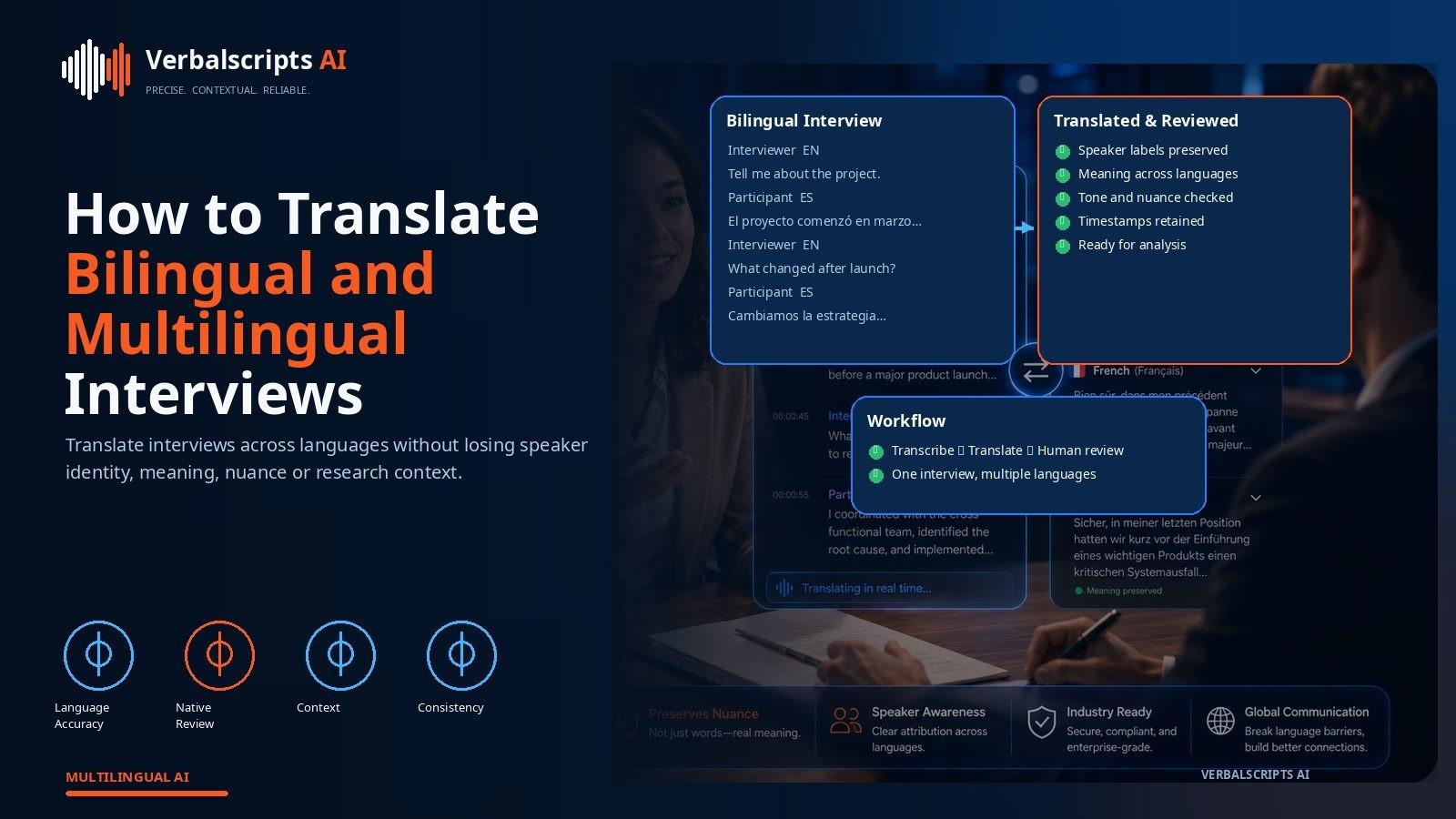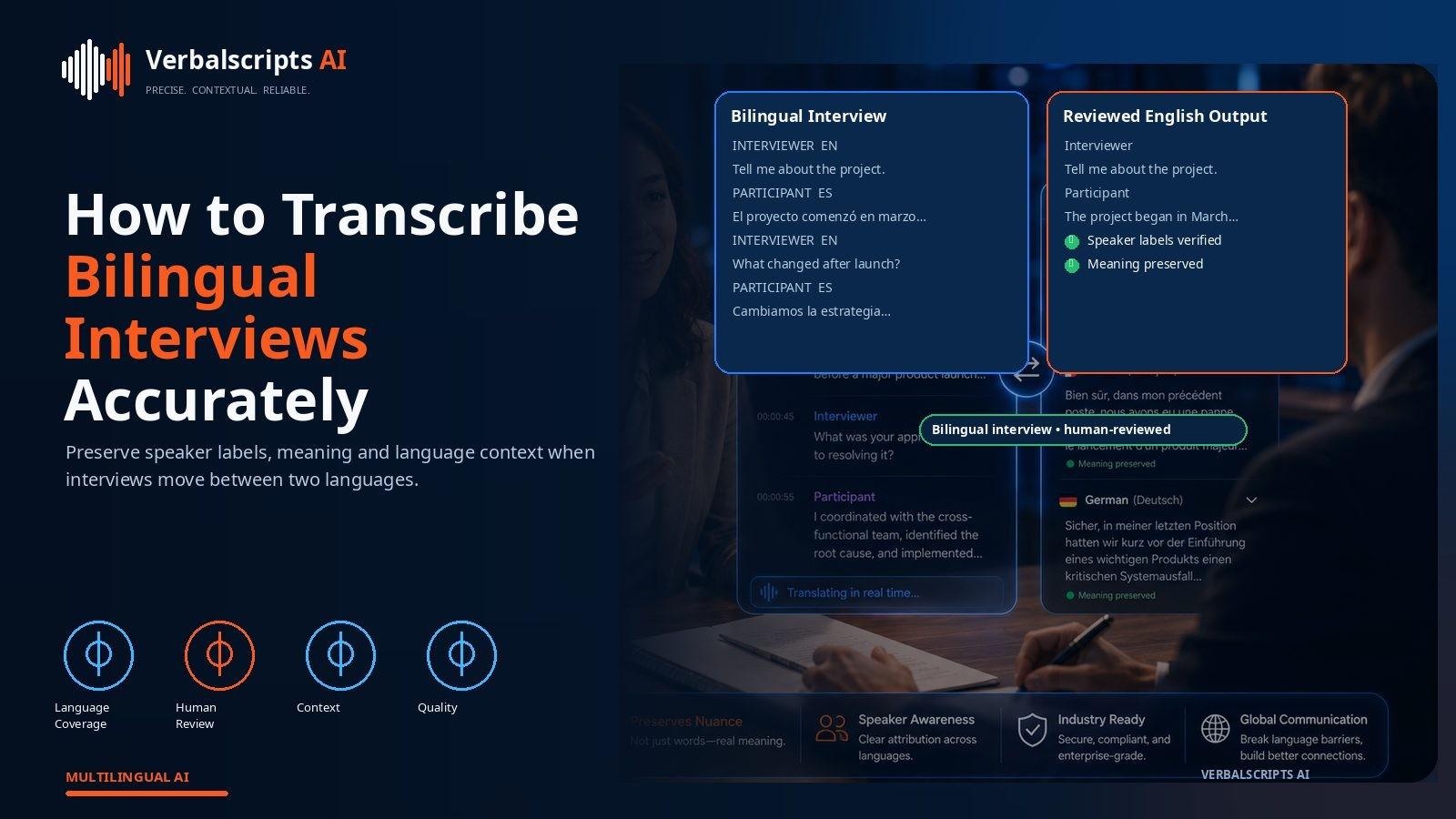
How do you transcribe a bilingual interview accurately? Identify the language pair before processing, use multilingual ASR or language-specific routing, enable speaker diarization, preserve source-language wording and script, mark language switches according to the project style, verify names and low-confidence segments against the audio, and use bilingual/native review for important content. Decide whether the transcript is verbatim, clean verbatim or normalized before transcription begins.
| SEO title | How to Transcribe Bilingual Interviews Accurately |
|---|---|
| Slug | transcribe-bilingual-interviews-accurately |
| Meta description | Learn how to transcribe bilingual interviews accurately using language-aware ASR, speaker labels, code-switch handling, terminology and human review. |
| Primary keyword | transcribe bilingual interviews |
| Search intent | How-to |
| Hero image | 180-bilingual-interview-transcription.jpg |
| Hero alt text | Bilingual interview transcription editor showing interviewer and participant turns with language tags and timestamps |
| Article body words | 1909 |
For production multilingual workflows, see our AI Translation service for the delivery path behind the guidance in this article.
Bilingual interviews create a transcription problem that is partly acoustic and partly editorial.
The recording may contain one language per speaker, code-switching within answers, borrowed terms, names from several languages and interviewer questions that rely on previous context. A good transcript must preserve who said what, in which language and with what degree of fidelity.
Do not translate the second language inside the source transcript unless the deliverable specifically calls for an integrated translation.
Step 1: define purpose
Interview used for:
- research;
- journalism;
- legal;
- customer discovery.
Purpose determines:
- fidelity;
- timestamps;
- language tags.
Step 2: define language pair
Record:
- primary language;
- secondary;
- locales/dialects.
Provide to ASR.
Step 3: define transcript style
Verbatim
Preserve:
- fillers;
- false starts.
Clean verbatim
Remove non-meaningful fillers.
Normalized
Standardize dialect/grammar.
Research/legal often need closer fidelity.
Step 4: speaker labels
Use:
- INTERVIEWER;
- PARTICIPANT.
Or verified names.
Speaker structure is essential.
Step 5: timestamps
Choose:
- per turn;
- every 30 sec;
- every speaker.
Timestamps support:
- audio review;
- quoting.
Step 6: language tags
Options:
- label each turn if language changes;
- label only switches.
Avoid clutter.
Example:
PARTICIPANT [SW]: ...
Step 7: native script
Preserve original script.
Do not romanize by default.
If downstream analysts cannot read script, provide transliteration as separate layer.
Step 8: multilingual ASR
Use a model supporting both languages.
If each speaker consistently uses one language:
- diarize;
- route.
For code-switching:
- one multilingual model often works better.
Step 9: candidate language ID
Constrain to known languages.
This reduces detection ambiguity.
Step 10: custom terminology
Prepare:
- people;
- companies;
- places;
- study concepts.
Interviews contain many proper names.
Step 11: transcript confidence
Flag:
- unclear audio;
- overlapping speech.
Use conventions:
[inaudible]
rather than guessing.
Step 12: overlapping speech
If both speak simultaneously:
- transcribe both if intelligible;
- mark overlap.
Diarization can fail here.
Human review is valuable.
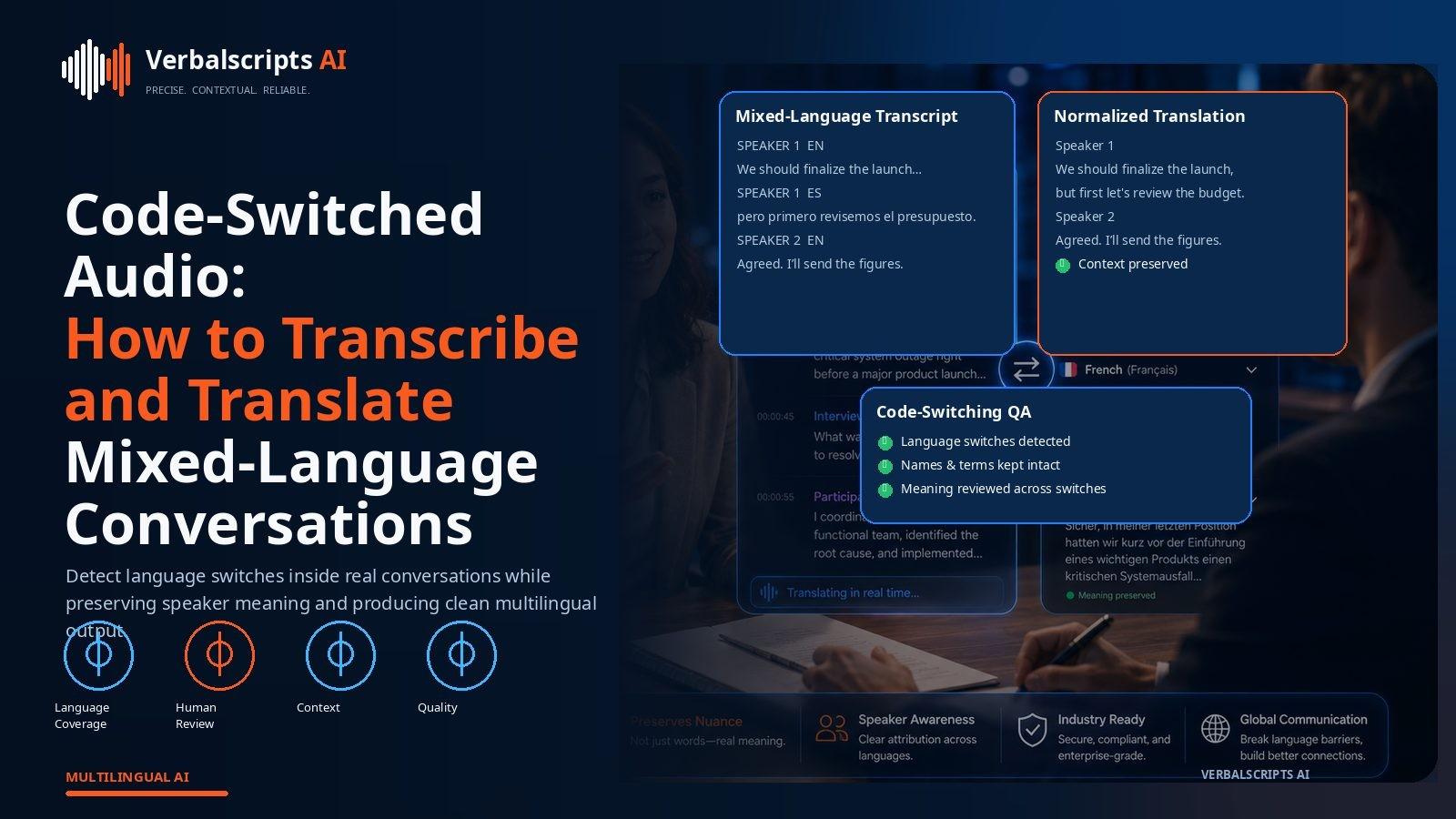
Step 13: code-switching
Preserve the actual switch.
Do not replace secondary-language word with translation in source transcript.
If study cares about switch behavior, tag it.
Step 14: borrowed terms
Decide whether common borrowed English terms are treated as:
- part of local speech;
- code-switch.
For research, create annotation rule.
Step 15: names
Verify:
- spelling;
- accents/diacritics.
Ask participants/metadata when possible.
Never infer unusual names purely from ASR.
Step 16: punctuation
Interview speech is messy.
Add readable punctuation without restructuring meaning.
Do not turn hesitant speech into polished written argument.
Step 17: interviewer questions
Preserve full question.
Short answer depends on it.
Do not omit “routine” questions if the transcript is data.
Step 18: human review
Bilingual reviewer checks:
- both languages;
- switches;
- names.
If one reviewer cannot cover both:
- split review.
Step 19: quality sampling
For large research projects:
- fully review a subset;
- review all low-confidence.
But public quotations should be verified individually.
Step 20: export
Useful deliverables:
- source DOCX;
- timestamped transcript;
- bilingual translation.
Keep source transcript immutable after approval.
Research interviews
The transcript can be analyzed for:
- themes;
- language use.
Normalization can change data.
Document editorial decisions in methodology.
Journalism
A journalist may later translate selected quotes.
Keep a trace from:
- quote;
- timestamp.
This supports verification.
Legal interviews
Use stricter verbatim and review.
Do not remove:
- uncertainty;
- negation.
Customer research
Product teams may prefer clean verbatim.
Preserve:
- product language;
- emotions.
Translation/analysis can come later.
Quality metrics
WER per language.
But qualitative errors matter:
- name;
- code-switch.
Track critical terms.
Common failures
Dominant-language normalization
Secondary words disappear.
Wrong speaker
Question/answer merge.
Translation during transcription
Source fidelity lost.
Polishing
Participant sounds more certain.
Missing language metadata
Analysts cannot reconstruct switching.
Example bilingual interview specification
Before transcription, write a one-page spec:
- languages: English + Swahili;
- output: clean verbatim;
- source script: Latin;
- speaker labels: INTERVIEWER / PARTICIPANT;
- timestamps: each speaker turn;
- code-switch: preserve exact source, add language label only for changes longer than one word;
- fillers: retain only meaningful hesitation;
- unclear speech: [inaudible 00:12:44];
- names: verify against participant list.
This prevents reviewers from improvising conventions.
Dual-column deliverables
For studies or legal review, a useful layout can include:
- left: source transcript;
- right: English translation;
- shared timestamp.
The source stays intact while non-source-language stakeholders can work with the target. Segment IDs ensure later corrections remain aligned.
Interviewer consistency across a research project
If the same interview guide is used 100 times, pre-approve the interviewer questions in every target language and reuse them. This avoids slight wording drift that could change how participants interpret the question.
The participant answers still need natural transcription and translation.
Quality audit of published quotes
Before a quote leaves the research or journalism team:
- listen to the original audio;
- confirm speaker;
- verify source transcript;
- compare target translation;
- confirm any editing did not change meaning.
This final five-step check is inexpensive relative to the reputational risk of misquoting a multilingual participant.
When one reviewer is not enough
If the interview combines a low-resource dialect with specialist medical or legal terminology, use layered expertise:
- language/dialect reviewer;
- domain reviewer.
The first checks what was said; the second checks specialist meaning. This is often more reliable than trying to find one person who perfectly covers every dimension.
Audio preparation for interview teams
Interviewers can improve transcription before the interview begins:
- use a close microphone;
- avoid speakerphone where possible;
- record separate channels in remote interviews;
- ask participants to state/spell unusual names;
- reduce background audio.
These steps improve both languages simultaneously.
Interview-guide metadata
Store the approved interviewer questions as structured source text. If the ASR slightly mishears a standard recurring question, the system can compare against the known interview guide while preserving the participant’s spontaneous answer independently.
Do not use the guide to overwrite a question that the interviewer actually phrased differently when exact wording matters.
Clean verbatim rules for bilingual speech
A clean-verbatim guide should state:
- which fillers are removed;
- how repeated words are handled;
- whether language switches are tagged;
- how incomplete sentences are punctuated.
Apply the same editorial standard to both languages so one side is not cleaned more aggressively than the other.
Review order
A bilingual reviewer can work efficiently in this order:
- speaker labels;
- language tags;
- names/numbers;
- low-confidence audio;
- full transcript continuity;
- formatting.
Fixing speaker/language segmentation first prevents editing text that will later be reassigned.
Research data preservation
If the interview is research data, keep:
- original audio;
- raw ASR;
- corrected source transcript;
- translation.
These layers document the transformation from speech to analyzed text and support future methodological review.
Interview confidentiality
Bilingual reviewer pools may be international. Apply:
- secure access;
- confidentiality;
- project minimization.
Do not share participant identities with reviewers if pseudonyms are sufficient for the transcription task.
Translation after bilingual transcription
If the final project also needs translation, do not translate before the source transcript is approved for critical passages. One corrected source turn can then feed all target languages consistently.
Maintain:
- source turn ID;
- source-language label;
- reviewed source;
- target translations.
This is particularly valuable in research studies that later add new target languages.
Quote extraction workflow
For each quote selected for publication:
- mark source turn ID;
- verify audio;
- confirm source wording;
- approve translation;
- record final editorial version.
If the quote is shortened, keep the full approved translation in the archive.
Bilingual interview quality report
A project-level report can include:
- audio duration;
- languages present;
- percentage code-switch;
- review method;
- unclear segments;
- names verified;
- final status.
This gives clients or researchers confidence without exposing sensitive interview content.
Handling laughter, emotion and non-speech
Depending on transcript style, preserve meaningful cues:
- [laughs];
- [pause].
Language switching may coincide with humor or emotion, so deleting all non-speech information can remove context.
Final practical principle
Treat bilingual interviews as one conversation with multiple linguistic resources, not as two separate monolingual files. Speaker context, question-answer relationships and language choice all belong to the same evidence chain.
Reviewer calibration for bilingual projects
Before a large interview series, have all reviewers transcribe the same 10–15 minutes. Compare:
- code-switch labeling;
- filler treatment;
- punctuation;
- names;
- unclear-speech marks.
Resolve differences before production. This prevents later transcripts from reflecting reviewer style more than participant speech.
File naming and version control
Use clear names such as:
INT07_source-reviewed_v2.docx
INT07_en-translation-reviewed_v1.docx
Do not overwrite source and target with ambiguous names like final2.docx. Research and legal projects often need to trace exactly which version supported a quote or analysis.
Translation handoff notes
If the bilingual transcript will be translated by another team, include:
- language pair;
- dialect notes;
- unresolved unclear passages;
- glossary;
- participant name spellings.
This prevents the translator from independently guessing information the transcription team already investigated.
Final delivery package
A strong delivery can include:
- reviewed source transcript;
- translated transcript if requested;
- timecoded uncertainty list;
- terminology/name sheet;
- methodology/style note.
The package gives downstream users both readability and confidence in how the multilingual recording was handled.
Source-transcript acceptance criteria
For a bilingual interview intended for publication or research, approve the source transcript only after:
- all requested audio is covered;
- speaker labels are verified;
- both languages are represented correctly;
- names and dates are checked;
- unclear passages are marked consistently;
- code-switch policy is followed.
Translation should begin from this approved version.
Common interviewer-side problems
Interviewers can accidentally create transcription difficulty by:
- speaking over the participant;
- asking long multi-part questions;
- moving away from the microphone;
- interrupting answers;
- using unintroduced acronyms.
Training interviewers on recording practice improves multilingual transcript quality before any AI model is involved.
Quality sampling across an interview series
Do not review only the first few interviews. Audio conditions and participant varieties can change throughout a study. Sample across:
- early/middle/late recordings;
- different interviewers;
- different participant regions;
- different recording methods.
This catches drift that a front-loaded QA plan misses.
Translation and analysis independence
If researchers will code the translated interviews, keep the source transcript accessible to at least part of the analysis team or language-review process. This makes it possible to verify whether a theme depends on a translation choice rather than participant meaning.
Final principle
The bilingual transcript is a source artifact. Preserve it carefully, then create translations, summaries and quotations as controlled derivatives. That separation supports both readability and methodological integrity.
Frequently asked questions
Should bilingual interview transcripts include translations inline?
Usually keep source transcript clean and provide translation separately unless client requests bilingual format.
Can one model transcribe both languages?
Often yes. Test code-switching.
Should every language switch be labeled?
Only if useful to audience/research.
What should happen when a phrase is unclear?
Mark uncertainty and review audio; do not guess.
Who should review?
Ideally a bilingual reviewer familiar with the dialects and domain.
Conclusion
Accurate bilingual interview transcription begins by respecting the recording as multilingual source data.
Define fidelity, preserve language and script, label speakers, use ASR that supports the real language pair and verify switches and names with bilingual expertise.
A strong source transcript then becomes a reliable foundation for translation, research analysis or publication.
Research references
- DECM code-switching benchmark:
- Google Speech-to-Text language detection:
- Google speaker diarization:
- Amazon speaker diarization: