How should you choose an AI translation service? Define your languages, formats, risk and required review first. Then compare providers using a representative test set for accuracy, terminology and layout; verify security, retention and training policies; evaluate human-review options, APIs, batch processing, glossaries, support, SLAs and total cost. Choose the provider that meets the required quality consistently on your content rather than relying on a generic accuracy percentage.
| SEO title | How to Choose an AI Translation Service |
|---|---|
| Slug | choose-ai-translation-service |
| Meta description | Choose an AI translation service by evaluating language quality, document formats, human review, security, terminology, APIs, pricing and SLAs. |
| Primary keyword | choose AI translation service |
| Search intent | Commercial investigation |
| Hero image | 164-choose-ai-translation-service.jpg |
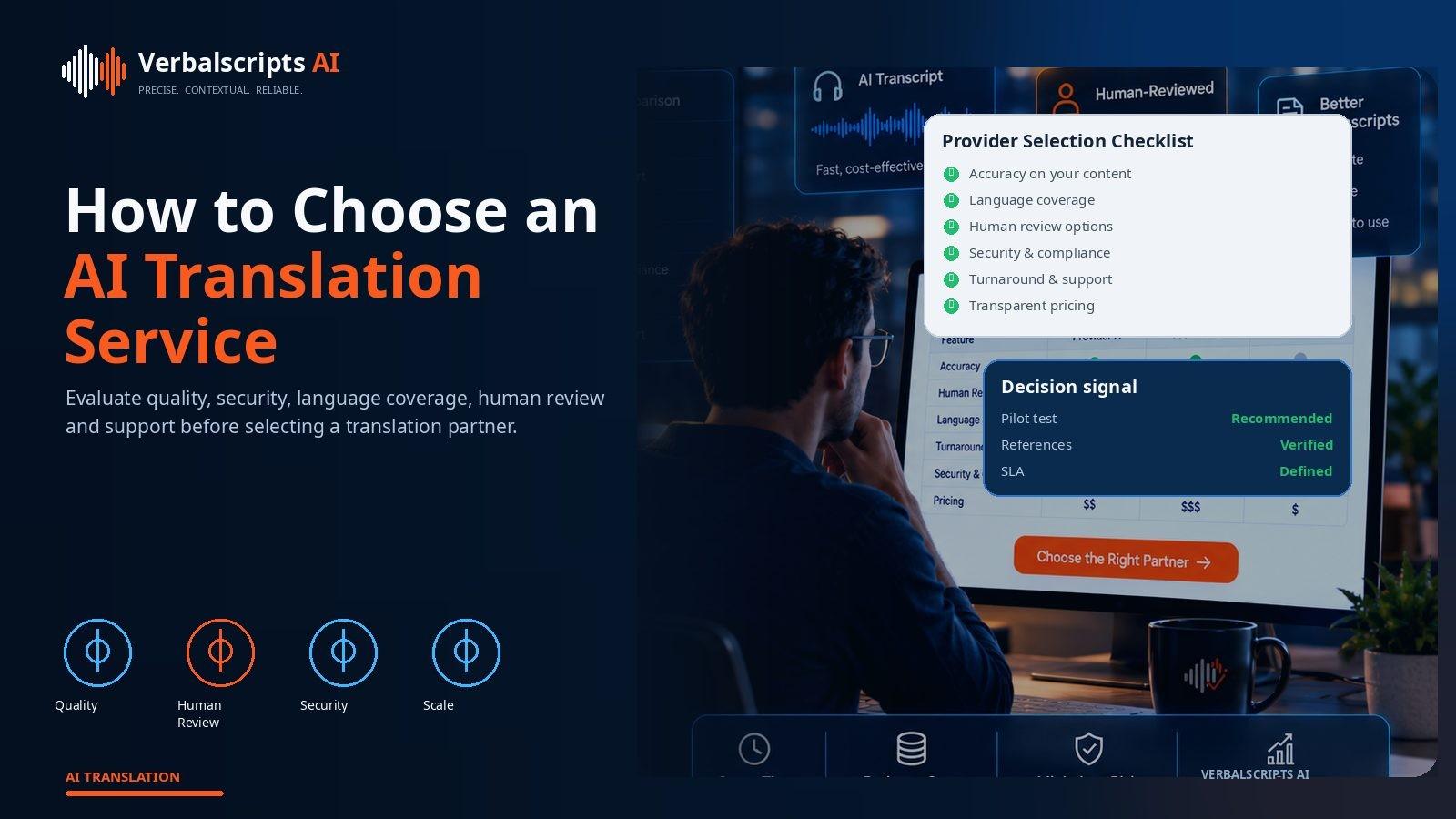
| Hero alt text | Enterprise buyer comparison dashboard evaluating AI translation providers on quality, languages, security, review and API capability |
| Article body words | 1915 |
For production multilingual workflows, see our AI Translation service for the delivery path behind the guidance in this article.
Choosing an AI translation service is difficult because most providers can produce an impressive demonstration.
The important differences appear in your own content: a rare legal term, a scanned PDF, a multilingual interview, a right-to-left layout, a strict data-retention requirement or 50 target languages.
The right evaluation process tests the complete service rather than selecting the model with the best marketing claim.
For enterprise use, governance and operational fit are as important as model quality.
Step 1: define use cases
List actual work.
Examples:
- text API;
- PDF;
- legal contracts;
- product localization;
- audio;
- subtitles.
A provider strong at text may not support document layout or speech.
Step 2: define language pairs
Do not ask only:
“How many languages do you support?”
Ask:
- source → target pair;
- locale;
- low-resource;
- dialect.
Test the exact pairs.
Step 3: define quality tier
Need:
- raw AI;
- human-reviewed;
- specialist-reviewed.
Providers offer different combinations.
A software API and managed translation service are different products.
Step 4: build representative test
Include:
- easy;
- difficult;
- terminology;
- names;
- numbers;
- long context;
- file types.
Use enough content to reveal patterns.
Do not test only one paragraph.
Step 5: blind quality evaluation
Have reviewers compare providers without seeing brand.
Score:
- accuracy;
- terminology;
- fluency;
- completeness.
Track critical errors.
Step 6: test documents
If you translate files, test:
- DOCX;
- PDF;
- PPTX;
- XLSX.
Inspect:
- formatting;
- tables;
- text boxes;
- hyperlinks.
Document translation quality includes reconstruction.
Step 7: test OCR
If you have scans:
- poor quality;
- tables;
- columns.
OCR errors can dominate translation.
Step 8: test terminology
Ask:
- glossary?
- custom terminology?
- do-not-translate?
- morphology?
Load your terms.
Measure compliance.
Step 9: human review
If required, ask:
- reviewer qualifications;
- native/in-market;
- domain experts;
- second review;
- turnaround.
“Human reviewed” needs definition.
Step 10: security
Verify:
- encryption;
- access control;
- retention;
- model training;
- region;
- subprocessors.
Do not rely on a generic “enterprise-grade” statement.
Step 11: privacy
For personal data:
- DPA;
- deletion;
- lawful processing support.
Review with privacy/legal team.
Step 12: API
Developers should test:
- authentication;
- latency;
- rate limits;
- batch;
- errors;
- SDK/documentation.
A great model with unreliable API can fail product needs.
Step 13: batch capacity
For large projects:
- files/job;
- size;
- targets;
- throughput.
Provider limits change.
Test at realistic scale.
Step 14: integration
Consider:
- CMS;
- TMS;
- cloud storage;
- webhook.
Manual file transfer can become bottleneck.
Step 15: quality analytics
Ask whether you receive:
- confidence;
- QA report;
- reviewer edits;
- quality metrics.
Data helps manage.
Step 16: support
What happens when:
- job fails;
- language quality drops;
- deadline urgent?
Evaluate:
- response SLA;
- technical support;
- account management.
Step 17: pricing
Compare total:
- model;
- review;
- formatting;
- minimum;
- rush.
Do not choose solely by API rate.
Step 18: vendor stability
For enterprise dependency, consider:
- roadmap;
- availability;
- service maturity.
Avoid proprietary lock-in where possible.
Step 19: export and portability
Can you export:
- translations;
- TM;
- glossary;
- review data?
Your language assets should not be trapped.
Step 20: pilot
Run real project.
Measure:
- quality;
- turnaround;
- reviewer effort;
- support;
- cost.
Then decide.
Red flags
Be cautious if provider:
- claims universal 99.9% accuracy;
- refuses retention details;
- cannot explain review;
- has no test process;
- treats all languages equal without evidence;
- cannot export language assets.
Provider types
Cloud API
Best for developers.
SaaS translation platform
Best for team workflows.
Managed AI + human service
Best for deliverables requiring review.
Specialist language provider
Best for regulated/domain content.
Some providers combine categories.
Decision scorecard
Weight:
- quality 30%;
- security 20%;
- language/format 15%;
- workflow 15%;
- support 10%;
- cost 10%.
Adjust to risk.
Avoid feature checklist buying
A provider may have:
- 200 languages;
- glossary;
- AI.
But not perform well on your content.
Benchmark remains the decisive evidence.
Build a weighted provider scorecard
After a pilot, score each provider with evidence.
Example:
| Criterion | Weight |
|---|---|
| Bilingual quality | 25% |
| Critical-error control | 10% |
| Terminology | 10% |
| Security/privacy | 20% |
| Formats/workflow | 10% |
| API/reliability | 10% |
| Human review network | 5% |
| Support | 5% |
| Total cost | 5% |
A heavily regulated organization might increase security and domain-review weighting. A public content company might weight scale and media support more.
Ask providers to explain failure handling
A strong provider should be able to answer:
- What happens if a 500-file batch partially fails?
- How do you detect untranslated text?
- How do you handle a critical mistranslation reported after publication?
- Can a client force a model/glossary version rollback?
These answers reveal operational maturity more effectively than a feature list.
Evaluate the reviewer workflow, not only the model
Request a demonstration of:
- reviewer interface;
- comments;
- terminology;
- source-target alignment;
- audit history.
If high-risk content will be human-reviewed, the reviewer experience directly affects quality and turnaround.
Test support during the pilot
Create a normal support request:
- malformed file;
- glossary question;
- API error.
Measure:
- response time;
- clarity;
- ownership.
Do not wait for a production outage to learn how the support organization works.
Consider language-asset ownership
Confirm that you can retrieve:
- glossaries;
- translation memories;
- approved translations;
- review history.
These assets accumulate business value. A provider switch should not require rebuilding years of terminology from scratch.
Exit criteria
Before signing, define conditions that would make the provider unacceptable:
- critical security gap;
- target-language pass rate below threshold;
- inability to meet required region;
- no specialist reviewers;
- unacceptable API failure rate.
Clear exit criteria prevent a cheap or impressive feature from compensating for a non-negotiable requirement.
Build a representative evaluation corpus before vendor demos
A useful pilot corpus can contain 20–50 items rather than one file:
- short UI strings;
- long prose;
- a terminology-heavy page;
- numbers/dates;
- one scanned document;
- a table;
- one difficult language pair.
The corpus should resemble production distribution. If 70% of your workload is legal PDF, a pilot dominated by clean marketing sentences tells you little.
Score operational fit as well as language quality
A provider may win linguistic testing but create operational friction through:
- slow file intake;
- poor API documentation;
- no glossary export;
- weak batch status reporting;
- inflexible retention.
Create two scorecards:
- language quality;
- operational/governance quality.
A final decision can combine them after mandatory security requirements are satisfied.
Ask for failure transparency
During the pilot, intentionally include:
- unsupported file;
- password-protected PDF;
- malformed HTML;
- a language not in the requested candidate set.
Observe whether the provider:
- returns clear errors;
- silently produces bad output;
- gives recovery instructions.
Reliable failure behavior is a core enterprise feature.
Assess model/provider lock-in
Ask whether you can:
- export TMs;
- export glossary;
- access source/target history;
- reproduce translations after contract end.
If the provider uses proprietary models, that is fine; the concern is whether your approved language assets and business process become trapped.
Compare quality by language, not aggregate
A provider can average excellent Spanish and weak Swahili into one respectable score. Keep separate results for every strategic pair.
For low-volume languages, ask for stronger qualitative review even if the sample is small.
Run a monitored production pilot
Before a full migration, route a real but controlled share (perhaps one content category or a few locales) through the provider. Track:
- edit time;
- failure rate;
- support experience;
- cost;
- stakeholder satisfaction.
Production behavior is the strongest predictor of a long-term partnership.
Test terminology controls in both generation and QA
Some providers support glossary injection but offer no independent term QA. Others provide terminology checks but only after translation. Ideally, the system should do both:
- guide generation with approved terms;
- verify the result independently.
During the pilot, include terms that:
- have multiple senses;
- require inflection;
- must not be translated;
- are easy to confuse.
This reveals whether the feature is more than a simple word-replacement layer.
Evaluate document reconstruction separately
For document translation, create a layout score:
- all text present;
- tables intact;
- links preserved;
- no overflow;
- correct script fonts;
- images handled as expected.
A provider can win on linguistic accuracy and still fail a PowerPoint-heavy workflow because slide text constantly overflows.
Evaluate security through the exact product tier
A vendor may have different policies for:
- consumer app;
- enterprise SaaS;
- API.
Make sure your security review covers the actual SKU and deployment route you will purchase. Do not assume an enterprise statement on the corporate website applies to a free browser tool.
Consider operational geography
If reviewers or data processing must remain in particular countries or regions, ask for the actual workflow map. A data-residency feature for the model does not necessarily control where human review occurs.
This matters for confidential and regulated content.
Vendor roadmap questions
Ask about:
- upcoming model changes;
- language expansion;
- deprecations;
- API version life cycle.
A provider that cannot support your critical workflow next year may create migration cost even if it is strong today.
Reference checks
When speaking with reference customers, ask:
- What failed during onboarding?
- Which languages require most manual work?
- How does support handle urgent issues?
- Did pricing match actual invoices?
- How easy was data export?
These questions often reveal more than asking whether the client “likes the vendor.”
Final selection document
Write down:
- why provider was selected;
- accepted limitations;
- benchmark results;
- required review tiers;
- renewal/rebenchmark date.
This prevents the organization from forgetting the evidence that justified the decision.
Contract review before signature
Once a provider is selected, compare the contract with the pilot assumptions. Confirm that:
- the same product tier/model path is covered;
- security/data terms match the tested environment;
- glossary and language assets remain exportable;
- review level is defined;
- support/TAT commitments are included;
- pricing assumptions are reflected accurately.
Procurement mistakes often occur after selection, when an excellent pilot is followed by a contract for a slightly different service configuration.
Rebenchmark periodically
A provider that wins today may not remain the best fit forever. Rebenchmark after:
- major model changes;
- new strategic languages;
- significant volume growth;
- recurring quality incidents;
- contract renewal.
Use the same private benchmark where possible so results remain comparable over time.
Avoid “one-provider religion”
Even if one vendor becomes the primary platform, keep your internal terminology, evaluation data and content IDs provider-neutral. This reduces switching cost and allows selective use of another model for a language or format where it performs materially better.
The goal is a reliable multilingual capability, not loyalty to one underlying model.
Frequently asked questions
Which AI translator is most accurate?
There is no universal winner across all languages and domains.
Should I choose a cloud API or service provider?
API if you can build workflow; managed provider if you need human review/project delivery.
What security questions matter most?
Retention, model training, region, access and subprocessors.
How large should a pilot be?
Large enough to include representative difficult content and multiple files, usually far more than one sample paragraph.
Is cheapest provider best?
Not if human rework makes total cost higher.
Conclusion
Choose an AI translation service through evidence.
Define the task, benchmark your languages and documents, test terminology and security, understand the review workflow and calculate total cost.
The best provider is not the one that translates the demo most impressively. It is the one that delivers acceptable, governable quality repeatedly on the content your organization actually has.
Research references
- NIST AI Risk Management Framework:
- Google Cloud Translation docs:
- Microsoft Azure Translator:
- AWS Translate: