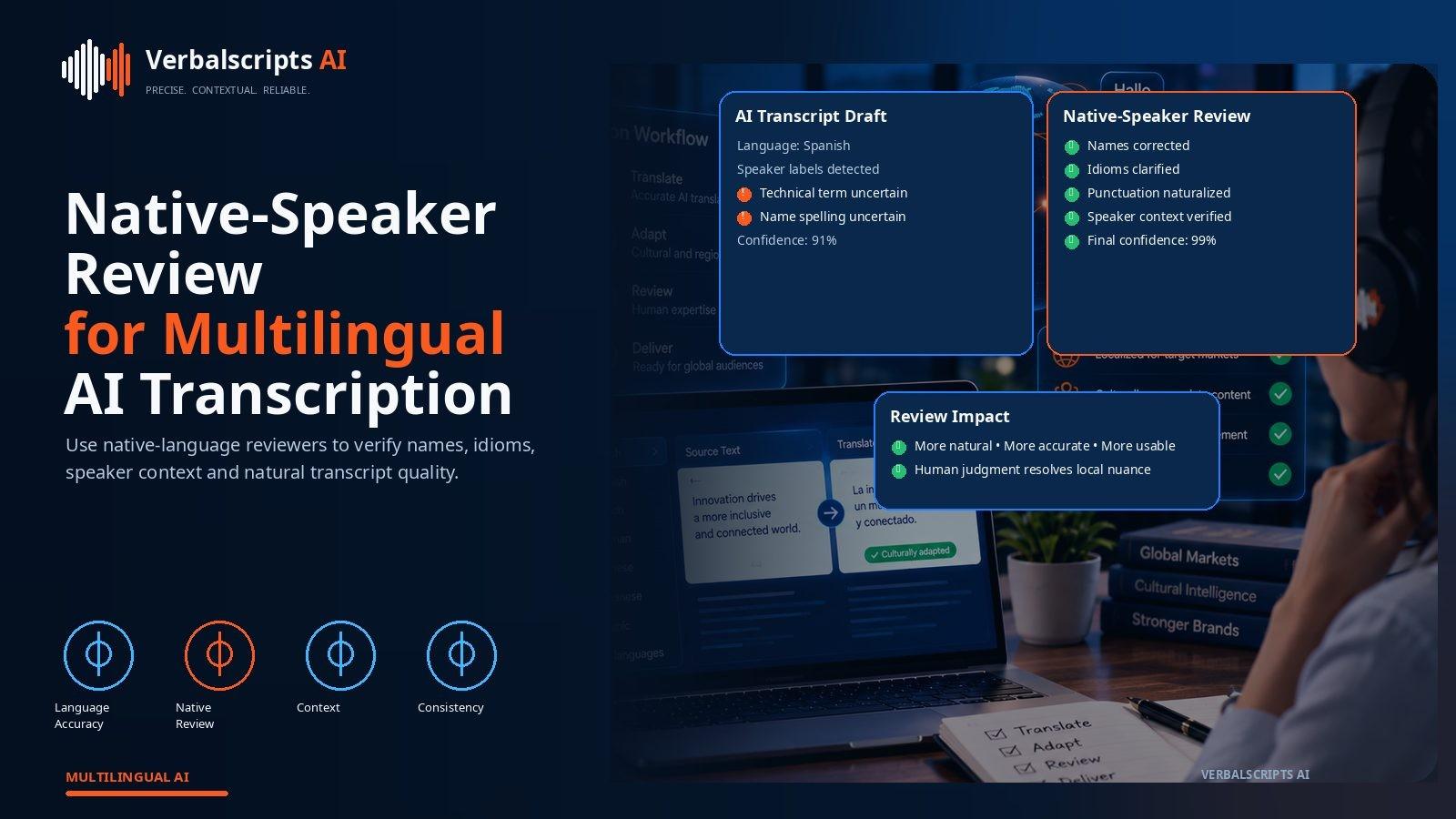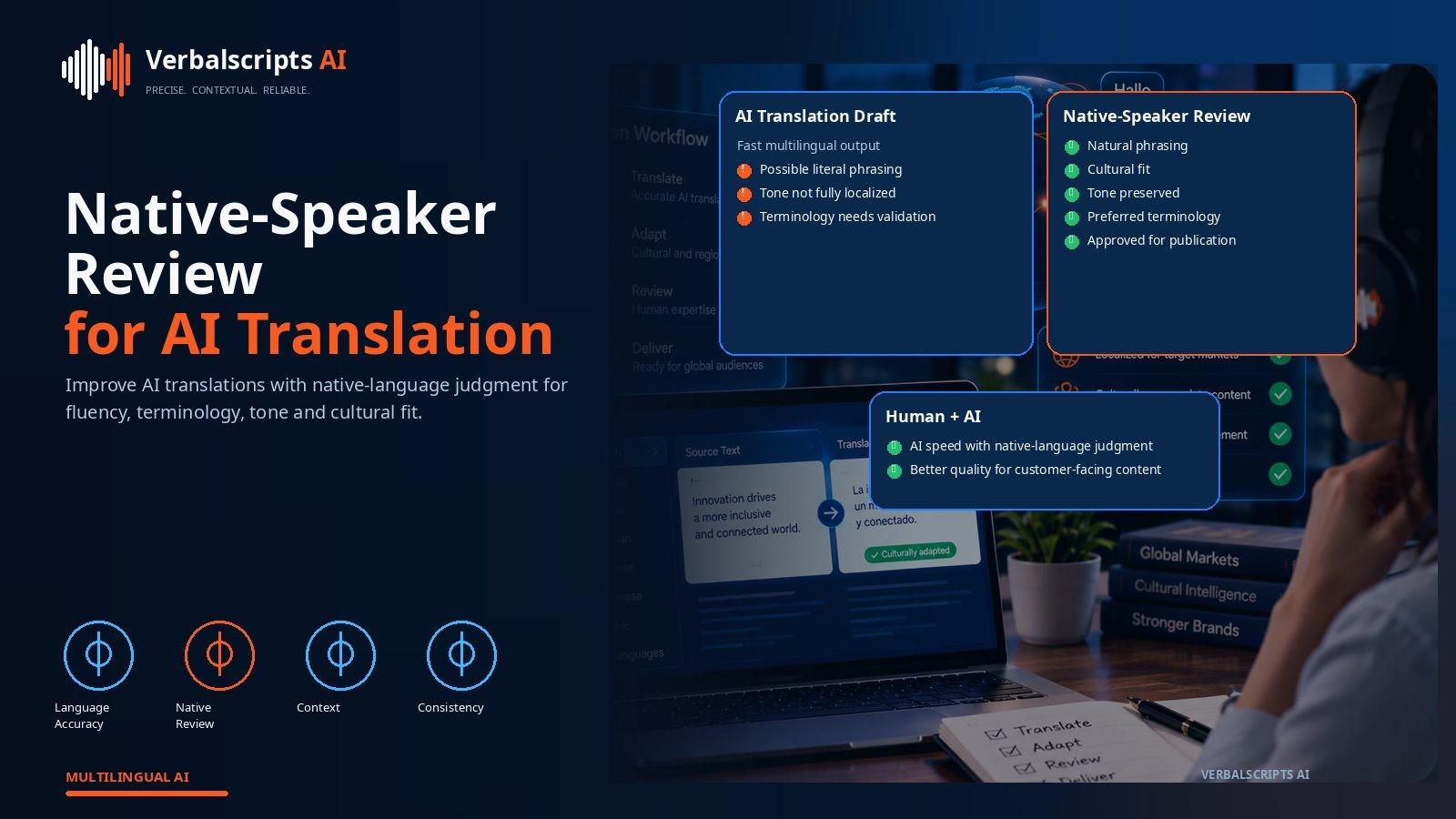
What does native-speaker review add to AI translation? It adds target-language naturalness, current locale usage, cultural judgment, register and practical terminology knowledge. For full accuracy review, the reviewer must also understand the source or work within a bilingual review process. High-risk content may require a domain specialist in addition to a native-language editor.
| SEO title | Native-Speaker Review for AI Translation |
|---|---|
| Slug | native-speaker-review-ai-translation |
| Meta description | Learn how native-speaker and in-market review improves AI translation through source fidelity, naturalness, locale fit, terminology and cultural quality. |
| Primary keyword | native speaker review AI translation |
| Search intent | Informational / Commercial research |
| Hero image | 184-native-speaker-ai-translation-review.jpg |
| Hero alt text | Native-language translation reviewer checking source and target text for accuracy, terminology, tone and locale fit |
| Article body words | 1954 |
For production multilingual workflows, see our AI Translation service for the delivery path behind the guidance in this article.
Native-language review is one of the most effective ways to turn fluent AI output into reliable target-language content. A skilled reviewer can recognize unnatural collocations, locale mismatch, awkward formality and cultural phrasing that a general metric or source-language editor may miss.
However, “native speaker” should not be treated as a complete qualification. Strong translation review requires a combination of target-language proficiency, source understanding, domain competence and adherence to a defined quality rubric.
The best reviewer is the person qualified for the specific language, locale, domain and purpose.
Target fluency
AI can write fluent language, but subtle unnaturalness remains.
Review:
- word combinations;
- rhythm;
- sentence order.
Target should not feel mechanically translated.
Source fidelity
Naturalness is not enough.
Reviewer should verify:
- meaning;
- omissions;
- unsupported additions.
If reviewer cannot read source, add bilingual step.
Locale
Native language can have multiple markets.
An in-market reviewer can distinguish:
- Canadian French;
- France French.
The correct locale should be specified.
Terminology
Review glossary compliance.
A reviewer can spot whether approved term is:
- grammatical;
- natural.
But terminology owner approves changes.
Formality
Languages may use:
- honorifics;
- formal pronouns.
Reviewer checks consistency.
Style guide decides policy.
Culture
Cultural review includes:
- idioms;
- humor;
- references.
ACL 2026 culture-aware MT research shows models do not always operationalize cultural knowledge correctly.
Brand voice
Review:
- brand examples;
- tone.
Avoid “improving” every sentence to personal style.
Human post-editing levels
Light
Correct meaning-breaking errors.
Full
Produce publication-ready target.
Define level contractually.
Domain review
Native finance speaker may not be finance expert.
High-risk domains:
- legal;
- medical.
Add subject reviewer.
Low-resource languages
Human review is especially valuable where:
- model data limited;
- automatic metrics weak.
Use representative native speakers.
Reviewer training
Provide:
- project brief;
- glossary;
- style guide;
- error taxonomy.
Review is professional process.
Reviewer calibration
Reviewers score same sample.
Discuss differences.
Update guide.
This produces consistent judgments across team.
Preference versus error
Require reviewers to distinguish:
Error
Violates meaning/guideline.
Preference
Alternative acceptable wording.
Too many preference edits increase cost and can reduce consistency.
Quality data
Store errors:
- accuracy;
- term;
- style.
Use to:
- improve model;
- prompt.
Sampling
Not every AI translation needs full review.
Use review for:
- new languages;
- high risk.
Sampling stable content keeps quality monitored.
In-market change
Language evolves.
Reviewers can identify:
- outdated terms.
Periodically refresh locale guide.
Reviewer disagreement
Use adjudicator for:
- terminology;
- cultural adaptation.
Document decision.
Turnaround
Human review adds time.
Plan based on:
- word volume;
- complexity.
Do not translate 1M words overnight and expect full review next morning unless reviewer capacity exists.
Cost
Review cost depends on:
- quality.
Measure:
- edit time.
A model that requires fewer corrections can justify higher inference cost.
AI-assisted review tools
AI can highlight:
- numbers;
- glossary;
- possible omissions.
This reduces reviewer search.
The human remains accountable.
Security
Reviewers may access sensitive content.
Use secure portal.
Apply:
- least privilege;
- retention.
Legal certification
A native reviewer is not automatically certified translator or legal verifier.
If formal certification required, use appropriate professional.
Measuring reviewer performance
Track:
- critical errors missed;
- agreement;
- turnaround.
Reviewer quality should be audited respectfully.
Source-target review and target-only editing should be separate mental passes
During the first pass, the reviewer asks:
- Is this what the source means?
During the second, they ask:
- Does this sound like natural target-language content?
Trying to do both simultaneously can cause either accuracy or style to receive too little attention. The two passes do not always need separate people, but the review protocol should separate the goals.
In-market review for rapidly changing vocabulary
Fast-moving fields such as AI, gaming, fintech and social media develop terminology quickly. A reviewer who uses the language daily in the target market may know whether audiences prefer:
- translated term;
- English loanword;
- abbreviation.
Update the glossary from these decisions rather than repeatedly leaving them to individual reviewers.
Preventing preference inflation
A native reviewer can rewrite almost any sentence in another valid way. Use the rule:
Edit when the target is wrong, violates the guide or clearly reduces usability, not simply because another phrasing is personally preferred.
For creative copy, preference editing may be part of the service, but it should be identified as copy editing/transcreation rather than accuracy review.
Native review of AI cultural adaptation
If an AI system localizes examples, reviewers should check both sides:
- Did the adaptation make sense locally?
- Did it preserve the source message and factual claim?
An adaptation can sound wonderfully native and still introduce an unsupported product promise or different cultural meaning.
Escalation to source author
Some problems cannot be solved by the target reviewer. Escalate when:
- source term is ambiguous;
- product behavior unclear;
- legal sentence contradictory;
- name spelling uncertain.
A strong review process is allowed to ask questions instead of forcing the reviewer to guess.
Native review must preserve source meaning before improving style
A reviewer should not begin by rewriting sentences to sound elegant. First verify:
- no missing information;
- no unsupported information;
- correct semantic relationships;
- numbers and names.
Only then optimize naturalness. This order matters because fluent rewriting can make a mistranslation harder to notice.
Native versus bilingual reviewer roles
A project can separate responsibilities:
Bilingual accuracy reviewer
- compares source and target;
- catches omissions/mistranslations.
Native/in-market target editor
- improves naturalness, register and locale fit.
For common language pairs, one qualified professional may perform both. For rare or specialist combinations, separating roles can broaden reviewer availability.
Reviewer decision hierarchy
When a reviewer sees an awkward glossary term, they should not simply replace it. Follow:
- Is the source concept clear?
- Is the glossary term mandatory?
- Is the target grammatically inflected correctly?
- Is an approved variant available?
- If not, raise terminology change.
This protects global consistency while still allowing real language improvement.
Review of AI paraphrasing
LLM translations may restructure more freely than traditional MT. Native reviewers should verify that paraphrasing has not:
- strengthened certainty;
- removed qualification;
- changed causal relationships;
- introduced promotional language.
The target may be beautifully natural and still be less faithful than a literal machine translation.
In-market terminology
Some terms are used differently across markets sharing a language. Reviewers should know the intended market and not “correct” a valid regional form to their own local preference.
Store examples in the locale guide.
Native review for SEO content
For target-language articles, reviewers can check whether important topic terms sound like the language real users use, but they should not stuff translated keywords into every heading. SEO research and linguistic quality should work together.
Google’s current AI-search guidance emphasizes the same foundational helpful-content and SEO principles rather than a separate AI-specific optimization trick.
Reviewer QA for translations produced by different models
If a platform routes content to several AI models, hide model identity from the reviewer where practical. This reduces expectation bias and allows fair comparison of edit rates and error types.
The reviewer should respond to the language, not the model brand.
Handling disagreement with client preference
A client can prefer wording that is unusual but intentional. Record:
- client-preferred;
- linguistically recommended;
- final decision.
Once approved, the client preference becomes project terminology/style unless it creates a safety/legal problem.
Review time and fatigue
Text review is faster than audio review but still cognitively demanding. Use manageable batches. High-risk legal or medical work should not be scheduled as the last task after hours of low-level editing.
Quality systems should account for human attention.
Native review of multilingual documents
A document may contain source-language names, Latin product terms and target-language body text. Reviewers should not remove foreign-script content merely because it looks “untranslated.”
Do-not-translate rules and entity metadata distinguish intended multilingual content from real omissions.
Final reviewer report
For high-value projects, capture:
- reviewer name/role;
- review date;
- unresolved questions;
- major changes;
- final status.
This gives clients an audit trail without requiring a narrative about every minor edit.
Scaling review efficiently
As quality data grows, reduce review for stable low-risk content using:
- sampling;
- automated QA;
- LLM triage.
Keep native reviewers focused on new languages, high-risk content and segments where models show uncertainty. This is the sustainable human-in-the-loop model.
Review matrix by content type
Native review priorities differ:
| Content | Highest-priority review |
|---|---|
| Marketing | brand, culture, CTA |
| Support | clarity, empathy, product terms |
| Legal | accuracy, modality, defined terms |
| Medical | terminology, instructions, readability |
| Technical | procedure, terminology, UI match |
| Blog/SEO | naturalness, factual fidelity, search language |
A reviewer should know what kind of content they are handling before editing.
Review of target-language search behavior
For SEO/AEO articles, native reviewers can flag cases where a literal translation uses a technically correct phrase that target users rarely search. The final keyword choice should combine:
- local search research;
- linguistic naturalness;
- content meaning.
Do not instruct reviewers to force high-volume keywords into sentences where they sound unnatural.
Review of machine-translated references
Articles may cite standards, papers or product features. The reviewer should not translate official titles or product names inconsistently. Where an official localized title exists, use it; otherwise preserve the source title and translate the surrounding explanation.
Document-level coherence
For a 2,000-word article or a 50-page manual, review:
- repeated terms;
- transitions;
- pronoun references;
- heading consistency.
Segment-based AI can create subtle drift even when every individual sentence is acceptable.
Native review and accessibility
A target sentence can be natural but unnecessarily complex. For public information, help centers and education, reviewers can recommend clearer wording within the permitted fidelity level.
This is especially valuable when the source itself is verbose. However, they should not simplify legal or clinical meaning without approval.
Reviewer access to source context
Provide:
- full paragraph;
- document title;
- page/screen;
- audience.
Reviewing one isolated target sentence increases preference edits and meaning errors because the reviewer cannot see the discourse function.
Specialist escalation log
Track every language decision that required domain escalation. If the same legal or medical concept repeatedly creates uncertainty, promote it into:
- glossary;
- style guide;
- reviewer example.
This reduces future specialist workload.
Measuring “accepted unchanged”
A useful KPI is the percentage of AI segments a qualified reviewer accepts without edit. Interpret it alongside critical-error rate and review time.
High unchanged rate + low critical errors indicates mature automation. High unchanged rate + weak audit performance indicates superficial review.
Final recommendation
Native review should be integrated into the language data loop. Approved edits, glossary changes and locale decisions should improve future AI output. Otherwise the organization pays repeatedly for the same human intelligence without capturing it.
Frequently asked questions
Is native-speaker review mandatory?
Not for every translation. It is valuable for public, culturally sensitive and high-risk content.
Is in-market review better?
Often for current local usage, but qualifications matter.
Can a native speaker review without knowing source?
They can review target fluency, but not full accuracy.
Should every reviewer be a professional translator?
For formal high-quality translation, professional language skills are strongly preferable; domain/use case determines exact qualification.
How does AI reduce human cost?
By providing a draft and automating mechanical QA so reviewers focus on meaning and nuance.
Conclusion
Native-speaker review is not a ceremonial final read. It is a targeted quality control that evaluates how the translation actually functions in the target language and market.
Combine target expertise with bilingual fidelity, domain knowledge and clear guidelines. Then use review data to improve the AI workflow.
That creates a translation system in which human judgment is concentrated where it adds the most value.
Research references
- Culture-Aware Machine Translation in LLMs (ACL 2026):
- ISO 17100:2015:
- Microsoft Learn, Localization overview: