Why does native-speaker review improve AI translation? A strong native-language reviewer can detect unnatural phrasing, inappropriate formality, regional vocabulary, cultural mismatches, collocations and subtle meaning problems that automated metrics may overlook. The most effective reviewer also understands the source language or works from a verified bilingual review process, because target-language fluency alone cannot guarantee source accuracy.
| SEO title | How Native-Speaker Review Improves AI Translation |
|---|---|
| Slug | native-speaker-review-ai-translation |
| Meta description | Learn how native-speaker review improves AI translation through naturalness, locale fit, terminology, cultural judgment and error detection. |
| Primary keyword | native speaker review AI translation |
| Search intent | Informational / Commercial research |
| Hero image | 152-native-speaker-review-ai-translation.jpg |
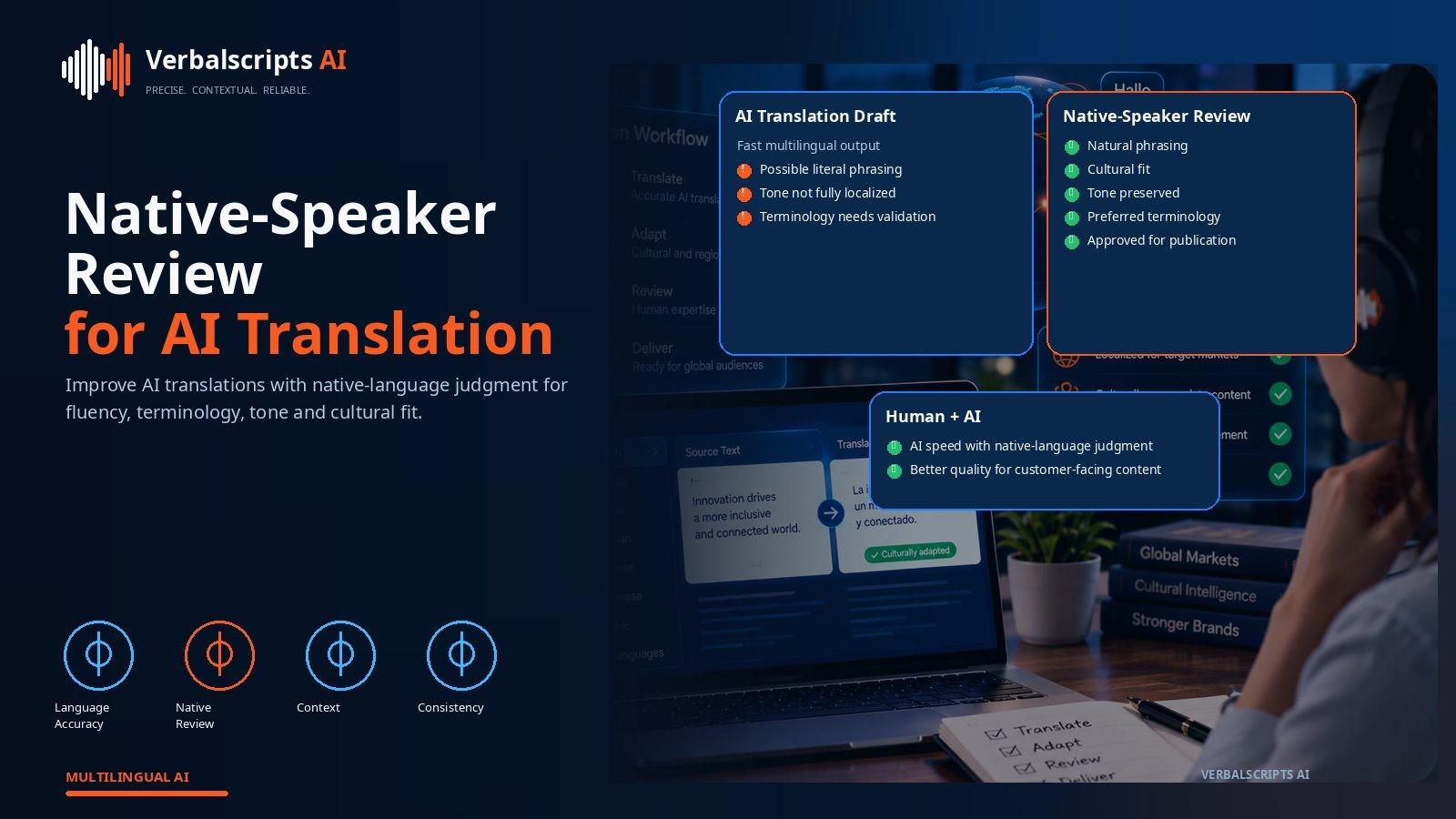
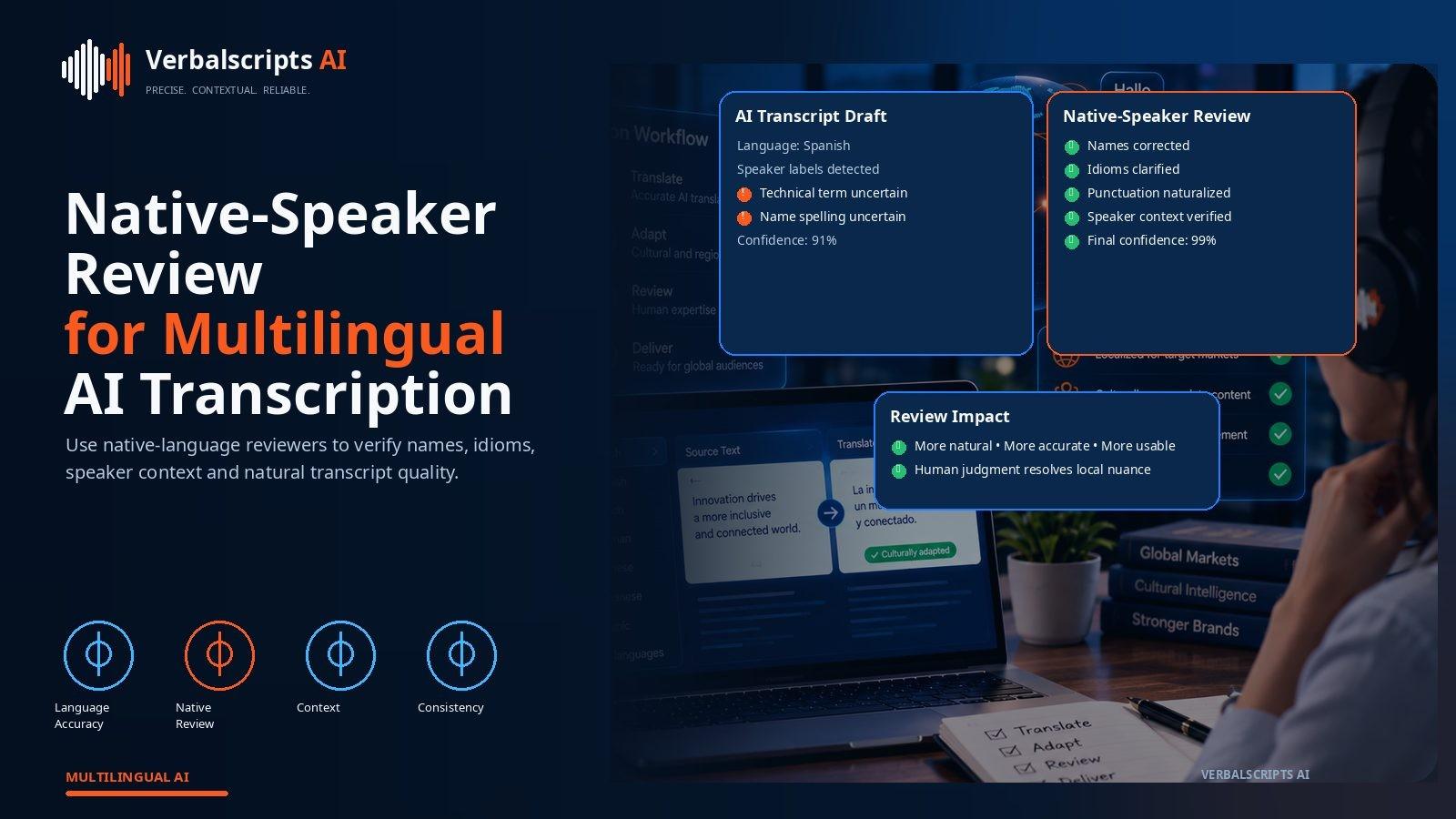
| Hero alt text | Native-language reviewer comparing AI translation against source content with terminology, tone and locale notes |
| Article body words | 2027 |
For production multilingual workflows, see our AI Translation service for the delivery path behind the guidance in this article.
AI translation can produce grammatically polished language at remarkable speed. Native-speaker review adds a different kind of intelligence: lived knowledge of how people actually communicate in the target language and locale.
That review is especially valuable where translation quality is not only about literal meaning, but also about naturalness, register, culture, product language and trust.
“Native speaker” is useful shorthand, but professional competence, domain expertise and current familiarity with the target market matter as much as birthplace or identity.
Native review catches unnatural fluency
AI output can be grammatically correct but sound translated.
Common signs include:
- unusual word combinations;
- excessively formal phrasing;
- literal idioms;
- repeated sentence patterns;
- source-language syntax.
A target-language reviewer can replace these with natural forms while preserving meaning.
Collocations
Languages have preferred word combinations.
English speakers say:
- “make a decision,” not usually “do a decision.”
Other languages have their own patterns.
AI often handles common collocations well but can produce odd combinations in specialized domains or low-resource languages.
Native review catches the difference between possible and idiomatic.
Register
Register includes:
- formal;
- informal;
- technical;
- conversational;
- institutional.
A translation can have correct grammar but wrong register.
For example, customer support may sound:
- too bureaucratic;
- too casual;
- rude.
A native/in-market reviewer evaluates the relationship with the audience.
Formal versus informal address
Many languages encode politeness directly.
The reviewer can ensure consistent:
- pronouns;
- verb forms;
- titles.
The decision should follow the locale style guide rather than reviewer preference.
Regional vocabulary
Language varies by market.
Examples:
- Spanish;
- Portuguese;
- French;
- Arabic;
- English.
A reviewer from the relevant locale can identify a word that is technically correct but unfamiliar or marked elsewhere.
This matters in customer-facing content.
Cultural knowledge
Native/in-market reviewers can flag:
- awkward idioms;
- confusing references;
- unintended humor;
- socially inappropriate language.
Recent culture-aware MT research shows that models can possess cultural knowledge without consistently using it correctly in translation.
Human review remains valuable for the last mile.
Source accuracy requires bilingual capability
A native target speaker who cannot read the source can proofread fluency, but cannot independently verify:
- omission;
- hallucination;
- mistranslation.
Separate roles if necessary:
Bilingual accuracy reviewer
Checks source-target meaning.
Native target editor
Checks naturalness, locale and style.
Some reviewers can perform both.
Domain expertise
Medical, legal and technical translation needs more than ordinary fluency.
A reviewer should understand:
- specialized terms;
- standard phrasing;
- domain conventions.
A native speaker without legal knowledge may accept a fluent but legally wrong term.
Terminology
Native reviewers help determine whether glossary terms work in real sentences.
They may identify:
- grammatically awkward glossary form;
- outdated term;
- market-specific alternative.
However, reviewers should not freely override approved terminology.
Create a terminology-change process.
Brand voice
Brand voice is difficult to score automatically.
A native reviewer can compare the target with:
- approved examples;
- brand principles;
- in-market competitors.
They should edit for brand, not personal taste.
Low-resource languages
Native review becomes more important where model performance is less predictable.
Low-resource languages can have:
- less training data;
- spelling variation;
- fewer automatic metrics.
Human evaluation provides a stronger quality signal.
New-language launch
Before launching a new locale:
- translate a representative test set;
- use multiple reviewers;
- build glossary/style guide;
- measure recurring errors;
- expand gradually.
The first reviewer should not be expected to invent every localization rule independently.
Review levels
Light target edit
Focus:
- grammar;
- naturalness.
Suitable for lower-risk content where semantic quality is already well measured.
Bilingual review
Focus:
- meaning;
- terminology;
- completeness;
- naturalness.
Suitable for customer-facing work.
Specialist review
Adds domain expertise.
Suitable for high-risk content.
In-market versus native
“In-market” often matters more than a strict native/non-native distinction.
A highly skilled professional translator living in the target market may know:
- current terminology;
- contemporary slang;
- local regulation.
Avoid using “native speaker” as the only qualification criterion.
Reviewer guidelines
Provide:
- source;
- target;
- glossary;
- style guide;
- context;
- risk notes.
Ask reviewers to distinguish:
- objective error;
- preference.
Otherwise over-editing increases cost and reduces consistency.
Error classification
Reviewers should tag meaningful corrections:
- accuracy;
- terminology;
- fluency;
- style;
- locale.
This creates actionable quality data.
Reviewer feedback loop
If the same issue appears repeatedly:
- update prompt;
- update glossary;
- update source;
- add automated check.
Do not pay humans forever to correct one predictable error.
Measuring reviewer value
Track:
- edit rate;
- major errors found;
- critical errors found;
- customer feedback;
- reviewer agreement.
A very high edit rate may indicate weak AI.
A very low edit rate can mean excellent quality or superficial review.
Audit the process.
Sampling native review
At scale, use native review selectively.
Prioritize:
- new locale;
- new model;
- high-traffic page;
- low-resource language;
- public campaign;
- high-risk domain.
Review more heavily during change.
Multiple reviewers
Use more than one reviewer when:
- establishing benchmark;
- resolving controversial terminology;
- measuring evaluator reliability.
For routine production, one qualified reviewer plus periodic audits may be sufficient.
Adjudication
When reviewers disagree, document the final rule.
Common disagreements involve:
- formality;
- terminology;
- style.
The adjudicated decision should update the locale guide.
AI-assisted human review
AI can help reviewers:
- highlight terminology;
- compare entities;
- identify low-confidence segments;
- suggest explanations.
The human remains the decision maker.
This reduces repetitive search work.
Cost
Native review adds cost, but target it intelligently.
A strong automation stack means human time is spent on:
- nuanced;
- high-risk;
- uncertain.
This is more efficient than manual translation from scratch.
Native review of machine-generated “near synonyms”
One of the most common AI behaviors is choosing a target word that is technically synonymous with the approved wording. A native reviewer can judge whether the difference is harmless or whether it changes product meaning, register or user expectation.
For example, two target terms may both mean “workspace” in a dictionary but one may sound like a physical office while the product refers to a digital collaborative environment. The reviewer’s correction should be recorded as a terminology decision so the system does not keep rediscovering the problem.
Reviewing in the rendered context
Target-language naturalness can change when the string is seen inside a button, headline or legal table. Give reviewers screenshots or rendered previews for high-visibility content. This helps them catch:
- a verb that reads like a noun in a menu;
- a heading that becomes too long;
- a pronoun that refers to the wrong nearby element;
- an RTL phrase that displays incorrectly.
Reviewing only a spreadsheet of strings is efficient but often removes the context needed for good decisions.
Native review for AI-generated marketing variants
When an AI system creates three or five localized headline options, reviewers can score them on:
- source-message fidelity;
- brand voice;
- local naturalness;
- risk of unintended connotation;
- length/fit.
The reviewer is not simply correcting one translation. They are selecting the strongest target-language solution within the approved messaging boundaries. This is a high-value use of human expertise because AI handles variation generation while the reviewer handles judgment.
Audit sampling after apparent quality improves
When edit rates fall, do not eliminate human review immediately. Continue blind sample audits. A low edit rate can mean the model improved, but it can also mean reviewers became less attentive or a new class of errors is harder to notice.
Periodic second-review audits help distinguish those possibilities. For important locales, compare reviewer corrections against a small gold benchmark over time.
Reviewer notes should be actionable
Require notes for major or recurring changes, but keep them concise. Useful notes include:
- “approved glossary term wrong for this sense; needs separate concept entry”;
- “formal pronoun required by locale guide”;
- “source ambiguous; client clarification needed.”
Unhelpful notes such as “sounds better” create preference editing without improving the system.
Native review for long-form content
Long documents require reviewers to evaluate consistency across pages, not just individual segments. Check:
- recurring terms;
- pronouns referring to earlier entities;
- formality drift;
- heading style;
- repeated names.
A sentence-level review interface should therefore allow document-level search and terminology summaries.
Reviewer profiles and routing
Store reviewer capabilities as structured metadata:
- language/locale;
- domain;
- content type;
- security eligibility;
- certification where relevant;
- availability.
The workflow can then route a Canadian French financial document to a reviewer who actually covers that locale and domain rather than to the first person listed under “French.”
Second-pass audit for critical projects
For high-stakes content, a second reviewer can focus only on the highest-risk dimensions rather than repeating the entire first review. For example:
- Reviewer 1: full bilingual linguistic review.
- Reviewer 2: numbers, defined terms, obligations and final target fluency.
This creates meaningful redundancy without doubling all effort.
Native review and model benchmarking
Human review data should be reused to compare models. If reviewers spend 40% less time editing model B than model A and critical error rates are no worse, that is strong operational evidence even if both models have similar automatic scores.
Capture review time and accepted-without-edit rate alongside linguistic error categories.
Protecting reviewer autonomy
Review tools should show AI suggestions as suggestions, not as authoritative “correct answers.” If the model proposes a correction, reviewers can accept, reject or edit it. This reduces automation bias and preserves the human role as an independent quality check.
Building a reviewer feedback corpus
A useful review platform stores the AI draft and the final approved target as separate fields rather than overwriting the original output. The difference between them becomes a high-value corpus of real production corrections.
Over time, analyze this corpus for:
- terminology changes;
- grammar fixes;
- source-meaning corrections;
- cultural edits;
- formatting changes.
This reveals where the model systematically underperforms. The organization can then improve prompts, glossaries or model routing rather than relying forever on post-editing.
Reviewer performance should be interpreted carefully
Review statistics can be misleading. A reviewer with many edits may be very thorough, while another with few edits may be accepting weak output. Use periodic gold-standard samples to evaluate reviewer detection of known issues.
Likewise, a reviewer who makes fewer stylistic changes may actually be better aligned with the instruction to avoid preference editing. Reviewer quality is about correct decisions, not edit volume.
Native review and accessibility
For public digital content, ask reviewers to consider readability as well as linguistic naturalness. Long sentences, unexplained jargon and unusual abbreviations can remain technically correct but be difficult for users.
The reviewer should not rewrite regulated content beyond the allowed scope, but can flag areas where the source itself creates comprehension problems. Localization feedback can therefore improve source writing.
Handoff to domain specialists
When the native reviewer encounters a domain question they cannot resolve confidently, the workflow should allow an explicit escalation rather than forcing a guess. Examples include:
- a medical procedure name with several local equivalents;
- a legal concept without a direct counterpart;
- an engineering term whose official product name is uncertain.
The language reviewer identifies the problem; the subject specialist resolves the concept; the termbase records the final decision. This separation produces stronger quality than expecting one person to know everything.
Frequently asked questions
Does every AI translation need native review?
No. It depends on risk, audience and measured quality.
Is a native speaker automatically a good reviewer?
No. Professional review skills, source competence, domain knowledge and guideline adherence matter.
What is in-market review?
Review by someone familiar with current target-market language and expectations.
Can a monolingual reviewer verify accuracy?
Not fully. They can verify target quality but need a bilingual process for source fidelity.
What should native reviewers focus on most?
Naturalness, locale, register, culture and context-specific terminology while preserving source meaning.
Conclusion
Native-speaker review improves AI translation because language quality is more than grammar.
The strongest reviewers know the target language deeply, understand the market and follow clear project rules. Combine their judgment with bilingual fidelity review and automated QA.
Used selectively, native review delivers the human nuance that makes AI-generated translation feel trustworthy rather than merely fluent.
Research references
- Yuan et al., Culture-Aware Machine Translation in LLMs (ACL 2026):
- ISO 17100:2015 Translation services:
- Microsoft Learn, Localization overview: