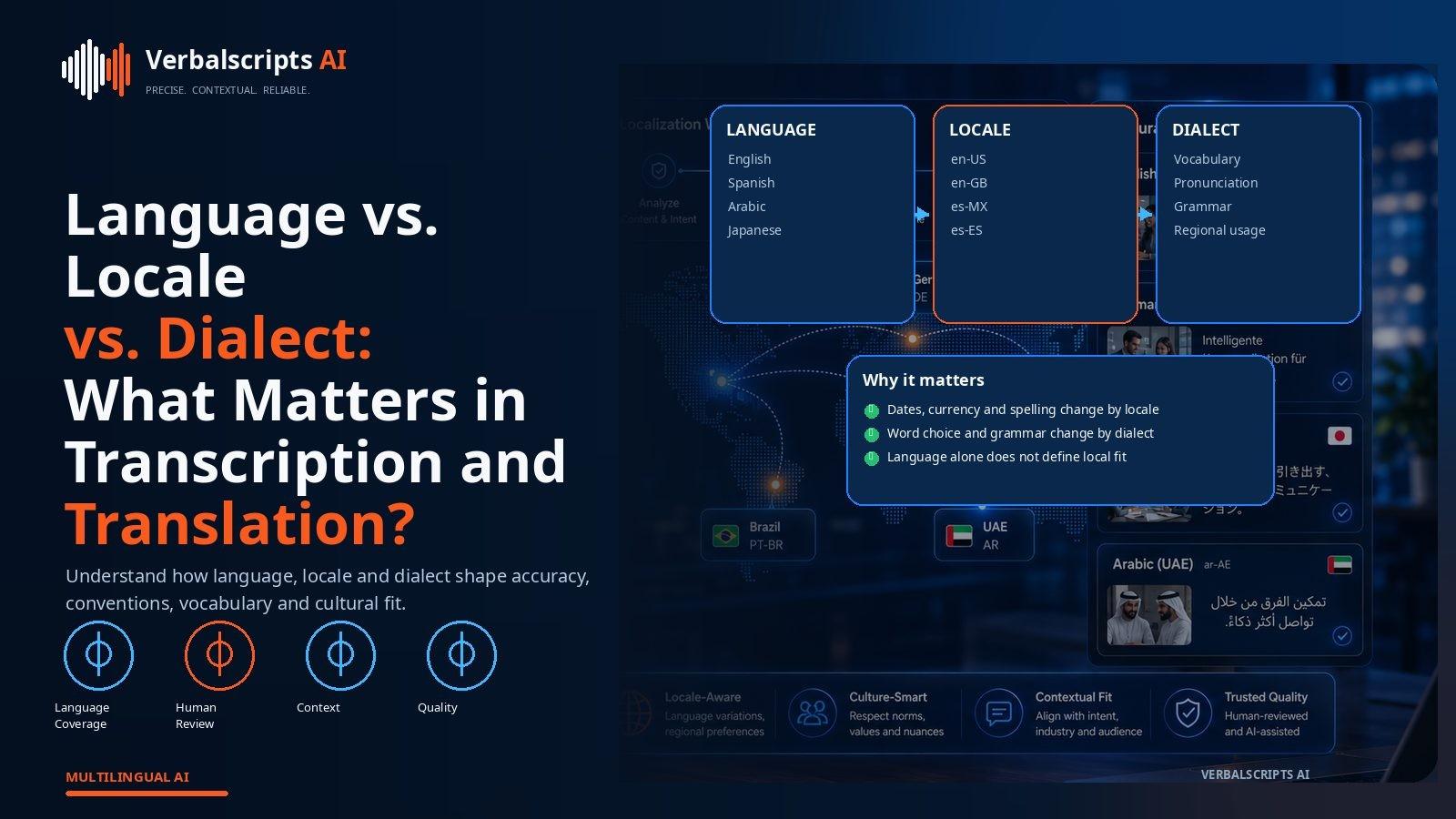
What is the difference between language, locale and dialect? A language is a linguistic system such as English or Swahili. A dialect is a variety of a language with characteristic pronunciation, vocabulary and grammar. A locale is a software/localization concept describing language plus regional or cultural preferences such as date, number and currency conventions. Transcription quality is strongly affected by accent/dialect; translation and product localization are affected by language, variety and locale.
| SEO title | Language vs. Locale vs. Dialect in Transcription & Translation |
|---|---|
| Slug | language-locale-dialect-transcription-translation |
| Meta description | Learn the difference between language, locale and dialect, and why each affects AI transcription, translation, formatting, search and quality. |
| Primary keyword | language vs locale vs dialect |
| Search intent | Informational |
| Hero image | 174-language-locale-dialect.jpg |
| Hero alt text | Language metadata diagram separating language, locale and dialect for transcription and translation workflows |
| Article body words | 1967 |
For production speech-to-text workflows, see our AI Transcription service for the delivery path behind the guidance in this article.
“Language,” “locale” and “dialect” are often used as if they were interchangeable. In multilingual AI systems, they describe different kinds of information, and mixing them up can cause avoidable errors.
A transcription model needs to know what people sound like. A translation system needs to know what linguistic system and regional form to produce. A website may also need date, number and currency conventions that are not part of language grammar.
W3C language-tag standards such as BCP 47 can encode language plus optional region and script, but dialect boundaries do not always map neatly to software codes.
Language
Examples:
- English;
- French;
- Swahili;
- Japanese.
A language has:
- grammar;
- vocabulary;
- conventions.
Language boundaries can also be social and political, not purely technical.
AI systems use language labels pragmatically.
Locale
A locale is used in software to select culturally appropriate conventions.
Examples:
- en-US;
- en-GB.
Differences may include:
- date;
- decimal;
- currency;
- spelling.
W3C’s Language Tags and Locale Identifiers document distinguishes language tagging from the broader system of user preferences used by locale-sensitive software.
Dialect
A dialect can differ in:
- vocabulary;
- grammar;
- pronunciation.
Examples:
- regional Arabic varieties;
- English varieties;
- Swahili regional varieties.
Dialect is linguistic.
Locale is an application configuration.
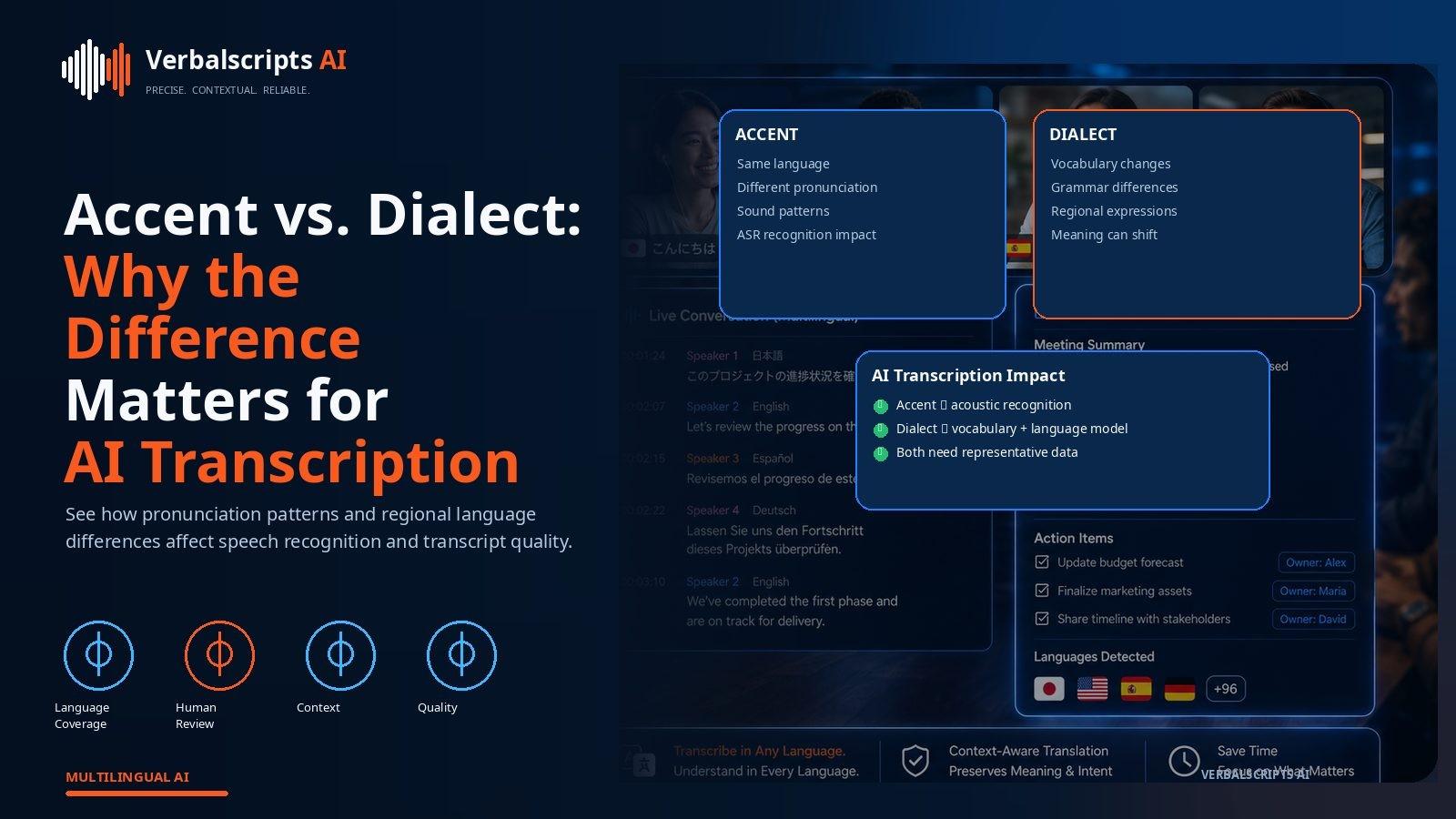
Accent
Accent is mainly pronunciation.
Two speakers can share:
- grammar/vocabulary
but have different accents.
This distinction matters in ASR.
An accent challenge may not require a different translation locale.
Why ASR cares
Speech recognition processes sound.
Variation in:
- vowels;
- consonants;
- rhythm;
- tone
affects recognition.
If training data underrepresents an accent/dialect, WER may increase.
Why translation cares
Translation works primarily with linguistic meaning.
Dialect affects:
- vocabulary;
- grammar;
- slang.
A dialect transcript normalized to standard language may lose speaker identity.
Decide project requirements.
Why localization cares about locale
Web/software needs:
- $1,234.50;
- 1.234,50 €.
These are locale conventions.
Do not expect text translation alone to handle dynamic formatting.
Use CLDR/ICU-style locale libraries.
BCP 47
BCP 47 tags can include:
- primary language;
- script;
- region;
- variants.
W3C recommends keeping tags only as specific as needed.
Example:
sr-Latn
identifies Serbian in Latin script.
Region is not dialect
en-KE identifies English associated with Kenya as a locale/language tag context.
It does not automatically encode every Kenyan English accent or social variety.
Do not infer speaker identity or precise dialect from locale code.
Script
Script can be independent.
Languages may use:
- Latin;
- Cyrillic;
- Arabic script.
Script matters for:
- rendering;
- transliteration.
BCP 47 can include script subtags.
Transcription metadata schema
Useful fields:
- language;
- locale;
- dialect/variety;
- accent label if relevant;
- script;
- code-switch.
Not every field needs a standardized tag.
Use controlled internal labels with definitions.
Translation target specification
Instead of:
Spanish
Use:
Spanish, Mexico, consumer support, informal-neutral tone.
This communicates more than locale code alone.
Dialect normalization
Some projects want:
Verbatim dialect
Preserve dialect grammar/vocabulary.
Standardized transcript
Normalize to standard written language.
Research interviews often prefer preservation.
Business meeting notes may prefer normalization.
Define before transcription.
Dialect-to-standard translation
A speaker may use a dialect and target may be standard language.
The system must:
- understand dialect;
- translate meaning.
Dialect recognition failure can look like translation error.
Language identification
Similar languages/varieties can be hard to distinguish.
A language-ID system should use a constrained candidate set and confidence.
Do not overclaim precise dialect detection.
Code-switching
Speakers can use multiple languages within one sentence.
One locale tag cannot describe the whole utterance.
Use span-level labels where needed.
Customer support
Locale affects:
- language;
- date;
- address.
Dialect affects:
- what customer actually says.
Support systems may need both.
Subtitles
Subtitle target should use audience-appropriate written variety.
Source dialect can be preserved stylistically if important.
Avoid stigmatizing or caricaturing dialect.
Quality evaluation
Benchmark per:
- language;
- locale;
- dialect/accent group.
A model can show good average English WER while failing a specific speaker population.
Fairness
Underrepresentation of accents can create unequal service quality.
Organizations should test users they actually serve.
Do not treat “standard accent” as neutral by default.
Example: one sentence, three different metadata needs
Suppose a Kenyan customer speaks English with a local accent in an application configured for Kenya.
Possible metadata:
- language: English;
- locale: en-KE for formatting/product behavior;
- accent: Kenyan English variety;
- script: Latin.
The ASR model may need acoustic coverage of the accent. The translation system may only need to know the language. The UI formatter needs the locale. Trying to represent all three needs with one field such as language = en-US produces unnecessary mismatch.
Dialect labels require care
Dialect boundaries can be socially sensitive and linguistically debated. Use labels for a clear operational purpose:
- benchmark subgroup;
- reviewer routing;
- requested transcript style.
Do not infer race, ethnicity or nationality from a dialect label. Collect participant metadata only when needed and consented.
Locale fallback chains
Applications often need a fallback:
fr-CA → fr → default.
Define the chain explicitly for:
- translation resources;
- date/number formatting;
- fonts.
A fallback should not silently apply France-specific legal content to Canada simply because the language is French. Content and formatting fallback rules may need to differ.
Speech-model locale versus content locale
A speaker using British-accented English may be reading a US-market script. Speech recognition locale and publication locale therefore can differ.
Store them separately:
- recognition configuration;
- target content locale.
This avoids letting an acoustic choice incorrectly determine downstream formatting.
Quality reporting by variety
For a voice product, report errors by relevant speaker variety rather than only by application locale. For text translation, report by target locale. The metadata used for evaluation should match the component being measured.
Language metadata in a real content platform
A robust CMS or speech platform may keep several fields:
- content_language: language of the text;
- locale: market formatting/UX;
- recognition_locale: ASR configuration;
- script: writing system;
- variety: internal dialect label when needed.
These fields can differ.
For example, a British speaker can record an English video intended for a US market. Recognition may use en-GB, while the localized landing page uses en-US conventions.
Avoid over-tagging dialect
Not every speech difference requires a permanent dialect label. Collect and store dialect metadata only when it has a real purpose such as:
- model evaluation;
- reviewer routing;
- requested output style.
Excessive labels can create privacy and governance burden without improving the product.
Locale-aware quality review
A translation can be grammatically correct for the language but still fail locale review through:
- spelling;
- terminology;
- date conventions;
- formal address.
Therefore a QA record should distinguish:
- language accuracy;
- locale fit.
This is useful when a shared French model serves France and Canada.
Dialect transcription policies
Create explicit choices:
Preserve
Use when language variety is evidence or research data.
Light normalization
Use for readable interviews while preserving characteristic vocabulary.
Standardize
Use for internal minutes where exact dialect is not needed.
A transcript reviewer should not choose the level independently from project instructions.
Product language selector design
A user-facing language picker should usually show language names in recognizable native forms and distinguish regions only when they produce a meaningful content difference.
Do not overwhelm users with internal dialect taxonomy. Internal metadata can be more granular than the public selector.
Fallback handling
If an es-MX resource is unavailable, falling back to generic Spanish may be acceptable for some interface text but not for:
- local pricing;
- legal terms;
- country-specific support.
The application should support content-specific fallback policies.
Evaluation conclusion
Use the metadata that corresponds to the question you are asking. Accent labels evaluate acoustic fairness; locale tags evaluate market behavior; language tags evaluate linguistic content. Conflating them creates misleading quality conclusions.
Metadata examples by task
For an English customer call from Kenya:
ASR: language en, recognition locale/model chosen for expected Kenyan English performance. Transcript storage: language en, optional variety label if needed for evaluation. Customer UI: locale may be en-KE. Translation: target may be fr-FR.
Each stage has a different metadata requirement. Designing explicit fields avoids trying to make one language code do all jobs.
Dialect and locale in human review
A reviewer may be qualified for a language but not a regional market. Store reviewer expertise as:
- language;
- locale;
- dialect/variety familiarity.
For high-visibility local content, prefer in-market expertise. For source transcription, prefer familiarity with the speaker’s variety.
Search and analytics
Analytics may need to group:
- all French locales;
- one country;
- one speech variety.
Use hierarchical metadata so reports can aggregate without deleting specificity.
Do not encode analytics assumptions in display strings such as “French (Canada).”
Standards and internal labels
Use standards like BCP 47 where they fit. For internal dialect categories that lack standardized tags, use controlled labels documented in your data dictionary rather than inventing nonstandard BCP 47 subtags casually.
This keeps interoperability while allowing operational detail.
Product fallback example
A target fr-CA page may safely fall back to generic French for an evergreen help explanation, while a Quebec-specific legal notice cannot. Fallback therefore needs content-type awareness, not only language hierarchy.
Data-model recommendation
Do not overload one language column. A minimal multilingual content model can include:
- language_tag;
- locale;
- script;
- optional speech_variety;
- source_language;
- target_locale.
This may seem redundant for simple English content, but it prevents expensive migrations later when the application adds speech, regional markets or multiple writing systems.
Final rule of thumb
Use language to describe linguistic content, locale to describe market-specific presentation/behavior and dialect or accent metadata only when the speech variety itself matters to recognition, review or analysis.
Documentation for developers and linguists
Keep a small data dictionary explaining every multilingual metadata field, accepted values and who owns it. Engineers need to know which fields drive routing; linguists need to know which fields describe language behavior. Shared definitions prevent the same word (especially “locale”) from meaning different things in different teams.
Implementation takeaway
For production use, treat separating recognition locale, content locale and dialect metadata as measurable parts of the workflow rather than assumptions. Define the relevant policy before processing content, keep the model or data configuration versioned, and verify results on representative material from the actual language, locale and domain. If automation produces a result that conflicts with a deterministic rule, authoritative terminology or qualified human evidence, escalate the item instead of averaging the disagreement away. The most durable multilingual systems preserve source-to-target traceability, record exceptions and feed reviewed corrections back into benchmarks, glossaries or routing rules. That discipline makes quality improvements reproducible when models, providers, reviewers or source content change.
Frequently asked questions
Is accent the same as dialect?
No. Accent mainly concerns pronunciation; dialect also includes vocabulary and grammar.
Is locale the same as language?
No. Locale includes regional formatting and cultural conventions.
Does BCP 47 identify dialect?
Sometimes variants can be represented, but not every dialect has or needs a standardized tag.
Should transcripts preserve dialect?
It depends on use. Define verbatim versus normalized output.
What should I specify to an AI translation provider?
Language, target locale, audience, domain and any dialect/variety requirements.
Conclusion
Language, locale and dialect describe different layers of multilingual experience.
Speech systems care about pronunciation and varieties. Translation systems care about meaning and target language. Software localization also needs locale conventions and script.
Model and metadata quality improve when these distinctions are explicit rather than hidden behind one “language” dropdown.
Research references
- W3C, Language Tags and Locale Identifiers:
- W3C, Language tags:
- RFC 5646 / BCP 47:
- W3C Internationalization Glossary: