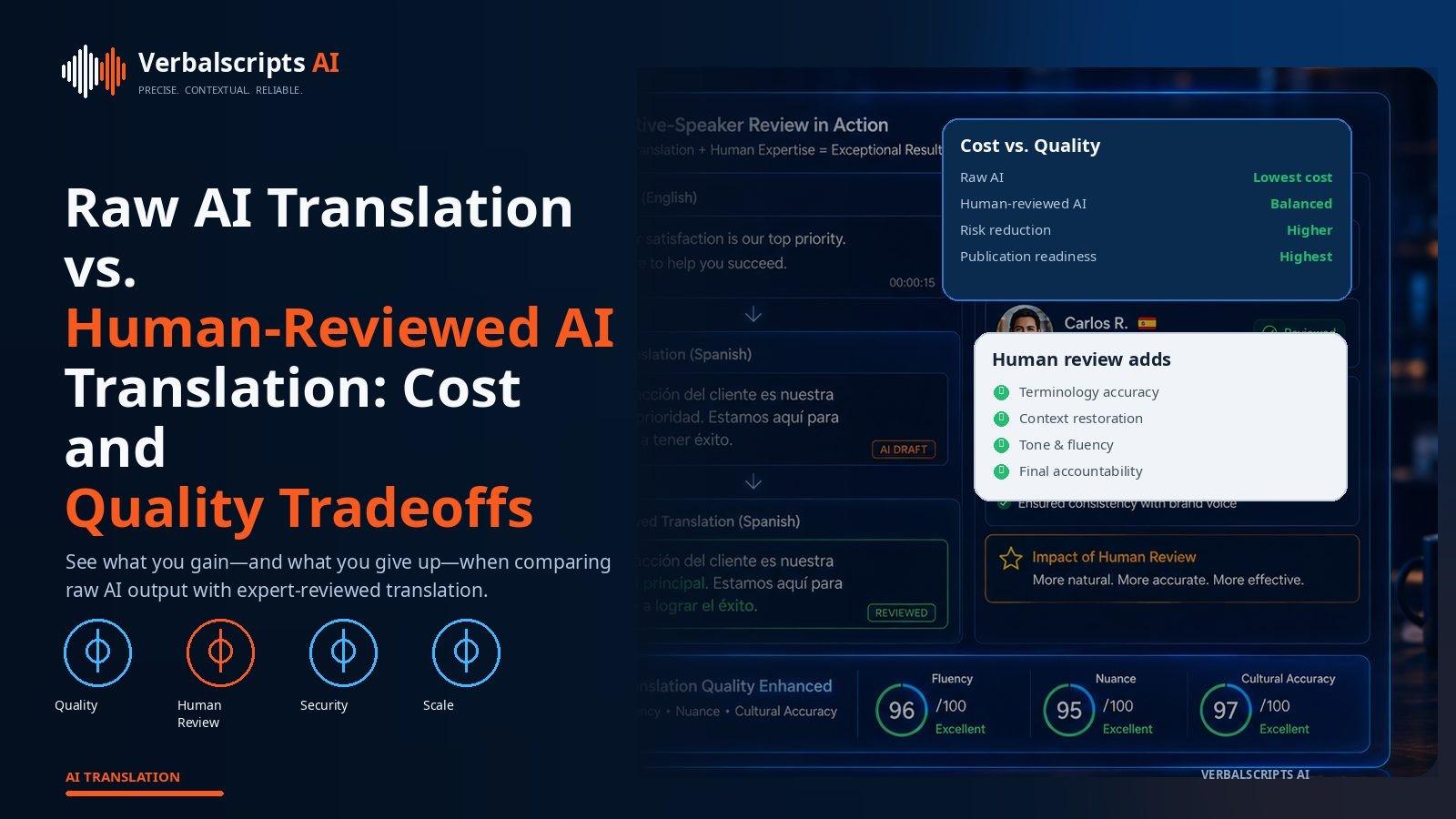
When should you use raw AI translation versus human-reviewed AI translation? Use raw AI for low-risk internal understanding, content discovery and high-volume material where occasional errors are acceptable. Use human-reviewed AI translation for customer-facing, published, legal, medical, financial, technical or brand-critical content. Human review costs more and takes longer, but it detects semantic, terminology and contextual errors that automated systems can miss.
| SEO title | Raw AI vs. Human-Reviewed Translation: Cost & Quality |
|---|---|
| Slug | raw-ai-vs-human-reviewed-translation-cost-quality |
| Meta description | Compare raw AI translation with human-reviewed AI translation for cost, speed, accuracy, risk, public use and enterprise quality assurance. |
| Primary keyword | raw AI translation vs human reviewed |
| Search intent | Comparison / Commercial research |
| Hero image | 163-raw-ai-vs-human-reviewed-translation.jpg |
| Hero alt text | Side-by-side comparison of raw AI translation and human-reviewed AI translation with speed, cost and quality indicators |
| Article body words | 1929 |
For production multilingual workflows, see our AI Translation service for the delivery path behind the guidance in this article.
Raw AI translation and human-reviewed AI translation use the same basic automation but deliver very different levels of assurance.
Raw translation optimizes for speed and cost. Human-reviewed translation uses AI for the first draft and then applies bilingual or specialist verification before delivery.
Neither is always better. The right choice depends on what happens if the translation is wrong.
The decision should be based on risk, not simply budget.
What raw AI translation means
Raw output is generated and delivered without qualified bilingual review.
It may still include automated checks such as:
- placeholders;
- formatting;
- profanity.
But no person verifies meaning.
This is appropriate in many situations.
What human-reviewed means
A reviewer compares:
- source;
- AI target.
They correct:
- mistranslation;
- omission;
- terminology;
- grammar;
- style.
High-risk workflows may also include:
- domain specialist;
- final proofread.
Speed
Raw AI:
- seconds/minutes.
Human-reviewed:
- hours/days.
For urgent internal comprehension, raw output is often superior because waiting removes its value.
For a contract filed next week, review time is justified.
Cost
Raw AI model cost can be extremely low.
Human review becomes the main cost.
However, human review can still be cheaper than fully manual translation because the reviewer edits a strong draft rather than translating every segment from scratch.
Actual savings depend on AI quality.
Quality distribution
Raw AI is not uniformly bad or good.
A 10,000-word document may contain:
- 9,900 excellent words;
- 100 problematic words.
The challenge is identifying which 100.
Human review provides detection.
Fluent errors
Modern AI can generate fluent mistranslations.
These are dangerous because a monolingual user will not recognize them.
Human bilingual review is particularly valuable for:
- negation;
- qualifiers;
- terminology;
- numbers.
Hallucinations and omissions
Raw output can occasionally:
- add unsupported text;
- omit source details.
Benchmarks such as HalOmi show these phenomena across languages and resource levels.
Automated detectors help but do not guarantee removal.
Terminology
Human review enforces:
- product names;
- domain terms;
- legal definitions.
Glossaries reduce the workload but reviewers handle contextual exceptions.
Naturalness
Raw output may be good enough for comprehension but slightly unnatural.
For public content, a native reviewer can improve:
- collocations;
- tone;
- formality.
This affects brand trust.
Low-resource languages
Raw quality can be less predictable for languages with limited training data.
Human review becomes more valuable.
Reviewer availability may also be lower, increasing cost.
Internal use
Raw AI is often appropriate for:
- reading foreign articles;
- triaging support;
- understanding documents;
- cross-team notes.
Label output clearly.
Do not let internal drafts migrate into external publication accidentally.
Customer support
AI + agent review can work well.
The agent verifies:
- factual answer;
- customer-specific details.
High-risk cases escalate.
This is a form of human-reviewed AI even if the reviewer is not a professional translator.
Marketing
Raw AI can draft.
Native/in-market editing should approve:
- headline;
- slogan;
- CTA.
Brand voice and culture matter.
Legal
Raw AI can support internal understanding.
Signed/filed documents need qualified review.
Legal terms can sound plausible but map poorly across jurisdictions.
Medical
Raw AI may support low-risk internal discovery.
Patient or clinical instructions need specialist review.
Financial
Internal summaries may use raw AI.
External disclosures and account communication should be reviewed.
Technical
AI performs strongly on repetitive technical content with glossary support.
Safety instructions and final manuals need appropriate review.
Quality tiers
A useful service model:
Tier A: raw AI
- no bilingual review;
- automated QA.
Tier B: human-reviewed
- bilingual language review.
Tier C: specialist-reviewed
- bilingual + domain.
This lets customers align cost and risk.
Sampling alternative
For huge low-risk volumes:
- raw AI;
- human sample.
Sampling measures ongoing quality.
If error rate exceeds threshold, switch more content to review.
LLM judge alternative
LLM judging can triage output.
But it is still automated.
Use it to:
- prioritize review;
- monitor.
Do not market automated judging as equivalent to human verification.
Reviewer productivity
Strong AI can make human review fast.
Track:
- edits per 1,000 words;
- time.
If AI quality is poor, post-editing can be slower than retranslating.
Choose models by total effort.
Post-editing levels
Light post-edit
Goal:
- understandable;
- correct major errors.
Full post-edit
Goal:
- publishable human-quality.
Define which is purchased.
“Human reviewed” should not be ambiguous.
Accountability
A reviewed workflow can identify:
- reviewer;
- date;
- quality status.
This matters for formal content.
Raw AI has no comparable human signoff.
Cost-benefit framework
Ask:
- What is cost of review?
- Probability of harmful error?
- Cost if error reaches user?
- Can error be corrected later?
A social-media draft is reversible.
A medical instruction may not be.
Decision table by consequence of error
| Use case | Raw AI | Human-reviewed AI |
|---|---|---|
| Internal article discovery | usually sufficient | optional |
| Support-agent understanding | often sufficient with agent context | selective |
| Public help center | risky without monitoring | recommended |
| Marketing campaign | draft | recommended |
| Legal filing | reference only | required/qualified |
| Medical patient instructions | not appropriate as final | specialist review |
| Financial disclosure | not appropriate as final | specialist review |
This table is not a legal rule; it demonstrates the risk-based logic.
Review can be targeted rather than universal
Human-reviewed does not always mean one person reads every word. A mature system can combine:
- deterministic QA on every segment;
- LLM/metric triage;
- full review of high-risk segments;
- statistical sample of stable low-risk content.
This lowers cost while preserving measured control. The review policy should be disclosed accurately rather than calling a sampled workflow “fully human reviewed.”
Post-editing effort as a model-selection metric
Track how long reviewers spend on each model’s output. A model that receives a slightly lower automatic score may still be better if humans edit it much faster because its errors are less disruptive.
Useful metrics:
- seconds per segment;
- keystrokes;
- major errors per 1,000 words;
- acceptance without edit.
Model selection should consider this operational evidence.
Risks of over-editing
Human review can also reduce quality if reviewers rewrite acceptable target language unnecessarily. Over-editing:
- increases cost;
- introduces inconsistency;
- can change meaning.
Provide a rule: correct errors and guide violations; do not rewrite solely for personal preference unless the service includes stylistic editing.
Labeling and user expectations
If raw AI is displayed directly to end users, label it where uncertainty matters. If a reviewed version exists, distinguish it in the product database.
For example:
- machine_translation;
- human_reviewed;
- specialist_approved.
Quality status should be data, not an assumption based on which folder the file came from.
Risk-adjusted publishing policy
A simple decision framework can use two axes:
Impact if wrong: low / medium / high. Reversibility: easy / difficult.
Examples:
- internal article summary: low impact, easy to correct → raw AI often fine;
- help-center page: medium impact, easy to update → AI + sampling/native review;
- printed medical instruction: high impact, difficult to correct → specialist-reviewed.
This framework is more useful than a blanket rule that all AI translation must be reviewed or none of it needs review.
Time-to-value tradeoff
Raw AI can be valuable precisely because it is immediate. In a multilingual investigation, research team or support escalation, a rough translation now may be more useful than a polished translation tomorrow.
The correct workflow can therefore produce two statuses:
- instant machine draft for internal use;
- reviewed final version later.
Users must be able to distinguish them clearly.
Review does not mean “rewrite from scratch”
A strong AI draft can reduce human effort substantially. The reviewer should focus on:
- source fidelity;
- critical terminology;
- natural target language;
- project instructions.
If a reviewer consistently retranslates every sentence, either the AI output is not good enough or the review workflow encourages unnecessary rewriting. Both should be investigated.
Quality evidence to request from providers
If a provider sells “human-reviewed AI,” ask:
- Is every segment compared to source?
- Is reviewer bilingual?
- What error rubric is used?
- Are numbers/terms automatically checked?
- What qualifications exist for specialist content?
- Is there a second QA step?
The phrase itself is not a standardized guarantee.
Update and revision economics
Human-reviewed targets have reuse value. If a source paragraph is unchanged next month, the approved target can often be reused without paying for a new generation/review cycle.
A managed translation memory or content-hash system therefore makes reviewed translation increasingly economical over time.
Recommendation by content lifecycle
For disposable, low-risk content, raw AI can be the right economic choice. For durable content that will be viewed thousands of times, reviewed translation usually has better lifetime value because the correction cost is amortized across all future readers.
Example: multilingual product documentation
A software company may use raw AI to create an immediate Japanese draft of release notes for internal engineers. The same notes, after terminology and native review, become the version published to customers.
This two-stage workflow avoids forcing the business to choose between speed and quality. Internal readers get information immediately, while public users receive the reviewed version when ready.
What human review catches that automated QA misses
Deterministic checks can verify:
- numbers;
- placeholders;
- glossary.
They cannot reliably decide:
- whether a sentence is subtly misleading;
- whether formality is wrong;
- whether a legal term maps correctly in context;
- whether the target sounds culturally inappropriate.
These are the main reasons human review retains value even when automatic metrics improve.
What raw AI does better than humans
Raw AI excels at:
- instantaneous scale;
- consistent availability;
- first-pass coverage across many languages;
- triage of content that otherwise would not be translated at all.
The tradeoff is assurance. Used in the right risk tier, raw AI is not “low quality” by definition; it is an output with a lower level of verified confidence.
Governance labels
Store quality state with the content itself:
- machine-only;
- automatically QA-checked;
- bilingual reviewed;
- specialist approved.
If a target is copied to another system, preserve the status. Otherwise a machine-only draft can lose its warning and be mistaken for an approved publication.
Choosing between light and full post-editing
Light post-editing is appropriate when the goal is comprehensibility and the output will not be customer-facing for long. Full post-editing should remove all material errors and bring the target to the agreed publication style.
Specify this in the statement of work. “Post-edited” without a definition can mean very different things to different vendors.
Long-term recommendation
As AI quality improves, reduce review based on measured evidence rather than optimism. Start with stronger review, collect error data and gradually automate stable content categories. This produces a defensible path toward lower cost without sacrificing trust.
Frequently asked questions
Is human-reviewed AI as good as human translation?
It can be when the AI draft is strong and qualified reviewers apply full review. Quality depends on process, not label.
Does human review remove every error?
No process guarantees perfection, but it materially reduces risk.
Is raw AI safe for internal use?
Often, if users understand it can contain errors.
Is post-editing always cheaper than human translation?
Not if the raw output is poor.
What should high-stakes content use?
AI-assisted translation plus qualified bilingual/domain review.
Conclusion
Raw AI translation buys speed and scale. Human-reviewed AI translation buys assurance.
Use raw output where errors are tolerable and reversible. Use human review where content represents the organization publicly or affects rights, health, money, safety or trust.
AI creates the draft. The review model determines the confidence you can place in it.
Research references
- HalOmi (EMNLP 2023):
- ISO 17100:2015:
- WMT 2024 Metrics Shared Task: