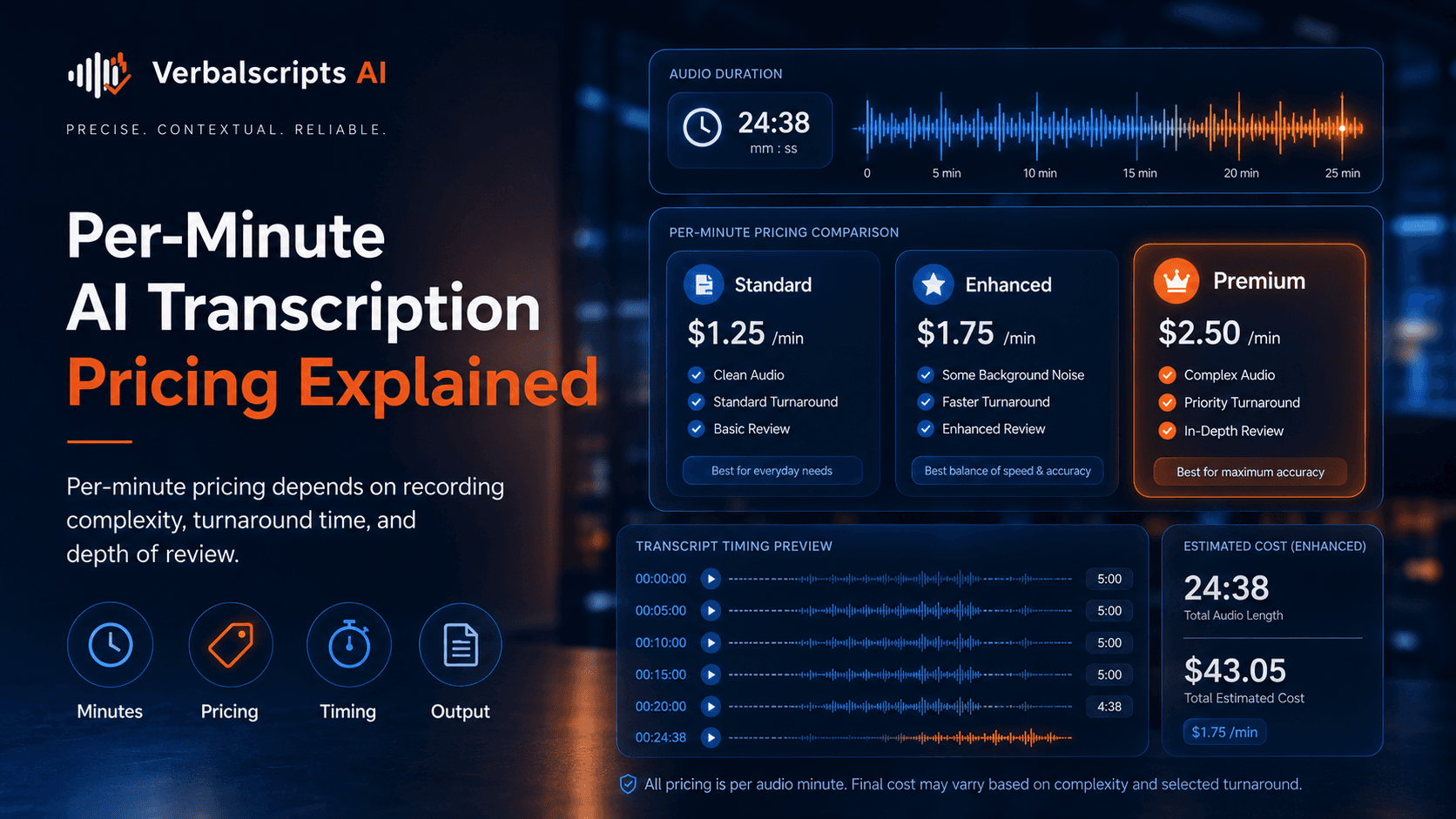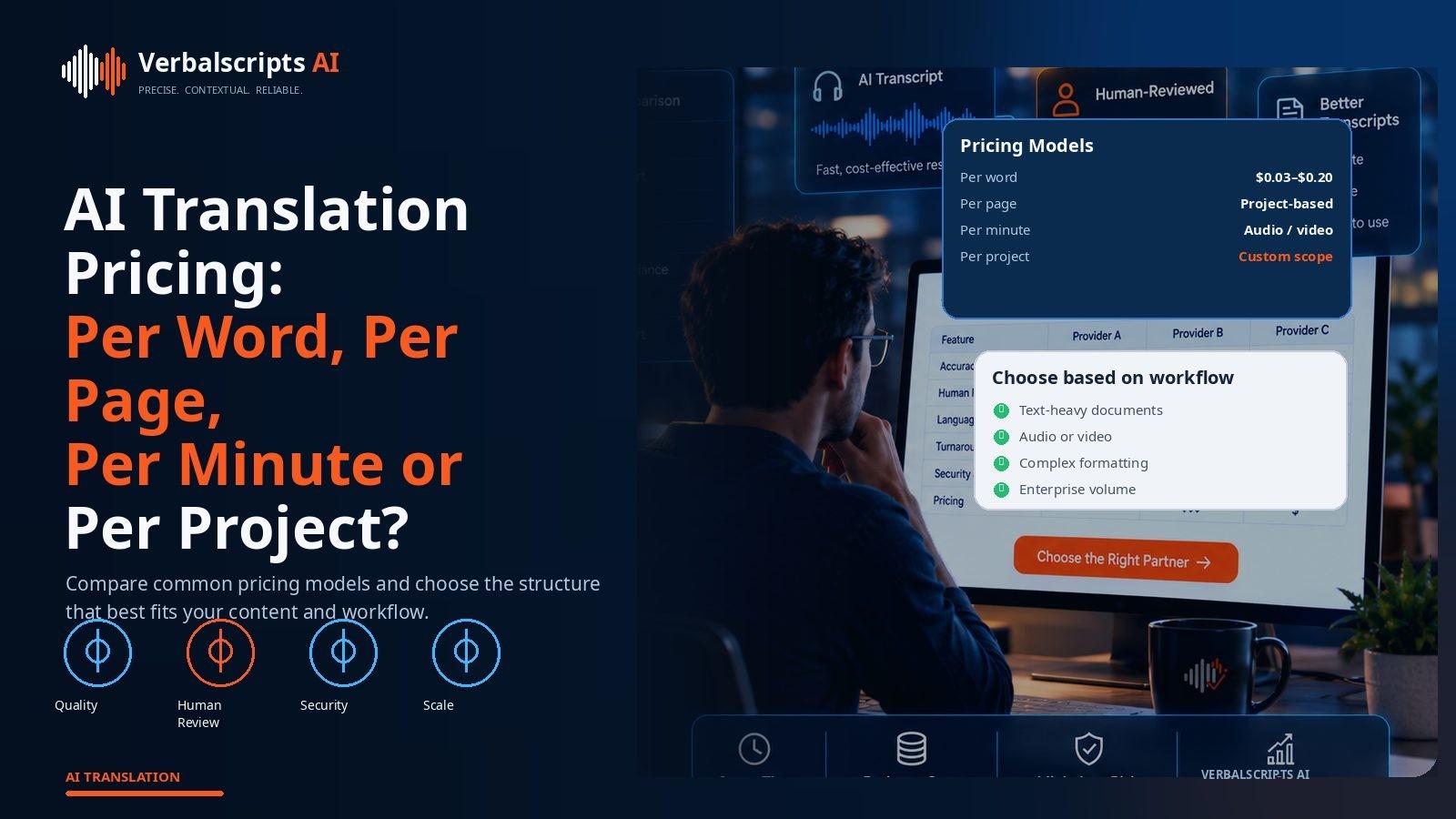
Which translation pricing model is best? Per-word pricing works well for editable text where word count reflects linguistic effort. Per-page pricing is convenient for standardized legal or formatted documents. Per-minute pricing fits audio/video because duration drives transcription and review. Per-project pricing is best when the scope combines languages, file types, formatting, QA and specialist work. Cloud APIs commonly meter characters or document pages rather than words.
| SEO title | AI Translation Pricing: Per Word, Page, Minute or Project? |
|---|---|
| Slug | ai-translation-pricing-per-word-page-minute-project |
| Meta description | Compare AI translation pricing per word, page, minute and project, with guidance on choosing the fairest model for text, documents, audio and enterprise work. |
| Primary keyword | AI translation pricing |
| Search intent | Commercial research |
| Hero image | 162-ai-translation-pricing-models.jpg |
| Hero alt text | Translation pricing comparison showing per-word, per-page, per-minute and per-project models |
| Article body words | 2006 |
For production multilingual workflows, see our AI Translation service for the delivery path behind the guidance in this article.
Translation pricing can look confusing because different providers quote different units.
One service charges per million characters. A legal translator charges per page. A media provider charges per audio minute. An enterprise localization project is quoted as one fixed amount.
Each model can be reasonable when it matches the work being measured.
The best quote makes the unit, inclusions and assumptions explicit.
API character pricing
Machine translation APIs commonly charge by:
- source characters;
- sometimes source + output characters.
Advantages:
- exact;
- automated;
- scalable.
Disadvantages:
- unfamiliar to buyers;
- does not include review.
Use for software integrations.
Per-word pricing
Human translation has traditionally used source words.
Advantages:
- predictable before translation;
- comparable.
A word-based quote should specify:
- source or target word;
- how numbers counted;
- minimum.
Source word is usually more stable.
AI-assisted per-word
A service can quote per word for:
- AI draft;
- human review.
The rate may depend on:
- language;
- domain;
- quality.
This is easier for clients than separate API + reviewer billing.
Per-page pricing
Useful when industry workflows think in pages.
Examples:
- court transcripts;
- certificates;
- legal records.
Define:
- standard page;
- actual PDF page.
A scan with one sentence and a dense report page are not equal effort.
Provider document-page pricing
Cloud document translation may use page billing for certain formats.
Google currently meters certain translated DOCX/PPT/PDF documents by pages.
This is a compute/service unit, not the same as professional human per-page pricing.
Per-minute pricing
Audio work usually starts with duration.
Price may include:
- transcription;
- translation;
- timestamps;
- speaker labels;
- subtitle timing.
A 60-minute clean lecture and 60-minute noisy interview differ in effort.
Use complexity adjustments where necessary.
Video minute pricing
Video can add:
- on-screen text;
- subtitles;
- dubbing;
- caption QA.
Clarify what “per minute” includes.
Per-project pricing
Project pricing is appropriate for:
- enterprise migration;
- multilingual website;
- mixed documents;
- urgent legal batch.
Provider estimates total labor + technology + overhead.
It gives budget certainty.
Fixed project advantages
Client knows total.
Provider can optimize internally.
Good for clearly defined scope.
Fixed project risks
Scope creep.
The quote should define:
- files;
- targets;
- review rounds;
- formatting;
- turnaround.
Change requests need a method.
Hybrid pricing
Many real projects use hybrid models.
Example:
- per-minute transcription;
- per-word translation;
- fixed formatting fee.
Or:
- API pass-through;
- hourly reviewer.
Hybrid pricing can be transparent but complicated.
Hourly pricing
Useful for:
- consulting;
- terminology;
- unusual QA;
- design reflow.
Hourly review can be fair when machine quality is uncertain.
Client may prefer capped hours.
Minimum project fee
Small files still require:
- setup;
- review;
- delivery.
Minimums prevent microprojects from being uneconomic.
Disclose them.
Language pricing
A provider may use different rates per language due to:
- reviewer supply;
- AI quality;
- script;
- domain.
Uniform pricing is simpler but may cross-subsidize.
Volume discounts
High-volume work can reduce unit cost through:
- reuse;
- automation;
- planning.
But higher volume also creates:
- project management;
- QA.
Discount only when savings are real.
Repetitions
Translation memory can classify:
- exact match;
- fuzzy match;
- new words.
Traditional localization sometimes prices them differently.
AI workflows can also reuse exact approved content rather than retranslating it.
Quality tier pricing
Offer tiers:
AI only
Fast, low cost.
AI + standard human review
Public-ready for common content.
Specialist-reviewed
Legal/medical/technical.
This is clearer than one rate that implies all outputs have equal assurance.
Formatting pricing
Clarify:
- layout preserved automatically;
- manual desktop publishing;
- bilingual format.
Complex PDFs cost more.
OCR
Scanned documents need OCR.
Quote:
- included;
- per page;
- separate.
Poor scans can require manual correction.
Subtitles
Per-minute subtitle translation may include:
- timing;
- segmentation.
If existing accurate SRT is provided, cost can be lower than translating raw video.
Dubbing
Dubbing adds:
- voice;
- audio editing.
Price separately.
Security premium
Custom enterprise security may add cost for:
- dedicated environment;
- restricted reviewers;
- custom agreements.
Not every provider charges separately, but it affects delivery cost.
Rush pricing
Urgent human review needs capacity.
Rush multiplier should be transparent.
Raw API does not necessarily need rush pricing but quota scaling may matter.
How to compare quotes
Normalize:
- quality level;
- source volume;
- languages;
- formatting;
- review;
- delivery.
Then calculate estimated total.
A $0.02/word raw AI quote is not comparable with $0.12/word specialist-reviewed output.
Pricing table example
| Work | Useful unit |
|---|---|
| API text | characters |
| DOCX/PDF automation | characters/pages |
| edited documents | words/pages |
| audio | minutes |
| subtitles | minutes |
| mixed enterprise | project |
The unit should follow the work.
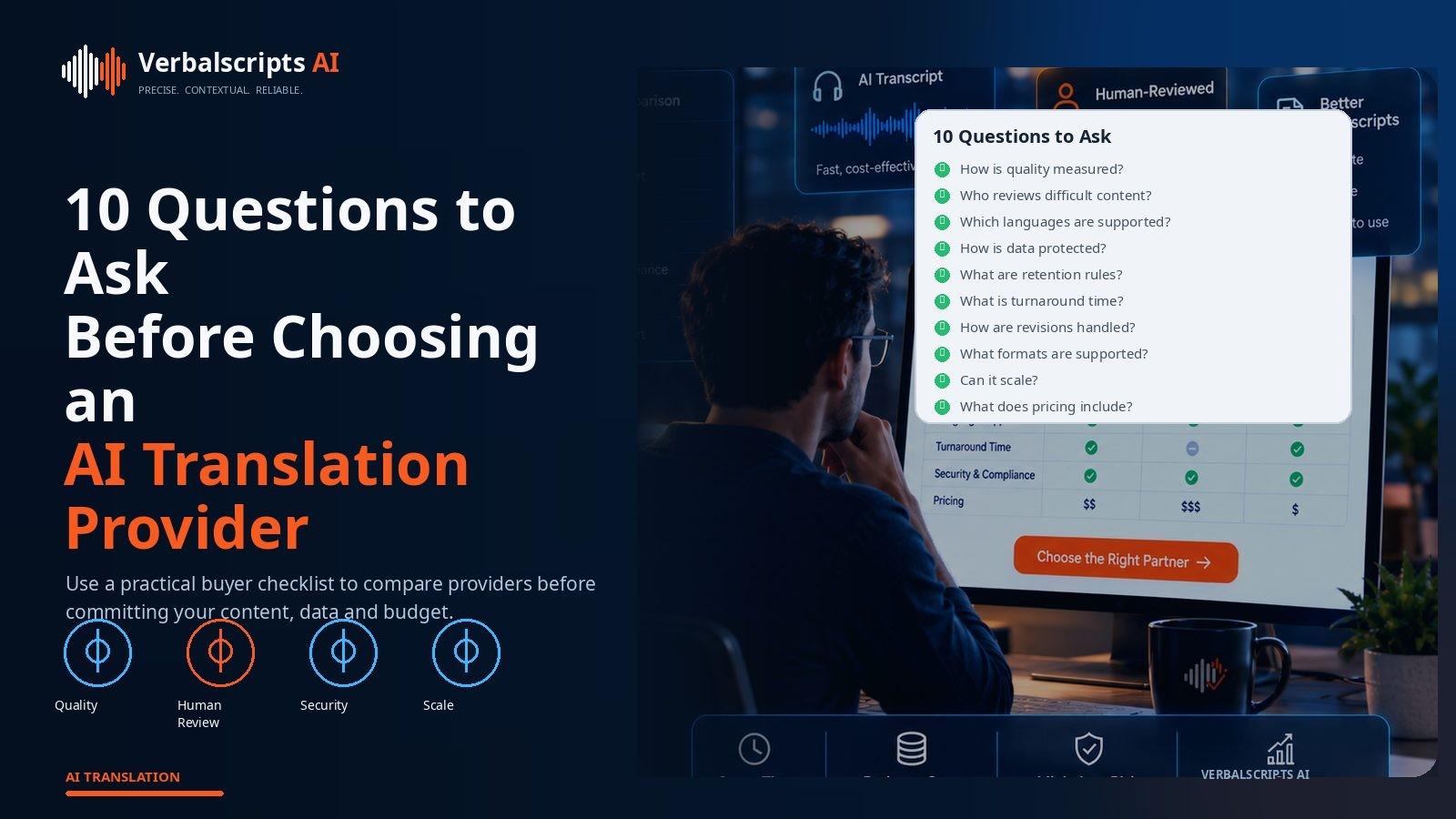
Questions to ask
- What does the rate include?
- Is human review included?
- What counts as page/minute?
- Minimum?
- Rush?
- Formatting?
- Revisions?
- Security?
Pricing example by content type
The same 50,000 source words can be priced differently depending on input.
Clean DOCX knowledge base
Per-word review may be simplest.
300-page scanned archive
Per-page OCR + per-word or project translation may be clearer.
10 hours of interviews
Per-minute transcription plus translation/review.
Website plus CMS integration
A project quote may include engineering and QA.
This is why a buyer should resist forcing every translation project into one unit.
How to define a “page”
If page pricing is used, define whether a page means:
- literal PDF page;
- standard 250-word page;
- transcript page with fixed lines;
- presentation slide.
A 20-word certificate and a 900-word dense report page have different effort. Standard-page definitions make comparisons fairer when document density varies.
Revisions and scope
Pricing should explain what happens after delivery.
Questions:
- Are reviewer corrections included?
- How many client revision rounds?
- Does source-text change trigger retranslation?
- Is formatting repair included?
A fixed project price without revision boundaries can become ambiguous for both buyer and provider.
Currency and tax
Enterprise buyers should confirm:
- quote currency;
- taxes/VAT;
- payment terms;
- exchange-rate policy.
This is especially relevant when reviewer networks and clients operate globally. The unit rate may look stable while the final invoice changes because of currency treatment.
Price transparency for AI-assisted services
A managed service does not need to expose every underlying model token, but it should clearly state what quality level the client receives. Distinguish:
- automated output;
- bilingual human review;
- specialist validation;
- certification where applicable.
The buyer can then compare equivalent deliverables instead of treating all “AI translation” as one service.
When per-word pricing works best
Per-word is easiest when:
- the source is editable text;
- word count is stable;
- review is the main human effort.
It becomes less representative when documents contain:
- many tables;
- scanned images;
- formatting-heavy pages;
- very short UI strings.
A vendor can still use per-word externally while estimating internal work through other units.
When per-page pricing works best
Per-page works well for standardized legal or document workflows where page density is reasonably consistent and clients naturally think in pages.
Before accepting it, define:
- what happens to image-only pages;
- blank pages;
- pages with tables;
- appendices.
The contract should make page-count rules transparent.
When per-minute pricing works best
Audio/video pricing should specify whether the minute includes:
- transcription;
- translation;
- speaker labels;
- timestamps;
- subtitle timing;
- human review.
A “$X/minute” quote for raw speech translation is not comparable with a full human-reviewed subtitle deliverable.
When per-project pricing is strongest
Use project pricing when the scope mixes:
- file preparation;
- many languages;
- specialist review;
- design/reflow;
- migration engineering.
The buyer receives budget certainty while the provider can optimize the internal workflow.
Example comparison
Imagine a 90-minute bilingual interview producing 18,000 source words and two target languages.
Possible quote structures:
- $/audio minute for transcription;
- $/source word for translation/review;
- fixed project fee for source verification + two targets.
All can be valid. The fairest model is the one that clearly maps to the work and includes the same deliverable.
Avoid double billing ambiguity
If a project is priced per page and per word, clarify which activities each unit covers. For example:
- per page = OCR/layout;
- per word = linguistic review.
The invoice should not make clients wonder whether the same work has been counted twice.
Total-cost comparison worksheet
For each quote, calculate:
- base translation;
- review;
- terminology/setup;
- formatting;
- rush;
- project management;
- taxes/fees.
Then divide by the same output measure if you want a normalized comparison. This exposes providers that advertise a low headline unit but charge essential components separately.
Pricing by review level
When pricing includes humans, define the expected review intensity.
Light review focuses on obvious meaning and grammar problems. It is suitable only where the machine output is already measured as strong and the content is low risk.
Full bilingual review compares source and target, checks terminology and produces publication-ready language.
Specialist review adds domain validation, for example a legal linguist or medical reviewer.
A per-word rate is meaningful only when the buyer knows which review level it represents.
Reuse and repetition discounts
Traditional localization platforms often distinguish exact matches, fuzzy matches and new words. AI-assisted services can use a simpler principle: do not charge full production effort for unchanged, previously approved content.
If a paragraph is identical and the approved target remains valid under the same locale and terminology policy, reuse it. The provider may still charge for project handling or QA, but the linguistic work is reduced.
This is one reason translation memory remains economically useful in an AI workflow.
Pricing low-resource languages
Lower-resource languages can cost more because:
- AI output may require more editing;
- qualified reviewers may be scarce;
- terminology research may take longer.
A provider that charges one universal review rate may absorb these differences internally, but buyers should not assume identical economics across every language.
Pricing changes and model choice
If an enterprise switches from a lower-cost NMT model to a more expensive LLM translator, the API bill may increase while total cost falls because reviewers make fewer edits.
Evaluate:
- model cost;
- reviewer time;
- critical error rate;
- turnaround.
That is the correct economic comparison.
Negotiating a volume agreement
For recurring work, ask for:
- monthly committed volume;
- tiered pricing;
- minimums;
- overage;
- unused-volume treatment;
- included review/PM.
Do not commit to huge character volumes until the provider has passed a real quality pilot. A discount on poor output is not valuable.
Final pricing principle
A translation unit should make invoices understandable, but it should not drive quality decisions. Choose the quality workflow first, then select the billing unit that reflects it cleanly.
Implementation takeaway
For production use, treat review level, scope boundaries and comparable total-cost calculations as measurable parts of the workflow rather than assumptions. Define the relevant policy before processing content, keep the model or data configuration versioned, and verify results on representative material from the actual language, locale and domain. If automation produces a result that conflicts with a deterministic rule, authoritative terminology or qualified human evidence, escalate the item instead of averaging the disagreement away. The most durable multilingual systems preserve source-to-target traceability, record exceptions and feed reviewed corrections back into benchmarks, glossaries or routing rules. That discipline makes quality improvements reproducible when models, providers, reviewers or source content change.
Frequently asked questions
Is per-word pricing outdated because of AI?
No. It remains a useful client-facing unit for human-reviewed text.
Is per-page fair?
For standardized page types. Less fair for highly variable density.
Why is audio priced per minute?
Duration drives speech processing and reviewer time.
When should I ask for project pricing?
When the project mixes many services or needs budget certainty.
Do cloud APIs charge per word?
Usually not; character or page billing is common.
Conclusion
Translation pricing works best when the unit reflects the real workload.
Use characters for APIs, words for linguistic text, pages for standardized documents, minutes for media and projects for complex enterprise scope.
More important than the unit is what sits behind it: raw AI, human review, specialist expertise, formatting and accountability.
Research references
- Google Cloud Translation pricing:
- AWS Translate pricing:
- Microsoft Azure Translator pricing: