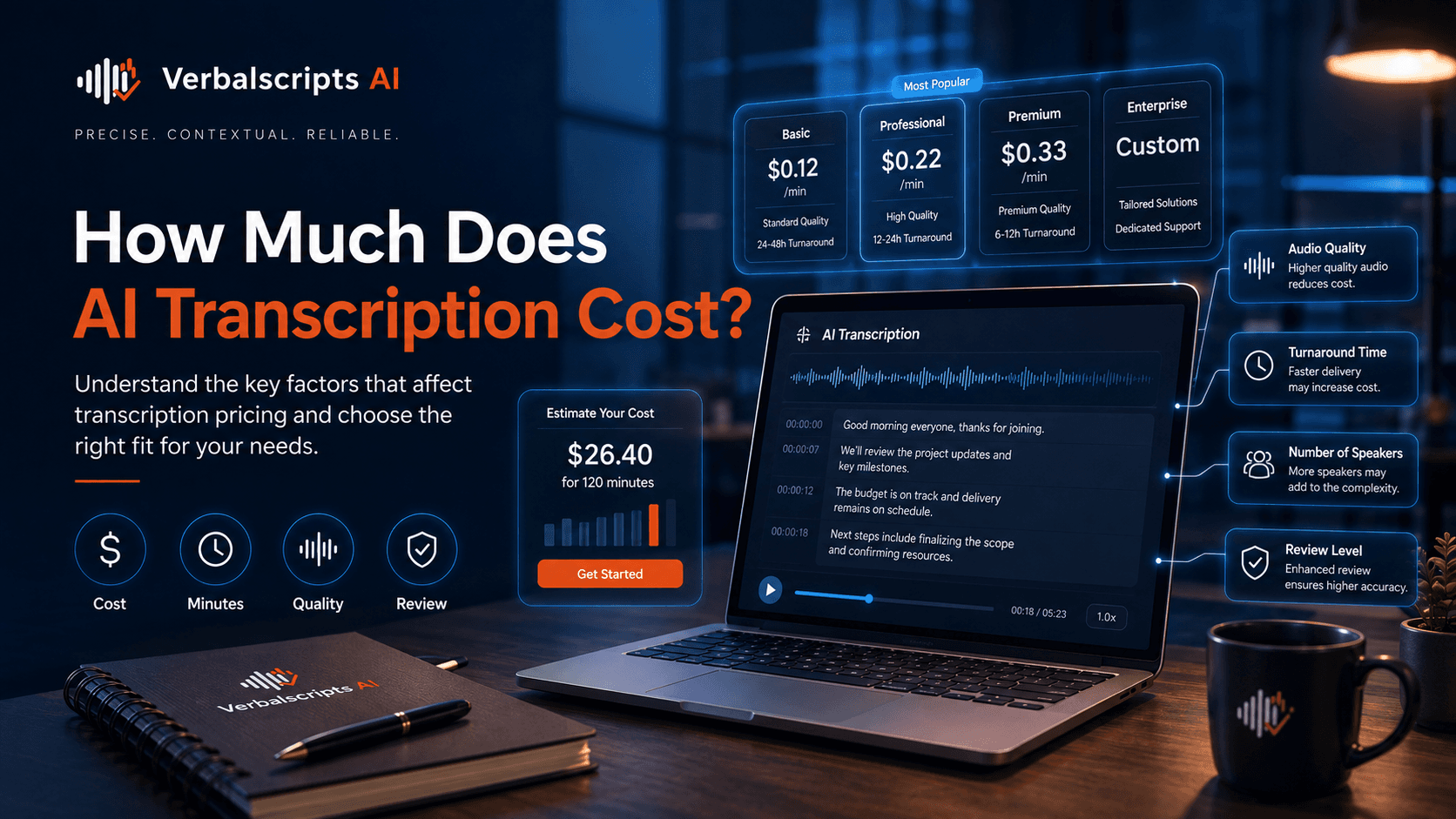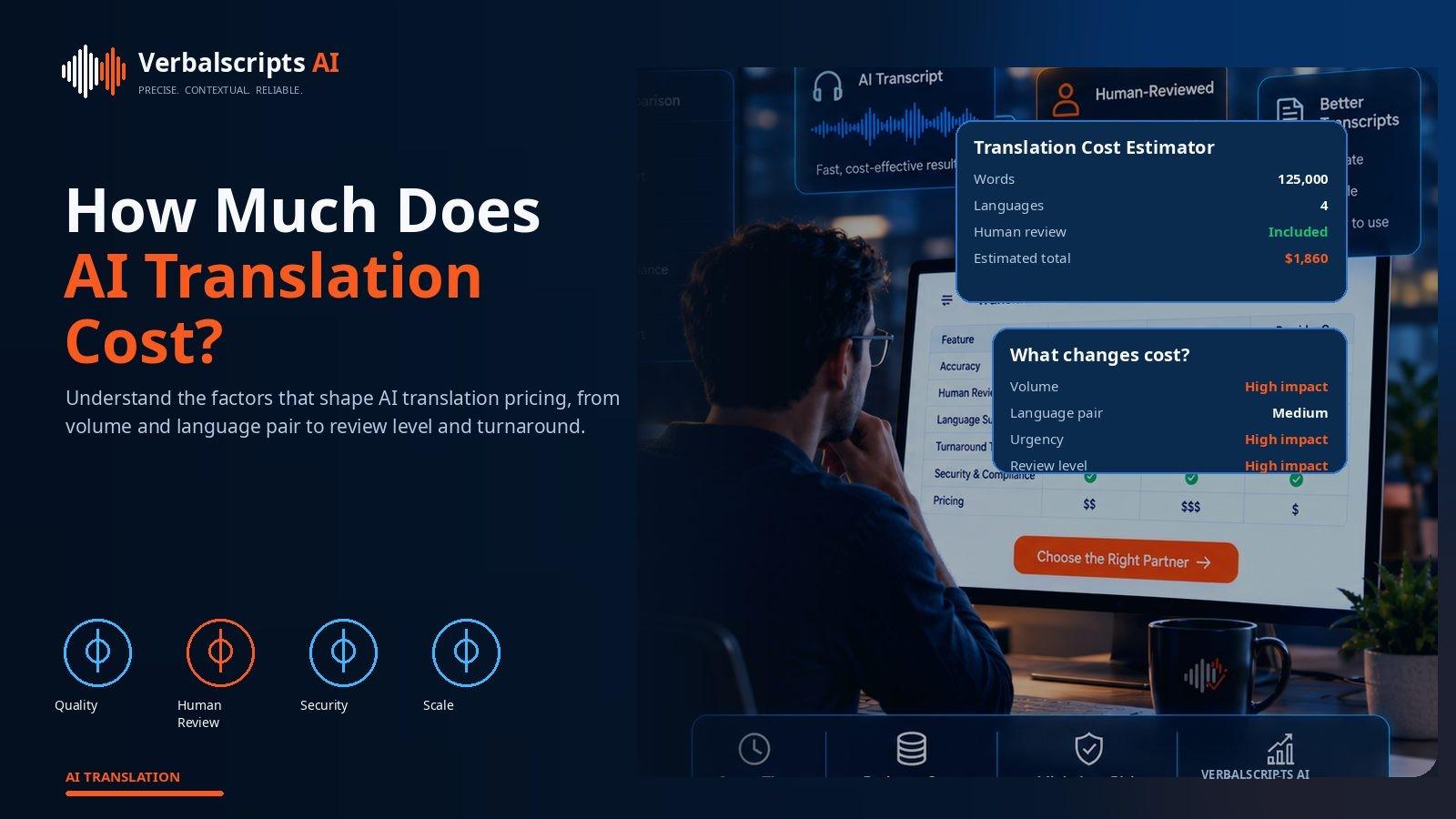
How much does AI translation cost? Raw cloud translation APIs commonly charge by the amount of text processed, often per million characters, while formatted document translation may be billed per page. Human-reviewed AI translation adds reviewer labor and can be priced per word, page, minute or project. Current Google Cloud pricing, for example, lists default NMT text translation after the monthly credit at $20 per million characters and NMT document translation for DOCX/PPT/PDF at $0.08 per page; rates and free tiers can change, so verify the provider’s current page before budgeting.
| SEO title | How Much Does AI Translation Cost? Pricing Explained |
|---|---|
| Slug | how-much-does-ai-translation-cost |
| Meta description | Learn what AI translation costs, how API, document and human-review pricing works, and how to estimate total project cost accurately. |
| Primary keyword | AI translation cost |
| Search intent | Commercial research / Informational |
| Hero image | 161-ai-translation-cost.jpg |
| Hero alt text | AI translation cost calculator showing characters, pages, target languages, human review and total estimated cost |
| Article body words | 1971 |
For production multilingual workflows, see our AI Translation service for the delivery path behind the guidance in this article.
AI translation can cost a fraction of fully manual translation for raw machine output, but the total price of a professional project depends on much more than the model call.
A low-risk API workflow may be billed per million characters. Document translation may be billed per page. Human-reviewed output can be priced per word, page, minute or project. Specialized content, difficult file formats and short turnaround can increase the total.
The right comparison is total cost for the required quality, not the cheapest API rate.
API cost is usually only one part of enterprise translation cost.
Main cost components
A project may include:
- ingestion;
- OCR/transcription;
- AI translation;
- terminology;
- human review;
- formatting;
- QA;
- project management;
- secure infrastructure.
Different projects use different combinations.
Raw text API pricing
Cloud translation providers commonly meter text by characters.
Characters may include:
- letters;
- punctuation;
- spaces.
Google Cloud explains that translation is metered per character/code point and that batch use is multiplied by target language.
AWS Translate currently prices standard and batch translation on a per-character basis as well.
This makes text API costs predictable at scale.
Character versus word
A word is not a fixed number of characters.
English averages may be used for estimates, but other languages differ.
Do not convert characters to words with one universal ratio when a precise API budget matters.
Count actual Unicode characters from representative content.
Multiple target languages
If you translate one million characters into 10 languages, you are effectively processing 10 million source-character translations under many provider billing models.
This is one of the largest scale multipliers.
Budget:
source volume × target languages × model price
Plus human review.
Document pricing
Formatted document translation can be billed differently from text.
Google currently lists per-page pricing for certain DOCX, PPT and PDF document translation using its NMT model.
Other providers may meter characters extracted from documents or bundle features differently.
Document pricing reflects:
- layout processing;
- file reconstruction.
OCR cost
Scanned PDFs may require OCR.
OCR can add:
- provider cost;
- QA time.
If OCR quality is poor, human correction may cost more than the translation model.
Always distinguish:
- native PDF;
- scanned PDF.
Audio translation
Audio workflows may include:
- speech-to-text charge;
- translation charge;
- review.
A 60-minute interview therefore has a different pricing basis from a 20-page report.
The transcript word count and audio quality affect review time.
LLM translation pricing
Some providers now offer translation using LLM-based models.
Google Cloud currently lists Translation LLM pricing using both input and output characters.
This differs from NMT services that may bill only source characters.
When comparing, include both sides where required.
Custom model costs
Custom/adaptive translation can add:
- training;
- examples;
- model hosting/inference.
Google’s current pricing page separately lists custom model/adaptive translation rates.
Customization is worth paying for only if it reduces:
- errors;
- human edits.
Benchmark first.
Human review
Human review is often the biggest cost after automation.
Reviewer effort depends on:
- AI quality;
- domain;
- language;
- format;
- risk.
A reviewer may process thousands of words per hour for strong clean output and much less for poor technical translation.
The review rate should reflect actual effort.
Per-word human-reviewed pricing
Common commercial translation services may quote per source word.
Advantages:
- predictable;
- familiar.
AI-assisted pricing can reduce the rate when machine quality is strong.
But providers should not promise the same rate for every language/domain if review effort differs substantially.
Per-page pricing
Useful for:
- legal documents;
- standardized PDFs;
- certificates.
A page can contain:
- 50 words;
- 700 words.
Define what counts as a page.
For variable documents, per-word may be fairer.
Per-minute pricing
Useful for:
- audio;
- video.
Price may include:
- transcription;
- translation;
- timestamps;
- subtitles.
Poor audio and many speakers raise effort.
Per-project pricing
Best for complex work with:
- multiple file types;
- several targets;
- specialist review.
The provider can quote total scope rather than many unit rates.
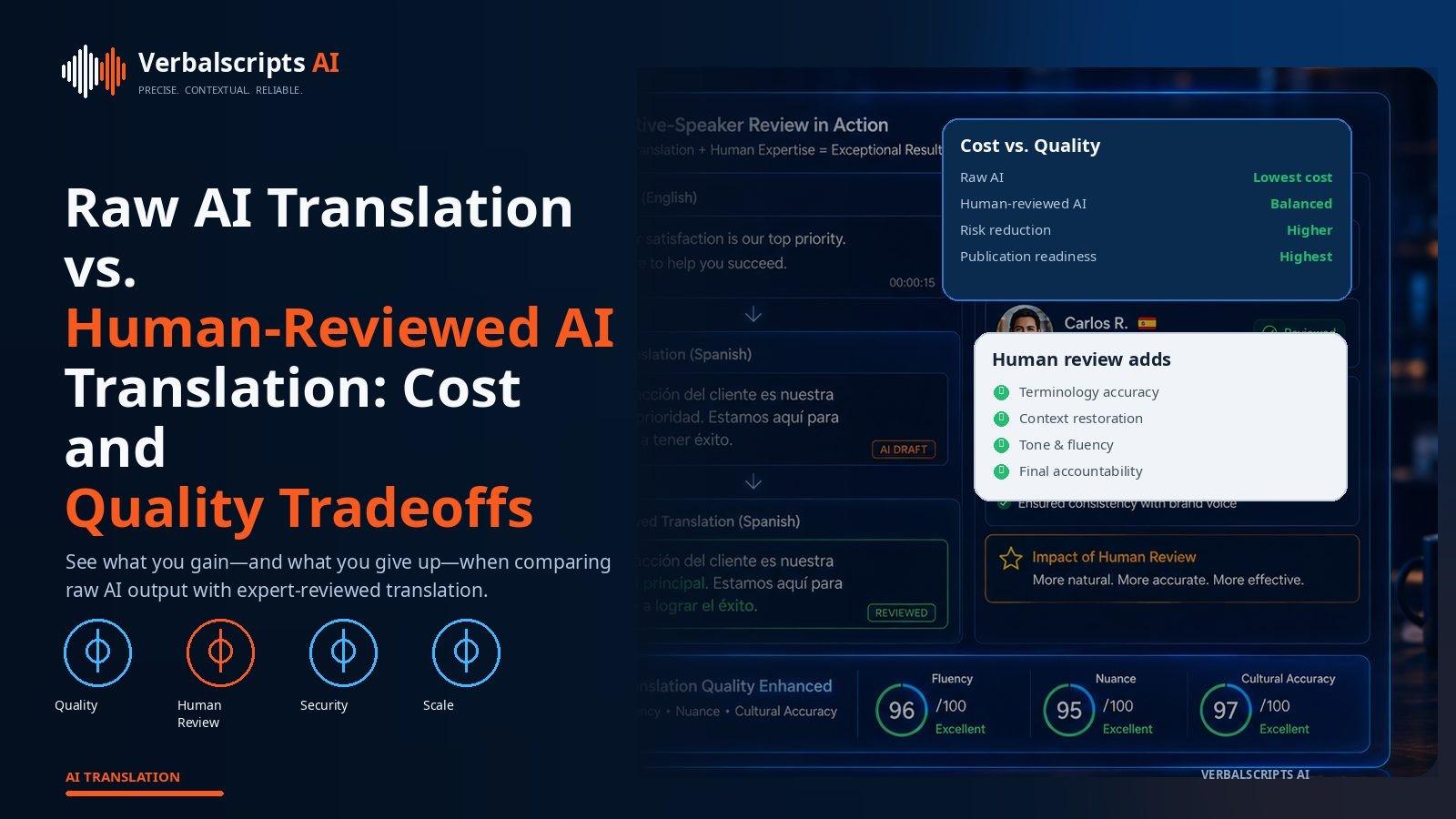
Raw AI versus reviewed cost
Raw AI output may cost pennies per page at cloud scale.
Human-reviewed output can cost orders of magnitude more.
This is not a contradiction.
The human service buys:
- verification;
- terminology;
- accountability;
- formatting.
Choose based on risk.
Project management
Large enterprise work needs:
- file tracking;
- reviewer assignment;
- client communication.
Some vendors include this in the unit price.
Others charge separately.
Ask.
Rush fees
Fast turnaround can require:
- more reviewers;
- overnight/weekend work;
- priority compute.
Rush pricing is normal in human-reviewed workflows.
Raw APIs generally scale differently but still have quotas.
Minimum charges
Small projects may have a minimum because:
- setup;
- billing;
- review;
- delivery
take fixed time.
A two-sentence legal certificate can cost more per word than a 100,000-word batch.
Language pair
Review cost depends on reviewer availability.
High-resource languages may have:
- more linguists;
- stronger AI.
Low-resource languages can cost more because:
- model quality lower;
- reviewer supply smaller.
Domain
Specialized domains require:
- expert terminology;
- specialist review.
Medical/legal/technical can cost more than general content.
Formatting
A simple TXT output is cheaper than:
- bilingual formatted DOCX;
- complex PPTX;
- recreated PDF;
- subtitle file.
Ask whether layout QA is included.
Security
High-security projects may require:
- isolated environment;
- dedicated reviewers;
- custom retention;
- on-prem/private deployment.
Security requirements can add cost.
Total cost of quality
Calculate:
model + engineering + review + rework + failure risk
A cheaper model with higher post-edit cost may be more expensive overall.
Track reviewer edit time by model.
Worked API example
Suppose:
- 5 million source characters;
- 4 target languages.
Billed source volume:
20 million character-translations.
At a hypothetical $20/million:
$400 raw translation.
Human review could be several times higher depending on word count and rate.
Always use current provider pricing.
Worked document example
1,000-page archive into 3 target languages:
3,000 translated pages.
At a hypothetical $0.08/page:
$240 raw document translation.
Add:
- OCR;
- review;
- storage.
Again, current provider terms control.
Cost optimization
Reduce cost with:
- deduplication;
- translation memory;
- caching;
- glossary;
- better source content;
- risk-based review.
Do not translate unchanged content again.
Ask vendors for transparent scope
A quote should specify:
- unit;
- target languages;
- review;
- formatting;
- QA;
- turnaround;
- minimum.
Avoid comparing a raw API quote with a human-reviewed service quote as if they are the same product.
Build a total-cost model before requesting quotes
A useful cost model separates variable and fixed components.
Variable:
- model characters/pages/minutes;
- human review words/minutes;
- target-language count.
Fixed:
- setup;
- terminology preparation;
- project management;
- engineering/integration.
This explains why a very small high-risk project can have a high unit price while a million-word recurring catalog can have a much lower unit cost.
Compare cost per approved word, not cost per generated word
A cheap model that creates 20% reviewer edits can be more expensive than a higher-cost model with 2% edits. Track:
total translation + review cost / final approved source volume
Also track:
- reviewer minutes per 1,000 words;
- critical-error rate.
This converts quality into economics.
Example: raw API versus reviewed service
Suppose 100,000 source words correspond to roughly 600,000 characters, and the content needs five target languages. The raw API volume becomes roughly three million source-character translations. At cloud API rates, the model layer may remain inexpensive.
If every target then receives full human review, reviewer labor dominates the budget. The buyer should therefore ask not only “what is your AI rate?” but “what review level is required for this content and what is the expected edit effort?”
Hidden costs to include
Translation budgets can miss:
- fixing source documents;
- OCR cleanup;
- terminology decisions;
- DTP/layout;
- engineering;
- vendor onboarding;
- security review;
- correction of low-quality output.
These are real project costs even if they do not appear on the provider’s rate card.
When a higher price is rational
Pay more when it buys:
- materially lower review effort;
- domain specialist verification;
- stronger security;
- faster reliable delivery;
- lower critical-error risk.
For a legal filing, saving $50 on raw translation is irrelevant if a mistranslation creates days of rework. Cost should be considered in relation to consequence.
Cost should be modeled by quality tier
One project can have several cost layers:
Tier 1: machine-only: model inference plus engineering/hosting. Tier 2: machine + linguistic review: adds bilingual reviewer labor. Tier 3: specialist-reviewed: adds legal, medical, financial or technical expertise. Tier 4: managed enterprise: may also include project management, security controls, terminology, reporting and SLAs.
When procurement compares quotes, require every provider to identify which tier is being priced. Otherwise a raw API price may appear dramatically cheaper than a service that includes review, formatting and delivery management.
Calculate review cost from measured productivity
Do not assume a universal post-editing rate. Run a pilot and measure reviewer throughput.
For example:
- 8,000 source words/hour for light edits on strong output;
- 3,000 words/hour for full bilingual review;
- 1,200 words/hour for dense specialist content.
Those figures are illustrative only; actual productivity varies by language and domain. Use the pilot to estimate labor, then add reviewer rate and expected revision time.
Cost of bad quality
Translation budgeting should include failure risk. A cheap public translation that causes:
- customer confusion;
- legal rework;
- corrected printing;
- support tickets
can cost far more than the original translation.
This is especially relevant for high-risk content where “cost per word” captures only production expense and not consequence.
Price benchmarking over time
API rates and model offerings change. Store:
- date checked;
- provider;
- model;
- unit;
- free tier;
- volume discount assumptions.
Review the budget at least annually or before large migrations. Do not build a multi-year business case from a screenshot of one provider’s old price table.
Internal chargeback
Large organizations may allocate translation cost to business units by:
- characters/words;
- target-language count;
- reviewer hours;
- project management.
An internal cost model makes demand visible and discourages unnecessary “translate everything into every language” requests while still allowing shared terminology and infrastructure to remain centralized.
Practical buying recommendation
Ask for two numbers:
- raw machine cost;
- expected cost per approved deliverable at your quality tier.
The second number is what the business actually pays to obtain usable multilingual content. A provider that can demonstrate low edit effort and reliable terminology may be more economical even with a higher model rate.
Frequently asked questions
Is AI translation cheaper than human translation?
Raw AI is dramatically cheaper. Human-reviewed AI translation sits between raw machine output and fully manual translation depending on workflow.
How much does Google Translate API cost?
Current Google Cloud pricing varies by method/model; verify its official pricing page because rates can change.
Is pricing per word or character?
APIs often use characters; professional services may use words, pages, minutes or projects.
Why does human review cost so much more?
Because a qualified person checks meaning, terminology and risk rather than only generating text.
How can I reduce translation cost?
Reuse approved translations, deduplicate, control terminology and apply human review according to risk.
Conclusion
AI translation can be extremely inexpensive at the model layer, but professional multilingual work is priced by the quality and operational requirements around the model.
Estimate the true source volume, target count, format, security and review level. Then compare providers on total cost of acceptable quality, not the lowest headline rate.
Research references
- Google Cloud Translation pricing:
- AWS Translate pricing:
- Microsoft Azure Translator pricing: