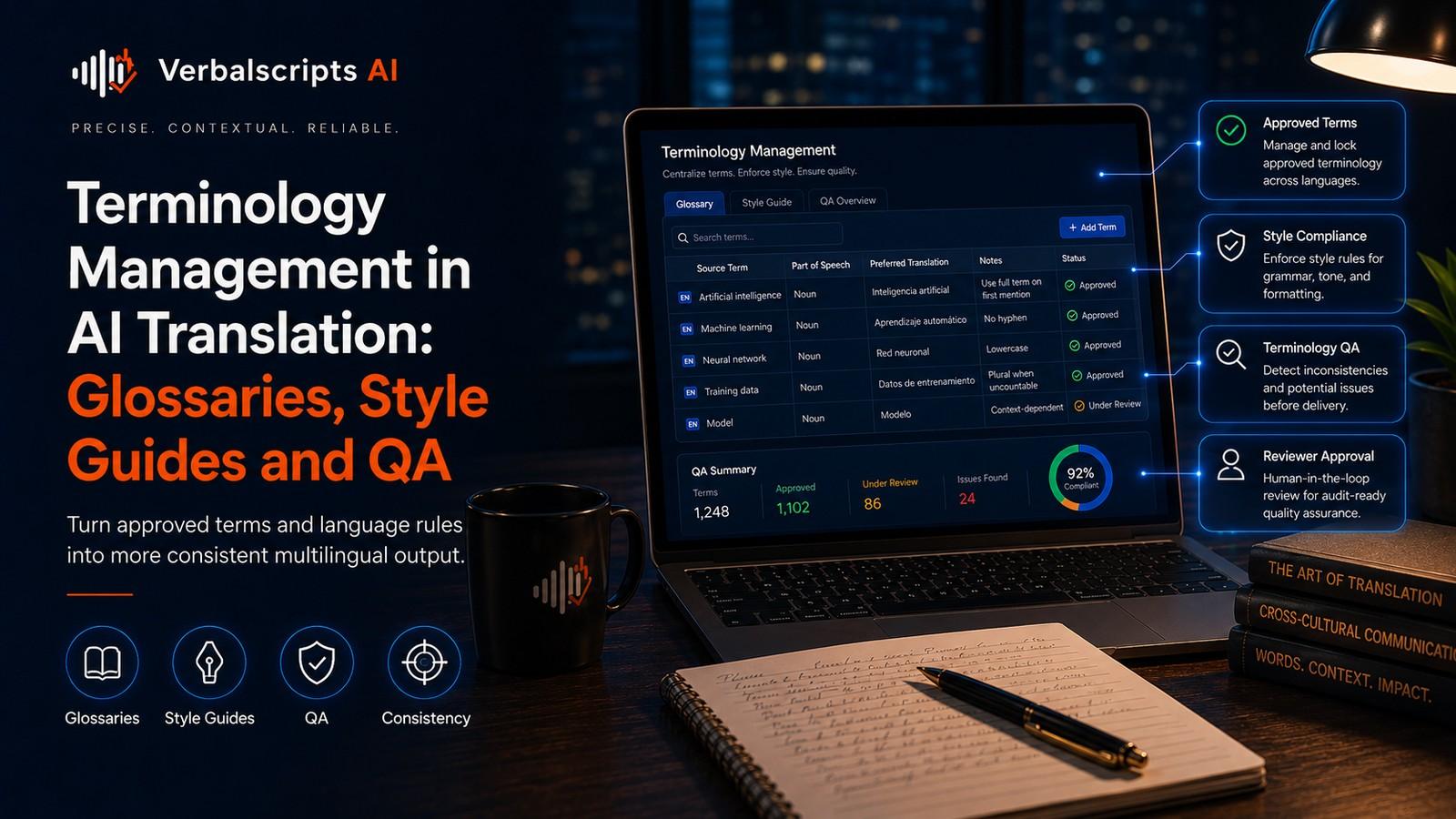
What is terminology management in AI translation? It is the controlled use of approved words and phrases across multilingual content. Teams create a glossary or termbase containing source terms, definitions, target-language equivalents, usage rules and forbidden alternatives. AI translation systems use those resources to guide output, while automated QA and human reviewers verify that terms are used correctly in context.
Consistent terminology is one of the clearest differences between casual translation and a managed multilingual program. A model may be capable of translating a term several different ways and still produce grammatically valid output. An organization, however, often needs one approved form because the term identifies a product, legal concept, technical component, medical procedure or financial category.
For production multilingual workflows, see our AI Translation service for the delivery path behind the guidance in this article.
Terminology management is the process of defining, approving, storing, applying and quality-checking those choices.
A glossary tells the system *what words to use*. A style guide tells writers and reviewers *how to use language around them*. QA confirms that both were followed.
Why terminology matters
Suppose a software company uses “workspace,” “project” and “organization” as three different product concepts. A generic translator might choose target-language synonyms that sound natural but blur the distinctions. The result could confuse users even though no sentence is obviously mistranslated.
In regulated fields, the consequences can be more serious. A financial term may have a recognized statutory translation. A medical term may distinguish two procedures. A legal defined term may need identical wording throughout a contract.
Research from WMT terminology tasks has repeatedly examined this problem because general translation quality does not guarantee correct term usage. Recent work on terminology-constrained translation shows that domain-specific glossaries and targeted post-editing can materially improve the use of required terms.
Glossary, termbase and style guide: what is the difference?
Glossary
A glossary is usually a list of source terms and preferred target equivalents. It may be a spreadsheet or a format supported by a translation platform.
Termbase
A termbase is richer. It can store definitions, subject domains, usage status, grammatical information, context examples, sources, variants and relationships between terms.
Style guide
A style guide governs broader writing choices: tone, formality, punctuation, capitalization, date formats, units, sentence style and market-specific conventions.
All three can work together. The glossary controls the term. The termbase explains it. The style guide controls the surrounding language.
What should a translation glossary contain?
At minimum:
| Field | Purpose |
|---|---|
| Source term | The word or phrase to detect |
| Target term | Approved translation |
| Language / locale | Where the rule applies |
| Status | Approved, deprecated, provisional |
| Do not translate | Yes/no rule |
| Notes | Usage restrictions |
For stronger control, add:
- definition;
- domain;
- part of speech;
- grammatical gender;
- plural form;
- case behavior;
- capitalization;
- acronym;
- context sentence;
- forbidden alternatives;
- owner;
- approval date;
- source of authority.
A term without a definition can still be ambiguous. “Account,” for example, may refer to a user login, a financial account or a customer relationship.
Microsoft’s terminology guidance recommends planning terminology management from the beginning because controlled terms improve product consistency and later localization quality.
How AI systems use glossaries
Different translation systems implement terminology constraints differently.
Some systems perform direct substitution. Others provide glossary entries as context or constraints during generation. Some use customized models, fine-tuning or post-editing.
Google Cloud describes glossaries as custom dictionaries used to translate domain-specific terms and named entities consistently and to prevent selected words or product names from being translated.
LLM-based workflows can also include terminology in prompts or retrieval context. This is flexible, but flexibility creates a governance question: is the model merely being *asked* to use the term, or is compliance actually being checked?
For production systems, terminology enforcement should be verified after generation.
Exact matching is not enough
Languages inflect words. An approved dictionary form may need to change for number, case, gender or agreement.
A simplistic QA check may wrongly flag a correct inflected form as an error. Conversely, exact substitution can produce ungrammatical output.
Terminology systems therefore need a balance between control and linguistic flexibility.
Recent WMT research has highlighted this issue from another angle: human translations can contain legitimate term variation, so a metric that assumes one target string is always correct can over-penalize valid language. The business requirement should determine how strict consistency needs to be.
A legal defined term may require near-absolute consistency. A marketing phrase may allow controlled variants.
Build the glossary before translation
The most efficient time to resolve terminology is before a large translation starts.
A practical preparation process:
1. Extract candidate terms
Collect product names, repeated noun phrases, abbreviations, technical concepts and high-risk language from source content.
2. Prioritize
Do not try to govern every word. Focus on terms where inconsistency creates confusion, risk or extra review work.
3. Define
Write a short definition that distinguishes the intended concept from similar meanings.
4. Translate with subject-matter input
For specialized domains, involve a reviewer who understands the subject, not only the language.
5. Approve
Assign ownership and status. Avoid multiple “preferred” translations without a rule for when each applies.
6. Publish to the translation workflow
Make the termbase available to AI, translators, editors and QA tools.
Domain terminology needs context
Specialized terms are not always globally fixed. A term can have one meaning in finance and another in computing.
For example, “margin” can refer to profit, collateral, page layout or a boundary. A glossary should store the domain and definition so the translation system can disambiguate.
WMT 2023 research on domain terminology integration showed that feeding pre-approved terms into translation and post-editing processes can substantially increase terminology incorporation. The broader lesson is that terminology is not merely a list to check at the end; it can guide generation itself.
Terminology and product design
Terminology management should begin before localization if possible.
If the source product uses three labels for the same feature, translation will multiply that inconsistency. Standardizing source terminology reduces translation cost and improves UX in every language.
A strong source-language termbase also helps:
- support teams;
- technical writers;
- marketing;
- search;
- training data;
- knowledge bases;
- API documentation;
- chatbot responses.
Multilingual terminology is therefore part of information architecture, not just a translation department task.
Style guides prevent “correct but wrong” translations
A glossary might specify the correct word for “subscription,” yet a translation can still be off-brand or inappropriate for the market.
The style guide should cover:
- audience;
- tone;
- formality;
- pronouns and address;
- punctuation;
- capitalization;
- numerals;
- units;
- dates;
- interface conventions;
- treatment of English words;
- transliteration rules;
- inclusive language;
- prohibited wording.
For each target locale, add rules that cannot be generalized from the source language.
Automated terminology QA
Automated checks are excellent at catching repeatable errors.
Useful checks include:
- source term present but approved target missing;
- prohibited target variant found;
- do-not-translate term altered;
- inconsistent capitalization;
- acronym mismatch;
- untranslated text;
- placeholder corruption;
- number mismatch;
- duplicate spaces or punctuation anomalies.
The system should distinguish hard errors from review flags. A forbidden legal term may be a hard error. An alternate marketing synonym may merely require review.
Human terminology review
Automated QA cannot always determine whether the approved term fits the sentence grammatically or semantically.
A human reviewer should verify:
- the correct sense of the source term;
- the correct target term for that sense;
- grammatical integration;
- consistency with surrounding concepts;
- target-market naturalness;
- whether an exception is justified.
Reviewers should have a way to propose glossary updates. Otherwise they will repeatedly correct the same problem outside the system.
Governance: who owns the term?
Terminology programs fail when nobody can decide.
Assign roles such as:
- domain owner;
- language owner;
- localization manager;
- legal approver;
- product owner;
- final terminologist.
Every term should have a lifecycle:
candidate → reviewed → approved → deprecated / replaced
Record why a change was made. That history matters when old documentation, translations and training data still contain a previous term.
Version control matters
If a term changes, which projects should adopt the new form? Immediately? Only new releases? After a legal date?
Versioned glossaries make this explicit. Each translation job can store the terminology version used so the output is reproducible.
This becomes especially important for regulated or audited workflows.
Terminology across 20, 50 or 100 languages
Scale changes the problem. A single spreadsheet becomes difficult to govern when every source term has dozens of target-language entries.
At scale, use:
- a central term ID independent of language;
- locale-specific target entries;
- status and ownership per language;
- definitions shared across languages;
- automated validation;
- API or platform integration;
- change notifications;
- coverage dashboards.
Do not assume a term must exist in every language. Some products launch only in selected markets. Some languages may intentionally retain the English term.
Term extraction with AI
AI can help identify candidate terminology from large corpora by detecting:
- repeated noun phrases;
- unusual technical words;
- capitalized product labels;
- abbreviations;
- phrases that vary across documents;
- concepts associated with a domain.
AI can also propose definitions and initial translations, but those proposals should be treated as candidates until reviewed.
The highest-value use of automation is often prioritization: finding the small set of terms that cause most inconsistency.
Terminology evaluation metrics
For QA, separate terminology performance from general translation quality.
Useful measures include:
Term accuracy: percentage of required terms rendered with an approved acceptable form.
Term consistency: whether the same concept is rendered consistently when the context is equivalent.
Forbidden-term rate: frequency of prohibited variants.
Coverage: percentage of high-priority source terms that have approved target entries.
Exception rate: how often reviewers override the glossary.
An unusually high exception rate may mean the glossary is too rigid or the definitions are inadequate.
A production checklist
Before translation:
- identify target locales;
- freeze or version source terminology;
- approve high-priority terms;
- provide definitions and context;
- define do-not-translate items;
- establish style rules.
During translation:
- make terminology available to the model;
- preserve document context;
- log unmatched terms;
- run automatic checks.
After translation:
- review high-risk terms;
- inspect inconsistent variants;
- approve justified exceptions;
- update glossary entries;
- record the terminology version.
Frequently asked questions
What is a translation glossary?
A translation glossary is a controlled list of source terms and approved target-language equivalents, often with rules about terms that must remain untranslated.
What is the difference between a glossary and a termbase?
A glossary is typically simpler. A termbase stores richer metadata such as definitions, domains, status, grammatical information, examples and ownership.
Can AI follow a glossary automatically?
Many systems can use glossary or terminology constraints, but the implementation varies. Production workflows should still check whether required terms actually appeared and whether they fit the sentence correctly.
How large should a glossary be?
As large as necessary to control meaningful terminology, but not so large that it becomes unmaintainable. Prioritize terms that are frequent, high-risk, product-specific or easily confused.
Who should approve specialized terms?
Ideally both a target-language expert and someone who understands the domain. Legal, medical, scientific and financial terminology often requires subject-matter review.
Conclusion
Terminology management turns translation from a series of isolated language decisions into a controlled multilingual system.
The strongest AI translation workflows use approved terms before generation, verify them after generation and give reviewers a structured way to improve the terminology resource. Glossaries, termbases, style guides and QA are therefore not separate extras. Together, they are the operating layer that makes multilingual output consistent at scale.
Research references
- Microsoft Learn, *Manage terminology*:
- Google Cloud, *Overview of the Cloud Translation API*:
- Moslem et al. (WMT 2023), *Domain Terminology Integration into Machine Translation*:
- Semenov et al. (WMT 2023), *Findings of the WMT 2023 Shared Task on Machine Translation with Terminologies*:
- Dahan et al. (AMTA 2026), *Improving Term Evaluation in Machine Translation: Variation Matters*: