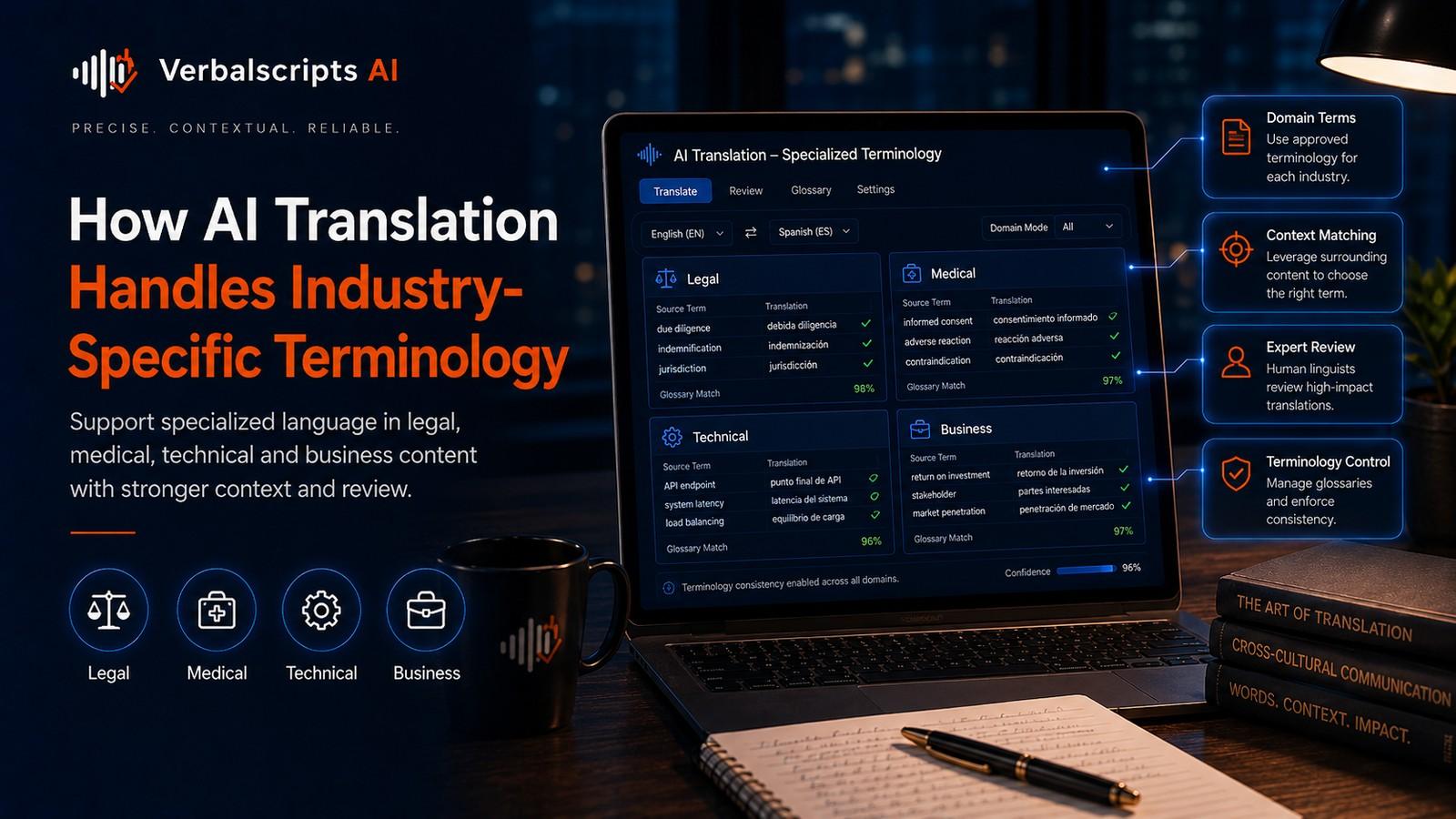
How does AI translate industry-specific terminology? Modern systems infer term meaning from context and domain patterns, while production workflows improve reliability with glossaries, domain-specific examples, retrieval, customized models or post-editing. High-risk fields should add subject-matter human review because a fluent sentence can still contain a technically incorrect term.
Industry terminology is where translation quality becomes operational rather than merely linguistic. In a casual message, a near-synonym may be acceptable. In a contract, clinical document, patent, financial disclosure or engineering manual, the “near” part can be the problem.
For production multilingual workflows, see our AI Translation service for the delivery path behind the guidance in this article.
AI translation can handle specialized terminology well when the system has the right context and terminology resources. It can also produce fluent errors when it does not.
The most important distinction is between general language quality and domain accuracy. They are related, but they are not the same measurement.
Why specialized terminology is difficult
Industry terms create at least five challenges.
One term can have different meanings across domains
“Consideration” in ordinary English differs from its legal use. “Current” means something different to an electrical engineer than to a financial analyst. “Culture” has a specific meaning in microbiology.
Different terms can look interchangeable but are not
A general-language model may prefer stylistic variety. Technical documentation often requires the opposite: controlled repetition.
Accepted terms vary by jurisdiction or market
Legal and regulatory terms may have official translations. Medical terminology may follow national conventions. Accounting vocabulary may depend on the reporting framework.
New terminology appears quickly
Technology, medicine and finance constantly create new product names, abbreviations and concepts.
Context may be distributed across a document
The definition of a term can appear pages earlier. Translating isolated segments removes evidence that a human expert would use.
What research says about terminology
Machine translation research has increasingly evaluated terminology separately from overall translation quality.
A 2024 WMT paper on specialized-domain terminology emphasized that fields such as patents, finance and biomedical content often require agreed translations rather than semantically plausible alternatives. WMT terminology shared tasks have also tested systems with and without terminology support.
A 2025 study of tax and financial education terminology across typologically diverse languages found continuing challenges with specialized terms and highlighted the value of high-quality multilingual terminology resources.
The practical lesson is straightforward: a strong general model is useful, but domain-specific information still matters.
How AI identifies a domain
An AI system can infer domain from several signals:
- document title;
- nearby terminology;
- file metadata;
- client profile;
- surrounding paragraphs;
- provided instructions;
- selected translation model;
- glossary;
- examples or reference documents.
Explicitly telling the system the domain is better than forcing it to infer everything.
“Translate this into French” provides less information than:
“Translate this pharmacovigilance report into French for a regulatory audience. Use the approved medical glossary, preserve product names and do not simplify adverse-event terminology.”
The second instruction constrains the task.
Legal terminology
Legal translation is difficult because the target language may belong to a different legal system. A word that appears equivalent in a bilingual dictionary may not refer to the same legal concept.
Good legal translation workflows therefore use:
- jurisdiction information;
- defined-term lists;
- prior approved documents;
- legal glossaries;
- consistent capitalization;
- clause-level context;
- human legal-linguistic review for high-stakes material.
AI should not silently “normalize” unusual source wording if the wording itself may have legal significance.
Defined terms deserve special protection. If “Services” is capitalized and defined in a contract, the target document should preserve that role consistently.
Medical and life-sciences terminology
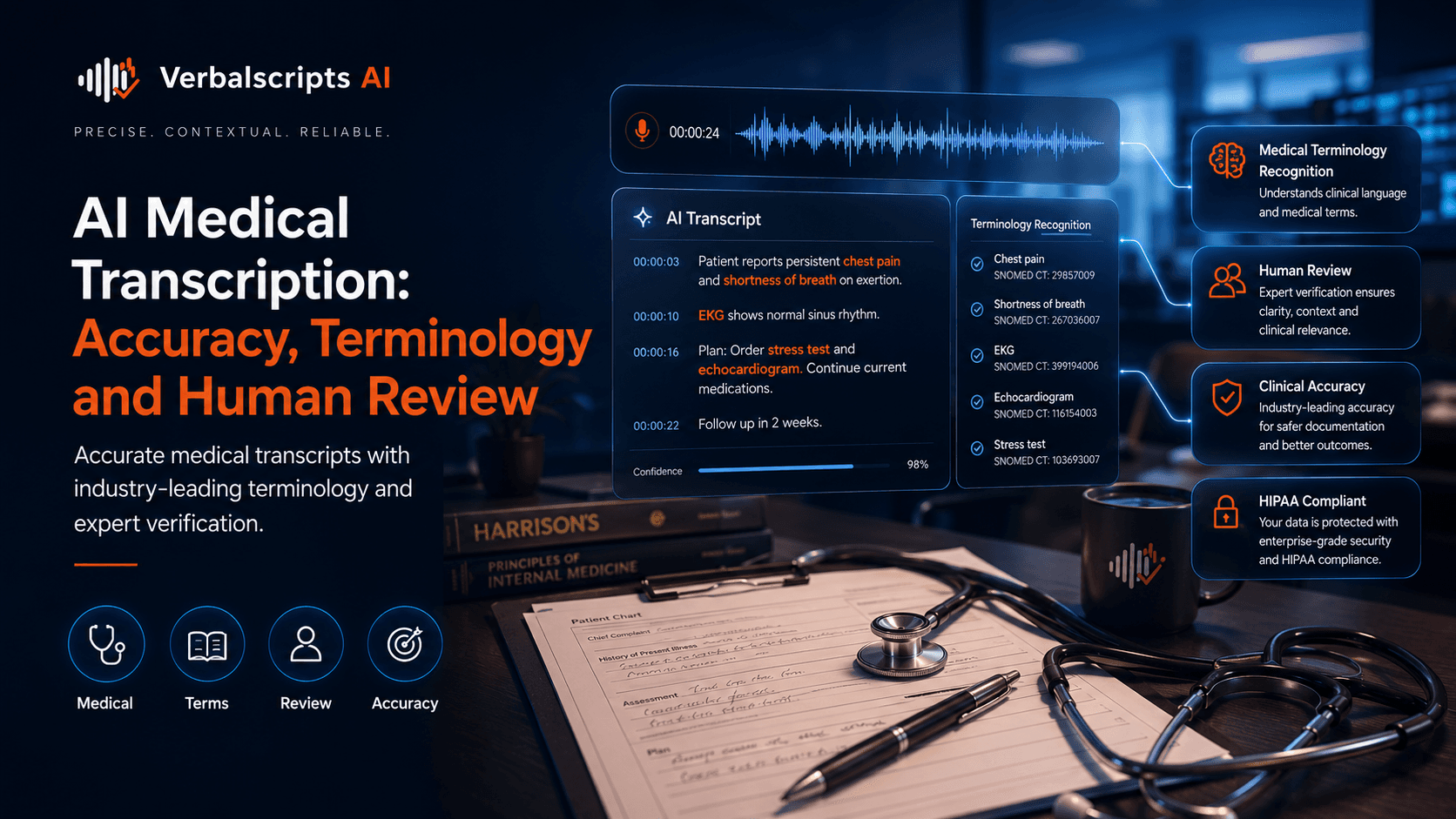
Medical terminology requires both linguistic and clinical precision.
Challenges include:
- drug names;
- active ingredients;
- anatomical terms;
- diagnoses;
- procedure names;
- laboratory abbreviations;
- adverse events;
- dosage expressions;
- units.
A general-language synonym can be unsafe if it changes a clinical distinction.
Translation should also separate what must remain unchanged from what should be localized. Brand drug names may differ by market; generic substance names may follow standardized naming conventions.
High-stakes clinical, patient-facing and regulatory content should be reviewed by qualified humans according to the project’s quality and regulatory requirements.
Financial terminology
Finance combines technical language with extreme sensitivity to numbers.
A finance translation workflow should protect:
- currency values;
- percentages;
- decimal separators;
- dates;
- accounting labels;
- instrument names;
- defined abbreviations;
- legal entity names;
- negative numbers and parentheses;
- table alignment.
The terminology problem is not isolated from formatting. If a translated table moves a number into the wrong row, the language may be perfect and the document still wrong.
Research on multilingual finance translation has found significant relationships between term handling and broader translation quality, reinforcing the need to evaluate financial terminology explicitly.
Engineering and technical documentation
Technical translation often benefits from controlled language because the same component should have the same name every time.
Typical high-priority terms include:
- part names;
- commands;
- interface labels;
- measurements;
- safety terminology;
- material names;
- standards references;
- model identifiers.
Technical manuals also contain cross-references, diagrams and labels. Translating the paragraph but not the figure can create inconsistency.
A termbase should connect component names with definitions and, when useful, images or product taxonomy IDs.
Software and SaaS terminology
Software products have their own vocabulary:
- workspace;
- tenant;
- organization;
- project;
- environment;
- deployment;
- instance;
- role;
- permission;
- integration.
These terms may appear generic, but inside a product they can have specific definitions.
The translation team should align UI strings, help center content, developer docs and marketing. Otherwise one concept can acquire several target-language names depending on which team produced the content.
Patents and intellectual property
Patent translation requires unusual precision because the document’s wording can define scope and technical relationships.
Terminology should be consistent within claims and specifications. At the same time, translators must avoid “improving” ambiguous source language in ways that change interpretation.
AI can assist with first drafts, term extraction and consistency checking, but expert legal/technical review is important for filings and disputes.
Scientific and academic terminology
Scientific fields can contain:
- Latin names;
- mathematical notation;
- standardized symbols;
- field-specific abbreviations;
- chemical names;
- units;
- citation conventions.
The translation workflow must recognize what is language and what is notation.
Equations, code, gene symbols and chemical formulas usually require preservation rather than translation.
Industry glossaries
A domain glossary should include more than a bilingual pair.
Useful fields are:
- source term;
- target term;
- domain and subdomain;
- definition;
- approved context;
- prohibited alternative;
- source authority;
- locale;
- grammatical information;
- abbreviation;
- status.
For example, “bond” in a financial glossary should not be confused with a chemical bond or a legal bail bond.
Retrieval and reference material
Large language model workflows can retrieve relevant terms or approved examples at translation time.
This is useful when the terminology database is too large to include in every prompt. The system can identify relevant concepts and supply only the applicable entries.
Reference retrieval can also include:
- previous approved translations;
- subject-matter notes;
- standard operating procedures;
- product documentation;
- regulatory templates.
The source of each reference should be governed. Unapproved historical translations can propagate old mistakes.
Domain adaptation and customization
Some translation systems allow customized models or fine-tuning using in-domain parallel data. This can improve terminology and style when the data is high quality.
However, customization is not a substitute for terminology governance. The model may learn patterns probabilistically; the organization still needs explicit rules for terms that must be exact.
A good architecture often combines:
strong general model + domain context + terminology constraints + automated QA + human review
rather than expecting one component to solve everything.
Human subject-matter review
Native language fluency does not automatically equal domain expertise.
For specialized material, assign reviewers based on both:
- language competence;
- subject competence.
A target-language attorney and a general translator may notice different problems in a contract. A clinician and a copy editor may notice different problems in patient instructions.
For the highest-risk projects, use layered review: linguistic review first, subject-matter verification second.
How to measure terminology quality
Do not rely only on an overall translation score.
Track:
Term accuracy
Did the output use an approved or acceptable term for each required concept?
Term consistency
Was the concept translated consistently where context was equivalent?
Critical error rate
How many terminology errors could change a legal, clinical, financial or technical interpretation?
Untranslated term rate
Were source-language terms accidentally left in the output?
Reviewer override rate
How often did experts reject the AI’s term choice?
Coverage
What percentage of high-risk source terms are represented in the glossary?
These metrics reveal where to improve the terminology resource rather than blaming the model generically.
A practical domain-translation workflow
Step 1: Classify the content
Record industry, subdomain, jurisdiction, audience, locale and risk.
Step 2: Extract terminology
Use automated extraction plus expert review to identify high-value terms.
Step 3: Build or select the glossary
Include approved terms and do-not-translate rules.
Step 4: Provide reference context
Supply relevant prior translations, definitions and style guidance.
Step 5: Generate the AI draft
Translate in sufficiently large context windows.
Step 6: Run automated checks
Validate numbers, units, terminology, placeholders, formatting and omissions.
Step 7: Human review
Use a linguist and, where needed, a domain specialist.
Step 8: Update the termbase
Convert recurring corrections into controlled terminology.
Risk-based review
Not every specialized document needs the same amount of human intervention.
A useful risk model considers:
- consequence of error;
- public visibility;
- regulatory use;
- novelty of terminology;
- language-resource level;
- source quality;
- document complexity.
An internal engineering note may tolerate post-edited AI output. A clinical consent form should have stricter review.
Common failure patterns
Fluent but technically wrong term
This is the classic specialized-translation failure: the sentence sounds excellent to a non-expert.
Wrong sense of a polysemous term
The system selects a general meaning instead of the domain meaning.
Inconsistent abbreviation
The full term and acronym drift across sections.
Overtranslation
A model translates a code, product name or standardized identifier that should remain unchanged.
Undertranslation
The model leaves a technical phrase in the source language even though an established target term exists.
False precision
The model resolves an ambiguity the source did not resolve.
Frequently asked questions
Is AI accurate enough for technical translation?
It can be highly useful, especially with good terminology resources and well-resourced language pairs, but accuracy should be evaluated for the specific domain and risk level.
Why can a fluent AI translation still be wrong?
Fluency measures whether language sounds natural. Technical accuracy depends on whether specialized concepts were interpreted and rendered correctly.
What is domain adaptation?
Domain adaptation is the process of tailoring a translation system to a specific field using in-domain data, terminology, prompts, retrieval or model customization.
Do I need a subject-matter expert?
For high-risk legal, medical, financial, scientific and engineering content, subject-matter review is strongly advisable. Lower-risk content can use lighter review depending on quality requirements.
What is the best way to improve industry terminology?
Start with a controlled glossary containing definitions and approved target terms, then use QA data and reviewer corrections to expand it over time.
Conclusion
AI translation is strongest in specialized industries when it is not asked to work from language alone.
Domain context, approved terminology, reference material, automated validation and expert review convert a general translation model into a controlled production workflow. The objective is not simply to make the output sound professional. It is to ensure that the technical concepts remain the same across languages.
Research references
- Kim et al. (WMT 2024), *Efficient Terminology Integration for LLM-based Translation in Specialized Domains*:
- Oncevay et al. (EMNLP 2025), *Translating Domain-Specific Terminology in Typologically-Diverse Languages*:
- Oncevay, Smiley & Liu (NAACL 2025), *The Impact of Domain-Specific Terminology on Machine Translation for Finance*:
- Microsoft Learn, *Manage terminology*: