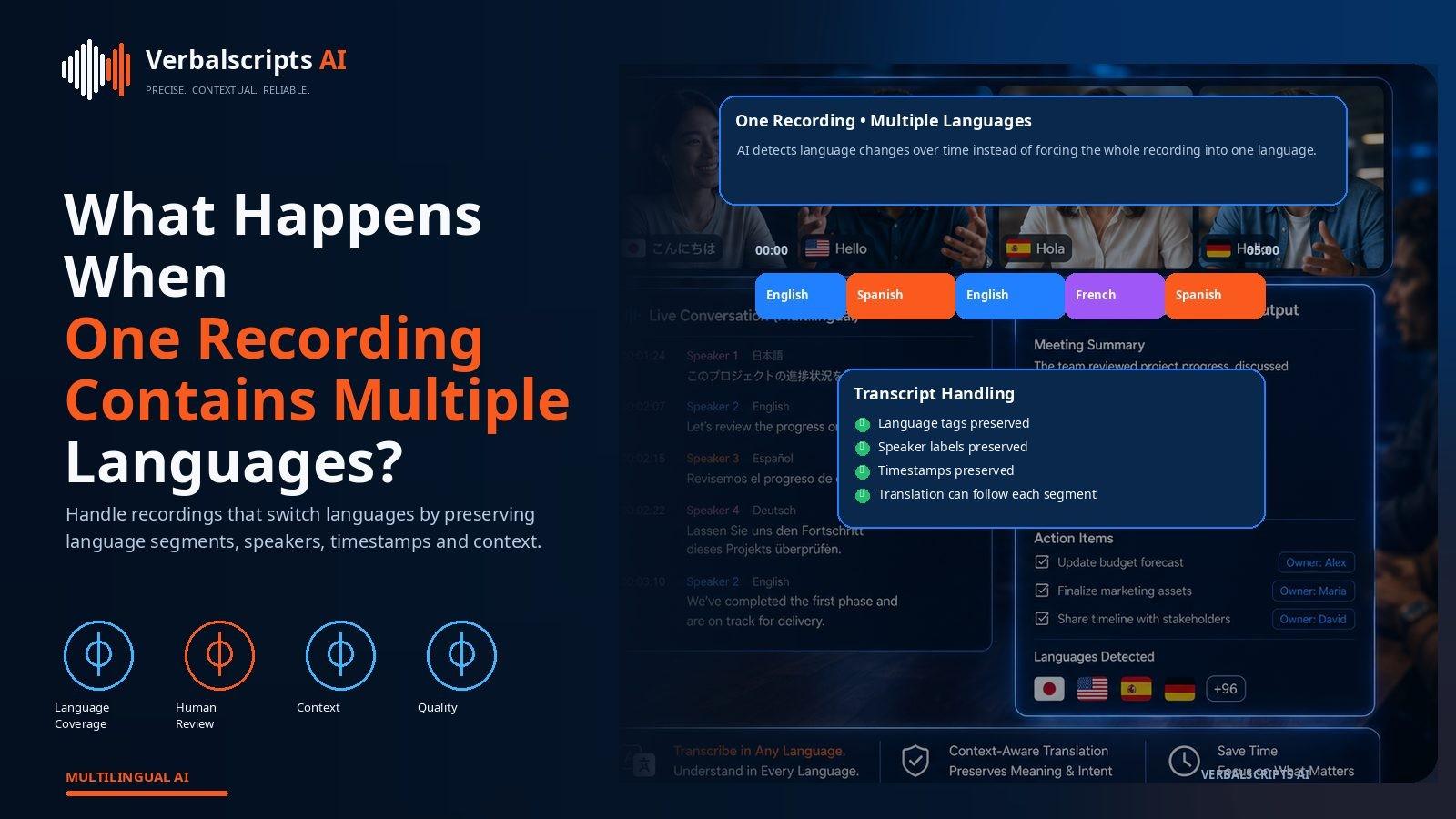
What happens when audio contains multiple languages? A multilingual transcription system must identify which language is active at each relevant segment, transcribe speech using models that support those languages and preserve language changes in the output. If speakers use different languages, diarization plus segment-level LID can work well. If one speaker code-switches inside a sentence, the system needs code-switch-capable multilingual ASR, and accuracy may be lower. Human review is advisable when language boundaries or low-resource terms matter.
| SEO title | What Happens When One Recording Contains Multiple Languages? |
|---|---|
| Slug | recording-contains-multiple-languages |
| Meta description | Learn how AI transcription handles recordings with multiple languages, including speaker-language changes, code-switching, LID, diarization and translation. |
| Primary keyword | multiple languages one recording transcription |
| Search intent | Informational |
| Hero image | 178-recording-multiple-languages.jpg |
| Hero alt text | Audio timeline showing different speakers and language segments labeled across a multilingual recording |
| Article body words | 1948 |
For production multilingual workflows, see our AI Translation service for the delivery path behind the guidance in this article.
Real conversations do not always stay inside one language.
A meeting can begin in English, move to French for one speaker and include Spanish questions. A Kenyan interview may mix English and Swahili inside the same answer. A call may include an interpreter who alternates between two languages.
These recordings require more than ordinary monolingual transcription.
The output should make multilingual structure visible rather than forcing the entire recording into one language label.
Scenario 1: one language per file section
Example:
- first 10 minutes English;
- next 10 Spanish.
This is relatively easy.
Process:
- segment;
- LID;
- ASR.
Language changes are long and clear.
Scenario 2: one language per speaker
Example:
- interviewer English;
- participant French.
Use:
- diarization;
- LID per speaker/turn.
The transcript can label:
INTERVIEWER [EN]
PARTICIPANT [FR]
This is useful for bilingual interviews.
Scenario 3: interpreter
An interpreter alternates:
- source speech;
- target rendition.
The transcript should distinguish:
- original;
- interpreter.
Otherwise content appears duplicated.
For legal/medical interpreting, identify which channel is authoritative according to project requirements.
Scenario 4: code-switching
One speaker says:
“We need to finish the report, lakini deadline imekaribia.”
This mixes English and Swahili.
File-level LID cannot solve it.
The model must recognize multiple languages inside the utterance.
Why code-switching is hard
Multilingual ASR training often contains many languages but mostly monolingual utterances.
Research such as the 2024 DECM benchmark shows state-of-the-art multilingual models still face challenges on code-switched speech.
The issue is not only identifying language; words from each language influence recognition context.
Language boundaries
Where should a language switch be labeled?
Options:
- per segment;
- per word.
A readable transcript usually does not need a language tag on every word.
Research datasets may.
Define output.
Language tags
Use stable tags:
- [EN];
- [SW].
Or BCP 47:
- [en];
- [sw].
If locale matters:
- [fr-CA].
Avoid visually noisy labeling.
Translate everything to one language?
A translated deliverable may normalize all speech into English.
Still retain the original-language transcript if:
- research;
- legal;
- audit.
Otherwise code-switch meaning and source traceability disappear.
Preserve source phrases?
Some phrases may remain untranslated:
- product names;
- quotes;
- terms.
Define policy.
For sociolinguistic research, language switching itself is data.
Language identification
Use continuous or segment LID.
Candidate languages should be known when possible.
A language detector can struggle with embedded short phrases.
Diarization interaction
Diarization separates speakers.
LID identifies language.
Combined metadata can produce:
This is powerful for multilingual meetings.
Multiple ASR models
Architecture:
- diarize;
- detect language;
- send segment to language-specific ASR.
Benefit:
- specialized performance.
Cost:
- routing complexity.
Single multilingual ASR
One model handles all.
Benefit:
- code-switching;
- simple pipeline.
Risk:
- quality variation.
Benchmark.
Language switching latency
In streaming, language may change faster than the detector reacts.
Use:
- continuous LID;
- multi-language model.
Do not switch ASR on one ambiguous word.
Proper names
Names can look like foreign-language words.
Do not classify language solely from names.
Context matters.
Borrowed words
Languages borrow terms.
Example:
- “software” used inside many languages.
This is not necessarily code-switching.
Language annotation guidelines should distinguish borrowing from active switch if research requires.
Transcription normalization
Should the transcript keep:
- original script?
Usually yes.
Example:
Arabic words should not automatically be Latin-transliterated unless required.
Preserve native script for source fidelity.
Translation
After multilingual transcription:
- translate each segment to target.
Use one shared context.
The translator should know when target phrase was originally a code-switch.
This can affect tone.
Quality review
A reviewer should understand:
- languages present.
For three-language recordings, one person may not cover all.
Use multiple reviewers.
Low-resource language segments
A small portion of recording may use a low-resource language.
AI can fail specifically there while English segments are excellent.
Quality sampling must cover each language.
Metrics
Calculate:
- WER per language;
- LID F1;
- code-switch boundary accuracy.
Overall WER can hide minority-language failures.
Storage model
Store language on each segment.
Example JSON:
- speaker;
- language;
- text;
- start/end.
This supports later translation.
Search
Multilingual transcripts can support search across:
- original text;
- translated text.
Index both.
Privacy
Language labels can sometimes correlate with identity/ethnicity.
Treat language metadata respectfully and only collect what is needed.
Do not infer protected identity from speech language.
Common failures
Dominant-language bias
System forces minority words into dominant language.
Switch missed
Short phrase mistranscribed.
Over-detection
Borrowed word triggers language switch.
Speaker/language confusion
Interpreter text attributed to original speaker.
Example transcript representation
A multilingual meeting can be stored as:
| Time | Speaker | Language | Source text | English translation |
|---|---|---|---|---|
| 00:10 | A | en | ... | ... |
| 00:18 | B | fr | ... | ... |
| 00:35 | B | fr/en | ... | ... |
This keeps language metadata available even when the final reader primarily consumes the English translation.
Decide whether language changes are semantically meaningful
In some settings, language switching is incidental. In others it signals:
- quotation;
- emphasis;
- identity;
- change of audience.
Research and legal teams may need the original language pattern preserved. Internal meeting minutes may not.
The transcript specification should state this explicitly.
Multilingual reviewer orchestration
A three-language recording may require several reviewers. Use shared segment IDs and allow each reviewer to approve only the language they are qualified for. A final editor then checks continuity.
This is safer than asking one reviewer to guess unfamiliar passages.
Reprocessing minority-language segments
If 95% of a recording is English and 5% is an underrepresented language, a global quality score can look strong while the minority portion fails. Route those spans through a specialist model or native reviewer.
The system should preserve language distribution and quality by language.
Search across multilingual transcripts
Index:
- original-language text;
- optional transliteration;
- target translation.
A user can search an English concept and find a Swahili source passage through the translated index while still opening the original audio/transcript.
This turns language-aware transcription into multilingual knowledge infrastructure rather than a one-time file.
Recording-level versus utterance-level language metadata
A single recording can have:
- primary language;
- additional languages.
Store both.
Example:
- primary: English;
- additional: French, Swahili;
- segments: language-tagged.
This supports search and routing without pretending every file is monolingual.
Translator workflow for mixed-source recordings
When creating one English target from several source languages, a translation coordinator can:
- source-review each language span;
- align them to shared speaker/timestamp IDs;
- translate all into English;
- run one final target-only edit for continuity.
This prevents the final transcript from reading like fragments produced by several independent translators.
Interpreters and repeated meaning
Interpreter-mediated recordings contain repeated semantic content. Decide whether the final target:
- includes both original and interpreted rendition;
- includes only one;
- preserves both but labels them.
For research/legal work, retaining both can be useful. For ordinary readable minutes, including both may feel duplicated.
Quality weighting for minority-language spans
If a 60-minute file contains only 90 seconds of a second language, manually inspect those 90 seconds. They are too small to be represented reliably by random whole-file sampling and often receive the weakest model coverage.
Language-sensitive search
An indexed transcript can allow filters such as:
- show original French segments;
- search English translations;
- find code-switch moments.
This is useful for qualitative research, customer insights and language-model dataset creation.
Editorial transparency
If the final published transcript translates all languages into one target, consider a short note:
Portions of the interview were conducted in multiple languages and translated for readability.
This preserves transparency without cluttering every sentence with language tags.
Multiple languages and document-style output
A polished transcript can use subtle language labels rather than inserting tags in every line. For example, a heading can note:
Language changes are marked at the beginning of each affected speaker turn.
This keeps the document readable while preserving multilingual evidence.
Translation-quality dependency
When one language is weaker in ASR, the translated target will be weakest in exactly those segments. A target-only reviewer may see fluent but incorrect output and not know which source sections deserve attention.
Carry ASR confidence and source-language metadata into the translation review UI.
Cross-language names
A person may pronounce their name according to one language while the official spelling comes from another script. Verify the name against project metadata rather than treating it as a language-detection clue.
Mixed-language subtitles
If a source video intentionally alternates languages and the target audience understands one of them, you may translate only the other language. This is a localization choice, not a technical limitation.
The subtitle spec should state:
- which source languages are translated;
- which are preserved;
- how language switches are indicated.
Archive analytics
For multilingual recordings, language-distribution statistics can help allocate reviewer resources:
- hours of English;
- hours of Swahili;
- code-switched minutes.
Use these operational statistics without inferring personal identity about speakers.
Multilingual completeness check
Count speech duration or segments by language before and after transcription. If the raw recording contains 12 minutes of French but the final transcript contains only a handful of French-labeled segments, investigate whether the ASR dropped or normalized that portion.
This kind of language-distribution check is a simple way to catch dominant-language bias in long recordings.
Final principle
One recording can have one file ID and many language labels. Preserve that complexity in the data even if the final reader sees a simplified single-language translation.
Human-readable final transcripts
Even when the backend stores detailed language metadata, the final client transcript should remain easy to read. Use language labels only where they clarify meaning, maintain consistent speaker formatting and avoid technical LID confidence scores unless the client needs them for analysis.
Final QA rule
When a recording is multilingual, no language should disappear silently from the final source record.
Implementation takeaway
For production use, treat language-distribution checks, minority-language review and readable final output as measurable parts of the workflow rather than assumptions. Define the relevant policy before processing content, keep the model or data configuration versioned, and verify results on representative material from the actual language, locale and domain. If automation produces a result that conflicts with a deterministic rule, authoritative terminology or qualified human evidence, escalate the item instead of averaging the disagreement away. The most durable multilingual systems preserve source-to-target traceability, record exceptions and feed reviewed corrections back into benchmarks, glossaries or routing rules. That discipline makes quality improvements reproducible when models, providers, reviewers or source content change.
Frequently asked questions
Can one ASR model transcribe several languages?
Many multilingual models can, but code-switch performance varies.
Should language tags appear in the transcript?
If they help users or analysis. Not every consumer transcript needs them.
Does code-switching mean the speaker is confused?
No. It is a normal linguistic practice in multilingual communities.
Can AI translate mixed-language audio directly?
Yes, but a structured source transcript makes review easier.
How should quality be measured?
Per language and on code-switch segments, not only overall.
Conclusion
A multilingual recording should be treated as a sequence of language events, not forced into one language label.
Use diarization, language identification and multilingual ASR at the right granularity. Preserve original language and script, then translate with context.
The hardest part is code-switching, where language boundaries are short and intertwined. That is precisely where careful evaluation and human review add the most value.
Research references
- DECM code-switching ASR benchmark:
- Burchell et al., Code-Switched LID:
- Dhawan et al., Unified Code-Switch ASR/LID:
- Google Speech-to-Text language detection: