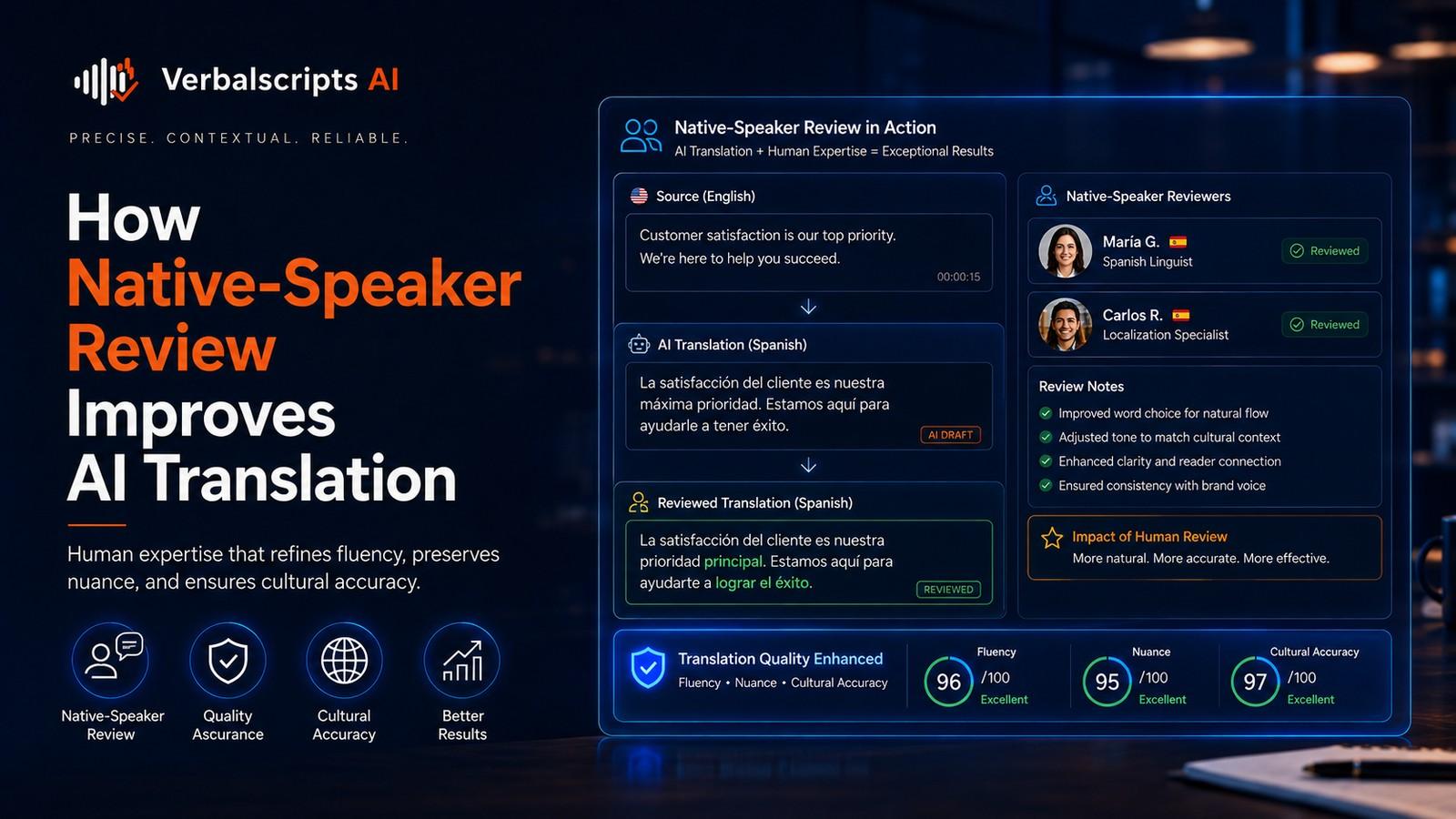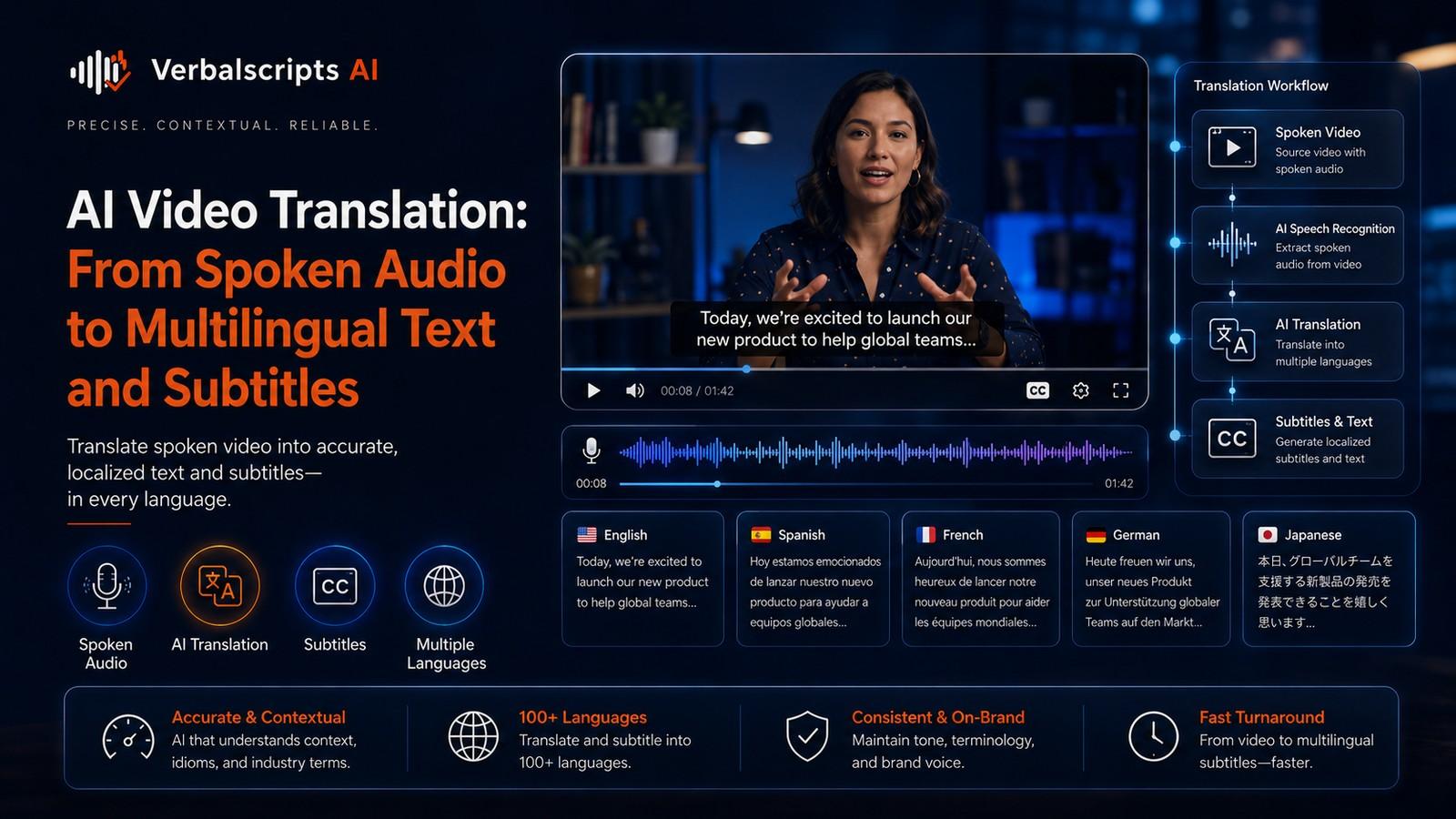
How do you evaluate cultural fit in AI-translated content? Identify culture-sensitive elements in the source, define the target locale and audience, then have in-market reviewers score whether the translation preserves meaning while sounding appropriate and understandable. Evaluate idioms, references, politeness, humor, examples and potentially sensitive content separately. For important marketing or public-facing content, supplement expert review with user or market feedback.
| SEO title | How to Evaluate Cultural Fit in AI-Translated Content |
|---|---|
| Slug | evaluate-cultural-fit-ai-translated-content |
| Meta description | Learn how to evaluate cultural fit in AI-translated content using locale review, cultural-item analysis, audience testing and structured scoring. |
| Primary keyword | cultural fit AI translation |
| Search intent | Informational / Localization |
| Hero image | 148-cultural-fit-ai-translation.jpg |
| Hero alt text | Cultural translation review interface comparing idioms, local references, formality and target-market reviewer scores |
| Article body words | 1973 |
For production multilingual workflows, see our AI Translation service for the delivery path behind the guidance in this article.
A translation can be grammatically perfect and culturally wrong.
The target wording may use an unfamiliar idiom, an inappropriate level of formality or a reference that has different associations in the target market. The problem is difficult to detect with ordinary automatic metrics because cultural fit is partly about what the content does to a reader, not only whether the source meaning survives.
Cultural evaluation therefore needs its own framework.
Recent ACL 2026 research on culture-aware machine translation found that models can recognize cultural information without consistently applying that knowledge correctly during translation. This is why cultural fit should be tested rather than assumed.
What cultural fit means
Cultural fit does not mean changing every source reference into a local one.
It means the target-language choice is appropriate for:
- audience;
- purpose;
- content type;
- locale.
Sometimes cultural fit requires preserving the original reference with explanation.
Sometimes it requires substitution.
Sometimes literal translation works.
The correct strategy depends on function.
Culture-specific items
Potential culture-specific items include:
- food;
- holidays;
- institutions;
- historical references;
- idioms;
- brands;
- social customs;
- forms of address;
- humor;
- units;
- sports;
- media references.
A cultural-review system should first identify these items.
Literal translation can fail
Source:
“It was a Hail Mary pass.”
A literal translation may confuse readers unfamiliar with American football.
Possible strategies:
- target-language sports metaphor;
- plain paraphrase;
- preserve phrase plus explanation.
Evaluation asks whether the chosen strategy communicates the intended effect.
Cultural preservation versus domestication
Translation theory often distinguishes strategies that keep source-culture markers from those that adapt more strongly to target culture.
For business localization, neither extreme is always correct.
A travel article about Japan should not erase Japanese culture.
An American tax metaphor in a global software onboarding flow may be unnecessary.
The project brief should specify how much adaptation is acceptable.
Locale definition
Culture cannot be evaluated against a vague target like “Spanish.”
Review should know:
- Spain;
- Mexico;
- Argentina;
- US Spanish;
- Latin American neutral.
Regional norms affect:
- vocabulary;
- formality;
- humor;
- cultural reference.
Audience matters
The same locale can contain multiple audiences.
A teen social-media campaign and a government tax notice need different cultural expectations.
Record:
- age;
- profession;
- subject familiarity;
- relationship to brand;
- reading context.
Cultural fit is audience-specific.
Formality
Formality is one of the clearest cultural dimensions.
Some languages require formal/informal pronoun choices.
Even within the same language, customer-service expectations differ by region.
Review:
- pronouns;
- titles;
- greetings;
- requests;
- imperatives.
An AI system may produce grammatically valid language that creates the wrong social distance.
Humor
Humor is highly culture dependent.
Evaluate whether:
- joke is understandable;
- punch line survives;
- reference is recognizable;
- translated wordplay works.
For marketing or entertainment, human creative review is often necessary.
A translation that explains a joke perfectly may no longer be funny.
Idioms
Common idioms may have equivalents.
Rare idioms may require paraphrase.
A cultural-fit reviewer should judge:
- meaning;
- naturalness;
- register;
- familiarity.
Do not reward a target idiom merely because it is “local” if it changes meaning.
Brand voice
Brand voice intersects culture.
A global company might aim to be:
- confident;
- friendly;
- direct.
In one market, direct imperatives may feel normal.
In another, they may feel aggressive.
Local brand voice is a relationship, not a word-by-word property.
Images and symbols
Cultural localization goes beyond text.
Review:
- imagery;
- gestures;
- flags;
- maps;
- icons;
- colors.
AI text translation cannot resolve a problematic visual.
A full localization review should include the rendered page or campaign.
Sensitive topics
Culture-aware QA should flag topics such as:
- religion;
- politics;
- identity;
- historical conflict;
- health;
- death;
- sexuality.
The goal is not censorship. It is to recognize where context and wording require additional care.
Culture-aware MT research
The ACL 2026 CanMT research introduced a benchmark and multidimensional framework for culture-aware translation.
It found:
- substantial model differences;
- strategy-dependent outcomes;
- different difficulty across cultural item types;
- a gap between cultural knowledge and correct translation use.
It also found reference translations improved LLM-based evaluation reliability.
This supports a structured human-plus-AI evaluation design.
Cultural-fit rubric
A practical rubric can score:
Meaning fidelity: 0–5
Is the source meaning preserved?
Cultural comprehensibility: 0–5
Will the audience understand the reference?
Naturalness: 0–5
Does the phrasing feel native?
Social appropriateness: 0–5
Is formality/tone appropriate?
Adaptation restraint: 0–5
Did the translation avoid unnecessary cultural rewriting?
This last dimension is important. Over-localization can be just as damaging as literalness.
Error severity
Minor
Slightly unfamiliar phrase.
Major
Cultural mismatch harms comprehension or brand tone.
Critical
Content becomes offensive, legally problematic or dangerously misleading.
Severity depends on context.
In-market reviewers
An in-market reviewer should ideally:
- use the target language daily;
- understand the audience;
- understand the content purpose.
A native speaker living elsewhere can still be highly qualified, but market exposure matters for fast-changing slang and commercial language.
Reviewer instructions
Avoid asking:
“Does this sound culturally appropriate?”
Instead ask concrete questions:
- Is any source reference unclear?
- Is the level of formality right?
- Would a local reader interpret the joke as intended?
- Does any phrase have a negative unintended meaning?
- Should any item remain in the source culture?
Structured questions produce better feedback.
User testing
For flagship campaigns, test with target users.
Possible methods:
- comprehension interviews;
- A/B testing;
- survey ratings;
- moderated usability tests.
Behavioral evidence can reveal problems that translators do not predict.
Search behavior
Cultural fit affects search language.
Users may search for local concepts rather than literal translations.
SEO localization should therefore use:
- local keyword research;
- search-console data;
- local competitor vocabulary.
Do not treat a translated keyword list as cultural validation.
LLM-as-a-judge for culture
LLM judges can help flag:
- culture-specific items;
- literal idioms;
- potential formality problems.
They should not be the only cultural judge.
The same model family may share cultural blind spots with the translation model.
Use references and human calibration.
Cultural QA at scale
For hundreds of thousands of words:
- detect likely cultural items automatically;
- route high-risk items to in-market review;
- sample routine content;
- maintain locale issue logs;
- update style guides.
This keeps cultural QA manageable.
Documenting localization decisions
Store recurring decisions such as:
- formal pronoun;
- treatment of holidays;
- units;
- common idioms;
- brand humor policy.
This makes future AI output more consistent.
Example: cultural fit in a customer-support message
Source:
“No worries. We’ve got you covered.”
A literal target may preserve the positive meaning but sound too casual for a banking customer in a market where service language is normally formal. A culturally appropriate version can remain reassuring without reproducing the exact idiom.
The reviewer should score both fidelity and social appropriateness. Replacing the message with an unrelated local proverb would be over-localization; keeping an unfamiliar idiom would be under-localization. Cultural quality often lies between those extremes.
Build a cultural-item inventory
For recurring content, tag source elements that commonly need cultural decisions:
- humor;
- sport metaphors;
- holiday references;
- food;
- education systems;
- measurement conventions;
- forms of address;
- historical references.
The localization system can route these items to a stronger model or an in-market reviewer rather than treating every sentence as equally culture-sensitive.
Avoid stereotyping in cultural adaptation
Culture-aware translation should not reduce a market to clichés. Do not automatically replace examples with stereotyped foods, clothing or holidays simply because they are associated with a country.
The adaptation should be justified by the content’s purpose. When an original reference is relevant and understandable, preserving it can be more respectful than forcing a “local” substitute.
Cultural QA evidence
For high-value campaigns, maintain a decision log explaining why major adaptations were made. This is particularly useful when global brand teams review local copy and ask why the target differs substantially from the source.
The evidence can include:
- target-audience rationale;
- approved alternative;
- user-test result;
- market owner approval.
This turns cultural adaptation into a governed business decision rather than subjective rewriting.
Cultural fit in regulated and factual content
Cultural adaptation should be more conservative when the source is regulated, evidentiary or factual. A patient instruction can use locally understandable language, but a reviewer should not replace a clinical example with a culturally familiar one if that changes the medical meaning. A government notice can adopt local terminology but must not alter eligibility requirements.
Create an adaptation scale:
- Level 0: faithful translation only;
- Level 1: locale conventions and natural register;
- Level 2: examples/idioms may be adapted;
- Level 3: creative transcreation permitted.
Assign the level by content type before translation begins.
Cross-market comparison
For global campaigns, review equivalent target versions together at concept level. Ask whether every locale communicates the same core promise even if the wording differs substantially. This prevents one market from receiving a much stronger or weaker claim because a translator or model “localized” too creatively.
A simple matrix can compare:
- offer;
- urgency;
- proof point;
- CTA;
- tone.
The words need not match, but the commercial meaning should.
Cultural issue logs
Maintain a locale-specific issue log with recurring decisions such as:
- preferred formality;
- sensitive historical terminology;
- whether English tech terms are normally retained;
- holiday references that should be avoided;
- local units.
This becomes a practical source of retrieval context for future AI jobs and reduces dependence on individual reviewer memory.
When user testing is worth the cost
Human linguistic review is usually enough for routine content. User testing becomes especially valuable when:
- the campaign is expensive;
- humor or identity is central;
- a new market is launching;
- prior research shows low comprehension;
- the wording affects a major conversion flow.
A five-person moderated review can reveal misunderstandings that hundreds of automated language scores cannot see.
Final cultural sign-off
For flagship content, record the locale owner who approves the final adaptation and the adaptation level used. That small piece of governance makes future updates much easier because the next reviewer can see whether the previous wording was intentionally localized or merely translated.
Implementation takeaway
For production use, treat locale-owner approval, cultural evidence and adaptation boundaries as measurable parts of the workflow rather than assumptions. Define the relevant policy before processing content, keep the model or data configuration versioned, and verify results on representative material from the actual language, locale and domain. If automation produces a result that conflicts with a deterministic rule, authoritative terminology or qualified human evidence, escalate the item instead of averaging the disagreement away. The most durable multilingual systems preserve source-to-target traceability, record exceptions and feed reviewed corrections back into benchmarks, glossaries or routing rules. That discipline makes quality improvements reproducible when models, providers, reviewers or source content change.
Frequently asked questions
Can cultural fit be measured automatically?
Partly. AI can identify candidate issues and score them, but human in-market review remains important.
Is cultural adaptation always necessary?
No. Sometimes preserving the source culture is the correct choice.
What content needs cultural review most?
Marketing, public communication, entertainment, education and culturally specific source material.
Can reference translations help cultural evaluation?
Yes. Recent research found references improved LLM-as-a-judge reliability for culture-aware MT.
Is native-speaker review enough?
It is strong, but the reviewer should also understand the target market and content purpose.
Conclusion
Cultural fit is a quality dimension that begins where literal accuracy ends.
Define the locale and audience, identify culture-sensitive items, use a structured review rubric and bring in in-market judgment for high-impact content. AI can help detect and propose adaptations, but cultural quality ultimately depends on whether real target users understand and receive the message as intended.
Research references
- Yuan et al., Culture-Aware Machine Translation in LLMs (ACL 2026):
- Microsoft Learn, Localization overview:
- W3C, Localization vs. Internationalization: