What is the difference between translation and localization? Translation focuses on transferring meaning from a source language into a target language. Localization is broader: it adapts language plus market-specific conventions, terminology, formats, user experience, visual design and cultural context. AI can automate much of the translation and many rule-based localization tasks, but human judgment remains important for cultural fit, brand voice, high-risk content, market strategy and quality approval.
| SEO title | Translation vs. Localization: What AI Can and Cannot Automate |
|---|---|
| Slug | translation-vs-localization-ai-automation |
| Meta description | Understand translation vs. localization, what AI can automate, what still needs human judgment, and how to build a reliable multilingual workflow. |
| Primary keyword | translation vs localization |
| Search intent | Informational / Commercial research |
| Hero image | 141-translation-vs-localization-ai-automation.jpg |
| Hero alt text | AI localization workspace comparing direct translation with locale-specific adaptation of language, dates, currency and interface content |
| Article body words | 2156 |
For production multilingual workflows, see our AI Translation service for the delivery path behind the guidance in this article.
Translation and localization are closely related, but they are not the same task. Translation changes language. Localization adapts a product, document, website, interface or media experience so that it works for a particular audience, market or locale.
That distinction matters more in the age of AI because modern systems can translate enormous amounts of text in seconds. Fast translation does not automatically produce a fully localized product. A page can be perfectly translated and still show the wrong currency, use unfamiliar date formats, contain culturally inappropriate examples, break in a right-to-left layout or send customers to a source-language checkout.
W3C defines localization as adapting a product, application or document to meet the language, cultural and other requirements of a target market. Microsoft likewise emphasizes that localization includes translation but also covers formats, conventions, content preparation, validation and delivery.
Translation is primarily a language transformation
A translation workflow asks questions such as:
- What does this sentence mean?
- What is the correct target-language equivalent?
- Is the terminology accurate?
- Is the grammar natural?
- Is anything omitted or added?
Examples include translating:
- a contract from English to French;
- product documentation from German to Japanese;
- an interview transcript from Swahili to English;
- a website article from Spanish to Portuguese.
AI is now extremely capable at this core language transformation for many common language pairs.
Localization is a market adaptation process
Localization asks additional questions:
- Which locale is the content for?
- How should dates, numbers and currencies be displayed?
- Is the tone appropriate for that market?
- Should examples change?
- Does the layout support the target script?
- Are forms suitable for local addresses and phone numbers?
- Should a product name remain untranslated?
- Are legal notices correct for the market?
- Does the localized page use the terminology local users actually search for?
The language is only one part of the experience.
A simple example
Suppose a US ecommerce page says:
“Get free shipping on orders over $50. Offer ends 9/10.”
A direct French translation can preserve those words, but a localized French-market version may also need to decide:
- whether the offer applies in France;
- whether the threshold should still be USD 50;
- whether the date means September 10 or October 9;
- whether local delivery terms differ;
- whether the promotion is legally valid in that market;
- whether the CTA sounds natural in French.
AI can translate the sentence. Localization requires product, commercial and market context.
Locale is more than language
A locale represents a set of regional and cultural preferences. W3C notes that locale behavior can affect dates, times, numbers, sorting, currencies and other conventions.
Consider English:
- en-US
- en-GB
- en-CA
- en-AU
All use English, but they differ in spelling, dates, units and other conventions.
Spanish has even broader regional variation. “Spanish” alone may be insufficient for:
- product copy;
- customer support;
- legal content;
- search optimization;
- forms.
A mature localization workflow records both language and locale.
What AI can automate well
1. First-pass translation
AI can generate target-language drafts rapidly across large volumes of text.
This is especially useful for:
- support content;
- knowledge bases;
- product catalogs;
- internal documents;
- user-generated content;
- draft marketing copy.
2. Terminology application
Translation systems can use glossaries to enforce preferred product or domain terms.
Microsoft recommends maintaining terminology lists and style guides as localization resources, and cloud translation platforms such as Google and AWS provide glossary or custom-terminology mechanisms.
3. Repetitive content
AI is strong on repeated structures:
- UI strings;
- product attributes;
- recurring policy language;
- FAQ templates;
- technical procedures.
A structured workflow can reuse prior approved decisions.
4. Language identification
Systems can detect the likely source language and route content to the appropriate translation workflow.
5. Format-aware document translation
Modern document translation APIs can preserve substantial amounts of file formatting across DOCX, PPTX, PDF and other formats.
6. Rule-based locale formatting
Software can automatically format:
- dates;
- numbers;
- currencies;
- percentages;
- plural forms.
Libraries built on Unicode CLDR data provide locale-specific conventions without requiring an AI model to guess them.
7. Quality checks
Automation can flag:
- untranslated text;
- glossary violations;
- number mismatches;
- broken placeholders;
- invalid tags;
- text overflow;
- wrong script.
These checks are highly valuable because they are repeatable.
What AI can assist with but should not own blindly
Brand voice
AI can follow a style guide and examples, but important campaigns still need people to decide whether the target message truly feels like the brand.
Cultural adaptation
Models can propose local alternatives, but cultural fit depends on audience, sensitivity and context.
A reference that is harmless in one market may be confusing or inappropriate in another.
SEO localization
AI can translate keywords, but target-language search behavior needs actual market research. People may use different phrases rather than literal equivalents.
UX localization
AI can suggest shorter labels or adapt language, but a designer or product owner needs to determine whether the interface still functions correctly.
Regulatory content
AI can draft translations, but legal and regulatory obligations should not be inferred casually.
What AI cannot reliably automate end-to-end
Market strategy
AI cannot independently decide:
- which market to enter;
- what products to offer;
- what pricing model applies;
- which regulatory claims are permissible.
Those are business decisions.
Legal acceptance
A translated contract may require human legal-linguistic review, certification or jurisdiction-specific treatment.
Cultural accountability
A model can estimate cultural fit but cannot assume responsibility for how a community will receive the message.
Final quality ownership
Someone needs to approve what goes live.
For low-risk content, this may be automated sampling. For high-risk content, it may be a qualified native reviewer.
Translation versus localization versus internationalization
These terms are often confused.
Translation
Language A → Language B.
Localization
Adapt the product or content for a particular locale.
Internationalization
Design the product so that it can be localized efficiently.
W3C summarizes the relationship well: developers internationalize products so that they can be easily localized.
Internationalization includes engineering decisions such as:
- Unicode support;
- externalized strings;
- responsive layouts;
- locale-aware number formatting;
- support for RTL scripts;
- flexible date handling.
If internationalization is poor, localization becomes expensive.
The cost of treating localization as translation only
Organizations that translate text but ignore localization often see:
- broken layouts;
- untranslated navigation;
- incorrect currencies;
- inconsistent product names;
- wrong legal links;
- confused users;
- lower conversion;
- increased support requests.
These are not “translation errors” in the narrow sense. They are localization failures.
AI localization workflow
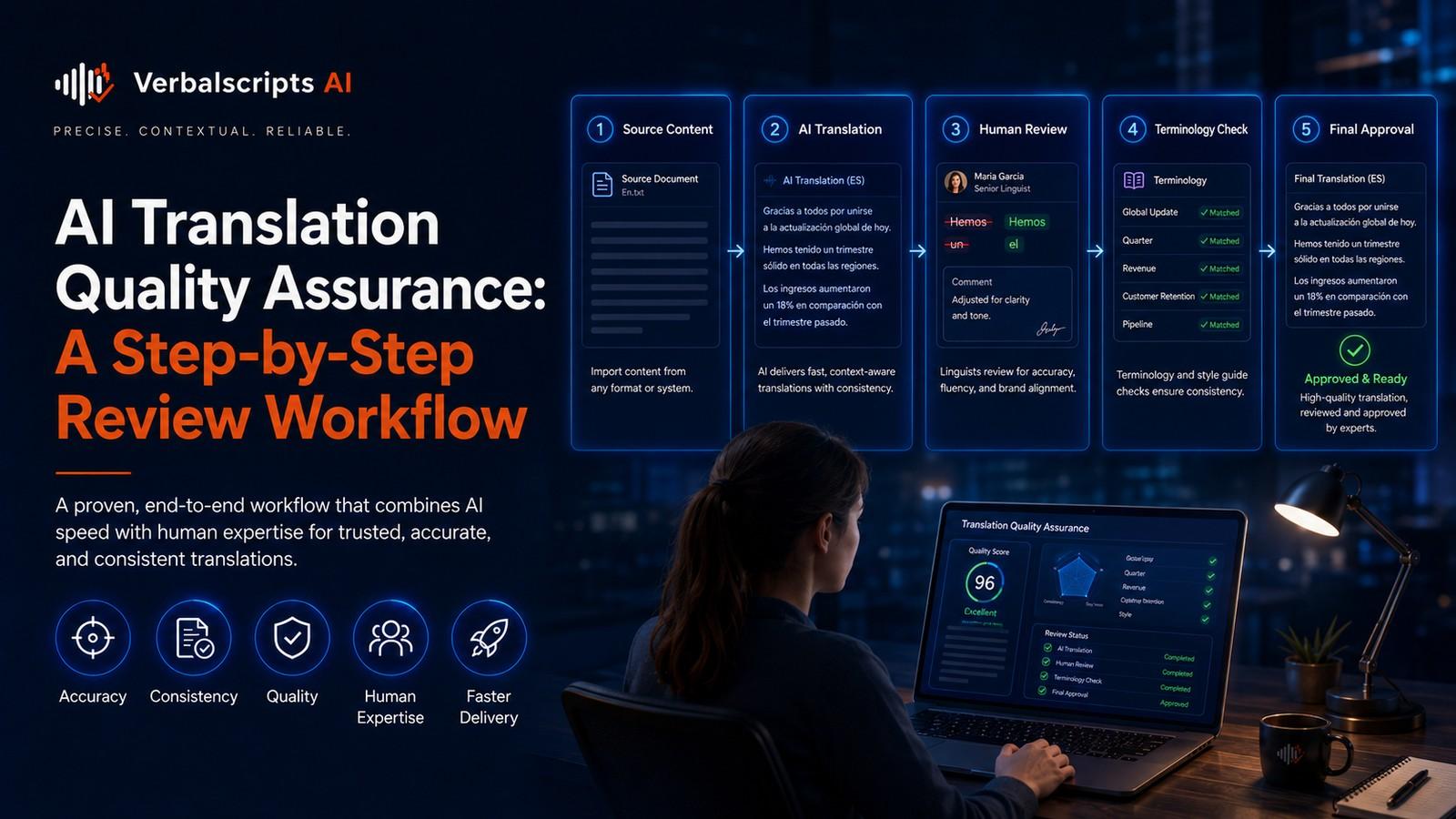
A practical workflow can use seven stages.
Step 1: Define target markets
Specify:
- language;
- locale;
- audience;
- channel;
- content risk.
Step 2: Internationalize the source
Separate content from code, use Unicode, support flexible layouts and avoid hard-coded locale assumptions.
Step 3: Prepare linguistic resources
Create:
- glossary;
- style guide;
- translation memory or approved examples;
- do-not-translate list.
Step 4: Generate AI translation
Translate with market and content context.
Step 5: Apply locale transformations
Use deterministic locale libraries for:
- dates;
- numbers;
- currencies;
- pluralization;
- address patterns where appropriate.
Step 6: Review
Review linguistic quality, cultural fit, UX, compliance and visual layout according to risk.
Step 7: Publish and monitor
Track:
- errors;
- customer feedback;
- SEO performance;
- conversion;
- support issues.
Feed corrections into the next localization cycle.
Human-in-the-loop localization
The strongest use of AI is often to automate predictable work while giving humans the decisions that require judgment.
A useful division of labor is:
| Task | AI automation | Human role |
|---|---|---|
| First-pass translation | High | Review exceptions |
| Glossary enforcement | High | Approve terminology |
| Date/number formatting | High | Define locale policy |
| Cultural adaptation | Medium | Final judgment |
| Brand voice | Medium-high | Brand approval |
| Legal/regulatory language | Medium | Specialist verification |
| UX layout | Medium | Design validation |
| Final go-live decision | Low | Accountable owner |
This is not a limitation of automation; it is a better allocation of expertise.
Localization quality is multidimensional
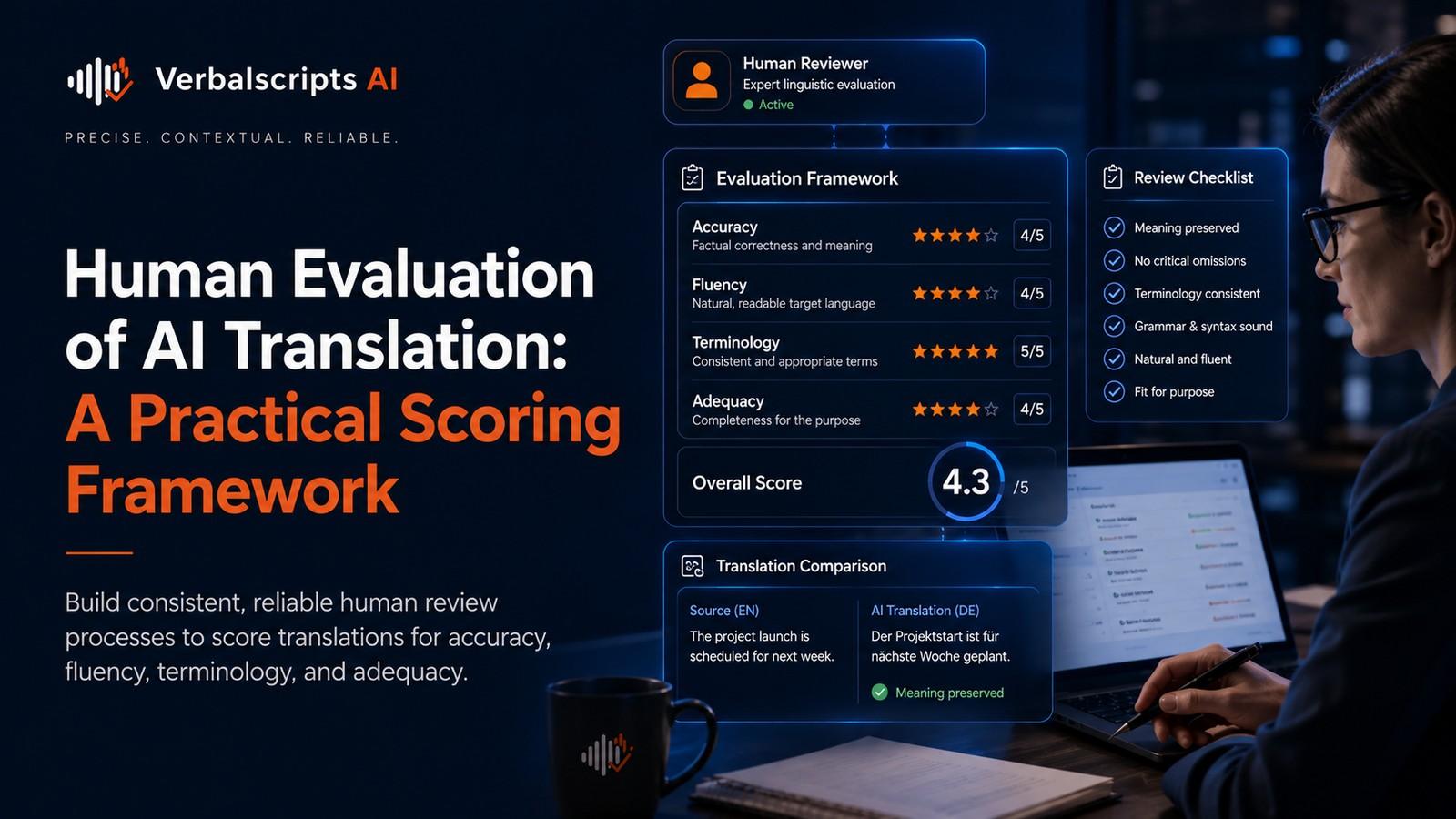
A localized product should be evaluated across:
- linguistic accuracy;
- fluency;
- terminology;
- functional behavior;
- visual layout;
- cultural fit;
- regulatory correctness;
- accessibility.
An excellent translation can still fail on any of the other dimensions.
AI for 50+ markets
At scale, localization becomes an operating system.
Teams need:
- centralized terminology;
- locale-specific style guides;
- language owners;
- automated QA;
- review sampling;
- content versioning;
- dashboards.
AI reduces the cost of generating translations, which makes governance more important rather than less important. When output volume increases tenfold, unmanaged inconsistency also increases tenfold.
AEO and localization
Answer-engine optimization follows the same principle as traditional multilingual SEO: create genuinely useful local-language content.
Google states that its AI search features rely on the same foundational SEO practices as standard Search. A localized page should therefore:
- answer the target user’s question clearly;
- use natural local wording;
- expose crawlable text;
- provide descriptive headings;
- avoid thin machine-generated variants.
AEO is not a reason to publish raw AI translations without localization review.
Localization engineering is not optional
The most scalable multilingual programs solve predictable localization problems in software rather than asking translators or AI models to fix them repeatedly. A well-internationalized application stores text as Unicode, externalizes user-facing strings, supports plural rules, allows layouts to expand and uses locale-aware libraries for dates, numbers and currencies. Those decisions reduce the number of judgment calls at translation time.
This is particularly important for AI workflows. If a source application hard-codes $, assumes every address has a US state, or builds sentences from fragments such as “You have” + number + “items,” a language model may produce plausible localized strings but cannot repair the product architecture consistently. Internationalization gives the translation system a clean operating environment.
Where deterministic rules beat generative AI
Generative models are excellent when language requires interpretation. They are not automatically the best tool for deterministic formatting. If an application needs to display 1234.5 as a locale-appropriate number, a CLDR/ICU-based formatter is usually more reliable, testable and reproducible than asking an LLM how the number should look.
The same applies to:
- plural categories;
- currency spacing;
- date skeletons;
- time-zone rendering;
- list formatting.
A mature architecture uses AI where ambiguity and language generation are valuable and uses standards-based software where rules are already well defined.
Translation memories still matter in an AI workflow
The rise of LLMs does not make approved historical translations useless. Translation memories contain institutional decisions: how a product feature was named, how a legal phrase was rendered, how a support organization addresses customers. Those decisions can be retrieved and supplied as examples to an AI system.
The advantage is not simply cost savings. It is continuity. A new model may generate a different but acceptable phrase; the organization may nevertheless prefer the phrase customers have already learned. AI localization should therefore be retrieval-aware, not permanently “creative.”
Localization maturity model
Organizations often move through four stages:
Stage 1: ad hoc translation
Teams translate files or pages individually. Terminology and review vary by project.
Stage 2: managed localization
The organization creates glossaries, style guides, language owners and repeatable review.
Stage 3: automated localization
Content pipelines, APIs, translation memories, AI generation and QA are integrated into publishing.
Stage 4: continuously measured localization
Quality, conversion, support issues and language performance feed back into the system.
AI has the greatest business value in stages 3 and 4 because the organization has enough structure to govern scale.
Frequently asked questions
Is localization just a better translation?
No. Localization includes translation but also adapts formats, design, cultural context and market-specific behavior.
Can AI fully automate localization?
It can automate a large part of the workflow, but market decisions, cultural judgment, high-risk content and final approval still benefit from humans.
What is the difference between locale and language?
Language identifies a linguistic system; locale adds regional or cultural preferences such as formatting and usage.
Does every translated website need localization?
If the site serves real users in another market, yes. At minimum, navigation, formats, metadata and key workflows should be reviewed.
What should companies automate first?
High-volume translation, terminology checks, locale formatting and mechanical QA usually offer strong returns with relatively low risk.
Conclusion
Translation is the language layer. Localization is the complete market experience.
AI has made translation dramatically faster and can automate many localization mechanics, from terminology to locale formatting and QA. But localization still requires decisions about audience, culture, UX, compliance and brand.
The most effective strategy is not to ask whether AI can replace localization teams. It is to redesign localization so that machines handle scale and humans handle accountable judgment.
Research references
- W3C, Localization vs. Internationalization:
- W3C, Language Tags and Locale Identifiers:
- Microsoft Learn, Localizing your product:
- Google Search Central, International and multilingual sites:
- Google Search Central, AI features and your website: