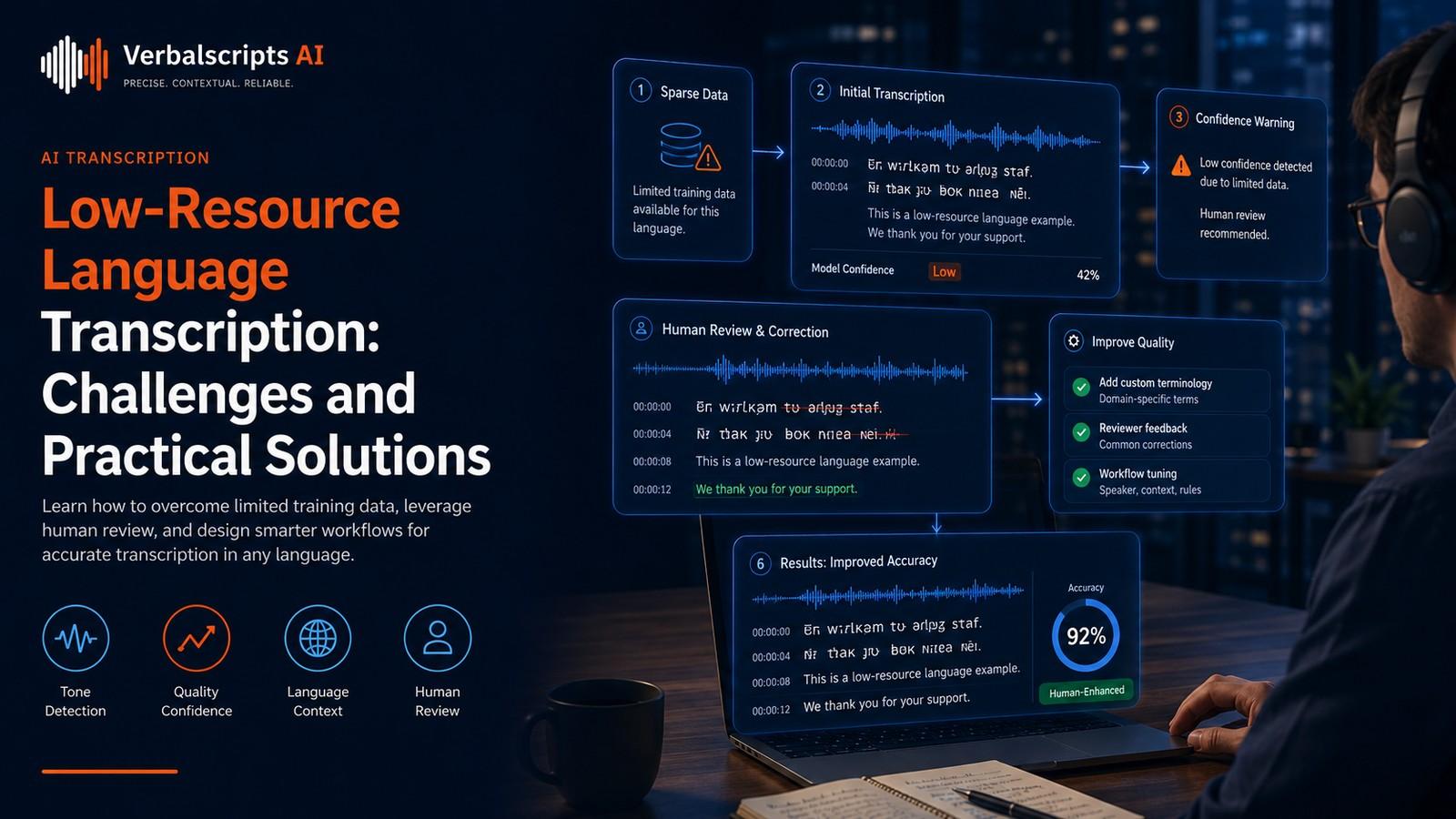
For language operations leaders, QA managers, reviewers, localization teams and enterprise buyers, designing acceptance criteria for AI translation projects sits between raw human communication and a downstream decision. That makes it a systems problem as much as a language problem. Model quality matters, but so do recording conditions, instructions, metadata, review, security, formatting and the way errors are measured.
The central problem is defining what “good enough” means. Review without a shared rubric becomes subjective, while a single automatic score can miss critical errors. In designing acceptance criteria for AI translation projects, the rubric should explicitly cover MQM-style error thresholds, as well as critical-error zero tolerance, along with severity and escalation.
Quick answer
Evaluate designing acceptance criteria for AI translation projects with a frozen, representative test set and a written scoring protocol. Report the main automatic metric, but also track failure slices that matter to users, such as speakers, names, terminology, language varieties, overlap or high-risk content. Review disagreements and keep the benchmark stable enough to detect regressions over time.
What a valid evaluation has to measure
The review process for designing acceptance criteria for AI translation projects is best understood as controlled verification. The reviewer is not simply “making the text nicer.” The reviewer compares output with a source of truth, applies a style or quality specification, records material errors and resolves uncertainty at the appropriate level of expertise. In this workflow, one requirement the reviewer must be able to verify is MQM-style error thresholds.
The distinction among proofreading, editing, source verification and domain review matters in designing acceptance criteria for AI translation projects because those activities have different scopes. If a team labels all of them “QA,” it becomes impossible to estimate effort or interpret a pass rate. Define the review operation at project level, train reviewers against concrete examples, and include critical-error zero tolerance in calibration material.
Why the hard cases matter
MQM separates translation quality into dimensions including terminology, accuracy, linguistic conventions, style, locale conventions, audience appropriateness, and design/markup. This helps teams avoid treating “quality” as a single vague impression.
The practical edge cases in designing acceptance criteria for AI translation projects are predictable, but they are not all equally important. Start with two priority areas (MQM-style error thresholds; and critical-error zero tolerance) then add cases where context is sparse, the source is noisy or ambiguous, or an automated result triggers a downstream action. Instead of averaging those failures away, make them explicit in the test plan and assign an owner for each exception path.
The quality dimensions to design for
1. MQM-style error thresholds
Treat MQM-style error thresholds as a design decision within designing acceptance criteria for AI translation projects. Write the requirement in operational terms, attach positive and negative examples, and test it on representative content before scaling. Record not only whether an output passed but why it failed, because recurring error categories are more actionable than one average score. Where the requirement is high risk, add a second source of evidence such as human review, a reference list or a targeted validation rule.
2. Critical-error zero tolerance
Treat critical-error zero tolerance as a design decision within designing acceptance criteria for AI translation projects. Write the requirement in operational terms, attach positive and negative examples, and test it on representative content before scaling. Record not only whether an output passed but why it failed, because recurring error categories are more actionable than one average score. Where the requirement is high risk, add a second source of evidence such as human review, a reference list or a targeted validation rule.
3. Terminology compliance
Use terminology compliance as targeted context in designing acceptance criteria for AI translation projects, where rare but important vocabulary can create outsized errors. Names, product terms, acronyms and specialist vocabulary may be rare in general model training data even though they are common in one organization. Supply authoritative spellings and approved equivalents before processing, and preserve the source reference used to resolve a term. Track critical-term accuracy separately because one wrong drug, case name or product identifier may make an otherwise strong output unacceptable.
4. Completeness
Treat completeness as a design decision within designing acceptance criteria for AI translation projects. Write the requirement in operational terms, attach positive and negative examples, and test it on representative content before scaling. Record not only whether an output passed but why it failed, because recurring error categories are more actionable than one average score. Where the requirement is high risk, add a second source of evidence such as human review, a reference list or a targeted validation rule.
5. Locale/style requirements
Define locale/style requirements with language-specific rules for designing acceptance criteria for AI translation projects. Language tags alone do not capture locale, script, dialect, code-switching behavior or preferred terminology. Specify the target variety, decide how mixed-language phrases are represented, and keep source-language evidence available for review. For multilingual evaluation, report per-language results before aggregating; otherwise high-resource languages can mask weak performance in lower-volume markets.
A practical production workflow
Step 1: Write the quality specification
Define source of truth, error types, severity, style, critical terms, sampling and pass/fail thresholds before reviewers begin. For designing acceptance criteria for AI translation projects, this step should explicitly verify MQM-style error thresholds. Record the decision in project metadata so later reviewers can reproduce the same rule.
Step 2: Create reviewer guidance and examples
Use positive and negative examples for ambiguous cases, speaker labels, terminology, omissions and formatting. For designing acceptance criteria for AI translation projects, this step should explicitly verify critical-error zero tolerance.
Step 3: Run the first review pass
Compare AI output with source material, record substantive corrections and tag uncertainty rather than silently guessing. For designing acceptance criteria for AI translation projects, this step should explicitly verify terminology compliance.
Step 4: Escalate specialist decisions
Route legal, medical, technical, native-language or genuinely unclear cases to the appropriate expert or client reference. For designing acceptance criteria for AI translation projects, this step should explicitly verify completeness. Record the decision in project metadata so later reviewers can reproduce the same rule.
Step 5: Adjudicate and calibrate
Resolve disagreements, update anchor examples, and periodically test reviewers on the same controlled sample. For designing acceptance criteria for AI translation projects, this step should explicitly verify locale/style requirements.
Step 6: Measure residual quality
Sample released work, calculate agreed quality measures, analyze error categories and feed learning back into models, glossaries and guidelines. For designing acceptance criteria for AI translation projects, this step should explicitly verify sampling and rework rules.
How to evaluate quality
Measure designing acceptance criteria for AI translation projects with a rubric that distinguishes error type and severity. Translation teams can use an MQM-aligned subset; transcription teams can define equivalent categories for wording, speaker attribution, entities, timestamps and format. Review enough material to estimate the failure modes that matter rather than checking only easy samples.
Reviewer performance is part of the measurement system. Maintain a gold or adjudicated set, calculate agreement or accuracy on the same units, and investigate drift. A quality threshold is credible only when reviewers apply it consistently; the calibration sample should include MQM-style error thresholds and critical-error zero tolerance.
- Measure or review MQM-style error thresholds; define the unit, source of truth and pass/fail rule before scoring.
- Measure or review critical-error zero tolerance; define the unit, source of truth and pass/fail rule before scoring.
- Measure or review terminology compliance; define the unit, source of truth and pass/fail rule before scoring.
- Measure or review completeness; define the unit, source of truth and pass/fail rule before scoring.
- Measure or review locale/style requirements; define the unit, source of truth and pass/fail rule before scoring.
Privacy, governance and operational controls
Human review in designing acceptance criteria for AI translation projects introduces another access path to sensitive content. Route only necessary files to reviewers, use role-based permissions, prevent uncontrolled downloads where appropriate, and define how reviewer workstations and subcontractors are governed. The reviewer should be able to retrieve source evidence for MQM-style error thresholds without creating shadow copies of sensitive files.
Keep reviewer identity and decision logs for designing acceptance criteria for AI translation projects where accountability requires them, but avoid turning QA analytics into unnecessary surveillance. Measure the process (error categories, agreement, throughput and escalation) and use critical-error zero tolerance as a calibration target where relevant rather than collecting unrelated personal data about reviewers.
Common failure patterns
- Treating MQM-style error thresholds as an informal preference instead of a testable requirement with examples and ownership.
- Treating critical-error zero tolerance as an informal preference instead of a testable requirement with examples and ownership.
- Relying on a general model for rare names and specialist terms even though authoritative reference spellings are available.
- Treating completeness as an informal preference instead of a testable requirement with examples and ownership.
- Reporting a global multilingual average that hides weak performance in smaller languages or locales.
A good corrective action for designing acceptance criteria for AI translation projects changes the system, not only the current file. If the failure involved MQM-style error thresholds or critical-error zero tolerance, update the relevant guideline, reference data, validation rule, routing logic or evaluation set so the same class of error is easier to detect next time.
Implementation checklist
- ☐ Write the intended use, target users and unacceptable error types.
- ☐ Use representative inputs rather than only clean demonstration files.
- ☐ Define reviewer competence, error taxonomy, severity, sampling and escalation requirements.
- ☐ Choose automatic metrics and human review rules that match the deliverable.
- ☐ Document privacy, retention, access, consent or licensing obligations.
- ☐ Preserve version, provenance and source links needed for audit or correction.
Advanced implementation considerations
Design the benchmark before optimizing the system
It is tempting to tune how to design acceptance criteria for AI translation projects against whatever data is easiest to obtain. That reverses the logic. First write the deployment population and failure costs, then build a benchmark that represents them. If the benchmark changes every time the model changes, improvement cannot be distinguished from a moving test. Keep one stable regression set and a separate challenge set for newly discovered edge cases.
Separate confidence from correctness
In how to design acceptance criteria for AI translation projects, model confidence can help prioritize review, but confidence scores are not automatically calibrated probabilities of correctness. Validate how confidence relates to actual error on your data and on important slices. A high-confidence wrong name or speaker label can be more damaging than a low-confidence harmless filler. Use confidence for routing only after demonstrating that the thresholds behave predictably.
Track correction effort as a product metric
For how to design acceptance criteria for AI translation projects, automatic scores describe output similarity; they do not directly describe the labor required to make a deliverable acceptable. Measure review minutes per audio minute, edits per thousand words, escalation rate, or another operational measure that fits the workflow. When two systems have similar accuracy, the one that produces easier-to-review structure can have substantially lower total cost.
Version instructions and reference data
In how to design acceptance criteria for AI translation projects, prompts, style guides, glossaries, speaker rosters, annotation rules and normalization code are part of the effective model. Store their versions with the job or dataset. When quality shifts, operators should be able to tell whether the change came from the model, the input mix, the instructions, or human review behavior.
- ☐ Run a pilot, measure rework and exceptions, then scale only after the acceptance criteria are met.
Frequently asked questions
What is the goal of designing acceptance criteria for AI translation projects?
For designing acceptance criteria for AI translation projects, the goal is to produce evidence that output meets a defined specification, not merely to improve style. The reviewer should know the source of truth, error taxonomy and escalation rules.
Should every file receive full human review?
For designing acceptance criteria for AI translation projects, not always. Review depth can be risk-tiered, but the sampling policy and automatic gates should be validated against real residual error.
How do you prevent reviewer inconsistency?
For designing acceptance criteria for AI translation projects, use written rubrics, anchor examples, qualification tests, shared calibration samples and adjudication. Measure drift over time rather than assuming reviewer quality is static.
Can an LLM replace a reviewer?
For designing acceptance criteria for AI translation projects, it can assist with consistency checks and triage, but should be calibrated against human evidence. Audio-grounded or culturally ambiguous decisions still require access to the source and appropriate expertise.
What should happen to reviewer corrections?
For designing acceptance criteria for AI translation projects, store them as structured quality data where permitted. Error categories and approved corrections improve guidelines, glossaries, model prompts and future evaluation sets.
Conclusion
How to Design Acceptance Criteria for AI Translation Projects is most useful when it is treated as a measurable workflow rather than a feature checkbox. Define the source of truth, preserve the context that the next step needs, test the hard cases, and make review depth proportional to risk. The result is faster automation without sacrificing traceability or quality discipline. For Verbalscripts AI, the practical objective is a language-data pipeline that can move from AI speed to human-reviewed reliability when the project requires it, while keeping output structured enough for research, product and enterprise systems.
Research references
- ISO 5060:2024 (Translation services) Evaluation of translation output: https://www.iso.org/standard/80701.html
- ISO 18587:2017 (Post-editing of machine translation output) Requirements: https://www.iso.org/standard/62970.html
- ISO 17100:2015 (Translation services) Requirements for translation services: https://www.iso.org/standard/59149.html
- MQM Council, The MQM Error Typology: https://www.themqm.org/mqm-pillars/typology/
- MQM Council, The MQM Scoring Models: https://www.themqm.org/mqm-pillars/the-mqm-scoring-models/
- NIST AI Risk Management Framework 1.0: https://www.nist.gov/itl/ai-risk-management-framework