How to Calibrate Human Evaluators for Translation Quality is best approached as an operating-system problem, not a single model decision. Define the target use case, data and quality requirements first; design measurable controls and human-review rules around them; validate the workflow on representative material; and only then scale volume, languages or automation.
Key takeaways
Key Takeaways
- Define quality and acceptance criteria before selecting a model or vendor.
- Evaluate on representative material and report slice-level results, not just one average score.
- Use human review selectively where confidence is low or the consequence of an error is high.
- Capture errors and corrections in structured form so the workflow improves over time.
- Optimize total cost per accepted output, not only raw API or model consumption.
Why This Topic Matters Now
AI systems improve quickly enough that a one-time benchmark is not a quality program. “How to Calibrate Human Evaluators for Translation Quality” is fundamentally about building an evaluation system that remains trustworthy as models, prompts, terminology and production data change. That means a protected gold set, transparent metrics, human adjudication and slice-level analysis of the errors that matter most.
This guide translates that problem into concrete design and evaluation choices. It defines what to specify before implementation, what to measure, how to test difficult cases, where human review adds value, and which security or procurement questions should be answered before the workflow is scaled. The objective is a system that can be audited and improved, not a marketing claim that depends on ideal inputs.
The Core Technical and Operational Issues
The core design question is what evidence would prove that translation evaluator calibration works for the intended use case. Write that evidence down before selecting the model, vendor or annotation approach.
Then capture the implementation variables (data version, model/profile, terminology, review rules, security configuration and output format) so quality changes can be traced to a specific change rather than guessed after the fact.
A Practical Enterprise Scenario
A useful proof of concept for AI translation should contain a normal slice and a deliberately hard slice. Measure not only output quality but also ingestion failures, review effort, turnaround, delivery success and the ease of explaining why an item failed. Production readiness is the combination of model quality and workflow reliability.
Calibration Is a Measurable Process
Before production evaluation, have reviewers score the same calibration set independently. Compare error categories, severity and overall decisions; discuss disagreements; update the rubric; and repeat until the team reaches acceptable consistency. Keep difficult adjudicated examples as a living reference library.
Track drift after launch. Reviewers can gradually become stricter, more lenient or locally interpret a rule. Periodic hidden calibration items and cross-review samples detect that drift. Do not use agreement alone as the quality target: reviewers can agree on the wrong interpretation if the reference standard is weak.
Define the Evaluation Target Before Choosing Metrics
Start by writing a requirements profile for AI translation. Describe the source material, expected output, languages or locales, domain terminology, expected volume, latency or turnaround needs, downstream systems, security classification and the consequences of an error. A customer-support analytics pipeline can tolerate different errors from a court filing, medical record, model-training corpus or public translation. Treating those uses as equivalent creates false confidence.
Convert the requirements into acceptance criteria. Instead of “high accuracy,” specify the metric, test set, threshold, sampling method and treatment of critical errors. Instead of “fast turnaround,” define when the clock starts, what pauses it, what constitutes delivery and what happens during spikes. Instead of “secure,” specify identity controls, encryption, retention, residency, subprocessor rules and the evidence a vendor must provide. Precise requirements make later vendor comparison and QA much easier.
Build and Protect a Gold-Standard Test Set
A gold-standard set is an evaluation asset, not simply a folder of manually corrected examples. Sample from real operating conditions, then freeze source files, reference outputs, normalization rules, metadata and scoring scripts together. Include hard cases deliberately: low signal-to-noise ratio, overlapping speech, unusual names, code-switching, dense terminology, tables, fragmented documents, low-resource languages or other phenomena that drive risk.
Use at least two qualified reviewers on a subset and adjudicate disagreements. The purpose is not to force perfect agreement but to reveal unclear instructions and inherently ambiguous cases. Mark ambiguous examples rather than pretending there is always one correct output. A gold set with hidden annotation uncertainty produces misleading precision in model comparisons.
Version the benchmark. Add new slices when products expand to new domains or languages, but retain historical slices to detect regression. Keep evaluation data isolated from training and prompt-development workflows, and control access so teams do not optimize specifically for the test examples.
Choose Metrics That Match the Failure Modes
BLEU compares n-gram overlap with one or more reference translations and remains useful for stable system-level comparisons, but acceptable translations can use different wording and still score poorly. Semantic learned metrics such as COMET use source/reference representations and have shown stronger correlation with human judgments in published MT evaluation research. Neither eliminates the need for human evaluation when the cost of a meaning error is high.
Human evaluation should separate dimensions instead of asking reviewers for an undefined “quality” score. MQM-style analysis classifies errors such as accuracy, terminology and fluency and adds severity, which makes results actionable. The same taxonomy can feed remediation: terminology errors suggest glossary or retrieval changes; omissions may indicate prompting/model problems; formatting failures may belong to a post-processing layer rather than the translation model.
Evaluate by Slice, Not Just by Average
Never stop at an overall average. Build evaluation slices that reflect the variables likely to change performance: locale, accent or dialect, domain, recording device, channel, background noise, speaker count, overlap, utterance length, document format, terminology density and content risk. Report the sample size for every slice so a dramatic percentage is not mistaken for a robust result when it comes from only a handful of items.
Set launch gates on the slices that matter most. A release can improve the global score while becoming worse on one language or one high-value customer domain. Regression policy should specify which failures block release, which trigger targeted human review, and which can ship with a documented limitation. This turns evaluation from a retrospective report into an engineering control.
Calibrate Human Evaluation and Error Taxonomy
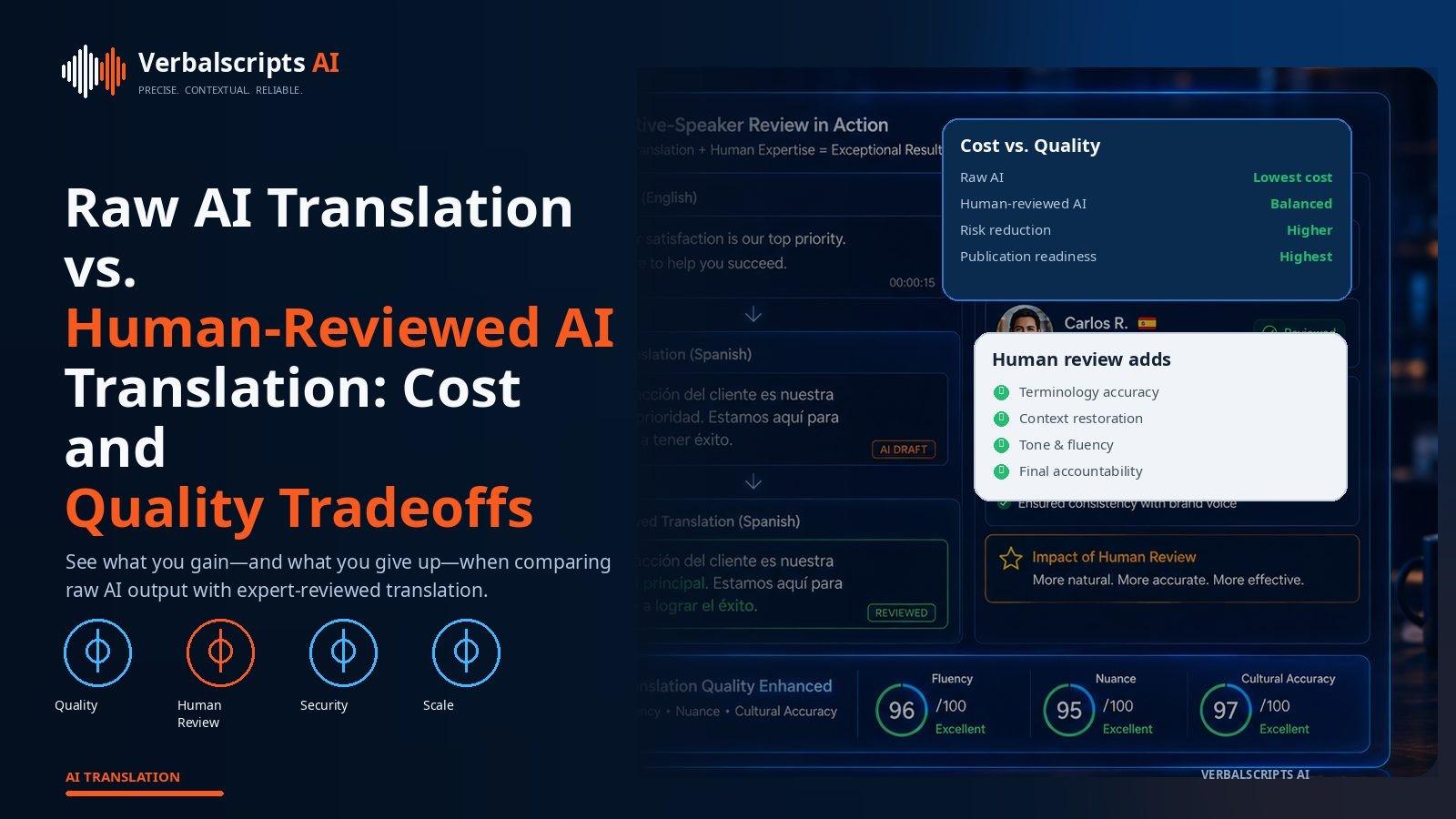
Human review should be risk-based rather than all-or-nothing. Route cases using confidence, domain, language, customer requirements and the potential cost of an error. High-confidence, low-risk material may pass automatically after sampling; low-confidence or high-consequence material should receive full review. Sampling should also include apparently easy cases so silent regressions are not missed.
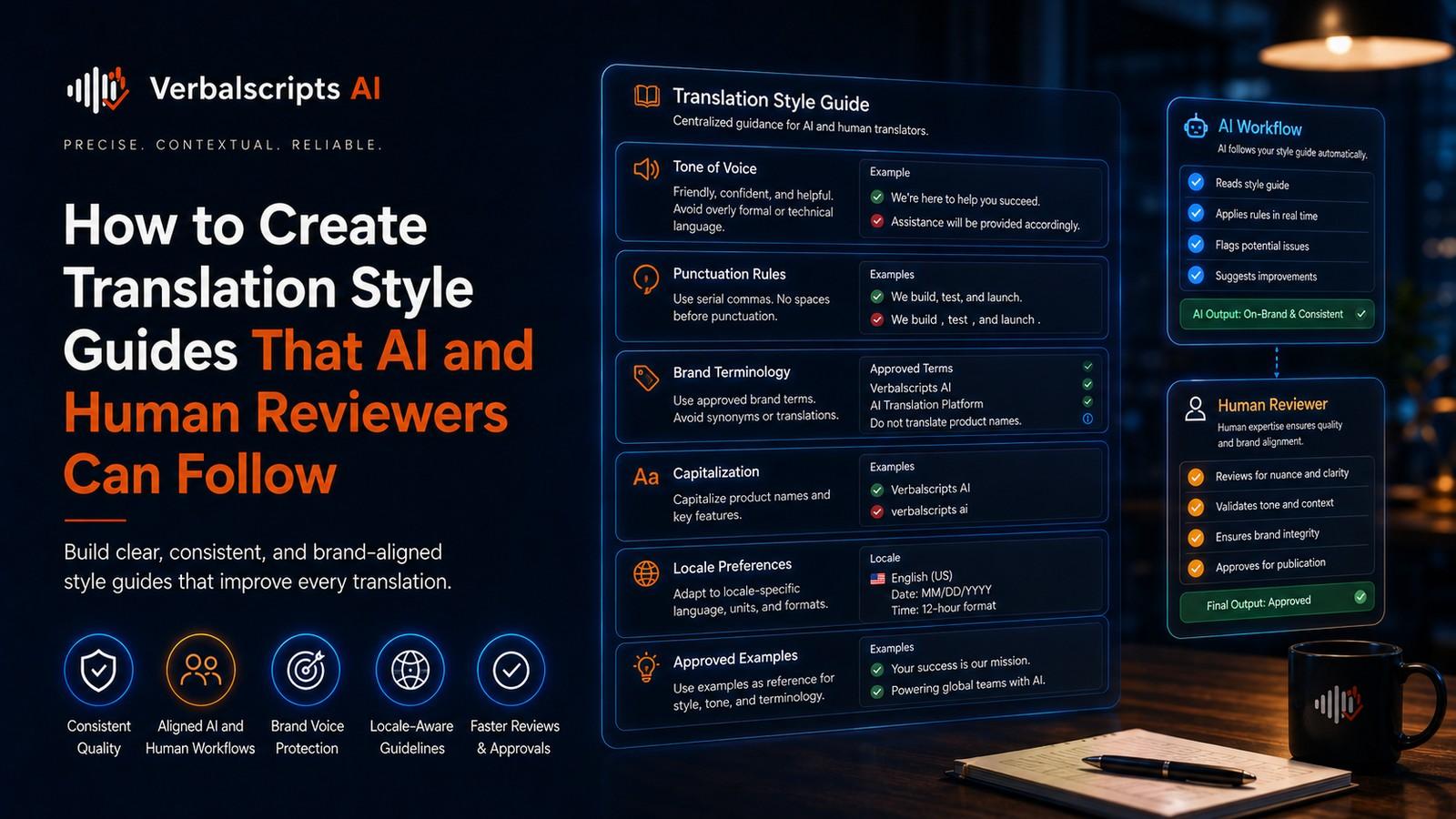
Review instructions need examples, not only principles. Define how to handle names, numbers, abbreviations, speaker identity, inaudible content, code-switching, terminology, omissions, additions, formatting and ambiguous source material. Calibrate reviewers on a shared set, compare disagreement, adjudicate recurring edge cases and update the guideline. Human review becomes more consistent when reviewers are measuring the same definition of “correct.”
Capture corrections structurally. Store the original model output, corrected output, error category, severity and context where permitted. That turns review from a cost center into evaluation and improvement data, while maintaining a clear audit trail of what changed and by whom.
Turn Errors Into Improvement Data
Fine-tuning starts with error analysis. Cluster production failures by cause, severity and context; then decide whether the remedy belongs in training data, decoding, prompting, terminology injection, post-processing or the user interface. Fine-tuning the model is expensive and can introduce regressions, so it should solve a measured pattern rather than a vague perception of quality.
Do not train on every correction indiscriminately. Filter for reviewer confidence, remove accidental formatting edits that do not reflect model quality, preserve source context, and deduplicate repeated customer templates. Weight or sample examples based on the error pattern you are trying to improve.
Keep a strict separation between improvement data and evaluation data. Train on a versioned dataset, record the model/checkpoint and hyperparameters, evaluate on frozen gold sets, and run regression tests before rollout. If improvement data comes from customer corrections, confirm that contracts and privacy choices allow that reuse; otherwise retain the correction only for that customer workflow.
Continuous Evaluation and Release Gates
Continuous evaluation combines scheduled benchmark runs with production signals. Track quality samples, confidence distributions, human-edit distance, critical-error counts, language mix, latency, cost and review rate. Alert on shifts rather than waiting for customer complaints. A sudden drop in review rate can be good (or it can indicate a broken routing rule) so operational and quality metrics should be interpreted together.
Maintain a release ledger that links model version, prompt or glossary version, post-processing rules and benchmark results. Use canary deployments or shadow evaluation where possible, and preserve rollback paths. When a new model looks better overall, compare the full slice table and critical errors before switching every customer at once.
Failure Modes to Test Before Production
Test AI translation against deliberate failure modes rather than only happy-path examples. Include corrupted or unsupported files, wrong language labels, empty segments, very long content, repeated uploads, partial network failure, duplicate webhook events, model timeouts and review exceptions where relevant. The system should fail visibly and recoverably instead of silently producing incomplete output.
Create a severity model for operational failures. A retryable timeout is different from a data-loss event; a low-confidence word is different from an unsupported file that appears to succeed. Dashboards should separate quality failures, infrastructure failures and policy failures so ownership is obvious.
Governance and Change Control
Treat model changes, prompt changes, glossary updates, annotation-guideline changes and post-processing rules as production changes. Version them, test them, document who approved them and retain the ability to roll back. A silent model upgrade can invalidate benchmark results even when the API endpoint name stays the same.
Establish a recurring review that brings together operations, language/domain quality, engineering and security/privacy. Review benchmark drift, customer escalations, critical errors, throughput, review effort and vendor changes. The goal is to make improvement routine rather than crisis-driven.
Frequently Asked Questions
How to Calibrate Human Evaluators for Translation Quality?
Use a representative, human-verified test set and more than one metric. Combine an aggregate score with slice-level analysis and a critical-error taxonomy. For high-consequence speech or translation, include qualified human evaluation because a single automatic metric can hide errors in names, numbers, terminology, omissions or meaning.
What should enterprises look for in AI translation?
Enterprises should evaluate AI translation against their own data, required languages, workflow, risk level and downstream use. The most important buying criteria are representative quality, operational fit, security, observability, human-review options and total cost, not a generic benchmark claim.
How should AI translation quality be measured?
Use a representative, human-verified test set and more than one metric. Combine an aggregate score with slice-level analysis and a critical-error taxonomy. For high-consequence speech or translation, include qualified human evaluation because a single automatic metric can hide errors in names, numbers, terminology, omissions or meaning.
When is human review necessary for AI translation?
Human review is most valuable when errors have meaningful consequences, the content is difficult or specialized, the language is low-resource, or the output will become a reference artifact. Risk-based routing is usually more efficient than reviewing every file or reviewing none.
Conclusion
The strongest approach to calibrate human evaluators for translation quality is measurable, risk-based and operationally explicit. Define the intended outcome, preserve data provenance, test on representative material, use human expertise where consequences justify it, and make security and quality observable through logs and metrics. That produces a workflow that can improve as models change without forcing the organization to rebuild its governance every time a new model is released.
Verbalscripts AI is positioned around that hybrid model: AI for speed and scale, structured quality controls for consistency, and human expertise for the language, domain and edge cases where review materially changes the outcome. The right deployment is not “AI versus people”; it is a designed system that uses each where it creates the most value.
Research Notes and Sources
This article synthesizes current standards, research and publicly available vendor documentation. Pricing and product features change; verify live vendor terms before procurement. Benchmark/vendor claims are attributed as such and should not be treated as independently reproduced Verbalscripts AI results. For 2027-titled pieces, forward-looking statements are an outlook based on evidence available through September 2026 and should be refreshed before publication.
- Papineni et al., BLEU: a Method for Automatic Evaluation of Machine Translation: https://aclanthology.org/P02-1040/
- Rei et al., COMET: A Neural Framework for MT Evaluation: https://aclanthology.org/2020.emnlp-main.213/
- MQM Council - Multidimensional Quality Metrics: https://www.themqm.org/
- NIST AI Risk Management Framework 1.0: https://www.nist.gov/publications/artificial-intelligence-risk-management-framework-ai-rmf-10
- EU AI Act data governance and record-keeping provisions: https://eur-lex.europa.eu/legal-content/EN/TXT/?uri=CELEX:32024R1689
- Hugging Face Dataset Cards documentation: https://huggingface.co/docs/hub/datasets-cards