AI can make speech data collection dramatically faster, but speed only creates value when the output remains trustworthy in context. A transcript may be linguistically readable yet unusable for coding; a translation may be fluent yet wrong on one critical term; an API may be fast yet difficult to operate safely at scale.
The central budgeting problem is accepted yield. Recruitment, recording and annotation spend begins before QA, but only accepted data satisfies the specification. For speech data collection, model raw-to-accepted conversion, participant recruitment, recording operations, re-recording and review so the final unit cost reflects delivered data rather than attempted collection.
Quick answer
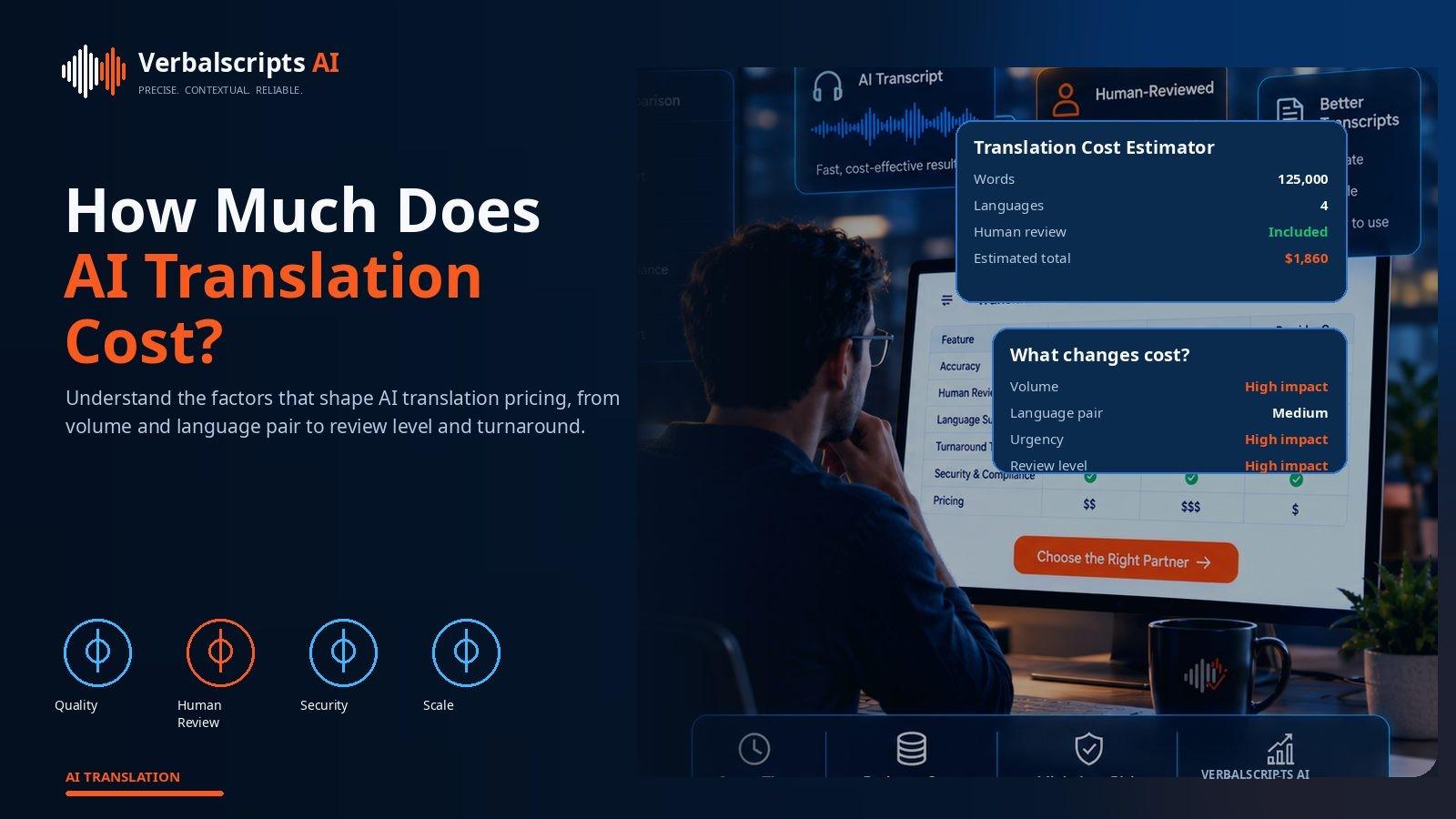
There is no universal per-hour cost for speech data collection. Build the budget from recruitment and participant compensation, recording operations, transcription/annotation, QA and re-recording, tooling/project management, and rights or compliance work. Compare projects by total cost per accepted post-QA hour, utterance or speaker, not the cheapest raw recording rate.
What the cost actually includes
Speech data collection cost is the total cost required to deliver accepted, rights-cleared, quality-controlled speech, not simply the amount paid to record audio. For speech data collection, separate participant recruitment and compensation, recording operations, transcription or annotation, QA/re-recording, tooling and project management, and consent/licensing or compliance work. The first planning question is participant recruitment.
Use a unit that survives quality control. Cost per accepted hour = total program cost divided by accepted post-QA hours; the same idea can be applied per utterance or per unique qualified speaker. If rejection or re-recording rates are high, raw captured hours can substantially exceed accepted hours. Track recording operations and rework explicitly so budget variance is visible early.
Why the hard cases matter
Mozilla Common Voice distinguishes contributed clips from validated speech data and publishes metadata about its collections. For commercial planning, that reinforces a useful costing rule: budget against accepted, quality-controlled units rather than assuming every raw recording will survive validation.
The practical edge cases in speech data collection are predictable, but they are not all equally important. Start with two priority areas (participant recruitment; and recording operations) then add cases where context is sparse, the source is noisy or ambiguous, or an automated result triggers a downstream action. Instead of averaging those failures away, make them explicit in the test plan and assign an owner for each exception path.
The quality dimensions to design for
1. Participant recruitment
Treat participant recruitment as a design decision within speech data collection. Write the requirement in operational terms, attach positive and negative examples, and test it on representative content before scaling. Record not only whether an output passed but why it failed, because recurring error categories are more actionable than one average score. Where the requirement is high risk, add a second source of evidence such as human review, a reference list or a targeted validation rule.
2. Recording operations
Treat recording operations as a design decision within speech data collection. Write the requirement in operational terms, attach positive and negative examples, and test it on representative content before scaling. Record not only whether an output passed but why it failed, because recurring error categories are more actionable than one average score. Where the requirement is high risk, add a second source of evidence such as human review, a reference list or a targeted validation rule.
3. Transcription and annotation
Treat transcription and annotation as a design decision within speech data collection. Write the requirement in operational terms, attach positive and negative examples, and test it on representative content before scaling. Record not only whether an output passed but why it failed, because recurring error categories are more actionable than one average score. Where the requirement is high risk, add a second source of evidence such as human review, a reference list or a targeted validation rule.
4. Quality assurance
Convert quality assurance into observable criteria for speech data collection. Define the error types reviewers will look for, which errors are critical, how samples are selected, and who adjudicates disagreements. A quality process is stronger when it records correction data rather than returning only “pass” or “fail.” Those corrections reveal whether the model, source material, instructions or reviewer guidance needs improvement and can become future benchmark examples.
5. Tooling and project management
Treat tooling and project management as a design decision within speech data collection. Write the requirement in operational terms, attach positive and negative examples, and test it on representative content before scaling. Record not only whether an output passed but why it failed, because recurring error categories are more actionable than one average score. Where the requirement is high risk, add a second source of evidence such as human review, a reference list or a targeted validation rule.
A practical production workflow
Step 1: Define the accepted unit
Choose the unit you are buying: accepted audio hour, utterance, speaker, scenario or annotated segment. State the post-QA acceptance rule so raw volume is not confused with deliverable volume. For speech data collection, this step should explicitly verify participant recruitment. Record the decision in project metadata so later reviewers can reproduce the same rule.
Step 2: Model recruitment and compensation
Estimate screening effort, participant incentives, rare-language or demographic recruitment premiums, scheduling, dropout and replacement rates. For speech data collection, this step should explicitly verify recording operations.
Step 3: Estimate recording operations
Include platform or studio costs, facilitator time, device logistics, support, uploads, failed sessions and any re-recording triggered by technical quality checks. For speech data collection, this step should explicitly verify transcription and annotation.
Step 4: Price annotation and transcription
Specify whether the dataset needs verbatim text, diarization, pronunciation labels, intent labels, metadata or specialist review; annotation depth is often a major labor driver. For speech data collection, this step should explicitly verify quality assurance. Record the decision in project metadata so later reviewers can reproduce the same rule.
Step 5: Add QA and rework reserve
Budget for validation sampling or full review, adjudication, rejected clips, re-recording, annotation correction and final dataset-level consistency checks. For speech data collection, this step should explicitly verify tooling and project management.
Step 6: Compare total cost per accepted unit
Add tooling, project management, security, rights and delivery overhead, then divide total expected program cost by accepted output. Use the same denominator when comparing suppliers or scenarios. For speech data collection, this step should explicitly verify rights, consent and rework.
How to evaluate quality
Evaluate a speech-data budget with operational cost metrics rather than ASR accuracy alone. Track cost per accepted hour or utterance, recruitment conversion rate, participant dropout, recording rejection rate, re-recording rate, annotation throughput, QA defect rate and rework hours. The accepted-output denominator keeps a low raw collection price from hiding expensive rejection or correction.
Run at least three planning scenarios, expected, favorable and adverse. Vary recruitment difficulty, acceptance rate, annotation effort and review depth, then show how each assumption changes delivered unit cost and schedule. When comparing vendors, normalize scope: the same consent rights, metadata, annotation schema, QA threshold, security requirements and accepted-unit definition must be included.
- Measure or review participant recruitment; define the unit, source of truth and pass/fail rule before scoring.
- Measure or review recording operations; define the unit, source of truth and pass/fail rule before scoring.
- Measure or review transcription and annotation; define the unit, source of truth and pass/fail rule before scoring.
- Measure or review quality assurance; define the unit, source of truth and pass/fail rule before scoring.
- Measure or review tooling and project management; define the unit, source of truth and pass/fail rule before scoring.
Privacy, governance and operational controls
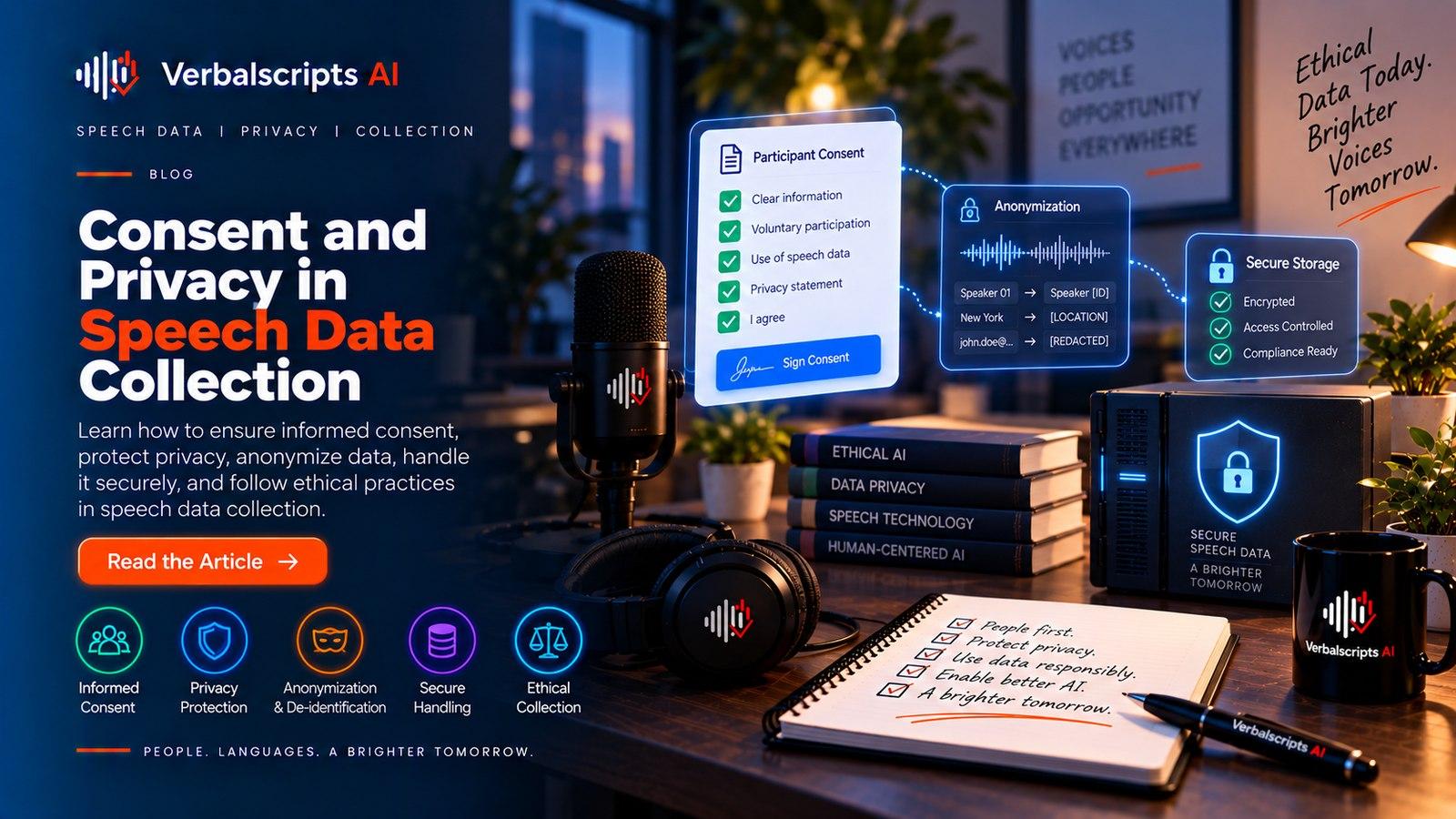
Voice data collected or evaluated for speech data collection can be personally revealing even when the transcript is innocuous. Specify consent, allowed uses, retention, redistribution/licensing and whether demographic metadata is optional or required. Keep participant contact information separate from training identifiers and restrict raw recordings according to the promised use. The governance plan should explicitly address participant recruitment.
Dataset lineage for speech data collection should record where each clip came from, which consent or license applies, who annotated it, and which releases include it. That traceability is especially important for recording operations; training or evaluation data that cannot be connected to a valid use condition becomes a long-term product and audit risk.
Common failure patterns
- Treating participant recruitment as an informal preference instead of a testable requirement with examples and ownership.
- Treating recording operations as an informal preference instead of a testable requirement with examples and ownership.
- Treating transcription and annotation as an informal preference instead of a testable requirement with examples and ownership.
- Using one average score without a written scoring protocol or high-risk error slices.
- Treating tooling and project management as an informal preference instead of a testable requirement with examples and ownership.
A good corrective action for speech data collection changes the system, not only the current file. If the failure involved participant recruitment or recording operations, update the relevant guideline, reference data, validation rule, routing logic or evaluation set so the same class of error is easier to detect next time.
Implementation checklist
- ☐ Write the intended use, target users and unacceptable error types.
- ☐ Use representative inputs rather than only clean demonstration files.
- ☐ Define languages, speakers, devices, noise, domains, annotation and normalization rules.
- ☐ Choose automatic metrics and human review rules that match the deliverable.
- ☐ Document privacy, retention, access, consent or licensing obligations.
- ☐ Preserve version, provenance and source links needed for audit or correction.
Advanced implementation considerations
Separate fixed and variable costs
Speech-data programs combine fixed setup costs (specification, scripts or prompts, tooling, consent language, pilot calibration and project setup) with variable costs that scale with speakers, recordings, annotation and review. Keep those categories separate so a larger project is not priced by simply multiplying a small pilot total.
Model acceptance yield
Raw collection volume is not the deliverable. If clips fail for noise, wrong prompts, ineligible speakers, missing consent, metadata defects or annotation errors, the team must replace or repair them. Forecast accepted yield and calculate the extra raw volume needed to reach the target after QA.
Price language and population scarcity explicitly
Recruitment effort can change sharply across locales, accents, age bands, professions or specialist speaker groups. Build a recruitment matrix and let difficult cells carry their own sourcing assumptions instead of averaging every speaker into one rate.
Use pilot economics before full launch
A pilot should measure conversion, dropout, technical rejection, annotation time and reviewer disagreement. Feed those observed values into the main budget and schedule. The objective is not the cheapest pilot; it is a reliable estimate of total cost per accepted unit at the required quality and rights scope.
- ☐ Run a pilot, measure rework and exceptions, then scale only after the acceptance criteria are met.
Frequently asked questions
What is the best unit for comparing speech-data costs?
Use cost per accepted post-QA hour, utterance or qualified speaker. Raw recorded hours are misleading when rejection, re-recording or annotation rework differs between projects.
Why can rare-language speech data cost more?
Recruiting eligible speakers, scheduling, linguistic QA and specialist annotation can require more effort when the target population or reviewer pool is small.
Should participant compensation be separated from vendor fees?
Yes. Separate participant incentives from recruitment, recording, annotation, QA, tooling and management so cost changes can be traced to their actual driver.
How much rework reserve should a project include?
Use pilot data rather than a universal percentage. Measure technical rejection, dropout, annotation defect and re-recording rates in the pilot, then model an adverse case before committing the full budget.
How should two speech-data quotes be compared?
Normalize the scope: accepted-unit definition, speaker criteria, consent/license rights, recording conditions, annotation schema, metadata, QA threshold, security, delivery format and rework responsibility.
Research and evidence notes
Mozilla Common Voice distinguishes contributed clips from validated speech data and publishes metadata about its collections. For commercial planning, that reinforces a useful costing rule: budget against accepted, quality-controlled units rather than assuming every raw recording will survive validation.
For speech data collection, public benchmarks and standards are useful anchors, but they should not be mistaken for proof of production performance. The strongest evidence combines published methods with a representative pilot, transparent scoring rules and source-grounded human review of failures. That combination lets a buyer or research team distinguish a repeatable quality process from a single favorable demo.
Conclusion
How Much Does Speech Data Collection Cost? is most useful when it is treated as a measurable workflow rather than a feature checkbox. Define the source of truth, preserve the context that the next step needs, test the hard cases, and make review depth proportional to risk. The result is faster automation without sacrificing traceability or quality discipline. For Verbalscripts AI, the practical objective is a language-data pipeline that can move from AI speed to human-reviewed reliability when the project requires it, while keeping output structured enough for research, product and enterprise systems.
Research references
- NIST Speech Recognition Scoring Toolkit (SCTK / sclite): https://github.com/usnistgov/SCTK
- Panayotov et al. (2015), LibriSpeech: an ASR corpus based on public domain audio books: https://www.openslr.org/12/
- Mozilla Common Voice datasets: https://commonvoice.mozilla.org/en/datasets
- Conneau et al. (2022), FLEURS: Few-shot Learning Evaluation of Universal Representations of Speech: https://arxiv.org/abs/2205.12446
- Imam et al. (2025), Automatic Speech Recognition for African Low-Resource Languages: https://aclanthology.org/2025.africanlp-1.13/
- Prabhu et al. (2023), Accented Speech Recognition With Accent-specific Codebooks: https://aclanthology.org/2023.emnlp-main.444/