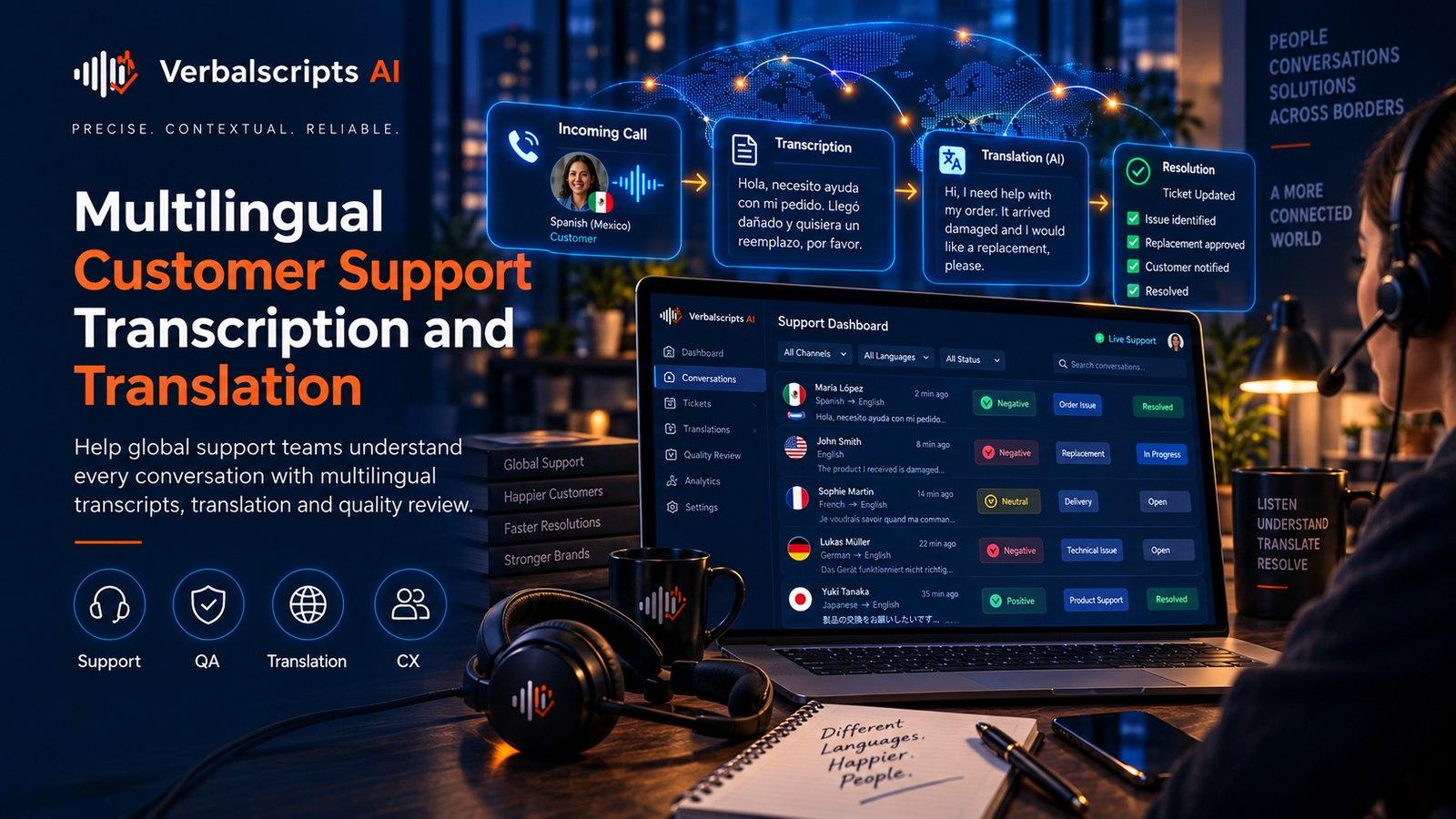
AI can make AI translation for global customer support dramatically faster, but speed only creates value when the output remains trustworthy in context. A transcript may be linguistically readable yet unusable for coding; a translation may be fluent yet wrong on one critical term; an API may be fast yet difficult to operate safely at scale.
The central problem is downstream amplification: search, analytics, CRM updates and multilingual support can turn a small language error into a larger operational error. In AI translation for global customer support, controls around two areas (approved support terminology; and locale-aware tone and politeness) need to be testable before automation writes into systems of record.
Quick answer
AI Translation for Global Customer Support works best when teams define the intended use first, provide representative data and context, measure the specific errors that matter, and route uncertain or high-risk output to qualified human review. The best system is not the one with the strongest generic benchmark; it is the one whose measured behavior matches the deployment conditions and acceptance criteria.
What AI Translation for Global Customer Support means in practice
In AI translation for global customer support, human communication becomes an operational artifact that other teams can search, analyze, translate or store. The core design question is what information needs to survive the conversion: exact wording, speaker role, timing, locale, intent, entities, formatting or all of these. For this workflow, approved support terminology is a first-order requirement.
A useful AI translation for global customer support workflow starts with the downstream schema and acceptance criteria. Once those are clear, model selection, human review and integration choices become easier to justify. Make locale-aware tone and politeness part of the acceptance plan so automation is optimized for the information the receiving system actually needs.
Why the hard cases matter
Enterprise language data often contains personal, confidential or commercially sensitive information. Security claims therefore need to be evaluated as an operational system: identity and access, retention, encryption, auditability, incident response and vendor governance all matter.
The practical edge cases in AI translation for global customer support are predictable, but they are not all equally important. Start with two priority areas (approved support terminology; and locale-aware tone and politeness) then add cases where context is sparse, the source is noisy or ambiguous, or an automated result triggers a downstream action. Instead of averaging those failures away, make them explicit in the test plan and assign an owner for each exception path.
The quality dimensions to design for
1. Approved support terminology
Use approved support terminology as targeted context in AI translation for global customer support, where rare but important vocabulary can create outsized errors. Names, product terms, acronyms and specialist vocabulary may be rare in general model training data even though they are common in one organization. Supply authoritative spellings and approved equivalents before processing, and preserve the source reference used to resolve a term. Track critical-term accuracy separately because one wrong drug, case name or product identifier may make an otherwise strong output unacceptable.
2. Locale-aware tone and politeness
Define locale-aware tone and politeness with language-specific rules for AI translation for global customer support. Language tags alone do not capture locale, script, dialect, code-switching behavior or preferred terminology. Specify the target variety, decide how mixed-language phrases are represented, and keep source-language evidence available for review. For multilingual evaluation, report per-language results before aggregating; otherwise high-resource languages can mask weak performance in lower-volume markets.
3. Customer identity and sensitive information
Specify customer identity and sensitive information so the output of AI translation for global customer support can be used without a second manual production step. Define headings, speaker labels, paragraphing, lists, timestamps, tables and non-speech notation before processing. For translated documents, structure and markup must survive language expansion and reordering. Validate the final DOCX, PDF, subtitle or structured JSON output, not just the raw text returned by a model.
4. Escalation for ambiguous or high-risk messages
Treat escalation for ambiguous or high-risk messages as a design decision within AI translation for global customer support. Write the requirement in operational terms, attach positive and negative examples, and test it on representative content before scaling. Record not only whether an output passed but why it failed, because recurring error categories are more actionable than one average score. Where the requirement is high risk, add a second source of evidence such as human review, a reference list or a targeted validation rule.
5. Consistency across channels
Treat consistency across channels as a design decision within AI translation for global customer support. Write the requirement in operational terms, attach positive and negative examples, and test it on representative content before scaling. Record not only whether an output passed but why it failed, because recurring error categories are more actionable than one average score. Where the requirement is high risk, add a second source of evidence such as human review, a reference list or a targeted validation rule.
A practical production workflow
Step 1: Define downstream use
Specify whether the output powers search, support review, analytics, CRM fields, meeting notes or multilingual publication. This determines what must be accurate. For AI translation for global customer support, this step should explicitly verify approved support terminology. Record the decision in project metadata so later reviewers can reproduce the same rule.
Step 2: Normalize inputs and metadata
Attach stable conversation IDs, channel, language/locale, roles and permissions before language processing begins. For AI translation for global customer support, this step should explicitly verify locale-aware tone and politeness.
Step 3: Transcribe or translate
Use the model and settings that match the domain, then preserve the raw output and provenance for later troubleshooting. For AI translation for global customer support, this step should explicitly verify customer identity and sensitive information.
Step 4: Validate high-value fields
Check names, numbers, commitments, critical terminology and other fields that can trigger downstream actions. For AI translation for global customer support, this step should explicitly verify escalation for ambiguous or high-risk messages. Record the decision in project metadata so later reviewers can reproduce the same rule.
Step 5: Transform into the target schema
Map approved text into searchable chunks, CRM objects, support records or structured analytics fields without discarding source references. For AI translation for global customer support, this step should explicitly verify consistency across channels.
Step 6: Monitor production quality
Sample completed conversations, track error categories and user corrections, and update terminology or routing rules when patterns change. For AI translation for global customer support, this step should explicitly verify human review for critical interactions.
How to evaluate quality
Measure AI translation for global customer support at the unit that drives business or research decisions. Track both average quality and critical exceptions, because a small number of wrong names, roles or commitments can dominate user impact.
Keep a sample of human-verified outputs as a regression set and update it deliberately when the product’s population, language mix or content changes.
- Measure or review approved support terminology; define the unit, source of truth and pass/fail rule before scoring.
- Measure or review locale-aware tone and politeness; define the unit, source of truth and pass/fail rule before scoring.
- Measure or review customer identity and sensitive information; define the unit, source of truth and pass/fail rule before scoring.
- Measure or review escalation for ambiguous or high-risk messages; define the unit, source of truth and pass/fail rule before scoring.
- Measure or review consistency across channels; define the unit, source of truth and pass/fail rule before scoring.
Privacy, governance and operational controls
Business material processed through AI translation for global customer support can contain customer identifiers, account information, confidential strategy and employee data. Apply least-privilege access, retention limits and clear rules on whether content may be used for model improvement. If transcripts are indexed for search or RAG, enforce the original document permissions at retrieval time rather than creating a new ungoverned copy. Controls around approved support terminology should be included in the data-flow review.
Governance for AI translation for global customer support also requires version control. Store the source version, locale or language settings, reviewer status and approval date so downstream artifacts remain synchronized. This is particularly relevant to locale-aware tone and politeness, where an apparently small source change can otherwise leave stale transcripts, translations or extracted fields in circulation.
Common failure patterns
- Relying on a general model for rare names and specialist terms even though authoritative reference spellings are available.
- Reporting a global multilingual average that hides weak performance in smaller languages or locales.
- Treating customer identity and sensitive information as an informal preference instead of a testable requirement with examples and ownership.
- Treating escalation for ambiguous or high-risk messages as an informal preference instead of a testable requirement with examples and ownership.
- Treating consistency across channels as an informal preference instead of a testable requirement with examples and ownership.
A good corrective action for AI translation for global customer support changes the system, not only the current file. If the failure involved approved support terminology or locale-aware tone and politeness, update the relevant guideline, reference data, validation rule, routing logic or evaluation set so the same class of error is easier to detect next time.
Implementation checklist
- ☐ Write the intended use, target users and unacceptable error types.
- ☐ Use representative inputs rather than only clean demonstration files.
- ☐ Define language, locale, speaker, formatting and terminology requirements.
- ☐ Choose automatic metrics and human review rules that match the deliverable.
- ☐ Document privacy, retention, access, consent or licensing obligations.
- ☐ Preserve version, provenance and source links needed for audit or correction.
Advanced implementation considerations
Design the benchmark before optimizing the system
It is tempting to tune AI translation for global customer support against whatever data is easiest to obtain. That reverses the logic. First write the deployment population and failure costs, then build a benchmark that represents them. If the benchmark changes every time the model changes, improvement cannot be distinguished from a moving test. Keep one stable regression set and a separate challenge set for newly discovered edge cases.
Separate confidence from correctness
In AI translation for global customer support, model confidence can help prioritize review, but confidence scores are not automatically calibrated probabilities of correctness. Validate how confidence relates to actual error on your data and on important slices. A high-confidence wrong name or speaker label can be more damaging than a low-confidence harmless filler. Use confidence for routing only after demonstrating that the thresholds behave predictably.
Track correction effort as a product metric
For AI translation for global customer support, automatic scores describe output similarity; they do not directly describe the labor required to make a deliverable acceptable. Measure review minutes per audio minute, edits per thousand words, escalation rate, or another operational measure that fits the workflow. When two systems have similar accuracy, the one that produces easier-to-review structure can have substantially lower total cost.
Version instructions and reference data
In AI translation for global customer support, prompts, style guides, glossaries, speaker rosters, annotation rules and normalization code are part of the effective model. Store their versions with the job or dataset. When quality shifts, operators should be able to tell whether the change came from the model, the input mix, the instructions, or human review behavior.
- ☐ Run a pilot, measure rework and exceptions, then scale only after the acceptance criteria are met.
Frequently asked questions
What is the main benefit of AI translation for global customer support?
For AI translation for global customer support, it reduces the manual effort required to convert spoken or multilingual content into structured, searchable and reviewable text while preserving a path back to source evidence.
What affects accuracy most?
For AI translation for global customer support, source quality, language and domain coverage, speaker variation, terminology, context, model selection and the amount and competence of human review all affect delivered accuracy.
Should AI output be reviewed?
For AI translation for global customer support, review depth should match risk. High-stakes, public-facing, research-critical or system-of-record content deserves stronger source-grounded review than low-risk internal drafts.
How should privacy be handled?
For AI translation for global customer support, define permitted use, access, retention and deletion before upload, then enforce least privilege and data minimisation through the workflow.
How do teams improve quality over time?
For AI translation for global customer support, capture corrections and error categories, analyze recurring failures, update reference materials or datasets, and re-run a stable benchmark after each material workflow change.
Conclusion
AI Translation for Global Customer Support is most useful when it is treated as a measurable workflow rather than a feature checkbox. Define the source of truth, preserve the context that the next step needs, test the hard cases, and make review depth proportional to risk. The result is faster automation without sacrificing traceability or quality discipline. For Verbalscripts AI, the practical objective is a language-data pipeline that can move from AI speed to human-reviewed reliability when the project requires it, while keeping output structured enough for research, product and enterprise systems.
Research references
- NIST AI Risk Management Framework 1.0: https://www.nist.gov/itl/ai-risk-management-framework
- NIST Privacy Framework: https://www.nist.gov/privacy-framework
- ISO/IEC 27001:2022: Information security management systems: https://www.iso.org/standard/27001
- ISO 5060:2024 (Translation services) Evaluation of translation output: https://www.iso.org/standard/80701.html
- ISO 18587:2017 (Post-editing of machine translation output) Requirements: https://www.iso.org/standard/62970.html