Can an LLM reliably judge translation quality? LLM judges can provide useful quality scores, error spans and MQM-style classifications at scale, especially when given clear rubrics and reference translations. Current research shows that they can correlate strongly with human judgments, but their reliability varies by model, language, prompt and error type. They should be calibrated against qualified human reviewers and should not be the sole acceptance gate for critical legal, medical, financial or safety content.
| SEO title | LLM-as-a-Judge for Translation Quality: Benefits & Limitations |
|---|---|
| Slug | llm-as-a-judge-translation-quality |
| Meta description | Learn how LLM-as-a-judge translation evaluation works, its benefits, biases and limitations, and how to combine it with MQM and human review. |
| Primary keyword | LLM as a judge translation |
| Search intent | Informational / Technical |
| Hero image | 146-llm-as-a-judge-translation-quality.jpg |
| Hero alt text | LLM translation evaluator reviewing source and target text with MQM-style error spans, severity labels and human calibration |
| Article body words | 2043 |
For production multilingual workflows, see our AI Translation service for the delivery path behind the guidance in this article.
Large language models can generate translations, but they can also evaluate them. This practice is usually called LLM-as-a-judge: the model receives a source sentence, a candidate translation and sometimes a reference translation, then scores quality or identifies specific errors.
The approach is attractive because it can scale far beyond expert human review. It can also produce explanations rather than only a number. Yet evaluation is a high-stakes use of an imperfect model, and a persuasive explanation is not proof that the judgment is correct.
A good use of LLM judging is automated review assistance, not unaccountable self-certification.
What LLM-as-a-judge means
A translation-evaluation prompt may contain:
- source text;
- target translation;
- target language;
- reference translation;
- evaluation rubric;
- severity definitions.
The model can return:
- overall score;
- pass/fail;
- error spans;
- MQM category;
- severity;
- explanation;
- suggested correction.
This is much richer than a traditional metric score.
Why LLM judges are attractive
Natural-language reasoning
An LLM can explain why a phrase is problematic.
Flexible rubrics
It can apply a client-specific framework rather than one fixed metric.
No reference required in some designs
A judge can compare source and target directly.
Scalability
Millions of segments can be evaluated more cheaply than expert bilingual review.
Error localization
Span-level evaluation can show exactly where a problem occurs.
These capabilities make LLM judging useful in enterprise QA.
Research evidence
Recent work has tested LLMs as translation evaluators in increasingly detailed settings.
RUBRIC-MQM, presented at ACL 2025’s Industry Track, evaluates high-end machine translation with span-level MQM-style LLM judging. The work reflects a broader shift from asking a model for one holistic score to asking it to identify specific error spans and categories.
Other research on LLM-based MT evaluation found that detailed instructions and access to reference translations materially affect performance. The lesson is important: “Ask a strong LLM to rate this” is not a reproducible evaluation methodology.
References improve evaluation
A reference translation gives the judge an additional high-quality example of how the source meaning can be rendered.
Research has found references particularly useful for:
- difficult semantic choices;
- culture-aware translation;
- subtle adequacy judgments.
However, references can also anchor the evaluator too strongly. A valid paraphrase should not be penalized simply because it differs from the reference.
The judge prompt should explicitly state that the reference is one valid translation, not the only valid translation.
Source-only versus reference-based judging
Source + candidate
Advantages:
- no reference-production cost;
- useful for real-world quality estimation.
Risks:
- judge must fully understand both languages;
- subtle domain meaning may be missed.
Source + candidate + reference
Advantages:
- additional semantic evidence;
- often better correlation with human review.
Risks:
- reference quality matters;
- style anchoring;
- reference errors can mislead the judge.
Both should be benchmarked in the target use case.
Holistic scoring
The simplest LLM judge gives a score, such as 1–5 or 0–100.
This is fast, but it has weaknesses:
- score interpretation can drift;
- two different error profiles can produce the same score;
- explanations may not align with the number.
For operational QA, error annotation is usually more actionable.
MQM-style judging
An MQM-style prompt asks the model to identify:
- error span;
- error category;
- severity.
Example:
"within three days" translated as "within thirty days".
The judge should mark:
- category: accuracy;
- subtype: mistranslation;
- severity: critical/major depending on policy.
This makes the output easier to validate against human annotations.
Span-level evaluation
Span-level judging reduces ambiguity because the model has to point to the actual problematic text.
A system can then:
- highlight the segment to reviewers;
- calculate error counts;
- route severe errors;
- compare model versions.
It also makes hallucinated evaluator explanations easier to detect because the claimed error must correspond to visible target text.
LLM judges can be biased
Possible biases include:
Verbosity bias
Longer explanations or translations may appear more complete.
Style preference
The judge may prefer language that resembles its own generation style.
Position bias
In pairwise comparison, the order of A and B can affect decisions.
Reference anchoring
The judge may over-penalize valid alternatives.
Self-preference
A model family may prefer outputs similar to its own patterns.
These effects need empirical testing.
Language coverage is uneven
A judge that performs well for English–German may not perform equally well for:
- low-resource languages;
- code-switched text;
- culturally specific content;
- complex morphology.
Do not generalize from one language pair.
Build language-specific calibration sets.
Culture-aware limitations
ACL 2026 research on culture-aware MT found a persistent gap between recognizing cultural information and operationalizing it correctly in translation. It also found that references improved LLM-as-a-judge reliability for cultural translation.
This means culture-sensitive evaluation should not be reduced to a generic “naturalness” score.
A judge may know that a cultural item exists and still evaluate the wrong translation strategy favorably.
Domain limitations
Legal, medical and technical review requires subject understanding.
An LLM judge may:
- miss a jurisdiction-specific legal distinction;
- accept a plausible but wrong medical term;
- fail to notice that a component name violates engineering terminology.
Domain references and glossaries help, but specialist human calibration remains important.
Prompt sensitivity
Changing the wording of the evaluation prompt can change scores.
For reproducibility:
- version the prompt;
- version the model;
- fix temperature or use deterministic settings where possible;
- store the rubric;
- store examples.
Treat the evaluator like production software.
Judge consistency
Run repeat tests.
Questions:
- Does the same segment receive the same rating?
- Does swapping pairwise order change the outcome?
- Does adding a reference change severity?
- Does the judge agree with experts on critical errors?
Consistency should be measured before automated acceptance is allowed.
Human calibration
Build a gold evaluation set.
Have qualified reviewers annotate:
- errors;
- severity;
- overall acceptability.
Then compare the LLM judge.
Useful measures include:
- correlation;
- precision/recall for major errors;
- critical-error recall;
- pass/fail agreement.
For production safety, critical-error recall may matter more than correlation.
LLM judges as triage tools
One of the strongest uses is routing.
For example:
- high-confidence clean segments → publish or sample;
- minor style flags → normal review;
- major accuracy flags → bilingual reviewer;
- critical risk flags → specialist.
This can reduce human workload while retaining accountability.
LLM judge plus deterministic QA
Do not ask the LLM to do everything.
Use deterministic checks for:
- numbers;
- placeholders;
- file structure;
- glossary exact matches;
- missing segments.
Use the LLM for:
- semantic adequacy;
- fluency;
- context;
- nuanced terminology.
This hybrid system is more reliable.
Cost considerations
LLM judging consumes inference tokens or characters.
At very high volume, calculate:
- cost per segment;
- cost per language;
- repeated evaluation passes;
- reference storage/retrieval.
A cheaper model may work for initial triage while a stronger judge evaluates uncertain cases.
Security considerations
The evaluator receives the translated content, so the same confidentiality controls that apply to translation also apply to judging.
For sensitive content, verify:
- data retention;
- model-training policy;
- access control;
- region;
- logging.
Quality evaluation should not become a hidden data-exposure path.
A practical deployment framework
Step 1: define rubric
Use a small, explicit error taxonomy.
Step 2: build human gold set
Include routine and difficult examples.
Step 3: test judge configurations
Compare:
- no reference;
- reference;
- different prompts;
- different model sizes.
Step 4: measure critical errors
Do not rely only on correlation.
Step 5: deploy as triage
Keep human review for high-risk cases.
Step 6: monitor drift
Recalibrate after model updates or domain changes.
Separating the translator from the judge
Where practical, use a different model family or evaluator configuration from the system that generated the translation. This reduces the risk that the same linguistic preference or failure pattern is rewarded twice. Independence does not guarantee correctness, but it improves the design of the quality-control system.
For high-volume systems, a useful stack is:
- translation model A;
- deterministic validators;
- evaluation model B;
- human sample review.
If evaluator B and humans begin disagreeing more often after a model update, recalibrate before continuing automated acceptance.
Structured outputs for judge reliability
Do not ask the evaluator for free-form prose only. Require a schema such as:
- pass/fail;
- error span;
- category;
- severity;
- short evidence;
- suggested correction.
Validate the schema programmatically. This makes the output easier to aggregate and reduces ambiguity when the judge is used for routing.
Test the evaluator on adversarial examples
A judge benchmark should include deliberately difficult candidates:
- target with one changed digit;
- fluent but omitted negative;
- source-faithful paraphrase unlike the reference;
- target containing an unsupported sentence;
- correct translation with unusual but valid wording.
These examples reveal whether the judge rewards surface fluency at the expense of source fidelity. A judge that misses critical alterations should not be used as an automated publishing gate regardless of its average correlation score.
Monitoring evaluator drift
The evaluator is itself an AI dependency. Store its:
- model version;
- system prompt;
- rubric;
- decoding settings.
Run the evaluator regression set after provider updates. Otherwise an apparent change in translation quality may actually be a change in the judging model.
When human adjudication should override the LLM judge
Automated judging should never become circular: the model flags an error, another automated score agrees, and the system treats the result as fact without a person ever seeing the disputed segment. Build an adjudication rule for cases such as:
- evaluator and deterministic checks disagree;
- evaluator labels a legal or medical error as minor;
- two LLM judges disagree materially;
- a high-risk segment is rejected solely for style;
- the output is in a low-resource language where the judge has limited calibration.
The adjudicator should record both the final decision and the reason. Those cases are especially valuable additions to the evaluator benchmark because they represent the boundary where automated judgment is weakest.
Evaluating explanations separately from decisions
A judge can select the correct pass/fail label while giving a weak explanation, or provide a persuasive explanation for an incorrect label. If explanations are shown to reviewers, evaluate them separately. Require the explanation to point to concrete source and target evidence rather than broad statements such as “the translation is unnatural.”
This reduces automation bias: human reviewers are less likely to accept an evaluator simply because its prose sounds confident.
Enterprise recommendation
Use LLM-as-a-judge first for coverage: every segment can receive a low-cost semantic screen. Use deterministic checks for exact constraints and qualified humans for risk. As the human-labeled dataset grows, tighten or relax routing thresholds based on measured false-negative rates.
The goal is not to maximize how much the judge decides. It is to maximize how reliably the total QA system catches unacceptable translations at a sustainable cost.
Frequently asked questions
Is LLM-as-a-judge better than COMET?
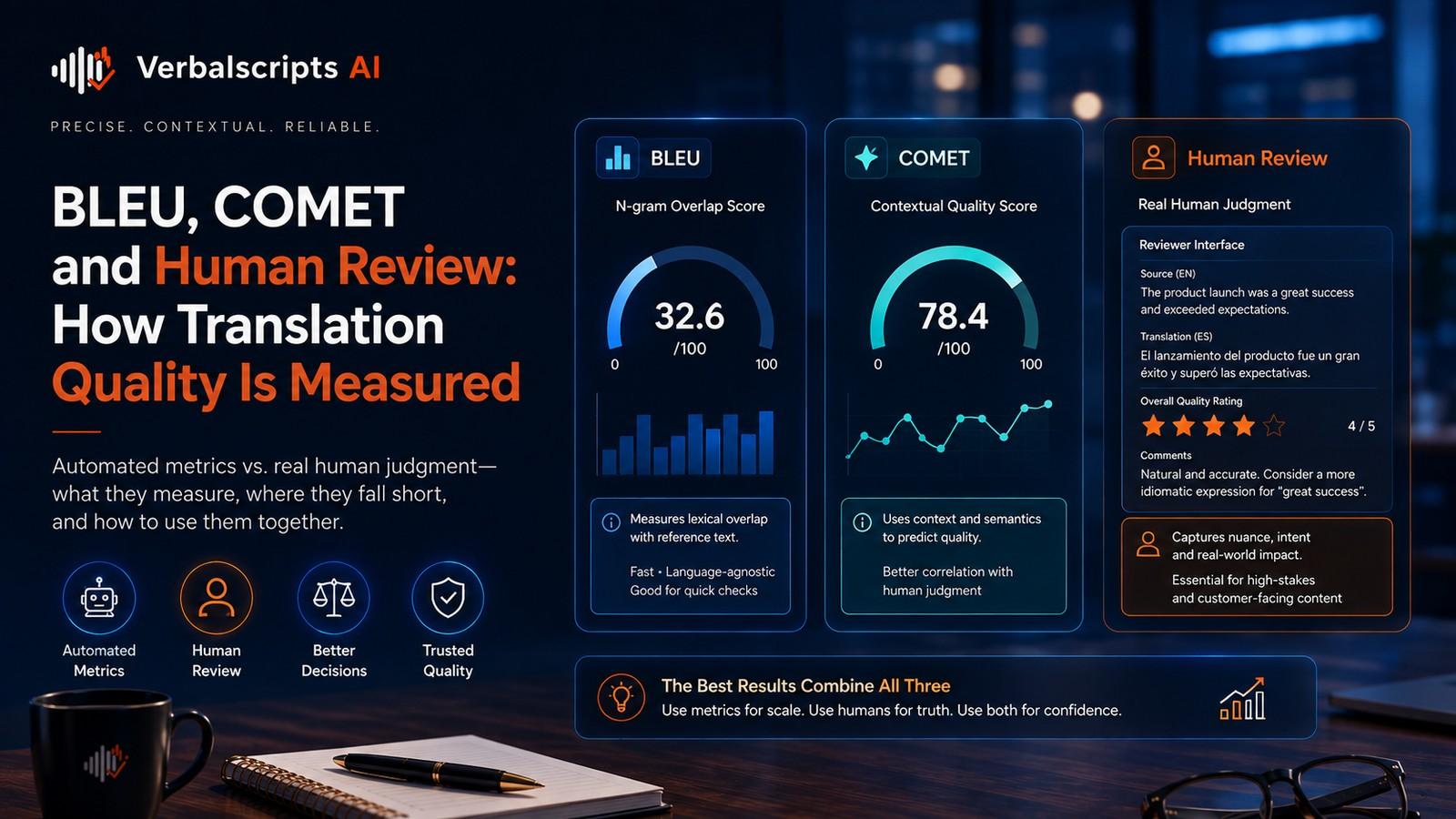
They serve different purposes. COMET is a specialized learned metric; LLM judges can apply flexible rubrics and explain errors. Both should be validated against humans.
Does an LLM judge need a reference translation?
Not always, but research shows references can improve reliability in many settings.
Can the same LLM translate and judge its own output?
Technically yes, but self-preference and correlated failure modes are concerns. Independent evaluation is safer.
Can LLM judging replace human MQM review?
It can reduce the amount of human annotation, but high-stakes acceptance still benefits from human calibration and specialist review.
What is the best use case?
Large-scale quality triage, regression testing and error detection where full human review would be too expensive.
Conclusion
LLM-as-a-judge is a powerful addition to translation QA because it can evaluate meaning, identify error spans and explain decisions at scale.
Its weakness is the same reason it is useful: it is a generative model making probabilistic judgments. Treat it as an evaluator that must be validated, versioned and monitored, not as an oracle.
The strongest systems combine deterministic checks, specialized metrics, LLM judging and human review according to risk.
Research references
- Kim, RUBRIC-MQM (ACL Industry 2025):
- Xu et al., What do LLMs Need for MT Evaluation? (EMNLP 2024):
- Yuan et al., Culture-Aware MT in LLMs (ACL 2026):
- WMT 2024 Metrics Shared Task: