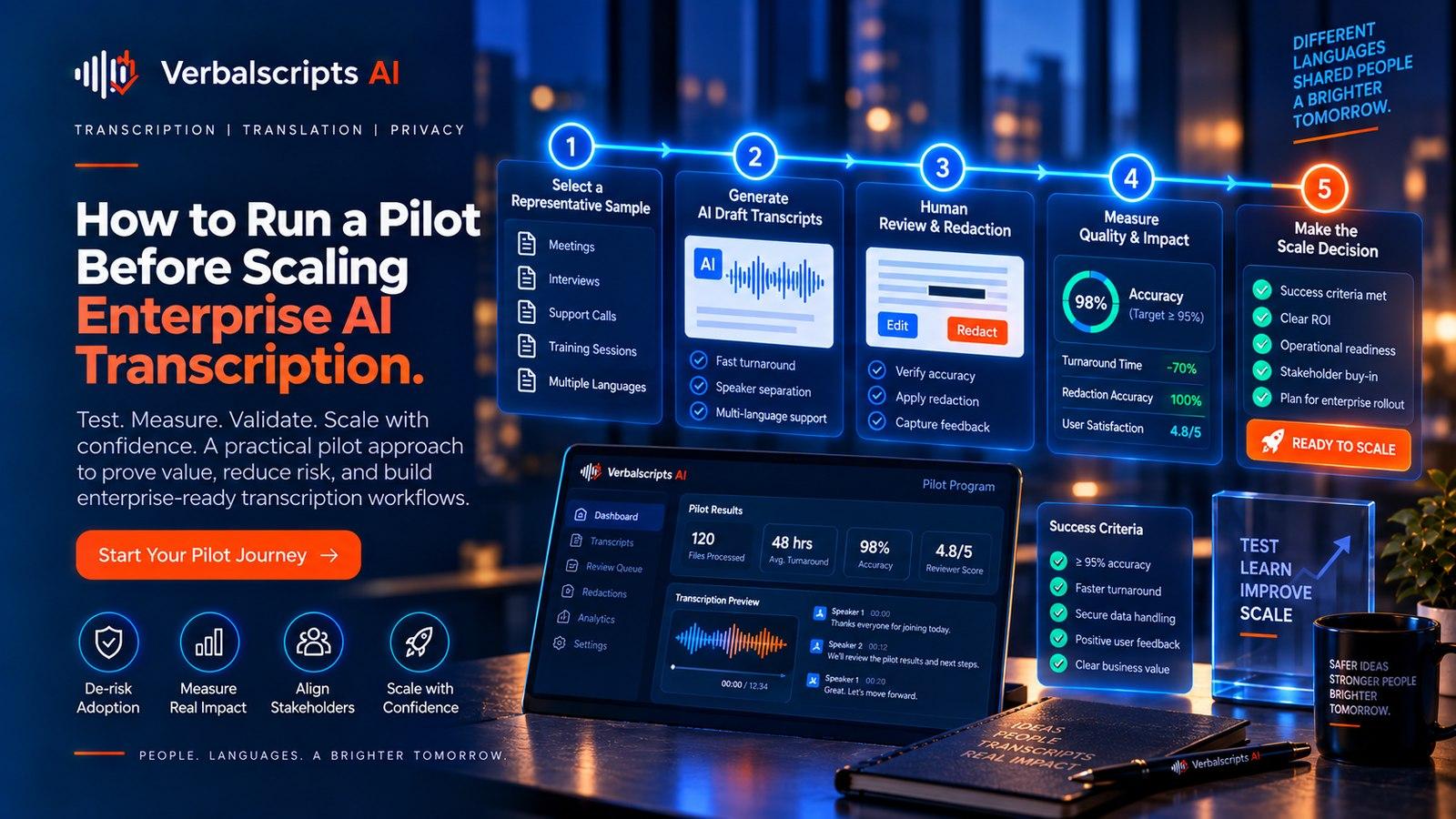
How to Run a Pilot Before Scaling Enterprise AI translation is best approached as an operating-system problem, not a single model decision. Define the target use case, data and quality requirements first; design measurable controls and human-review rules around them; validate the workflow on representative material; and only then scale volume, languages or automation.
Key takeaways
Key Takeaways
- Define quality and acceptance criteria before selecting a model or vendor.
- Evaluate on representative material and report slice-level results, not just one average score.
- Use human review selectively where confidence is low or the consequence of an error is high.
- Capture errors and corrections in structured form so the workflow improves over time.
- Optimize total cost per accepted output, not only raw API or model consumption.
Why This Topic Matters Now
Enterprise language operations become difficult at the points where files, people and systems meet. “How to Run a Pilot Before Scaling Enterprise AI translation” matters because a workflow that looks simple at ten files can become fragile at ten thousand: jobs are duplicated, outputs lose provenance, permissions sprawl, retention becomes unclear and quality exceptions disappear into email. The solution is to design the operating controls at the same time as the automation.
This guide translates that problem into concrete design and evaluation choices. It defines what to specify before implementation, what to measure, how to test difficult cases, where human review adds value, and which security or procurement questions should be answered before the workflow is scaled. The objective is a system that can be audited and improved, not a marketing claim that depends on ideal inputs.
The Core Technical and Operational Issues
The core design question is what evidence would prove that AI translation pilot works for the intended use case. Write that evidence down before selecting the model, vendor or annotation approach.
Then capture the implementation variables (data version, model/profile, terminology, review rules, security configuration and output format) so quality changes can be traced to a specific change rather than guessed after the fact.
A Practical Enterprise Scenario
A useful proof of concept for AI translation should contain a normal slice and a deliberately hard slice. Measure not only output quality but also ingestion failures, review effort, turnaround, delivery success and the ease of explaining why an item failed. Production readiness is the combination of model quality and workflow reliability.
Turn Requirements Into Measurable Service Levels
Start by writing a requirements profile for AI translation. Describe the source material, expected output, languages or locales, domain terminology, expected volume, latency or turnaround needs, downstream systems, security classification and the consequences of an error. A customer-support analytics pipeline can tolerate different errors from a court filing, medical record, model-training corpus or public translation. Treating those uses as equivalent creates false confidence.
Convert the requirements into acceptance criteria. Instead of “high accuracy,” specify the metric, test set, threshold, sampling method and treatment of critical errors. Instead of “fast turnaround,” define when the clock starts, what pauses it, what constitutes delivery and what happens during spikes. Instead of “secure,” specify identity controls, encryption, retention, residency, subprocessor rules and the evidence a vendor must provide. Precise requirements make later vendor comparison and QA much easier.
Accuracy and Quality SLAs
Quality for AI translation must be defined before it can be improved. Establish a reference standard, scoring rules and sampling plan, then separate model errors from workflow errors. The reference itself needs quality control: inconsistent human labels create an evaluation ceiling and can make a better system appear worse.
Combine automatic metrics with human evaluation. BLEU remains useful for reproducible lexical comparison, while semantic metrics such as COMET correlate more closely with human judgments in many research settings. Human analytic evaluation such as MQM makes error type and severity visible, including accuracy, terminology and fluency issues that a single score obscures.
Track severity as well as frequency. A missing comma and a wrong medication name should not carry the same business weight; neither should a stylistic translation choice and an omission that changes meaning. A practical program uses a critical-error taxonomy and defines which errors trigger rejection, mandatory review, customer notification or retraining.
Turnaround, Capacity and Availability
Service levels should separate quality from availability and turnaround. For quality, define the metric and sampling method plus a critical-error standard. For turnaround, specify service windows, queue cutoffs, pause conditions and batch-volume assumptions. For platform availability, specify the API or portal boundary, exclusions, maintenance rules and remedies. For support, use severity-based response targets and escalation paths.
Also define what happens when volume or language mix changes. A provider may meet a two-hour turnaround at 100 files per day and fail at 10,000. Capacity commitments, concurrency, rate limits and surge procedures belong in the SLA when the workflow is business-critical. Review performance monthly or quarterly; an SLA that is never measured becomes a decorative contract term.
Security and Data-Handling Commitments
Security should be mapped to the data lifecycle, not added only at upload. Use TLS for data in transit and strong encryption for stored source files, intermediate artifacts, outputs and backups. Centralize identity, require multi-factor authentication for privileged access, implement least privilege and role separation, and use short-lived credentials or signed URLs for automated retrieval. Secrets should be managed outside code and rotated through a defined process.
Logging must support accountability without becoming a second copy of sensitive content. Record who accessed what, when, from which service or role, and what action occurred; avoid writing transcript text, document content, access tokens or unnecessary PII into operational logs. Protect logs from modification or unauthorized deletion and define retention based on investigation and compliance needs. NIST CSF 2.0 places governance alongside identify, protect, detect, respond and recover, which is a useful reminder that controls require ownership and ongoing review, not just technology.
Vendor security reviews should examine subprocessors, data locations, breach-notification commitments, vulnerability management, penetration testing, key management, backup practices, personnel access, secure development and evidence such as independent assurance reports. Certifications can reduce due-diligence effort, but they do not prove that a particular workflow is configured safely.
Privacy requirements are easiest to satisfy when they are translated into system behavior. Define the purpose of processing, categories of personal data, legal or contractual basis, permitted users, retention period, approved processing locations and deletion workflow before data enters the pipeline. Keep customer data isolated by tenant and prevent support or quality staff from browsing content without a work-related reason.
Apply data minimization: collect only fields and content needed for the purpose, restrict reuse, and avoid keeping source data “just in case.” If content may later be used for analytics or model improvement, treat that as a separate purpose with its own authority, notice, contract terms and controls.
For programs that touch EU personal data, GDPR principles such as purpose limitation, data minimization and storage limitation are directly relevant, and cross-border transfers require an appropriate legal mechanism. Similar principles are useful even when a project is outside GDPR because they force the team to justify data collection, access and retention instead of defaulting to unlimited reuse.
Reporting, Remedies and Governance
A production AI translation pipeline should be observable from intake to delivery. Separate ingestion, validation, processing, quality control, human review, packaging and delivery so each stage can be retried or audited independently. Use stable asset and job identifiers rather than filenames as database keys, because filenames change and may contain information that should not leak into logs.
Represent the workflow as explicit states with clear entry and exit criteria. That makes handoffs measurable and lets teams distinguish a model failure from a file-ingestion failure, a review delay, a delivery error or a customer-side integration issue.
Design for failure from the beginning. Keep retryable and non-retryable errors distinct, cap automated retries, route poisoned or unsupported files to an exception queue, and expose enough context for an operator to act without opening sensitive content unnecessarily. A mature workflow also produces operational metrics: queue age, throughput, failure rate, review rate, rework rate, delivery success and age of unresolved exceptions.
Pilot Before Contracting at Scale
Run a pilot on representative AI translation material before scaling. Include ordinary cases, difficult cases and high-consequence cases. Keep the same files across vendors or model versions, blind reviewers where practical, and use a pre-agreed scoring rubric. Measure quality, turnaround, operational failure rate, review effort, integration effort and cost together.
The pilot should have explicit exit criteria: pass, fail or proceed with conditions. Record unresolved risks and customer responsibilities. If the pilot depends on one-off manual intervention by the vendor, distinguish that from the production design; otherwise the team may approve a quality level that cannot be reproduced at scale.
Failure Modes to Test Before Production
Test AI translation against deliberate failure modes rather than only happy-path examples. Include corrupted or unsupported files, wrong language labels, empty segments, very long content, repeated uploads, partial network failure, duplicate webhook events, model timeouts and review exceptions where relevant. The system should fail visibly and recoverably instead of silently producing incomplete output.
Create a severity model for operational failures. A retryable timeout is different from a data-loss event; a low-confidence word is different from an unsupported file that appears to succeed. Dashboards should separate quality failures, infrastructure failures and policy failures so ownership is obvious.
Governance and Change Control
Treat model changes, prompt changes, glossary updates, annotation-guideline changes and post-processing rules as production changes. Version them, test them, document who approved them and retain the ability to roll back. A silent model upgrade can invalidate benchmark results even when the API endpoint name stays the same.
Establish a recurring review that brings together operations, language/domain quality, engineering and security/privacy. Review benchmark drift, customer escalations, critical errors, throughput, review effort and vendor changes. The goal is to make improvement routine rather than crisis-driven.
Frequently Asked Questions
How to Run a Pilot Before Scaling Enterprise AI Translation?
How to Run a Pilot Before Scaling Enterprise AI translation is best approached as an operating-system problem, not a single model decision. Define the target use case, data and quality requirements first; design measurable controls and human-review rules around them; validate the workflow on representative material; and only then scale volume, languages or automation.
What should enterprises look for in AI translation?
Enterprises should evaluate AI translation against their own data, required languages, workflow, risk level and downstream use. The most important buying criteria are representative quality, operational fit, security, observability, human-review options and total cost, not a generic benchmark claim.
How should AI translation quality be measured?
Use a representative, human-verified test set and more than one metric. Combine an aggregate score with slice-level analysis and a critical-error taxonomy. For high-consequence speech or translation, include qualified human evaluation because a single automatic metric can hide errors in names, numbers, terminology, omissions or meaning.
When is human review necessary for AI translation?
Human review is most valuable when errors have meaningful consequences, the content is difficult or specialized, the language is low-resource, or the output will become a reference artifact. Risk-based routing is usually more efficient than reviewing every file or reviewing none.
Conclusion
The strongest approach to run a pilot before scaling enterprise AI translation is measurable, risk-based and operationally explicit. Define the intended outcome, preserve data provenance, test on representative material, use human expertise where consequences justify it, and make security and quality observable through logs and metrics. That produces a workflow that can improve as models change without forcing the organization to rebuild its governance every time a new model is released.
Verbalscripts AI is positioned around that hybrid model: AI for speed and scale, structured quality controls for consistency, and human expertise for the language, domain and edge cases where review materially changes the outcome. The right deployment is not “AI versus people”; it is a designed system that uses each where it creates the most value.
Research Notes and Sources
This article synthesizes current standards, research and publicly available vendor documentation. Pricing and product features change; verify live vendor terms before procurement. Benchmark/vendor claims are attributed as such and should not be treated as independently reproduced Verbalscripts AI results. For 2027-titled pieces, forward-looking statements are an outlook based on evidence available through September 2026 and should be refreshed before publication.
- NIST Cybersecurity Framework (CSF) 2.0: https://www.nist.gov/publications/nist-cybersecurity-framework-csf-20
- NIST SP 800-53 Rev. 5 Security and Privacy Controls: https://csrc.nist.gov/pubs/sp/800/53/r5/final
- NIST AI Risk Management Framework 1.0: https://www.nist.gov/publications/artificial-intelligence-risk-management-framework-ai-rmf-10
- NIST AI RMF Generative AI Profile: https://www.nist.gov/publications/artificial-intelligence-risk-management-framework-generative-artificial-intelligence
- NIST Privacy Framework: https://www.nist.gov/privacy-framework
- EU GDPR, Regulation (EU) 2016/679: https://eur-lex.europa.eu/eli/reg/2016/679/oj
- EU Artificial Intelligence Act, Regulation (EU) 2024/1689: https://eur-lex.europa.eu/legal-content/EN/TXT/?uri=CELEX:32024R1689