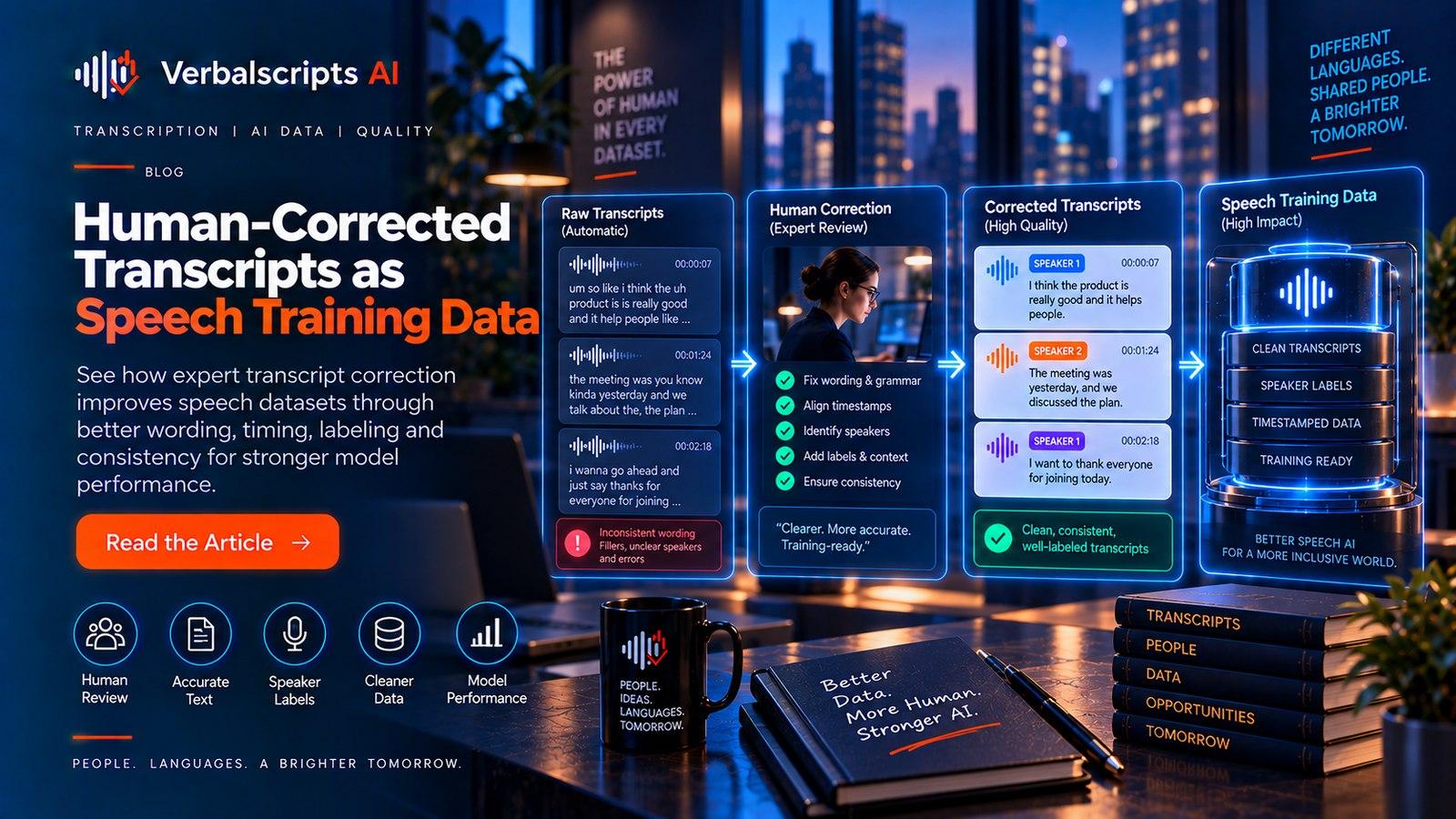
How Human-Corrected Transcripts Become Better Speech Training Data is increasingly relevant to speech AI teams, ML engineers, data leaders, product managers and evaluation teams because speech and multilingual content are no longer side files; they feed research analysis, product decisions and operational systems. The useful question is not simply whether AI can produce text. It is whether the output is accurate enough, structured enough and governed well enough for the next step.
The central problem is distribution mismatch. Speech models learn patterns from particular speakers, languages, devices and acoustic conditions, while real products encounter a wider and changing population. For using human-corrected transcripts as better speech training data, representative tests should deliberately cover two areas (gold-standard transcript quality; and correction provenance) instead of relying on one benchmark headline.
Quick answer
Using human-corrected transcripts as better speech training data works best when teams define the intended use first, provide representative data and context, measure the specific errors that matter, and route uncertain or high-risk output to qualified human review. The best system is not the one with the strongest generic benchmark; it is the one whose measured behavior matches the deployment conditions and acceptance criteria.
How the process works in practice
For using human-corrected transcripts as better speech training data, the speech AI stack begins with digital audio that is segmented or streamed, interpreted by a recognition or modeling system, and converted into text or higher-level labels. Architectures vary, but the engineering questions remain consistent, what data the system has seen, what representation it produces, and how success is measured on unseen speech. In this article, gold-standard transcript quality is one of the key design constraints.
Modern speech systems used for using human-corrected transcripts as better speech training data often combine large pretrained representations with supervised or weakly supervised task adaptation. This reduces the labeled data required for a new task, but does not remove the need for deployment-specific evaluation. Language, accent, channel and domain coverage still determine where errors concentrate; correction provenance should therefore appear in both dataset planning and the held-out test set.
Why the hard cases matter
FLEURS spans 102 languages and was designed for multilingual evaluation. Its dataset documentation itself cautions that read-speech results can differ from noisy production conditions, which reinforces the need for deployment-matched test data.
The practical edge cases in using human-corrected transcripts as better speech training data are predictable, but they are not all equally important. Start with two priority areas (gold-standard transcript quality; and correction provenance) then add cases where context is sparse, the source is noisy or ambiguous, or an automated result triggers a downstream action. Instead of averaging those failures away, make them explicit in the test plan and assign an owner for each exception path.
The quality dimensions to design for
1. Gold-standard transcript quality
Convert gold-standard transcript quality into observable criteria for using human-corrected transcripts as better speech training data. Define the error types reviewers will look for, which errors are critical, how samples are selected, and who adjudicates disagreements. A quality process is stronger when it records correction data rather than returning only “pass” or “fail.” Those corrections reveal whether the model, source material, instructions or reviewer guidance needs improvement and can become future benchmark examples.
2. Correction provenance
Capture correction provenance so using human-corrected transcripts as better speech training data remains reproducible after files move between systems or teams. Useful metadata identifies the source asset, language/locale, recording or document conditions, model/workflow version, annotation or reviewer version, consent/license state and dataset split where relevant. Keep metadata schemas stable and version changes explicitly. Provenance is especially valuable when a later correction must be propagated to training data, analytics, a translated artifact or an audit record.
3. Uncertain-segment adjudication
Convert uncertain-segment adjudication into observable criteria for using human-corrected transcripts as better speech training data. Define the error types reviewers will look for, which errors are critical, how samples are selected, and who adjudicates disagreements. A quality process is stronger when it records correction data rather than returning only “pass” or “fail.” Those corrections reveal whether the model, source material, instructions or reviewer guidance needs improvement and can become future benchmark examples.
4. Normalization consistency
Treat normalization consistency as a design decision within using human-corrected transcripts as better speech training data. Write the requirement in operational terms, attach positive and negative examples, and test it on representative content before scaling. Record not only whether an output passed but why it failed, because recurring error categories are more actionable than one average score. Where the requirement is high risk, add a second source of evidence such as human review, a reference list or a targeted validation rule.
5. Training/evaluation split hygiene
Treat training/evaluation split hygiene as a design decision within using human-corrected transcripts as better speech training data. Write the requirement in operational terms, attach positive and negative examples, and test it on representative content before scaling. Record not only whether an output passed but why it failed, because recurring error categories are more actionable than one average score. Where the requirement is high risk, add a second source of evidence such as human review, a reference list or a targeted validation rule.
A practical production workflow
Step 1: Specify the target population and conditions
Write down languages, accents, devices, channels, domains, noise conditions and user behaviors the system must handle. For using human-corrected transcripts as better speech training data, this step should explicitly verify gold-standard transcript quality. Record the decision in project metadata so later reviewers can reproduce the same rule.
Step 2: Build or select representative data
Use training and evaluation data with enough independent speakers and environment diversity to reflect deployment rather than convenience. For using human-corrected transcripts as better speech training data, this step should explicitly verify correction provenance.
Step 3: Create consistent labels and metadata
Apply transcription, diarization, pronunciation, entity and uncertainty rules consistently; poor labels become model behavior. For using human-corrected transcripts as better speech training data, this step should explicitly verify uncertain-segment adjudication.
Step 4: Train or configure the system
Fine-tune, adapt, apply contextual vocabulary or assemble the production model pipeline while keeping a reproducible version. For using human-corrected transcripts as better speech training data, this step should explicitly verify normalization consistency. Record the decision in project metadata so later reviewers can reproduce the same rule.
Step 5: Evaluate on a frozen benchmark
Score the main metric and important slices using documented normalization and alignment rules. Keep test speakers separated from training. For using human-corrected transcripts as better speech training data, this step should explicitly verify training/evaluation split hygiene.
Step 6: Perform error analysis and iterate
Inspect substitutions, deletions, insertions, speaker errors and domain-specific failures, then collect or correct data targeted to the largest user-impact gaps. For using human-corrected transcripts as better speech training data, this step should explicitly verify active learning from errors.
How to evaluate quality
Evaluate using human-corrected transcripts as better speech training data on held-out, representative recordings and report the metric at both aggregate and slice level. Useful slices include language, accent, channel, noise, speaker group, domain, overlap and utterance length. Lock the normalization/scoring code with the benchmark so a model update cannot improve the reported number by changing preprocessing.
Pair automatic metrics with user-impact checks. For transcription this may include entity accuracy, speaker attribution, post-edit time and critical-word error rate. For voice agents add latency, task completion, repair behavior and safe escalation. The purpose of evaluation is to predict deployment quality, not to maximize one abstract number. For this article, pay particular attention to gold-standard transcript quality and correction provenance.
- Measure or review gold-standard transcript quality; define the unit, source of truth and pass/fail rule before scoring.
- Measure or review correction provenance; define the unit, source of truth and pass/fail rule before scoring.
- Measure or review uncertain-segment adjudication; define the unit, source of truth and pass/fail rule before scoring.
- Measure or review normalization consistency; define the unit, source of truth and pass/fail rule before scoring.
- Measure or review training/evaluation split hygiene; define the unit, source of truth and pass/fail rule before scoring.
Privacy, governance and operational controls
Voice data collected or evaluated for using human-corrected transcripts as better speech training data can be personally revealing even when the transcript is innocuous. Specify consent, allowed uses, retention, redistribution/licensing and whether demographic metadata is optional or required. Keep participant contact information separate from training identifiers and restrict raw recordings according to the promised use. The governance plan should explicitly address gold-standard transcript quality.
Dataset lineage for using human-corrected transcripts as better speech training data should record where each clip came from, which consent or license applies, who annotated it, and which releases include it. That traceability is especially important for correction provenance; training or evaluation data that cannot be connected to a valid use condition becomes a long-term product and audit risk.
Common failure patterns
- Using one average score without a written scoring protocol or high-risk error slices.
- Treating correction provenance as an informal preference instead of a testable requirement with examples and ownership.
- Treating uncertain-segment adjudication as an informal preference instead of a testable requirement with examples and ownership.
- Treating normalization consistency as an informal preference instead of a testable requirement with examples and ownership.
- Changing normalization, formatting or review rules mid-project without versioning the benchmark or output specification.
- Scaling volume before measuring rework and exception rates on a representative pilot.
A good corrective action for using human-corrected transcripts as better speech training data changes the system, not only the current file. If the failure involved gold-standard transcript quality or correction provenance, update the relevant guideline, reference data, validation rule, routing logic or evaluation set so the same class of error is easier to detect next time.
Implementation checklist
- ☐ Write the intended use, target users and unacceptable error types.
- ☐ Use representative inputs rather than only clean demonstration files.
- ☐ Define languages, speakers, devices, noise, domains, annotation and normalization rules.
- ☐ Choose automatic metrics and human review rules that match the deliverable.
- ☐ Document privacy, retention, access, consent or licensing obligations.
- ☐ Preserve version, provenance and source links needed for audit or correction.
Advanced implementation considerations
Design the benchmark before optimizing the system
It is tempting to tune how human-corrected transcripts become better speech training data against whatever data is easiest to obtain. That reverses the logic. First write the deployment population and failure costs, then build a benchmark that represents them. If the benchmark changes every time the model changes, improvement cannot be distinguished from a moving test. Keep one stable regression set and a separate challenge set for newly discovered edge cases.
Separate confidence from correctness
In how human-corrected transcripts become better speech training data, model confidence can help prioritize review, but confidence scores are not automatically calibrated probabilities of correctness. Validate how confidence relates to actual error on your data and on important slices. A high-confidence wrong name or speaker label can be more damaging than a low-confidence harmless filler. Use confidence for routing only after demonstrating that the thresholds behave predictably.
Track correction effort as a product metric
For how human-corrected transcripts become better speech training data, automatic scores describe output similarity; they do not directly describe the labor required to make a deliverable acceptable. Measure review minutes per audio minute, edits per thousand words, escalation rate, or another operational measure that fits the workflow. When two systems have similar accuracy, the one that produces easier-to-review structure can have substantially lower total cost.
Version instructions and reference data
In how human-corrected transcripts become better speech training data, prompts, style guides, glossaries, speaker rosters, annotation rules and normalization code are part of the effective model. Store their versions with the job or dataset. When quality shifts, operators should be able to tell whether the change came from the model, the input mix, the instructions, or human review behavior.
- ☐ Run a pilot, measure rework and exceptions, then scale only after the acceptance criteria are met.
Frequently asked questions
Why is using human-corrected transcripts as better speech training data difficult in production?
For using human-corrected transcripts as better speech training data, production speech includes more variation in speakers, devices, noise, domains and language behavior than most curated benchmarks. That distribution shift exposes failures hidden by clean test data.
How should accuracy be measured?
For using human-corrected transcripts as better speech training data, use a frozen representative benchmark, a documented normalization/scoring protocol and both aggregate and slice-level metrics. Add task-specific measures where WER or CER misses user impact.
Does more training data always help?
For using human-corrected transcripts as better speech training data, only when the data adds relevant, correctly labeled coverage. Large volumes of duplicated, noisy or mismatched speech can provide less value than a smaller targeted dataset.
When is human review useful?
For using human-corrected transcripts as better speech training data, use human correction for benchmark references, ambiguous audio, critical entities, low-resource languages and error analysis. High-quality corrections can also become future training data.
How often should an ASR benchmark be refreshed?
For using human-corrected transcripts as better speech training data, keep a stable regression set for comparability, but add a separately versioned challenge set when users, devices, languages or product conditions materially change.
Conclusion
How Human-Corrected Transcripts Become Better Speech Training Data is most useful when it is treated as a measurable workflow rather than a feature checkbox. Define the source of truth, preserve the context that the next step needs, test the hard cases, and make review depth proportional to risk. The result is faster automation without sacrificing traceability or quality discipline. For Verbalscripts AI, the practical objective is a language-data pipeline that can move from AI speed to human-reviewed reliability when the project requires it, while keeping output structured enough for research, product and enterprise systems.
Research references
- NIST Speech Recognition Scoring Toolkit (SCTK / sclite): https://github.com/usnistgov/SCTK
- Panayotov et al. (2015), LibriSpeech: an ASR corpus based on public domain audio books: https://www.openslr.org/12/
- Mozilla Common Voice datasets: https://commonvoice.mozilla.org/en/datasets
- Conneau et al. (2022), FLEURS: Few-shot Learning Evaluation of Universal Representations of Speech: https://arxiv.org/abs/2205.12446
- Imam et al. (2025), Automatic Speech Recognition for African Low-Resource Languages: https://aclanthology.org/2025.africanlp-1.13/
- Prabhu et al. (2023), Accented Speech Recognition With Accent-specific Codebooks: https://aclanthology.org/2023.emnlp-main.444/