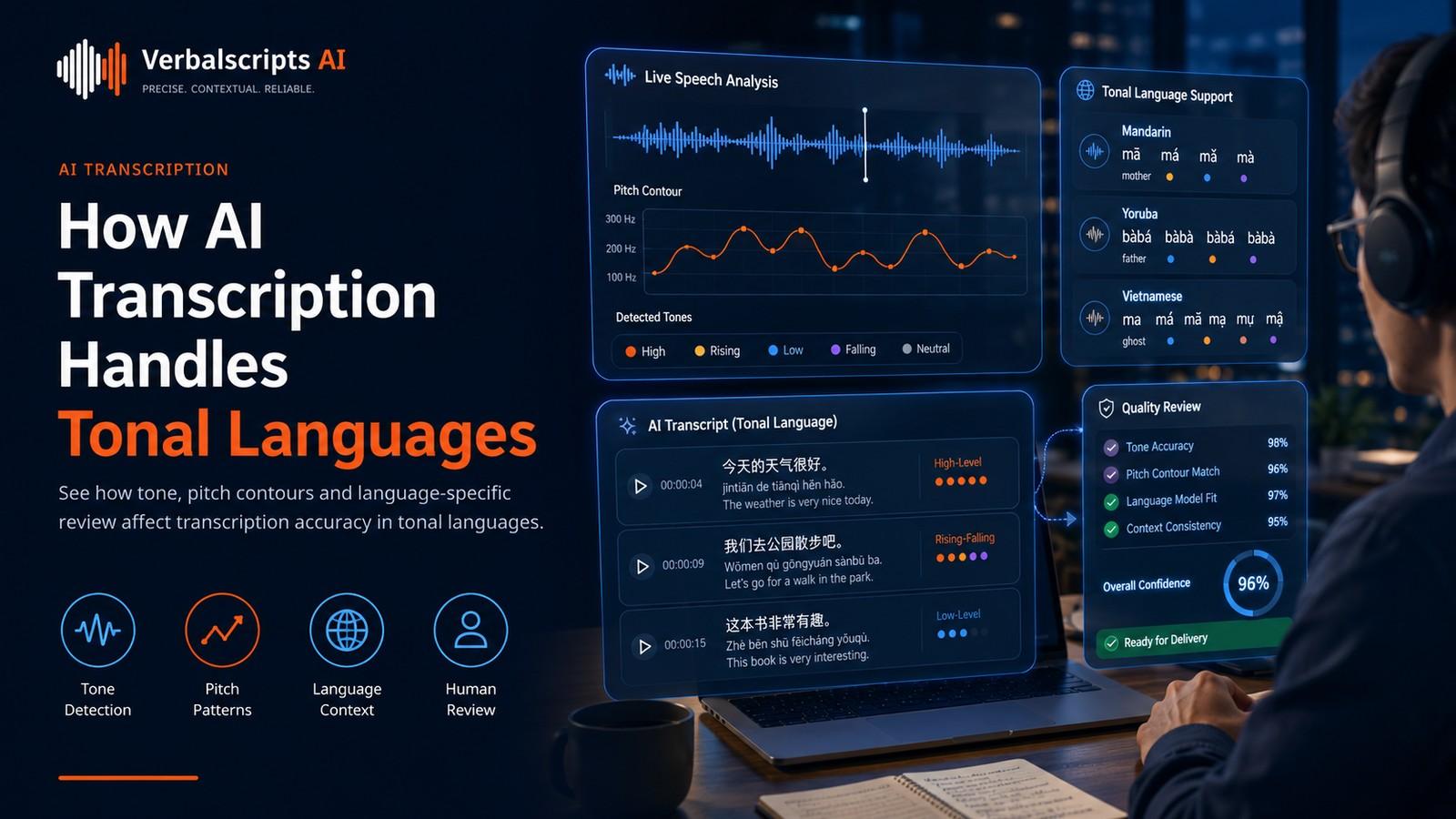
How does AI transcription handle tonal languages? Modern ASR models learn pitch and other acoustic patterns jointly with the rest of the speech signal rather than running a separate “tone detector” in most production systems. They can transcribe tonal languages successfully when training data and orthography are well represented, but tone distinctions may be lost when datasets omit tone marks or when the written standard uses diacritics inconsistently. Quality should be evaluated with language-specific measures in addition to ordinary Word Error Rate.
| SEO title | How AI Transcription Handles Tonal Languages |
|---|---|
| Slug | ai-transcription-tonal-languages |
| Meta description | Learn how AI transcription handles tonal languages, including pitch, lexical tone, diacritics, tone-aware evaluation, low-resource data and human review. |
| Primary keyword | AI transcription tonal languages |
| Search intent | Informational / Technical |
| Hero image | 191-ai-transcription-tonal-languages.jpg |
| Hero alt text | Speech recognition interface showing pitch contours, tone marks and a reviewed transcript in a tonal language |
| Article body words | 1939 |
For production speech-to-text workflows, see our AI Transcription service for the delivery path behind the guidance in this article.
In a tonal language, pitch can help distinguish one word or grammatical form from another. That makes speech recognition more complicated than simply recognizing consonants and vowels.
A transcription system has to capture enough acoustic information to identify the intended lexical item, then represent the result in an orthography that may or may not mark tone explicitly. In low-resource tonal languages, the challenge is amplified by limited speech data, inconsistent diacritic use and tokenization systems that were not designed around tone.
A 2026 Yoruba ASR study explicitly evaluated both Word Error Rate and Tone Error Rate and found that current transformer-based systems still face difficulty when tone is represented explicitly with diacritics.
What is a tonal language?
A tonal language uses pitch patterns as part of lexical or grammatical contrast.
That means two syllables with the same consonants and vowels can carry different meanings depending on pitch.
Tone systems vary. Languages may use:
- two tone levels;
- three or more tone levels;
- contour tones such as rising or falling;
- tone sandhi, where tone changes in context.
The transcription challenge therefore depends on the language, not simply on whether it is “tonal.”
Tone is not the same as intonation
All spoken languages use pitch for things such as:
- emphasis;
- emotion;
- question intonation.
In tonal languages, pitch also helps identify lexical or grammatical meaning.
An ASR model must distinguish language-specific lexical tone from broader prosodic patterns.
How speech models represent tone
Modern neural ASR models process acoustic features or learned representations that retain information about:
- frequency;
- timing;
- spectral structure;
- pitch-related cues.
Self-supervised speech encoders can learn representations from large amounts of unlabeled audio, then be fine-tuned on transcribed data.
Tone is therefore learned as part of the acoustic-to-text mapping.
Tone-marked versus unmarked orthography
A major issue is whether the written language marks tone.
Some languages:
- require tone marks in standard writing;
- mark them only in dictionaries or educational content;
- omit many marks in everyday digital text.
If training transcripts are mostly unmarked, a model may learn to recognize words but not output the full tonal orthography.
This matters for evaluation.
Yoruba example
Standard Yoruba uses diacritics for both:
- tone;
- certain vowel distinctions.
The 2026 study Tone in Yoruba ASR compared tone-marked and non-tone-marked data across several transformer-based ASR systems. It found lower error rates on non-tone-marked text and concluded that tone-aware tokenization, acoustic-text alignment and model objectives remain important areas for improvement.
This does not mean tone should simply be removed. It means the output standard and evaluation objective must be explicit.
Word Error Rate can hide tone mistakes
Suppose a transcript contains the correct base letters but the wrong tone marks.
Depending on tokenization and normalization, a standard WER pipeline may:
- count the whole word as wrong;
- normalize away the diacritics;
- fail to explain whether the lexical sequence or only tone was incorrect.
Language-specific evaluation helps.
Tone Error Rate
Tone Error Rate can measure errors in tone assignment separately from ordinary word recognition.
This is useful when:
- diacritics are required;
- tone carries lexical meaning;
- base word letters are otherwise correct.
A two-level score can therefore answer:
- Did the model recognize the lexical sequence?
- Did it represent tone correctly?
Orthographic normalization
Before measuring quality, define normalization.
Questions:
- Are Unicode combining marks normalized?
- Are tone marks mandatory?
- Is punctuation ignored?
- Are case differences meaningful?
Inconsistent Unicode normalization can make visually identical text compare as different strings.
Use a consistent Unicode normalization policy.
Tone data scarcity
Tonal languages are not inherently low-resource, but many underrepresented tonal languages have limited:
- transcribed speech;
- tone-marked text;
- pronunciation lexicons;
- benchmark datasets.
The broader African low-resource ASR literature identifies data scarcity, linguistic complexity and acoustic variability as important barriers.
Tone adds another dimension to those resource gaps.
Speaker variation
Pitch range differs by:
- speaker;
- age;
- vocal characteristics.
A recognition model must learn relative tonal patterns rather than relying on absolute pitch.
Training data therefore needs speaker diversity.
Tone sandhi
Tone can change according to neighboring words or syllables.
A purely isolated-syllable classifier may fail.
Sequence models benefit from context because the realized acoustic tone may differ from the lexical citation form.
Coarticulation and connected speech
Natural speech contains:
- reduced vowels;
- rapid transitions;
- overlapping tonal contours.
Read speech can be easier than spontaneous conversation.
Benchmark the same kind of speech your product will process.
Noise
Background noise can obscure pitch cues.
Low-frequency hum, poor microphones or compression can affect the acoustic features needed to distinguish tone.
Do not evaluate tonal ASR only on studio recordings if production audio comes from phones.
Multilingual models
Large multilingual speech models can transfer acoustic knowledge across languages.
That can help low-resource tonal languages, but cross-lingual transfer is not automatic proof of good tone recognition.
The target-language training and evaluation data still matter.
Tokenization
Text tokenization affects how the model represents tone-marked forms.
A subword vocabulary trained mostly on unaccented or unrelated languages may fragment tonal orthography inefficiently.
The Yoruba 2026 research specifically points to tokenization as a possible contributor to difficulty with tone-marked text.
Diacritics and keyboards
Human transcripts may omit tone marks because:
- keyboards are inconvenient;
- annotators are inconsistent;
- web text lacks standard marking.
This creates label noise.
Before collecting ASR data, define an annotation standard and provide proper input tools.
Human review
Reviewers should:
- understand the language;
- know the target orthography;
- have audio access.
A reviewer unfamiliar with tone-marking conventions may “correct” a valid form incorrectly.
For publishable or research transcripts, use qualified language reviewers.
Source transcript versus normalized transcript
Some workflows can store two layers:
Verbatim linguistic transcript
Full standard orthography with tone marks.
Search/readability normalized form
Potentially simplified for downstream systems.
Do not throw away the richer source representation merely because a search engine handles the simplified form better.
Search and indexing
Search systems may need normalization so users can find:
- tone-marked;
- unmarked forms.
Index aliases.
The display transcript can still retain correct orthography.
Names
Names in tonal languages may also require tone marks.
Use authoritative spelling where available.
ASR can be especially weak on names because they occur rarely in training data.
Custom vocabulary
Provider vocabulary hints can help with:
- names;
- specialist terms.
But a vocabulary list does not by itself solve tone recognition.
The acoustic model still needs to distinguish pitch patterns.
Fine-tuning
For a specialized tonal-language deployment:
- collect representative speech;
- transcribe consistently;
- normalize Unicode;
- fine-tune;
- evaluate WER + tone-specific error.
Ensure evaluation speakers are not the same people as training speakers.
Quality test set
Include:
- minimal tone contrasts;
- spontaneous speech;
- different speakers;
- noise;
- code-switching if relevant;
- proper names.
A generic test set can hide tone-specific weaknesses.
Code-switching
A tonal language may be mixed with a non-tonal language.
The model must:
- recognize language boundaries;
- retain tonal-language words.
Do not assume English words inside the utterance should receive local tone marks.
Translation downstream
If the transcript is later translated, a tone error can become a meaning error.
This makes source ASR quality especially important.
A target translation may look fluent while being based on the wrong tonal word.
A practical QA workflow
- define orthography;
- normalize text encoding;
- measure WER/CER;
- measure tone-specific accuracy;
- inspect lexical minimal contrasts;
- review names;
- native-speaker audit;
- track error by acoustic condition.
This produces more useful insight than one global WER.
Tone-aware confidence and review routing
A production system can route segments for review when:
- the lexical word is high confidence but tone marking is uncertain;
- a minimal-pair word changes a critical instruction;
- names contain tone marks not represented reliably;
- the recording is noisy enough to distort pitch contours.
This is more efficient than reviewing every syllable equally.
Data-collection recommendation
If the goal is fully tone-marked output, collect training data in the same standard. Mixing tone-marked and unmarked transcripts without metadata teaches the model inconsistent targets.
Useful dataset fields include:
- orthography version;
- whether tone is fully marked;
- annotator;
- review status;
- recording condition.
This makes later model comparisons interpretable.
Tone and text normalization
Do not normalize away tone marks before quality evaluation merely to improve headline WER. Keep at least two metrics:
- normalized lexical score;
- full orthographic score.
The first measures broad recognition. The second measures the actual deliverable users receive.
Human-review productivity
For languages with diacritic-heavy orthography, reviewer tools should make mark entry easy. Custom keyboard layouts, shortcuts or correction suggestions can reduce post-edit time substantially.
Poor input tooling can create human annotation inconsistency that later looks like model error.
Downstream NLP consequences
Tone/diacritic errors can affect:
- search;
- translation;
- named-entity recognition;
- text-to-speech.
If the transcript feeds other AI systems, preserve the richest correct orthography possible and normalize only in derived fields when downstream tools need it.
Final deployment principle
A tonal-language ASR system should be evaluated against the actual writing standard users expect. If the product displays full tone marking, the benchmark must measure it. If the product intentionally uses an accepted unmarked style, the evaluation should state that clearly.
Final evaluation rule
If the product promises tone-marked orthography, require tone-aware human sampling even when general WER is excellent. A system should not claim complete tonal-language transcription quality while its evaluation normalizes away the very marks that carry lexical information.
Implementation takeaway
For production use, treat tone-sensitive orthography, tone-error evaluation and native-review routing as measurable parts of the workflow rather than assumptions. Define the relevant policy before processing content, keep the model or data configuration versioned, and verify results on representative material from the actual language, locale and domain. If automation produces a result that conflicts with a deterministic rule, authoritative terminology or qualified human evidence, escalate the item instead of averaging the disagreement away. The most durable multilingual systems preserve source-to-target traceability, record exceptions and feed reviewed corrections back into benchmarks, glossaries or routing rules. That discipline makes quality improvements reproducible when models, providers, reviewers or source content change.
Frequently asked questions
Do ASR systems need a separate tone-recognition model?
Not necessarily. Modern end-to-end systems generally learn tonal acoustic cues jointly, though specialized tone-aware architectures can improve representation.
Can a transcript omit tone marks and still be correct?
Only if the project’s accepted orthography permits it. For languages where tone marks are required for standard writing or meaning, omission reduces quality.
Is WER enough for tonal languages?
Often not. Tone-specific or diacritic-sensitive evaluation can reveal errors hidden by normalization.
Are tonal languages harder for AI?
They present additional acoustic and orthographic requirements; actual difficulty also depends on data volume, model coverage and recording quality.
What should reviewers check first?
Lexical contrasts, required diacritics, names and low-confidence segments.
Conclusion
AI can transcribe tonal languages, but tone should not be treated as an invisible detail.
The acoustic model must learn pitch-based distinctions, the transcription data must represent the intended orthography consistently and the quality framework must measure tone when tone matters.
For underrepresented tonal languages, better data, tone-aware modeling and qualified human review remain central to reliable transcription.
Research references
- Olusanya, Tone in Yoruba ASR (LoResLM 2026):
- Imam et al., African Low-Resource ASR (AfricaNLP 2025):
- Yadav & Sitaram, Multilingual ASR survey (LREC 2022):