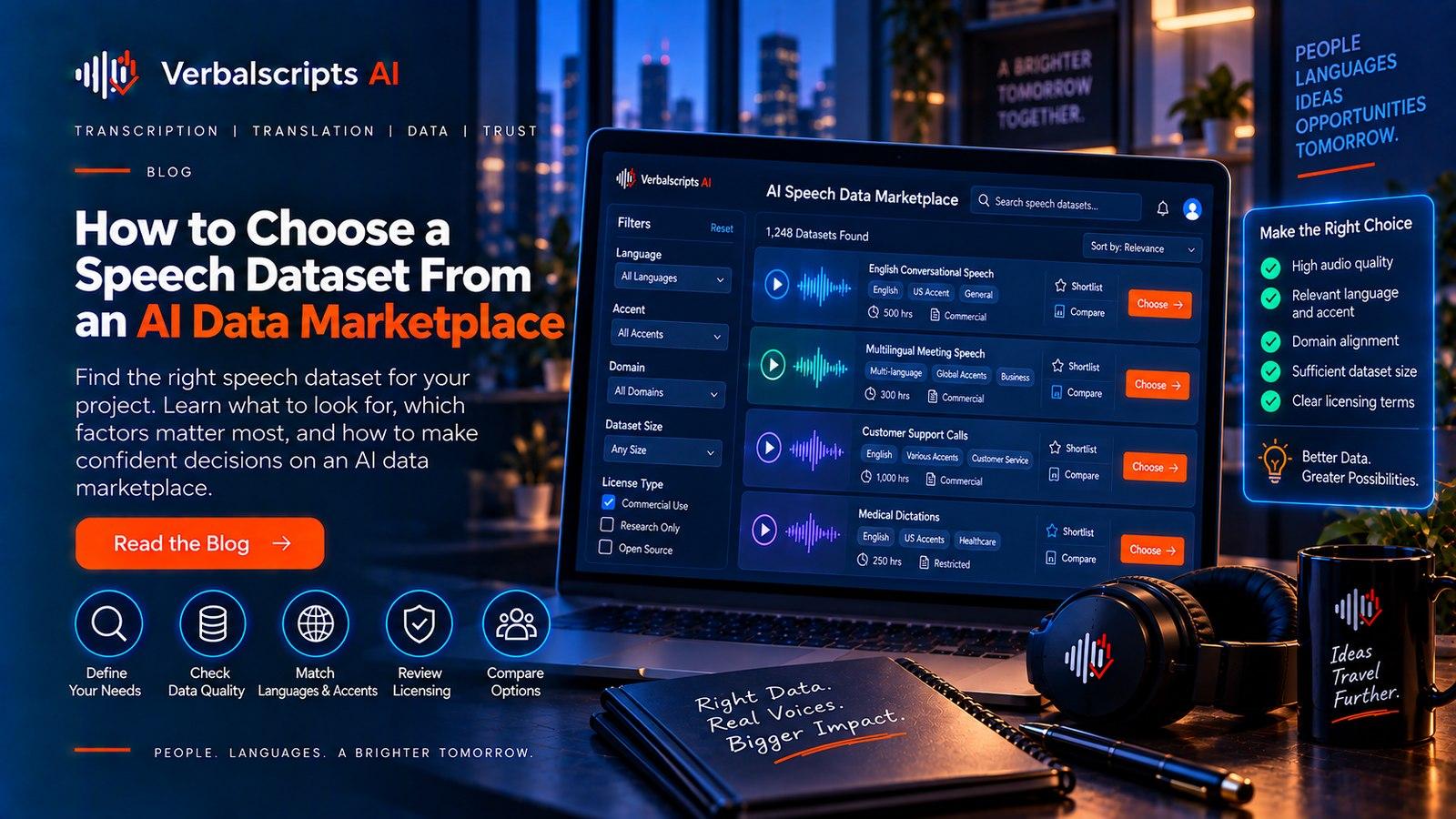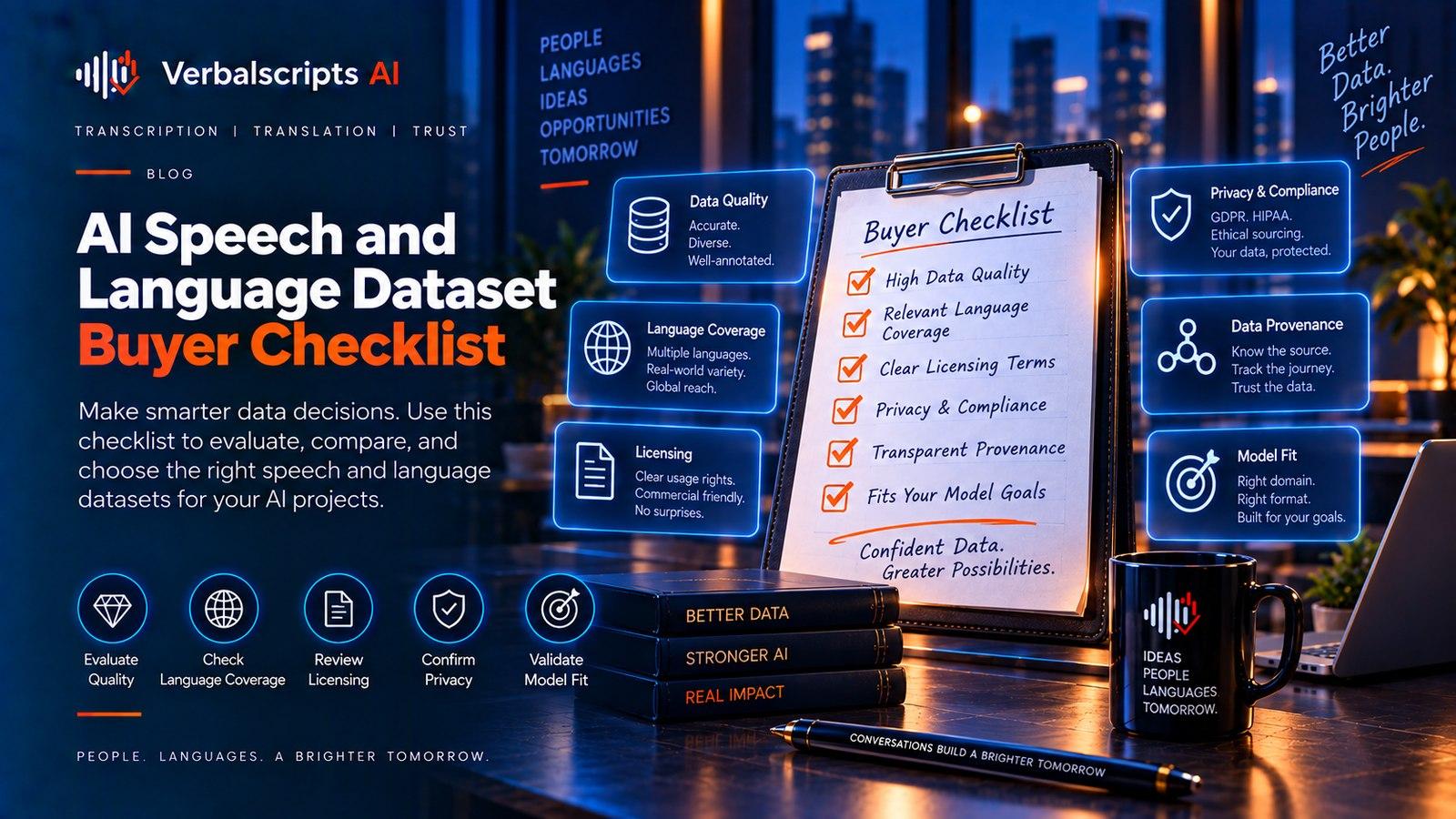
High-quality speech dataset data is fit for a defined model task, legally usable, representative of the intended population and conditions, consistently labelled, traceable to its source, and validated with measurable quality controls. Volume matters, but more data does not compensate for unclear consent, weak metadata, label noise, leakage or poor domain coverage.
Key takeaways
Key Takeaways
- Define quality and acceptance criteria before selecting a model or vendor.
- Treat provenance, licensing, metadata and split integrity as core data-quality dimensions.
- Use human review selectively where confidence is low or the consequence of an error is high.
- Capture errors and corrections in structured form so the workflow improves over time.
- Optimize total cost per accepted output, not only raw API or model consumption.
Why This Topic Matters Now
Speech and language datasets are production assets, not anonymous piles of examples. For “AI Speech and Language Dataset Buyer Checklist,” the key question is whether every record is usable for the intended model task and whether the organization can explain where it came from, how it was transformed, how it was labelled and where its limitations are.
This guide translates that problem into concrete design and evaluation choices. It defines what to specify before implementation, what to measure, how to test difficult cases, where human review adds value, and which security or procurement questions should be answered before the workflow is scaled. The objective is a system that can be audited and improved, not a marketing claim that depends on ideal inputs.
The Core Technical and Operational Issues
The core design question is what evidence would prove that AI dataset buyer checklist works for the intended use case. Write that evidence down before selecting the model, vendor or annotation approach.
Then capture the implementation variables (data version, model/profile, terminology, review rules, security configuration and output format) so quality changes can be traced to a specific change rather than guessed after the fact.
A Practical Enterprise Scenario
Suppose an ASR team acquires 5,000 hours of speech. If most clips come from a small number of speakers, metadata is incomplete and the test set contains the same speakers as training, the apparent scale is misleading. A smaller dataset with verified rights, diverse speakers/conditions, clean labels and leakage-resistant splits can produce more trustworthy learning and evaluation.
What “High Quality” Means for This Data
High-quality speech dataset data is purpose-specific. Start from the intended model behavior and work backward to the examples, labels and metadata needed to learn or test that behavior. Define inclusion and exclusion rules before collection begins; otherwise the dataset accumulates whatever is easiest to acquire rather than what the model needs.
Measure coverage across the conditions the target model will see: languages/locales, accents, devices, acoustic environments, speaker demographics where lawful and appropriate, domains, utterance length and rare phenomena. “More hours” is not synonymous with “more coverage.”
Quality control should combine automated validation and human review. Automated checks can catch missing fields, invalid timestamps, impossible durations, duplicate files, label-schema violations, language mismatches and train/test overlap. Human review is needed for semantic correctness, boundary judgment, speaker attribution, nuanced language and culturally specific issues. Track reviewer agreement and adjudication rates as signals of guideline quality.
Document the dataset like a product. A useful datasheet or dataset card describes motivation, composition, collection, preprocessing, annotation, known limitations, licensing, intended uses, out-of-scope uses and maintenance. That documentation makes later procurement and model-governance decisions much safer.
Licensing, Consent and Rights Management
Provenance answers a simple but high-stakes question: where did each data item come from, and what allows you to use it for this purpose? Maintain source identifiers, collection method, contributor or supplier, consent or license reference, transformations, annotation versions and chain of custody. If provenance is only stored in a slide deck or vendor email, it will be difficult to verify when a dataset changes hands.
License review should cover commercial use, model training, derivative works, redistribution, geographic restrictions, attribution, share-alike obligations, personal-data rights and termination. “Publicly accessible” does not mean “licensed for model training,” and a permissive content license does not automatically resolve privacy, publicity or contractual restrictions relating to a recorded person.
For purchased datasets, require warranties or representations that are specific enough to test, plus an audit trail for removals and rights requests. Maintain a process to quarantine or delete affected records and to identify which training or evaluation artifacts were derived from them. Good provenance reduces the cost of responding when a license changes or a contributor withdraws permission.
Privacy requirements are easiest to satisfy when they are translated into system behavior. Define the purpose of processing, categories of personal data, legal or contractual basis, permitted users, retention period, approved processing locations and deletion workflow before data enters the pipeline. Keep customer data isolated by tenant and prevent support or quality staff from browsing content without a work-related reason.
Apply data minimization: collect only fields and content needed for the purpose, restrict reuse, and avoid keeping source data “just in case.” If content may later be used for analytics or model improvement, treat that as a separate purpose with its own authority, notice, contract terms and controls.
For programs that touch EU personal data, GDPR principles such as purpose limitation, data minimization and storage limitation are directly relevant, and cross-border transfers require an appropriate legal mechanism. Similar principles are useful even when a project is outside GDPR because they force the team to justify data collection, access and retention instead of defaulting to unlimited reuse.
Design the Annotation or Data Specification
Start by writing a requirements profile for speech dataset. Describe the source material, expected output, languages or locales, domain terminology, expected volume, latency or turnaround needs, downstream systems, security classification and the consequences of an error. A customer-support analytics pipeline can tolerate different errors from a court filing, medical record, model-training corpus or public translation. Treating those uses as equivalent creates false confidence.
Convert the requirements into acceptance criteria. Instead of “high accuracy,” specify the metric, test set, threshold, sampling method and treatment of critical errors. Instead of “fast turnaround,” define when the clock starts, what pauses it, what constitutes delivery and what happens during spikes. Instead of “secure,” specify identity controls, encryption, retention, residency, subprocessor rules and the evidence a vendor must provide. Precise requirements make later vendor comparison and QA much easier.
Human review should be risk-based rather than all-or-nothing. Route cases using confidence, domain, language, customer requirements and the potential cost of an error. High-confidence, low-risk material may pass automatically after sampling; low-confidence or high-consequence material should receive full review. Sampling should also include apparently easy cases so silent regressions are not missed.
Review instructions need examples, not only principles. Define how to handle names, numbers, abbreviations, speaker identity, inaudible content, code-switching, terminology, omissions, additions, formatting and ambiguous source material. Calibrate reviewers on a shared set, compare disagreement, adjudicate recurring edge cases and update the guideline. Human review becomes more consistent when reviewers are measuring the same definition of “correct.”
Capture corrections structurally. Store the original model output, corrected output, error category, severity and context where permitted. That turns review from a cost center into evaluation and improvement data, while maintaining a clear audit trail of what changed and by whom.
Metadata, Provenance and Documentation
Metadata is the control plane for large language operations. At minimum, track a stable asset ID, project or tenant, source type, language/locale, creation or capture date, size/duration or word count, checksum, processing profile, confidentiality class, retention rule, consent or license reference, job status and output relationships. For multilingual work, distinguish language from locale because writing conventions, terminology, date formats and regulatory constraints may differ within the same language.
Use a schema with controlled values rather than free-text labels. ISO language and locale codes, versioned workflow profiles and enumerated status values reduce ambiguity across systems. Preserve source metadata separately from derived metadata so the organization can tell what came from the customer, what was inferred by a model, what was added by a reviewer and what changed after delivery. This provenance becomes especially important when outputs are later reused for model training or evaluation.
Provenance answers a simple but high-stakes question: where did each data item come from, and what allows you to use it for this purpose? Maintain source identifiers, collection method, contributor or supplier, consent or license reference, transformations, annotation versions and chain of custody. If provenance is only stored in a slide deck or vendor email, it will be difficult to verify when a dataset changes hands.
License review should cover commercial use, model training, derivative works, redistribution, geographic restrictions, attribution, share-alike obligations, personal-data rights and termination. “Publicly accessible” does not mean “licensed for model training,” and a permissive content license does not automatically resolve privacy, publicity or contractual restrictions relating to a recorded person.
For purchased datasets, require warranties or representations that are specific enough to test, plus an audit trail for removals and rights requests. Maintain a process to quarantine or delete affected records and to identify which training or evaluation artifacts were derived from them. Good provenance reduces the cost of responding when a license changes or a contributor withdraws permission.
Prevent Leakage and Build Defensible Splits
Create train, validation and test splits at the correct unit. In speech, splitting random clips from the same speaker across train and test can inflate performance because the model has effectively seen the voice before. In document translation, near-duplicate sentences, template boilerplate or versions of the same document can leak across splits. Group by speaker, conversation, source document or collection episode where appropriate.
Deduplicate both exact and near-duplicate content before finalizing the splits. Preserve a frozen test set that is never used for tuning prompts, choosing checkpoints or adjusting annotation guidelines after seeing results. When the production distribution changes, add a new evaluation slice rather than silently replacing the historical test set; that preserves comparability over time.
Quality Control and Acceptance Testing
Quality for speech dataset must be defined before it can be improved. Establish a reference standard, scoring rules and sampling plan, then separate model errors from workflow errors. The reference itself needs quality control: inconsistent human labels create an evaluation ceiling and can make a better system appear worse.
Choose metrics that reflect the downstream task, and report distributions and worst slices rather than only averages. A dataset or workflow that is excellent on the dominant slice may still fail the users who matter most.
Track severity as well as frequency. A missing comma and a wrong medication name should not carry the same business weight; neither should a stylistic translation choice and an omission that changes meaning. A practical program uses a critical-error taxonomy and defines which errors trigger rejection, mandatory review, customer notification or retraining.
Buying, Building and Auditing the Dataset
Compare providers using a weighted scorecard tied to your speech dataset use case. Typical dimensions are representative quality, language/locale coverage, latency and throughput, human-review capability, API and file-format support, security and privacy, data residency, administration, observability, support, roadmap stability and total cost. Weighting forces stakeholders to state what actually matters instead of choosing the vendor with the strongest demo.
Require evidence for each score. “Supports 100 languages” should become a tested list of locales and quality results. “SOC 2” should become the scope and date of the report plus any customer responsibilities. “99% accuracy” should become the dataset, metric, normalization and sample size behind the claim. If evidence is unavailable, mark the criterion unknown rather than assuming the marketing statement is comparable.
Run a pilot on representative speech dataset material before scaling. Include ordinary cases, difficult cases and high-consequence cases. Keep the same files across vendors or model versions, blind reviewers where practical, and use a pre-agreed scoring rubric. Measure quality, turnaround, operational failure rate, review effort, integration effort and cost together.
The pilot should have explicit exit criteria: pass, fail or proceed with conditions. Record unresolved risks and customer responsibilities. If the pilot depends on one-off manual intervention by the vendor, distinguish that from the production design; otherwise the team may approve a quality level that cannot be reproduced at scale.
Failure Modes to Test Before Production
Test speech dataset against deliberate failure modes rather than only happy-path examples. Include corrupted or unsupported files, wrong language labels, empty segments, very long content, repeated uploads, partial network failure, duplicate webhook events, model timeouts and review exceptions where relevant. The system should fail visibly and recoverably instead of silently producing incomplete output.
Create a severity model for operational failures. A retryable timeout is different from a data-loss event; a low-confidence word is different from an unsupported file that appears to succeed. Dashboards should separate quality failures, infrastructure failures and policy failures so ownership is obvious.
Governance and Change Control
Treat model changes, prompt changes, glossary updates, annotation-guideline changes and post-processing rules as production changes. Version them, test them, document who approved them and retain the ability to roll back. A silent model upgrade can invalidate benchmark results even when the API endpoint name stays the same.
Establish a recurring review that brings together operations, language/domain quality, engineering and security/privacy. Review benchmark drift, customer escalations, critical errors, throughput, review effort and vendor changes. The goal is to make improvement routine rather than crisis-driven.
Frequently Asked Questions
What should enterprises look for in speech dataset?
Enterprises should evaluate speech dataset against their own data, required languages, workflow, risk level and downstream use. The most important buying criteria are representative quality, operational fit, security, observability, human-review options and total cost, not a generic benchmark claim.
How should speech dataset quality be measured?
Use a representative, human-verified test set and more than one metric. Combine an aggregate score with slice-level analysis and a critical-error taxonomy. For high-consequence speech or translation, include qualified human evaluation because a single automatic metric can hide errors in names, numbers, terminology, omissions or meaning.
When is human review necessary for speech dataset?
Human review is most valuable when errors have meaningful consequences, the content is difficult or specialized, the language is low-resource, or the output will become a reference artifact. Risk-based routing is usually more efficient than reviewing every file or reviewing none.
How do you verify the provenance and licensing of speech dataset data?
Require source-level provenance, the applicable license or consent basis, transformation history, annotation version and a process for rights requests. A dataset-level “commercial use allowed” badge is not enough when records come from multiple sources or contain personal data.
Conclusion
The strongest approach to ai speech and language dataset buyer checklist is measurable, risk-based and operationally explicit. Define the intended outcome, preserve data provenance, test on representative material, use human expertise where consequences justify it, and make security and quality observable through logs and metrics. That produces a workflow that can improve as models change without forcing the organization to rebuild its governance every time a new model is released.
Verbalscripts AI is positioned around that hybrid model: AI for speed and scale, structured quality controls for consistency, and human expertise for the language, domain and edge cases where review materially changes the outcome. The right deployment is not “AI versus people”; it is a designed system that uses each where it creates the most value.
Research Notes and Sources
This article synthesizes current standards, research and publicly available vendor documentation. Pricing and product features change; verify live vendor terms before procurement. Benchmark/vendor claims are attributed as such and should not be treated as independently reproduced Verbalscripts AI results. For 2027-titled pieces, forward-looking statements are an outlook based on evidence available through September 2026 and should be refreshed before publication.
- Hugging Face Dataset Cards documentation: https://huggingface.co/docs/hub/datasets-cards
- Mozilla Common Voice datasets: https://commonvoice.mozilla.org/en/datasets
- Gebru et al., Datasheets for Datasets: https://arxiv.org/abs/1803.09010
- EU AI Act data governance requirements: https://eur-lex.europa.eu/legal-content/EN/TXT/?uri=CELEX:32024R1689
- NIST AI Risk Management Framework 1.0: https://www.nist.gov/publications/artificial-intelligence-risk-management-framework-ai-rmf-10
- Meta SeamlessM4T / Seamless Communication research: https://ai.meta.com/research/seamless-communication/