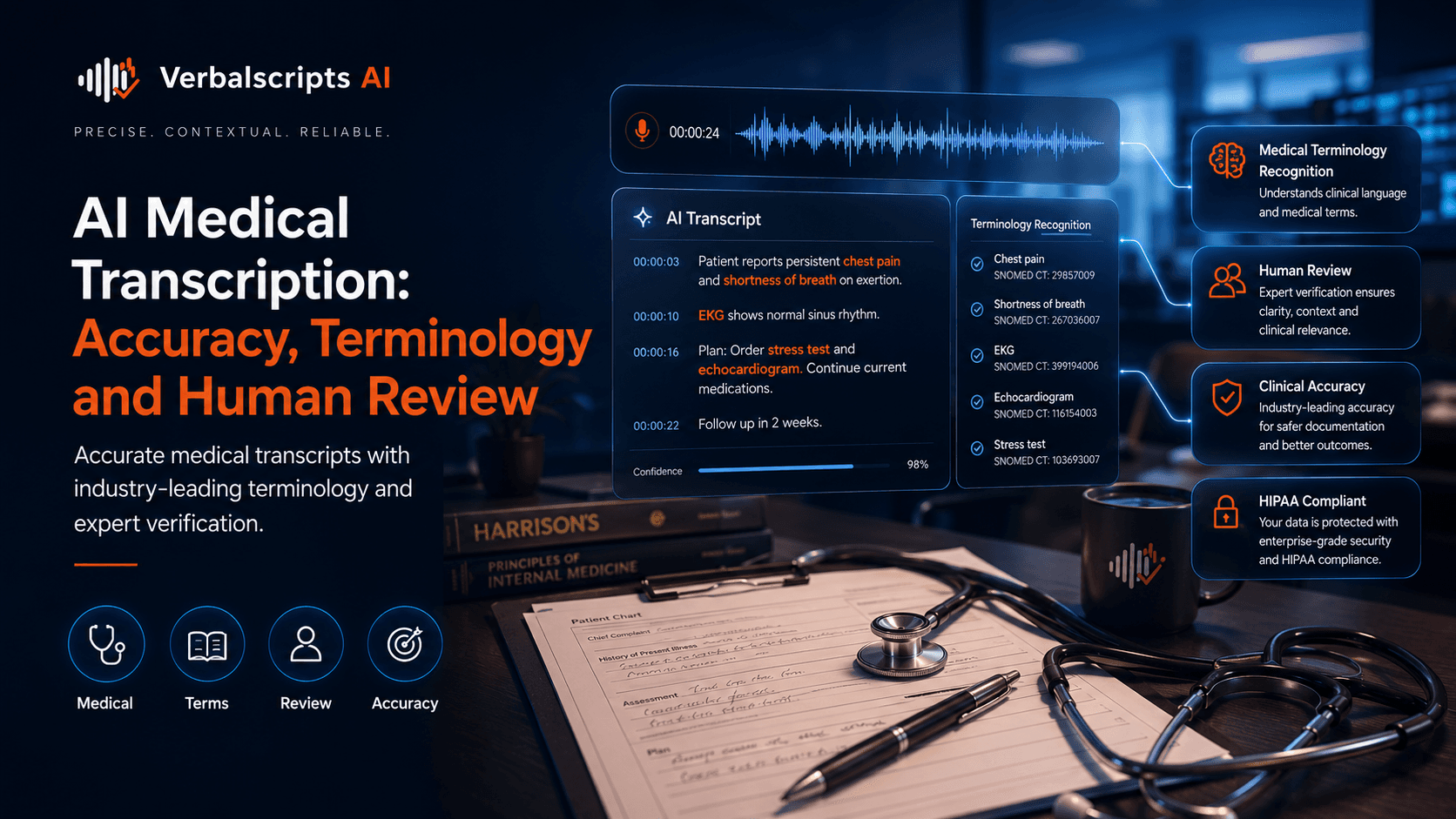
The practical question behind “AI Medical Transcription: Accuracy, Terminology and Human Review” is how to produce text that remains useful after the model finishes. Medical transcription sits between messy real-world audio and downstream systems that expect structure, consistency and traceability. A production workflow has to consider the model, the source recording, the review process and the final deliverable together.
For the product workflow, see AI Transcription. This guide focuses on the practical quality, workflow and buyer questions around the topic rather than product mechanics.
Key takeaways
Key takeaways
- Treat medical transcription as an end-to-end workflow, not just a model output.
- Evaluate quality on representative material and include custom vocabulary and term lists, contextual disambiguation and formatting conventions in the test plan.
- Use human review where the cost of a wrong word, speaker, number, name or translation is materially higher than the cost of checking it.
- Keep source, instructions, output and revisions traceable so teams can reproduce and audit important corrections.
- Judge the final deliverable by its downstream task: search, evidence, captions, analytics, localization, records, accessibility or another AI workflow.
1. Understanding medical transcription
Medical transcription applies the same ASR fundamentals to a specific operating context, but the acceptance criteria change with the use case. The ‘right’ transcript is defined by who will use it, what decisions it supports, and which errors would be material.
For this use case, quality usually depends on a combination of speaker attribution, terminology, context, source quality and document structure. A generic speech-to-text output may be useful as a draft but still require role labels, timestamps, formatting or human verification before it becomes the final record.
The most reliable implementation starts by writing the deliverable specification first: verbatim or clean-read policy, speaker naming, treatment of unclear audio, required time references, file format, confidentiality, review depth and turnaround.
2. What determines quality
Custom Vocabulary And Term Lists. Supplying likely names, products and domain terms can reduce ambiguity when the system supports contextual vocabulary or when reviewers use a glossary.
Contextual Disambiguation. Speech can be acoustically ambiguous. Agendas, prior sentences, speaker roles and domain context can distinguish plausible alternatives.
Formatting Conventions. Numbers, dates, addresses, acronyms and capitalization can be transcribed in more than one valid style. Define a style rule so quality is judged consistently.
Reference Materials Supplied By The Customer. Speaker rosters, case captions, agendas, glossaries and slide decks provide high-value context that neither audio nor a generic model contains on its own.
Human Verification Of High-Impact Entities. A small number of names, amounts, dates or identifiers may carry disproportionate risk. Targeted human verification can be more efficient than equal review of every word.
Clinical Terminology. Drug names, anatomy, abbreviations and similar-sounding clinical terms need domain-aware review because a fluent error can still be clinically material.
These factors interact. A glossary can reduce terminology errors but cannot recover speech lost to clipping; a clean microphone can improve recognition but cannot resolve an ambiguous name without context. The safest way to understand performance is to test the complete workflow on representative material.
3. A practical decision framework
The point of the framework is not to force every project into the same quality tier. It is to make tradeoffs explicit. A searchable internal archive, for example, may value throughput and broad recall; a legal or medical deliverable may prioritize exact names, numbers, attribution and review even if that adds time.
4. Recommended workflow
1. Capture or prepare the best available source. For medical transcription, preserve the original media whenever possible. Avoid unnecessary re-encoding and collect contextual material such as speaker names, agendas, glossaries or expected terminology.
2. Configure the task explicitly. Set language, output style, speaker requirements, timestamps, verbatim policy, formatting and any domain vocabulary. Ambiguous instructions create inconsistent transcripts.
3. Generate the first-pass output. Run the AI workflow while retaining source-to-output traceability. At scale, track file IDs, status, configuration and any processing failures.
4. Review the errors that matter. Listen to or inspect low-confidence and high-impact spans, then verify names, numbers, speaker labels, terminology, overlap and unclear passages according to the use case.
5. Finalize, export and validate downstream use. Deliver the transcript in the right format, run final checks after edits, and confirm that timestamps, speaker labels and metadata still align with the source.
5. Common failure modes to avoid
- Trusting phonetic guesses for names. Build a specific control for this failure mode rather than relying on a general accuracy promise.
- Inconsistent acronym expansion. Build a specific control for this failure mode rather than relying on a general accuracy promise.
- Changing number formats without a style rule. Build a specific control for this failure mode rather than relying on a general accuracy promise.
- Ignoring customer glossaries. Build a specific control for this failure mode rather than relying on a general accuracy promise.
- Failing to distinguish uncertainty from certainty. Build a specific control for this failure mode rather than relying on a general accuracy promise.
- Sending sensitive files through unmanaged channels. Build a specific control for this failure mode rather than relying on a general accuracy promise.
Failure analysis is especially valuable because average metrics can hide concentrated problems. A system may perform well overall but repeatedly fail on a particular accent, speaker role, language pair, product name or recording channel. Those recurring errors are often more actionable than a single global score.
6. How to evaluate a system or provider
Representative evidence. Use source files that reflect your normal work plus realistic edge cases. Ask for results on your material, not only benchmark claims.
Transparent quality definition. Define what counts as an error and what matters most: words, speakers, timestamps, names, numbers, formatting, meaning, omissions or downstream task success.
Review and correction process. Understand what is automatic, what receives human review, who performs that review, what reference materials are used, and how corrections are tracked.
Security and retention. Document how files are transferred, accessed, stored, retained and deleted. Sensitive workflows need controls proportional to the data and the consequences of exposure.
Operational fit. Check supported formats, turnaround, scale, API or batch behavior, revision handling, support, and whether the final output integrates cleanly with your tools.
For model and workflow evaluation, explore Verbalscripts AI Evaluation and use a pilot that mirrors your production mix.
7. Production implementation notes for medical transcription
- Treat clinical terms, drug names, dosages, measurements and patient identifiers as high-priority verification fields.
- Minimize PHI exposure by limiting access, avoiding uncontrolled share links and defining retention/deletion before files enter the workflow.
- Distinguish transcription support from clinical decision-making. A readable transcript is not a substitute for the clinician or authorized record workflow.
- Use human review when terminology ambiguity or small numerical errors could materially change interpretation.
- Document where the audio, transcript and reviewed version are stored and which systems receive them downstream.
8. Illustrative workflow example
Consider a team processing a representative batch for medical transcription. The team keeps the original files, defines speaker/timestamp/style rules, supplies known names and terminology, generates the first pass, routes high-risk or uncertain spans to review, and records corrections before export. The example is illustrative rather than a client case study; its purpose is to show how model output, review and document controls fit together.
During the pilot, the team records not only an overall error rate but which errors consume reviewer time: speaker attribution, names, numbers, overlap, unclear audio, timing or formatting. That information makes the next iteration measurable and prevents quality work from becoming subjective cleanup.
9. Related Verbalscripts AI resources
- AI Transcription: use this page when the reader is ready to move from education to the relevant product, workflow or buying decision.
- AI Evaluation: use this page when the reader is ready to move from education to the relevant product, workflow or buying decision.
- Resources: use this page when the reader is ready to move from education to the relevant product, workflow or buying decision.
- Pricing: use this page when the reader is ready to move from education to the relevant product, workflow or buying decision.
- AI Transcription for 911 Calls and Emergency Recordings: supporting cluster article.
- AI Telehealth Transcription: Privacy, Accuracy and Workflow Design: supporting cluster article.
- AI Transcription: The Complete Guide to Turning Audio and Video Into Accurate Text: supporting cluster article.
Frequently asked questions
What is the most important quality measure for medical transcription?
There is no single universal measure. Word accuracy is important, but the best metric depends on the use case. Speaker labels, critical names and numbers, timestamps, formatting, completeness and downstream usability may be equally important.
When should medical transcription include human review?
Use more human review as the cost of an error rises. Legal, medical, regulated, public-facing, evidentiary and customer-deliverable transcripts generally justify deeper verification than low-risk internal search or rough notes.
How can I test a transcription provider fairly?
Use a representative test pack, keep source files and instructions identical, create or verify a high-quality reference, score the same dimensions for every provider, and examine the types of errors rather than relying on one average number.
Does better audio always improve AI transcription?
Better capture usually helps, but it is not the only factor. Accents, language, terminology, overlap, channel, speaker count and model/domain fit can still affect output even with technically clean audio.
What should happen when the audio is unclear?
The workflow should avoid guessing. Mark uncertainty consistently, preserve timestamps where useful, try careful re-listening or appropriate enhancement, and escalate material passages to human review when the wording matters.
Final takeaway
AI Medical Transcription: Accuracy, Terminology and Human Review is ultimately a workflow design question. The strongest implementations define the required output, test real source material, measure the errors that matter, protect sensitive content and add human review where the consequences justify it. That approach is more durable than choosing a system from a headline accuracy number or a clean demo clip.
Next step: Explore AI Transcription with Verbalscripts AI or review pricing if you are comparing implementation options.
Authoritative external references
Use external links to support definitions, standards, security guidance and accessibility or platform-specific facts. Avoid over-linking to competitor marketing pages when a standards body, regulator or primary documentation source is available.
- NIST AI Risk Management Framework: National Institute of Standards and Technology; useful for trustworthiness, measurement, governance and AI risk management.
- HIPAA Privacy Rule: U.S. Department of Health and Human Services; useful for privacy requirements for protected health information.
- HIPAA Security Rule: U.S. Department of Health and Human Services; useful for administrative, physical and technical safeguards for ePHI.
- NIST SP 800-122: Guide to Protecting the Confidentiality of PII: National Institute of Standards and Technology; useful for identifying and protecting personally identifiable information.